
Introduction
Learning how to start investing in stocks can feel overwhelming when you are new to investing. There are thousands of stocks, different types of investment accounts, unfamiliar financial terms, and plenty of opinions about what you should buy.
The good news is that you do not need to become a professional trader to begin investing. A beginner can start with a simple plan, understand the basics, choose appropriate investments, and gradually build knowledge over time.
The most important thing is to avoid treating stock investing like a quick way to get rich. Investing should generally be connected to your financial goals, time horizon, and ability to handle market losses. The U.S. Securities and Exchange Commission recommends creating a financial plan, understanding your risk tolerance, and researching investments before putting money into them.
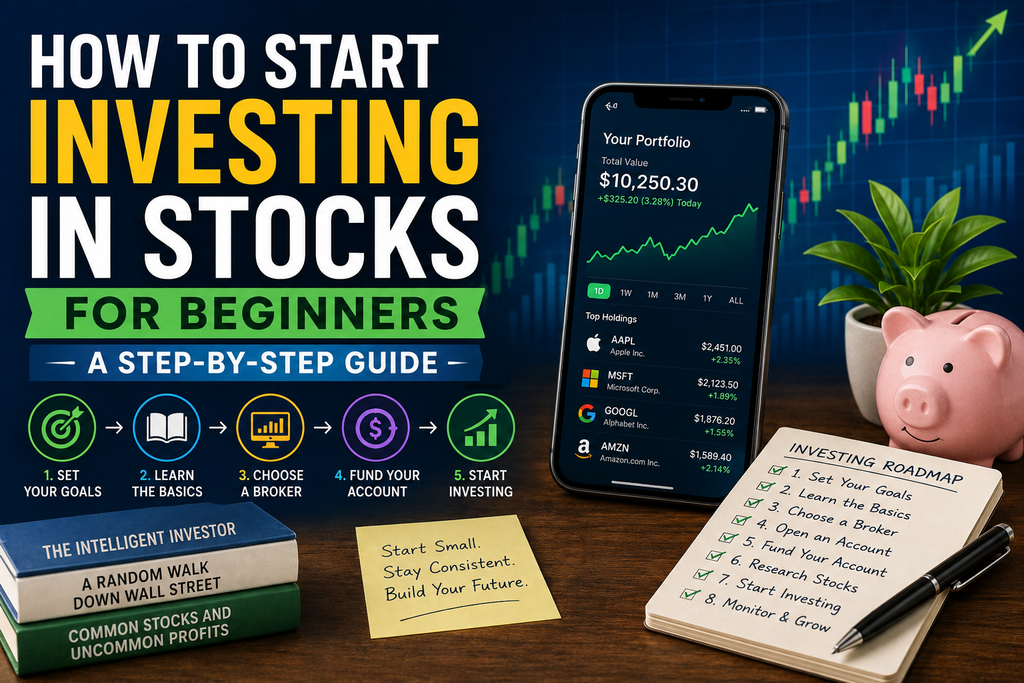
This guide explains how to start investing in stocks step by step.
1. Get Your Financial Foundation in Place First
Before opening a brokerage account, look at your overall financial situation.
Stock investing is generally better suited to money you can leave invested for years rather than money you may need for next month’s expenses.
Start by asking yourself:
- Do I have a workable monthly budget?
- Do I have money set aside for emergencies?
- Do I have high-interest debt that needs attention?
- What are my short-term and long-term financial goals?
- How much can I consistently invest?
For example, if you have $500 available but need that money for an upcoming car repair, putting the entire amount into stocks may not make sense.
A strong financial foundation can make it easier to stay invested when markets fall.
2. Decide Why You Want to Invest
Before choosing a stock, determine what you are investing for.
Your goal could be:
- Building long-term wealth
- Retirement
- A future home
- Financial independence
- Long-term savings
- Growing money beyond traditional savings
Your goal affects how much risk you may be able to take and how long you can keep your money invested.
Someone investing for a goal 20 years away may have a very different strategy from someone who expects to use the money in two years.
Investor.gov recommends considering your goals, investment time frame, and risk tolerance before making investment decisions.
3. Understand Your Risk Tolerance
Stocks can increase in value, but they can also decline substantially.
Risk tolerance refers to your ability and willingness to handle losses or market fluctuations.
Consider this example.
You invest $5,000 and the market falls. Your investment temporarily becomes $4,000.
Would you:
- Panic and sell?
- Feel uncomfortable but continue with your plan?
- Consider the decline an opportunity to buy more?
Your answer can help you understand your emotional tolerance for investment risk.
Risk tolerance is not simply about whether you want higher returns. It is also about whether you can financially and emotionally handle the potential losses associated with those investments.
4. Learn the Difference Between Individual Stocks and Diversified Investments
One of the biggest decisions for a beginner is whether to buy individual stocks or use diversified investments such as ETFs.
Individual Stocks
When you buy an individual stock, you own a portion of a particular company.
For example, buying shares of one company means your investment is directly connected to that company’s performance.
Individual stocks can provide significant growth potential, but they also expose you to company-specific risk.
ETFs
An ETF can hold many different securities inside a single investment.
Instead of purchasing shares of 20 different companies yourself, you could potentially buy an ETF that already provides exposure to a broad group of companies.
Diversification can help reduce the impact of poor performance from one individual investment. FINRA notes that ETFs and mutual funds can provide exposure to multiple securities and may help investors diversify.
For many beginners, diversified investments can be easier to manage than trying to select individual winning stocks.
5. Choose the Right Brokerage Account
To buy stocks yourself, you will generally need an investment account with a brokerage firm.
A brokerage account allows investors to place orders to buy and sell securities.
When comparing brokerage firms, consider:
- Account fees
- Investment choices
- Trading costs
- Customer support
- Research tools
- Educational resources
- Account minimums
- Security features
- Ease of use
Do not choose a brokerage simply because an advertisement says trading is free.
A platform may advertise zero commissions while other costs still apply. FINRA recommends understanding the fees and services associated with an investment account before opening one.
6. Understand Taxable and Retirement Accounts
U.S. investors may encounter different types of investment accounts.
A taxable brokerage account can generally be used for investing without the specific contribution and withdrawal rules associated with retirement accounts.
Retirement accounts are designed for retirement savings and may offer tax advantages, but they also have rules and restrictions that vary by account type.
The right account depends on your financial situation, goals, employment benefits, tax circumstances, and investment timeline.
If you are unsure which account is appropriate, consider researching the rules or speaking with a qualified financial or tax professional.
7. Decide How Much You Can Invest
You do not need thousands of dollars to begin learning about investing.
Instead of asking, “How much money do I need to become an investor?” ask:
“How much can I invest consistently without damaging my financial stability?”
For example, someone might start with:
- $25 per week
- $50 per week
- $100 per month
- $250 per month
The exact amount matters less than creating a sustainable strategy.
A smaller amount invested consistently can help you develop the habit of investing while giving you time to learn.
8. Consider a Simple Diversified Strategy
Beginners often make investing unnecessarily complicated.
A simple portfolio may use diversified funds instead of attempting to identify the next high-performing company.
For example, an investor could choose investments designed to provide broad exposure to the stock market rather than concentrating everything in one company or industry.
Diversification does not eliminate investment risk, but spreading investments across different securities and asset classes can reduce the damage caused by poor performance in one area.
Your appropriate asset mix depends on factors such as your goals, time horizon, and risk tolerance.
9. Research Before Buying a Stock
If you decide to buy individual stocks, research the company before investing.
Some useful areas to examine include:
Revenue
Does the company generate growing revenue over time?
Earnings
Is the company profitable, and are profits improving?
Debt
Does the business carry a large amount of debt?
Competitive Position
What makes the company different from its competitors?
Valuation
Is the stock price reasonable relative to the company’s financial performance?
Future Growth
Does the company have realistic opportunities to grow?
Public companies provide financial and other information that investors can use when researching investments. Investor.gov recommends performing research and due diligence rather than relying solely on stock tips.
10. Do Not Buy a Stock Just Because Someone Recommended It
Social media has made investing information easier to access, but not all investment advice is reliable.
You may see posts claiming:
- “This stock will double.”
- “Buy before it’s too late.”
- “This is the next big company.”
- “Guaranteed returns.”
- “You cannot lose with this investment.”
Treat these claims carefully.
No legitimate investment can guarantee that a stock will produce a particular return.
Investor.gov specifically advises investors not to purchase securities solely because of stock tips from other people.
Research the investment yourself and understand what you are buying.
11. Learn the Basics of Stock Orders
Once you have selected an investment, you need to understand how orders work.
Two common order types are market orders and limit orders.
Market Order
A market order generally instructs the brokerage to buy or sell the security at the best available price.
The final execution price can differ from the price you saw when you placed the order.
Limit Order
A limit order specifies the maximum price you are willing to pay when buying or the minimum price you are willing to accept when selling.
However, a limit order may not execute if the market does not reach your specified price.
Understanding how orders work can help you avoid accidentally placing an order you do not understand.
12. Consider Dollar-Cost Averaging
Dollar-cost averaging means investing a consistent amount of money at regular intervals rather than trying to predict the perfect time to invest.
For example, you might invest $200 every month.
Sometimes the market will be higher and sometimes lower.
The advantage is that you create a consistent investing habit without needing to make a perfect market-timing decision every month.
However, dollar-cost averaging does not guarantee profits or protect against losses.
13. Keep Investment Costs in Mind
Investment costs can affect long-term returns.
Depending on your account and investments, costs may include:
- Expense ratios
- Trading costs
- Advisory fees
- Account fees
- Other investment expenses
Even relatively small differences in ongoing costs can become meaningful over long periods.
FINRA recommends understanding the fees associated with both your investment account and the investments you purchase.
Before investing in a fund, review its expense ratio and other applicable costs.
14. Avoid Trying to Time the Market
Market timing means attempting to predict when stocks will rise or fall and making investment decisions based on those predictions.
The problem is that consistently predicting short-term market movements is extremely difficult.
A beginner may sell because prices fall, only to watch the market recover later.
Instead of constantly trying to predict the next market move, many long-term investors focus on:
- Diversification
- Consistent investing
- Reasonable costs
- Long-term goals
- Risk management
- Staying disciplined
The goal is not to predict every market movement. The goal is to build a strategy you can realistically maintain.
15. Create a Simple Beginner Investing Plan
You can turn everything above into a simple process.
Step 1: Organize Your Finances
Create a budget and understand your monthly cash flow.
Step 2: Build Financial Stability
Work toward an emergency fund and address expensive debt.
Step 3: Define Your Goal
Decide why you are investing and when you may need the money.
Step 4: Determine Your Risk Level
Understand how much volatility you can realistically handle.
Step 5: Choose an Investment Account
Compare brokerage and retirement account options based on your situation.
Step 6: Choose Your Investments
Consider diversified ETFs or other investments that fit your goals and risk tolerance.
Step 7: Start With an Affordable Amount
Invest an amount that you can maintain consistently.
Step 8: Keep Learning
Continue researching investments, fees, diversification, and market behavior.
Investor.gov emphasizes that investors are responsible for their decisions when investing on their own and should research investments before buying them.
Example of a Beginner Investing Plan
Imagine Sarah earns $4,000 per month after taxes.
After paying her regular expenses, she decides that she can consistently invest $300 per month.
Instead of immediately choosing several individual stocks, she first:
- Reviews her budget.
- Builds emergency savings.
- Pays attention to high-interest debt.
- Opens an appropriate investment account.
- Learns about diversified ETFs.
- Researches the costs and holdings of potential investments.
- Invests $300 each month.
- Reviews her strategy periodically rather than reacting to every daily market movement.
This approach does not guarantee investment success, but it gives her a structured process instead of relying on guesses or market hype.
Common Mistakes New Stock Investors Make
Investing Money They Need Soon
Stock prices can fall unexpectedly. Avoid investing money that you need for immediate expenses.
Buying Without Research
Do not buy a stock simply because it is trending online.
Investing Everything in One Stock
Concentration can expose your portfolio to significant company-specific risk.
Chasing Past Performance
A stock or fund that performed well previously may not produce the same results in the future.
Ignoring Fees
Investment costs can reduce long-term returns.
Selling During Every Market Decline
Short-term market declines are part of investing. Selling impulsively can turn temporary losses into permanent ones.
Checking Your Portfolio Constantly
Long-term investing does not require watching your account every hour.
Confusing Investing With Trading
Investing and short-term trading are different activities. A beginner focused on long-term wealth should understand the difference before taking frequent trading risks.
Should Beginners Buy Individual Stocks or ETFs?
There is no universal answer.
Individual stocks can provide direct ownership in specific companies and may offer substantial growth potential, but they also require more research and expose investors to company-specific risk.
ETFs can provide diversification through a single investment and may be easier for beginners who do not want to research individual companies.
The better choice depends on your goals, knowledge, risk tolerance, and investment strategy.
For many beginners, learning how diversified funds work before attempting to select individual stocks can be a practical starting point.
When Should You Start Investing?
There is no single perfect age or market day to begin.
The better question is whether you are financially prepared to invest money for your intended time horizon.
If your basic finances are organized, you understand the risks, and you have money that you can leave invested for the appropriate period, learning about investing may be a useful next step.
The important thing is not to rush.
Starting with a simple strategy and gradually increasing your knowledge can be more sustainable than trying to become an expert overnight.
Final Thoughts
Learning how to start investing in stocks does not require complicated strategies or constant market watching.
The process can be simple:
Build a financial foundation → define your goals → understand your risk → choose an account → research investments → diversify → invest consistently → keep learning.
Your first goal should not be finding the next stock that will skyrocket. Your first goal should be learning how investing works and creating a strategy that fits your financial life.
As your knowledge and financial situation develop, you can gradually make your investment strategy more sophisticated.
Remember that every investment involves risk, and past performance does not guarantee future results. Research investments carefully and consider professional advice when your circumstances require personalized guidance.
Reliable Sources
- U.S. Securities and Exchange Commission — Investor.gov
- Financial Industry Regulatory Authority — FINRA
- SEC EDGAR company filings database
- Brokerage firm disclosures and Form CRS
Disclaimer: This article is for educational purposes only and does not provide personalized financial, investment, or tax advice. Investment decisions should be based on your individual circumstances and risk tolerance.