
Retirement does not automatically mean your tax bill disappears.
Depending on how you save and invest, you may continue paying taxes on retirement account withdrawals, investment income, capital gains, and other sources of income. The way you organize your retirement income can therefore have a meaningful impact on how much money you actually get to spend.
Learning how to reduce taxes in retirement is not about avoiding taxes completely. Instead, the goal is to legally and strategically manage your taxable income so you can keep more of your retirement money while supporting your long-term financial needs.
This guide explains practical tax-planning concepts retirees and future retirees should understand.
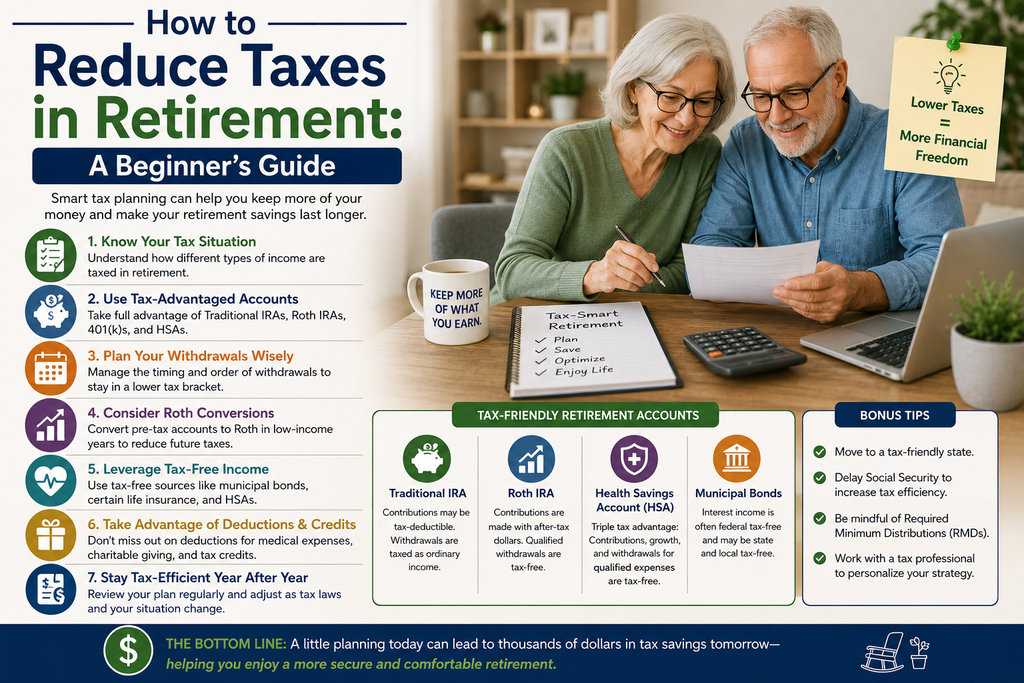
Why Taxes Still Matter After Retirement
Many people assume that their tax bill will automatically become much smaller after they stop working.
That may happen, but it is not guaranteed.
Your retirement income could come from:
- Traditional 401(k) withdrawals
- Traditional IRA withdrawals
- Roth IRA withdrawals
- Social Security
- Pension payments
- Taxable brokerage accounts
- Dividends
- Interest
- Capital gains
- Annuities
- Part-time employment
Some sources may be taxable while others may receive different tax treatment.
This makes tax diversification an important part of retirement planning.
1. Understand How Your Retirement Accounts Are Taxed
Before developing a retirement tax strategy, understand the basic difference between your accounts.
Traditional Retirement Accounts
Traditional 401(k)s and IRAs generally provide tax benefits while you are working, but withdrawals are generally included in taxable income.
Roth Retirement Accounts
Qualified withdrawals from Roth IRAs and Roth 401(k)s can generally be tax-free.
Taxable Brokerage Accounts
Taxable accounts may generate taxable dividends, interest, and capital gains.
Having different types of accounts can give you more flexibility when managing retirement income.
2. Build Tax Diversification
Tax diversification means holding money in different account types with different tax treatments.
For example, your retirement savings might be divided between:
- Traditional 401(k)
- Roth IRA
- Taxable brokerage account
- Cash savings
This can provide flexibility because you are not forced to take all retirement income from one taxable source.
Tax diversification can be especially valuable when tax rates, income, or personal circumstances change.
3. Plan Your Withdrawals
One of the most important retirement tax strategies is deciding where your income will come from each year.
You might use:
- Taxable investments
- Traditional retirement accounts
- Roth accounts
- Cash
- Social Security
- Pension income
The order can affect your taxable income.
For example, taking a large withdrawal from a traditional IRA may create significantly more taxable income than using money from a qualified Roth account.
Instead of automatically withdrawing from one account, consider coordinating your different sources.
4. Don’t Withdraw More Than You Need
Taking large retirement withdrawals without a specific reason can increase taxable income.
Before withdrawing money, ask:
How much do I actually need to spend?
If your expenses are $50,000 but you withdraw $80,000 from a taxable retirement account, the additional withdrawal may create unnecessary taxable income depending on your circumstances.
That does not mean you should always minimize withdrawals.
You may have legitimate reasons to withdraw additional money, such as a major purchase, tax planning, or required distributions.
The important point is to coordinate withdrawals with your overall plan.
5. Understand Required Minimum Distributions
Certain tax-deferred retirement accounts are subject to required minimum distribution rules.
These distributions can create taxable income even if you do not need the money for living expenses.
Because of this, RMDs should be considered before they begin.
Understanding the applicable rules can help you prepare for:
- Future taxable income
- Retirement withdrawals
- Roth conversion opportunities
- Charitable giving
- Social Security taxation
- Investment decisions
RMD rules can depend on your age, account type, and other circumstances, so current rules should always be reviewed before making decisions.
6. Consider Roth Conversions
A Roth conversion generally involves moving money from a traditional retirement account into a Roth account.
The amount converted is generally included in taxable income for the year of conversion.
Why consider this strategy?
Because paying taxes on some money now may potentially reduce future taxable withdrawals.
Roth conversions can be particularly relevant during years when your taxable income is relatively low.
However, converting too much at once can push you into a higher tax bracket or create other tax consequences.
7. Consider Conversions Before Required Distributions Begin
Some retirees have a window between retirement and the beginning of required distributions.
During this period, taxable income may be lower because employment income has stopped.
That can potentially create an opportunity for carefully planned Roth conversions.
For example, someone might gradually convert portions of a traditional IRA over several years rather than converting the entire balance in one year.
This can spread taxable income across multiple years.
A conversion strategy should be evaluated based on your specific tax situation.
8. Understand Tax Brackets
A common misunderstanding is that moving into a higher tax bracket means all of your income is taxed at the higher rate.
The U.S. federal income tax system uses marginal tax brackets.
This means different portions of taxable income can be taxed at different rates.
Understanding marginal tax rates can help you make more informed decisions about:
- Roth conversions
- Retirement withdrawals
- Capital gains
- Part-time work
- Investment income
Instead of simply trying to stay in the lowest possible bracket, focus on your overall long-term tax situation.
9. Manage Social Security and Other Income Together
Social Security should not be viewed independently from your other retirement income.
Depending on your circumstances, other taxable income can affect how much of your Social Security benefits is subject to federal income tax.
Therefore, your retirement tax plan should consider Social Security alongside:
- IRA withdrawals
- 401(k) withdrawals
- Pension income
- Investment income
- Capital gains
- Roth withdrawals
Coordinating these sources can make your retirement income strategy more efficient.
10. Use Roth Accounts Strategically
Qualified Roth withdrawals can provide tax-free income.
This can make Roth accounts valuable when managing taxable income.
For example, if taking another large traditional IRA withdrawal would increase your taxable income significantly, a qualified Roth withdrawal may provide another source of retirement spending without adding the same type of taxable income.
Roth accounts can therefore act as a tax-diversification tool.
11. Understand Taxable Brokerage Accounts
Taxable investment accounts are not automatically bad for retirement.
They can provide flexibility because you are generally not dealing with the same retirement-account withdrawal restrictions.
However, taxable accounts can generate:
- Dividends
- Interest
- Capital gains
Tax-efficient investing can therefore become important.
For example, investors may consider the tax characteristics of the funds and investments they hold in taxable accounts.
12. Understand Capital Gains
Selling an investment in a taxable account can create a capital gain or loss.
The tax treatment can depend on factors such as:
- How long you held the investment
- Your taxable income
- The size of the gain
- Your overall tax situation
Long-term capital gains may receive different federal tax treatment than ordinary income.
Understanding this distinction can help you plan investment sales more carefully.
13. Use Tax-Loss Harvesting When Appropriate
Tax-loss harvesting involves selling an investment that has declined in value and using the realized loss to potentially offset certain capital gains, subject to tax rules.
The strategy can sometimes help manage taxes in taxable investment accounts.
However, there are rules governing how losses can be used and how quickly you can repurchase substantially identical investments.
Tax-loss harvesting should therefore be done carefully rather than simply selling investments because they have declined.
14. Be Careful With Investment Income
Interest, dividends, and capital gains can all affect your tax situation.
Two portfolios with the same total value can produce very different amounts of taxable income.
This is one reason asset location can matter.
Asset location refers to choosing which types of investments to hold in taxable versus tax-advantaged accounts.
For example, some investments may be more tax-efficient in taxable accounts, while others may be more suitable for tax-advantaged accounts.
15. Consider Charitable Giving Strategies
Retirees who regularly give to charity may have additional tax-planning opportunities.
For example, eligible individuals with certain tax-deferred retirement accounts may be able to make qualified charitable distributions that can count toward required distributions while being handled differently for income-tax purposes.
The rules are specific, so charitable strategies should be reviewed carefully.
If charitable giving is already part of your retirement plan, discuss potential tax-efficient methods with a qualified tax professional.
16. Don’t Ignore State Taxes
Federal taxes are only one part of retirement tax planning.
State tax rules can also affect your retirement income.
Different states may have different approaches to:
- Individual income taxes
- Retirement income
- Social Security
- Pension income
- Property taxes
- Sales taxes
If you are considering moving after retirement, compare the complete tax environment rather than looking only at the state income-tax rate.
17. Think About Where You Live in Retirement
Your location can affect your retirement expenses and taxes.
If you are considering moving, compare:
- State income taxes
- Property taxes
- Housing costs
- Healthcare
- Insurance
- Transportation
- Cost of living
A state with no individual income tax is not automatically cheaper overall.
The correct decision depends on your complete financial picture.
18. Avoid Large Unplanned Withdrawals
Unexpected large withdrawals can create unnecessary tax complications.
Before making a major withdrawal, consider:
- Why you need the money
- Which account you will use
- Your current taxable income
- Your other income sources
- Potential tax consequences
- Whether the withdrawal can be spread over multiple years
For large financial decisions, professional tax advice may be worthwhile.
19. Plan Around Your Retirement Years
Your tax situation may change significantly throughout retirement.
You might have several different phases:
Early Retirement
You may have lower taxable income after leaving work.
Middle Retirement
Required distributions and investment income may become more important.
Later Retirement
Healthcare, charitable giving, estate planning, and changing spending patterns may become more significant.
Tax planning should therefore be viewed as a multi-year process.
20. Avoid Letting Taxes Control Every Decision
Reducing taxes is important, but it should not become the only objective.
For example, you should not keep an investment you no longer want simply because selling it could create a taxable gain.
Similarly, you should not make a financial decision solely because it produces a tax deduction.
The best retirement strategy balances:
- Taxes
- Investment risk
- Income
- Liquidity
- Spending
- Long-term goals
Sometimes paying taxes today can be reasonable if it improves your long-term financial position.
Example: Traditional vs. Roth Income
Imagine a retiree needs $60,000 for annual living expenses.
They have:
- Traditional IRA
- Roth IRA
- Taxable brokerage account
- Cash savings
Instead of automatically taking the entire $60,000 from the traditional IRA, they could evaluate different combinations of accounts.
For example:
- $30,000 from traditional retirement savings
- $15,000 from taxable investments
- $15,000 from qualified Roth withdrawals
This is only a simplified example and does not represent a universal withdrawal recommendation.
The point is that having multiple account types can provide more flexibility.
A Simple Retirement Tax Planning Strategy
If you want to start organizing your retirement tax plan, follow these steps.
Step 1: List Your Accounts
Write down every retirement and investment account you own.
Step 2: Identify the Tax Treatment
Determine which accounts are:
- Tax-deferred
- Roth
- Taxable
Step 3: Estimate Retirement Income
Calculate Social Security, pensions, investment income, and expected withdrawals.
Step 4: Estimate Taxable Income
Determine how much of your retirement income may be taxable.
Step 5: Review Future RMDs
Understand when required distributions may affect your plan.
Step 6: Consider Roth Conversions
If appropriate, evaluate whether partial conversions could improve long-term tax flexibility.
Step 7: Review Investments
Look for unnecessary taxable income and excessive investment costs.
Step 8: Review Annually
Tax laws and personal circumstances can change, so update your strategy regularly.
Common Retirement Tax Mistakes
Ignoring Taxes Until Retirement
Waiting until you retire can eliminate years of potential planning opportunities.
Keeping Everything in Traditional Accounts
Tax-deferred savings are valuable, but having no tax diversification can reduce flexibility.
Converting Too Much to Roth at Once
Large conversions can create substantial taxable income.
Ignoring Required Distributions
Failing to plan for RMDs can create unnecessary problems.
Forgetting State Taxes
Moving to another state can change your overall tax situation.
Making Investments Based Only on Taxes
Tax efficiency should be balanced with investment quality and your financial goals.
Taking Large Unnecessary Withdrawals
Withdraw only what fits your spending and financial strategy unless there is a specific reason to take more.
Retirement Tax Planning Checklist
Before retirement, review:
- Traditional 401(k) balances
- Traditional IRA balances
- Roth account balances
- Taxable investment accounts
- Social Security
- Pension income
- Expected annual spending
- Potential RMDs
- Roth conversion opportunities
- Capital gains
- Dividend income
- State taxes
- Healthcare expenses
- Charitable giving
- Estate-planning considerations
Final Thoughts
Learning how to reduce taxes in retirement is about making thoughtful decisions over many years.
You cannot eliminate every tax bill, and attempting to avoid taxes at all costs can sometimes lead to poor financial decisions.
Instead, focus on tax diversification, coordinated withdrawals, Roth planning, investment tax efficiency, Social Security planning, and preparation for required distributions.
The best retirement tax strategy is one that works alongside your broader financial plan.
If your retirement situation involves multiple accounts, significant assets, large Roth conversions, or complicated tax issues, consider working with a qualified tax or financial professional before making major decisions.
Frequently Asked Questions
How can I reduce taxes on retirement income?
Common strategies include using tax-diversified accounts, coordinating withdrawals, managing taxable income, considering Roth conversions, and planning for required distributions.
Are Roth IRA withdrawals taxable in retirement?
Qualified Roth IRA withdrawals are generally tax-free. However, specific rules must be satisfied, so not every withdrawal should automatically be assumed to be tax-free.
Should I convert my traditional IRA to a Roth IRA?
A Roth conversion can be useful in some situations, but it creates taxable income and may not be appropriate for everyone. Consider your current and future tax situation before converting.
Do retirees still pay income taxes?
Yes. Retirees may owe federal or state taxes depending on their income sources, account withdrawals, investment income, and location.
Can Social Security be taxed?
Some Social Security benefits may be subject to federal income tax depending on your overall income and circumstances.
What is tax diversification?
Tax diversification means holding assets in different account types that receive different tax treatments, such as traditional, Roth, and taxable accounts.
When should I start retirement tax planning?
Ideally, tax planning should begin years before retirement. However, it is never too late to review your accounts and improve how your retirement income is organized.
Should I hire a tax professional for retirement planning?
Professional advice can be valuable when you have significant retirement assets, multiple account types, large Roth conversions, complicated investment income, or other tax-planning issues.