
Introduction
If you are learning how to invest, you will eventually hear one piece of advice again and again: diversify your investments.
But what does diversification actually mean?
In simple terms, diversification means spreading your money across different investments instead of putting everything into one stock, one industry, or one type of asset. The basic idea is that if one investment performs poorly, the rest of your portfolio may help reduce the overall impact.
Diversification cannot eliminate investment risk, and it cannot guarantee that you will make money. However, it can help investors avoid becoming overly dependent on a single investment or market segment.
The U.S. Securities and Exchange Commission describes diversification as spreading investments among different assets and securities to reduce risk. It also emphasizes that the right asset allocation depends on factors such as your investment time horizon and risk tolerance.
For beginners, understanding diversification is one of the most important steps toward building a more balanced investment strategy.
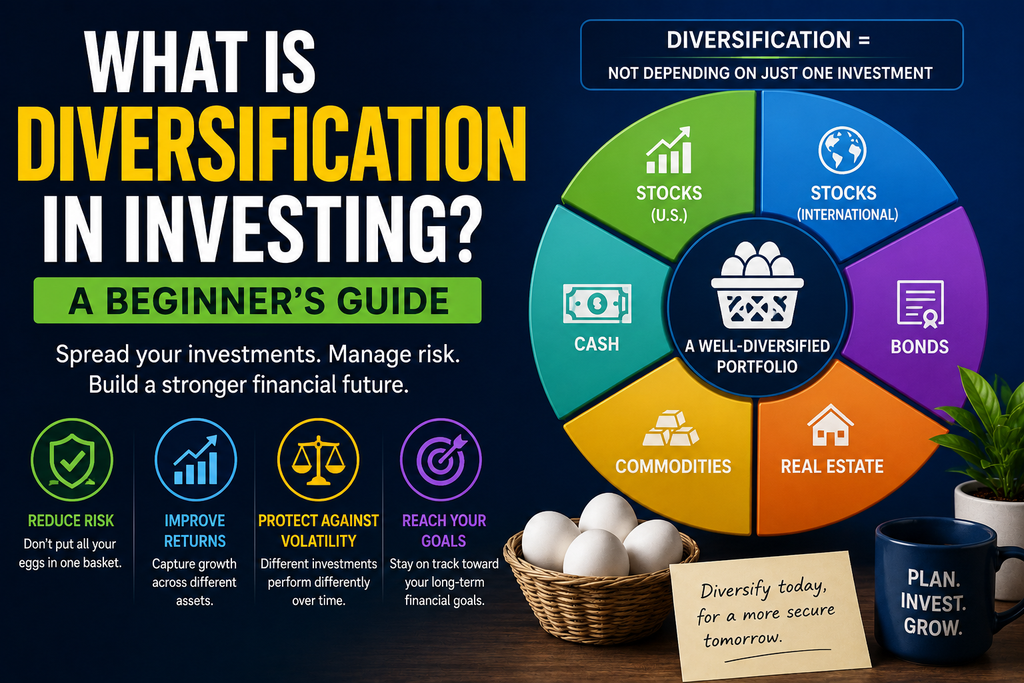
What Is Diversification in Investing?
Diversification is the practice of spreading your investments across different assets, companies, industries, or markets.
Imagine you invest $10,000 entirely in one company’s stock.
If that company experiences serious financial problems, your entire investment could be affected.
Now imagine spreading the same $10,000 across a broad collection of companies and other investments.
One company could perform poorly without necessarily destroying the entire portfolio.
This is the basic principle behind diversification:
Do not depend on one investment to determine your entire financial outcome.
Diversification can happen at several levels, including:
- Different companies
- Different industries
- Different asset classes
- Different geographic markets
- Different investment types
- Different levels of risk
Why Is Diversification Important?
Investments do not all perform the same way at the same time.
A technology company may perform strongly while an energy company struggles. Bonds may behave differently from stocks. One country’s market may rise while another market falls.
By spreading investments across different areas, investors may reduce the effect that one poor-performing investment has on the overall portfolio.
Investor.gov explains that diversification can improve the chances that losses from one investment will have a smaller effect on the entire portfolio. However, diversification does not guarantee that a portfolio will not lose money when markets decline.
A Simple Example
Suppose you have $10,000.
Portfolio A
You invest all $10,000 in one stock.
If the stock falls 40%, your investment could fall to approximately $6,000.
Portfolio B
You spread your money across many investments.
If one investment falls significantly, the effect on your total portfolio may be smaller because the other investments make up a larger portion of your holdings.
The second approach does not guarantee better returns.
Its main advantage is reducing concentration risk.
Diversification vs. Asset Allocation
Diversification and asset allocation are related, but they are not exactly the same thing.
Asset Allocation
Asset allocation refers to how you divide your portfolio among different asset categories.
For example, a portfolio could contain:
- Stocks
- Bonds
- Cash or cash equivalents
The appropriate mix depends on your financial goals, investment time horizon, and risk tolerance.
Diversification
Diversification focuses on spreading investments within and across those categories.
For example, if you own stocks, diversification could involve owning companies from different industries rather than concentrating your entire stock portfolio in one sector.
A portfolio can have several investments and still be poorly diversified.
How to Diversify a Portfolio
There are several ways investors can diversify.
1. Invest in Different Companies
One of the simplest ways to reduce company-specific risk is to avoid putting your entire stock portfolio into one company.
Instead of owning shares of only one company, investors can spread exposure across many companies.
However, simply owning several stocks does not automatically create a well-diversified portfolio.
If all of your stocks operate in the same industry, your portfolio may still be heavily concentrated.
2. Diversify Across Industries
Different industries can respond differently to economic conditions.
Common sectors include:
- Technology
- Healthcare
- Financial services
- Consumer goods
- Energy
- Industrials
- Real estate
- Utilities
- Communication services
If your portfolio is heavily concentrated in one sector, a downturn affecting that industry could have a larger impact on your investments.
Spreading investments across different industries can reduce this concentration.
3. Diversify Across Asset Classes
Another approach is investing across different asset categories.
For example, a portfolio could include:
- Stocks
- Bonds
- Cash
- Other investments appropriate for the investor
Stocks generally have greater growth potential but can also experience substantial price fluctuations. Bonds and cash investments have different risk and return characteristics.
The appropriate allocation depends on the individual investor.
Investor.gov notes that asset allocation should reflect your investment timeframe and ability and willingness to tolerate risk.
4. Consider Geographic Diversification
Investors can also diversify across countries and regions.
For example, someone whose entire portfolio consists of companies from one market may have greater exposure to economic conditions affecting that particular market.
International investments can provide exposure to other economies and companies.
However, international investing also introduces additional risks, including currency fluctuations, political developments, regulatory differences, and economic conditions.
Geographic diversification should therefore be considered as part of a broader investment strategy rather than automatically treated as better.
Can ETFs Help With Diversification?
Yes, certain ETFs can make diversification easier.
An ETF can hold a collection of stocks, bonds, or other securities.
For example, a broad-market ETF may provide exposure to many companies through a single investment.
This can be more convenient than purchasing dozens or hundreds of individual securities yourself.
However, not every ETF is automatically diversified.
A narrowly focused ETF might concentrate on:
- One industry
- One country
- One investment theme
- One commodity
- A small group of companies
Investor.gov specifically notes that mutual funds and ETFs can make diversification easier, but narrowly focused funds may not provide the level of diversification an investor expects.
Before buying an ETF, look at its holdings and understand what it actually owns.
Does Owning More Stocks Mean You Are Diversified?
Not necessarily.
Suppose you own 15 technology companies.
You technically own many stocks, but your portfolio may still be heavily concentrated in technology.
If the technology sector experiences a major downturn, many of your holdings could decline together.
True diversification requires looking beyond the number of investments.
Ask:
- What companies do I own?
- What industries are represented?
- What asset classes do I own?
- Are my investments exposed to the same economic risks?
- How much of my portfolio depends on one company or sector?
The goal is not simply to own many investments.
The goal is to avoid unnecessary concentration.
What Is Over-Diversification?
Diversification is useful, but more investments do not always mean a better portfolio.
Over-diversification can happen when an investor owns so many overlapping investments that the portfolio becomes difficult to understand and manage.
For example, an investor might own several ETFs that all contain many of the same large companies.
On paper, the investor may own five different ETFs.
In reality, the portfolio could still have substantial exposure to the same companies.
More investments can also mean additional fees, complexity, and difficulty monitoring the portfolio.
The objective should be appropriate diversification, not simply owning as many investments as possible.
How to Check If Your Portfolio Is Diversified
You do not need complicated software to perform a basic diversification check.
Start by listing your investments.
Then look at:
Company Exposure
How much of your portfolio is invested in your largest holdings?
Industry Exposure
Are most of your investments concentrated in one sector?
Asset Allocation
How much is invested in stocks, bonds, cash, and other assets?
Geographic Exposure
Are your investments concentrated in one country or region?
Fund Holdings
If you own ETFs or mutual funds, check their underlying holdings.
Two funds with different names may contain many of the same companies.
Reviewing these areas can help you identify concentration that may not be obvious at first.
Diversification and Risk
Diversification is primarily a risk-management strategy.
It can reduce the impact of problems affecting a particular company, industry, or investment.
However, diversification cannot eliminate all investment risk.
For example, if the overall stock market falls sharply, a diversified stock portfolio can still lose value.
Investor.gov emphasizes that diversification can reduce risk but cannot guarantee protection from market-wide declines.
This distinction is important.
Diversification helps manage specific risks, but investors can still face market risk.
What Is Concentration Risk?
Concentration risk occurs when too much of your portfolio depends on one investment, company, industry, asset class, or market.
Consider an investor whose portfolio looks like this:
- 70% technology stocks
- 20% one technology ETF
- 10% cash
Although the investor owns several securities, a very large portion of the portfolio is still connected to one sector.
A major decline in technology stocks could therefore have a significant impact.
Diversification attempts to reduce this type of concentration.
Diversification for Different Types of Investors
There is no single portfolio that is appropriate for everyone.
Beginner Investor
A beginner may prefer a simple portfolio containing broad, diversified investments rather than attempting to select many individual stocks.
Long-Term Investor
Someone investing for retirement decades in the future may have a different asset allocation from someone saving for a short-term financial goal.
Investor Near a Financial Goal
Someone approaching a major financial goal may need to reconsider how much portfolio risk is appropriate.
The SEC explains that asset allocation can change as an investor’s time horizon and circumstances change.
Diversification and Rebalancing
Your portfolio can become less diversified over time.
Suppose you start with a portfolio where stocks represent 60% of your investments.
If stocks rise substantially while other investments remain relatively flat, stocks could eventually represent a much larger percentage of your portfolio.
This changes your original asset allocation.
Rebalancing means adjusting your portfolio to bring it closer to your intended allocation.
Investor.gov explains that rebalancing can help return a portfolio to its intended asset mix after different investments have performed differently over time.
Rebalancing should not necessarily happen constantly.
Frequent changes can create unnecessary costs, taxes, or trading activity depending on the account and investments involved.
Common Diversification Mistakes
Putting Too Much Money Into One Stock
Even a company that looks extremely strong can experience unexpected problems.
Owning Only One Industry
A portfolio concentrated in one sector can experience significant volatility when that sector struggles.
Assuming Every ETF Is Diversified
Some ETFs are highly concentrated in a specific theme or industry.
Ignoring Fund Holdings
Always understand what your funds actually own.
Buying Too Many Similar Funds
Several funds can have significant overlap.
Forgetting About Asset Allocation
Diversifying stocks does not necessarily mean your entire portfolio is appropriately diversified.
Changing Your Strategy Because of Market Headlines
Short-term market movements can tempt investors to constantly change their portfolio.
A long-term strategy should generally be based on financial goals rather than daily headlines.
A Simple Diversification Example for Beginners
Imagine a beginner has $10,000 to invest.
Instead of putting all $10,000 into one company, the investor chooses a broader strategy.
The portfolio may include diversified stock investments along with other assets appropriate for the investor’s goals and risk tolerance.
The exact percentages should not be copied from someone else’s portfolio because asset allocation is personal.
The important principle is that the investor is not depending entirely on one company or one investment to determine the outcome.
How Often Should You Review Diversification?
You do not necessarily need to check your portfolio every day.
Instead, consider reviewing it periodically and whenever an important change occurs in your financial life.
You may want to review your portfolio when:
- Your financial goals change
- Your investment time horizon changes
- Your risk tolerance changes
- One investment becomes an unusually large portion of your portfolio
- Your financial situation changes
- Your investments no longer match your intended strategy
Investor.gov notes that rebalancing can be considered at regular intervals or when an asset class moves significantly away from a predetermined allocation.
Is Diversification Important for Long-Term Investing?
Yes.
Long-term investors still face uncertainty.
Companies can fail, industries can decline, markets can experience recessions, and investment trends can change.
Diversification can help prevent one unexpected event from having an unnecessarily large effect on an entire portfolio.
It is especially relevant for investors who are building wealth over many years because protecting against excessive concentration can be an important part of managing long-term investment risk.
Final Thoughts
So, what is diversification in investing?
Diversification is the practice of spreading your investments across different assets, companies, industries, and markets to reduce concentration risk.
The idea is simple, but applying it effectively requires more than buying several different stocks.
A diversified portfolio considers:
- Different companies
- Different industries
- Different asset classes
- Geographic exposure
- Investment goals
- Risk tolerance
- Time horizon
- Fund overlap
- Portfolio costs
Diversification cannot guarantee profits and cannot prevent losses during a broad market decline. But it can help reduce the damage caused by relying too heavily on one investment.
For beginners, a simple and diversified strategy can often be easier to understand and maintain than a complicated portfolio filled with individual investments.
The most important goal is not to own everything. It is to build an investment portfolio that matches your financial goals and provides a reasonable balance between potential growth and risk.
Frequently Asked Questions
What is diversification in investing?
Diversification means spreading your money across different investments to reduce concentration risk. It can involve different companies, industries, asset classes, and geographic markets.
Is diversification a good strategy for beginners?
Diversification can be useful for beginners because it reduces dependence on a single investment. However, the appropriate strategy depends on the investor’s goals, time horizon, and risk tolerance.
How many stocks do I need to be diversified?
There is no universal number. Simply owning many stocks does not guarantee diversification if they are concentrated in the same industry or have similar risks.
Are ETFs automatically diversified?
No. Some ETFs hold many securities, while others focus on a specific industry, theme, country, or small group of investments. Always check an ETF’s holdings before investing.
Can diversification eliminate investment risk?
No. Diversification can reduce certain types of investment risk, particularly concentration risk, but it cannot eliminate market-wide losses or guarantee profits.
What is the difference between diversification and asset allocation?
Asset allocation is how you divide investments among asset categories such as stocks, bonds, and cash. Diversification involves spreading investments within and across those categories.
Disclaimer: This article is for educational purposes only and does not provide personalized financial, investment, or tax advice. Investment decisions should be based on your individual financial circumstances, goals, time horizon, and risk tolerance.