
Introduction
Exchange-traded funds, commonly known as ETFs, have become an important investment option for many investors. They can provide exposure to stocks, bonds, and other assets through a single investment.
For beginners, ETFs can be easier to understand than building a portfolio of individual securities one by one. However, not every ETF is the same. Some provide broad diversification, while others focus on a specific industry, investment theme, asset class, or strategy.
An ETF generally pools money from multiple investors and invests it in a portfolio of securities or other assets. Each ETF share represents an investor’s ownership interest in that portfolio. ETFs can be bought and sold on stock exchanges during market hours.
This guide explains what ETFs are, how they work, the different types of ETFs, their potential advantages and risks, ETF fees, and what beginners should consider before investing.
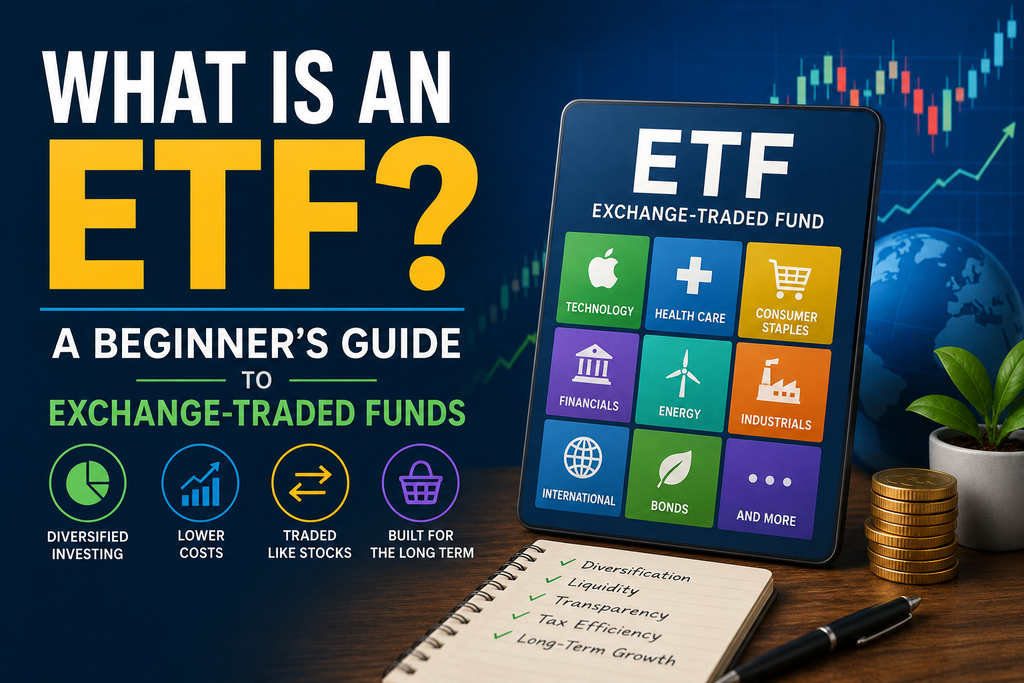
What Is an ETF?
An ETF, or exchange-traded fund, is an investment fund whose shares trade on a stock exchange.
An ETF can hold a collection of investments such as:
- Stocks
- Bonds
- Short-term securities
- Other assets
- A combination of different investments
The investments held by an ETF are called its portfolio. Each ETF share represents a portion of ownership in that portfolio.
For example, instead of purchasing shares of 500 individual companies yourself, you could invest in an ETF designed to track a broad stock-market index.
The ETF does not eliminate investment risk, but it can make it easier to gain exposure to many investments through one security.
How Do ETFs Work?
The basic concept is straightforward.
Imagine an ETF owns shares of hundreds of different companies.
When you purchase one share of that ETF, you gain exposure to the collection of investments held by the fund.
The ETF’s value changes based on the value of the securities and other assets inside its portfolio.
Investors generally buy and sell ETF shares through brokerage accounts on stock exchanges.
Unlike mutual funds, which are generally bought or redeemed from the fund at the next calculated net asset value, ETF shares trade throughout the trading day at market prices.
This exchange-traded structure is one of the main differences between ETFs and traditional mutual funds.
What Does an ETF Own?
An ETF can own many different types of assets.
For example, an ETF might invest in:
U.S. Stocks
The fund may own shares of companies listed in the United States.
International Stocks
Some ETFs invest in companies outside the United States.
Bonds
Bond ETFs can hold government, corporate, municipal, or other types of bonds.
Industry-Specific Stocks
An ETF might focus on a particular industry, such as technology, healthcare, energy, or financial services.
Market Indexes
Many ETFs are designed to track an index.
Other Assets
Some ETFs use specialized strategies or invest in specific asset categories.
Because ETFs can have very different objectives, investors should always check what a particular ETF actually owns before investing.
What Is an Index ETF?
An index ETF is designed to track the performance of a particular market index.
For example, an ETF may seek to track an index representing large U.S. companies.
The goal is generally not to select individual stocks in an attempt to outperform the market. Instead, the fund seeks to closely follow its chosen index, before fees and expenses.
Index funds generally use a passive investment strategy, which can result in less portfolio trading and potentially lower costs than some actively managed funds.
However, investors should still examine the fund’s expense ratio, holdings, tracking performance, and other characteristics.
What Is an Actively Managed ETF?
Not all ETFs simply track an index.
An actively managed ETF has a portfolio manager or investment team making decisions about which investments to buy and sell according to the fund’s stated strategy.
The goal may be to outperform a particular benchmark or achieve another investment objective.
Active management can involve more trading and potentially higher expenses, although costs vary from fund to fund.
The key distinction is:
Index ETF: Designed to track an index.
Actively managed ETF: Uses an investment strategy where managers make portfolio decisions rather than simply tracking a traditional index.
ETF vs. Mutual Fund
ETFs and mutual funds have many similarities.
Both can:
- Pool money from investors
- Own portfolios of stocks, bonds, or other assets
- Provide diversification
- Be professionally managed
- Follow active or passive strategies
- Charge investment-related expenses
However, they have important structural differences.
How ETFs Trade
ETF shares trade on stock exchanges throughout the trading day at market prices.
How Mutual Funds Trade
Mutual fund investors generally buy or redeem shares at the next calculated net asset value, subject to applicable fees and rules.
Investment Minimums
Many ETFs can be purchased in relatively small dollar amounts, although the actual amount depends on the ETF and brokerage.
Some mutual funds have minimum initial investment requirements.
Transparency
Many ETFs disclose portfolio holdings frequently, while mutual fund disclosure schedules can differ.
Neither structure is automatically better for every investor. The right choice depends on the investor’s goals, strategy, costs, tax considerations, and preferences.
ETF vs. Individual Stocks
An individual stock represents ownership in one company.
An ETF can contain shares of many companies.
For example:
Individual stock: You buy shares of one company.
Broad stock ETF: You buy one ETF that may hold shares of many companies.
This difference can make ETFs useful for investors seeking diversification.
The SEC notes that mutual funds and ETFs can make diversification easier by allowing investors to own portions of many investments through a single fund. However, a narrowly focused ETF may not provide broad diversification.
Why Do Investors Buy ETFs?
There are several reasons investors use ETFs.
Diversification
A single ETF may provide exposure to many securities.
If an ETF owns hundreds of stocks, the poor performance of one company may have a smaller effect on the overall fund than it would on a portfolio consisting entirely of that company.
However, diversification depends on the ETF’s holdings.
A technology-sector ETF, for example, may be much less diversified than a broad-market ETF.
Convenience
Instead of researching and purchasing dozens or hundreds of individual securities, an investor can potentially obtain broad exposure through one ETF.
Liquidity
Because ETF shares trade on exchanges, investors can generally buy and sell them during market hours.
Low Minimum Investment
ETF shares can often be purchased with relatively small amounts of money, although brokerage requirements and share prices vary.
Variety
There are ETFs covering many different investment objectives and asset classes.
Investors can find funds focused on:
- Broad U.S. stocks
- International stocks
- Bonds
- Specific industries
- Market segments
- Certain investment strategies
This variety gives investors many choices, but it also makes research important.
What Are ETF Fees?
ETFs have expenses associated with operating the fund.
One important cost is the expense ratio.
The expense ratio represents the fund’s annual operating expenses as a percentage of its assets.
For example, if a fund has an expense ratio of 0.10%, that represents approximately $1 in annual expenses for every $1,000 invested, before considering the effects of changes in the investment value.
The actual amount investors pay can vary with the value of their investment.
Fees may appear small, but even small differences in ongoing costs can affect long-term investment results. The SEC recommends understanding ETF fees and expenses before investing.
What Is the Expense Ratio?
The expense ratio is a commonly used measure of a fund’s annual operating expenses.
Suppose:
- Investment = $10,000
- Expense ratio = 0.20%
The approximate annual operating expense based on that starting value would be:
$10,000 × 0.20% = $20
This is a simplified illustration because the actual dollar amount can change as the investment’s value changes.
Investors should compare expenses along with other factors such as investment strategy, holdings, performance, and risk.
A lower expense ratio does not automatically make one ETF better than another.
Can You Lose Money in an ETF?
Yes.
ETFs are investments, not guaranteed savings products.
If the securities held by an ETF decline in value, the ETF’s value can also decline.
For example, if a stock-market ETF owns hundreds of stocks and the overall stock market experiences a major decline, the ETF may fall as well.
The SEC states that ETFs are not insured or guaranteed by the FDIC or another government agency and that investors can lose some or all of their invested money.
The amount of risk depends heavily on what the ETF owns.
A broad stock ETF and a narrow sector ETF can have very different risk profiles.
What Is ETF Diversification?
Diversification means spreading money among different investments to reduce dependence on any single investment.
An ETF can make diversification easier because one fund may own many securities.
For example, suppose an ETF holds 500 companies.
If one company performs poorly, its effect on the entire ETF may be relatively limited.
However, diversification does not eliminate market risk.
If most of the investments in the ETF fall at the same time, the ETF can still decline substantially.
The SEC also warns that owning multiple ETFs does not automatically mean you are diversified. Investors should examine fund holdings to identify overlap and concentration.
What Is a Sector ETF?
A sector ETF focuses on companies within a particular industry or economic sector.
Examples include ETFs focused on:
- Technology
- Healthcare
- Energy
- Financial services
- Consumer goods
- Industrials
Sector ETFs can help investors target a specific area of the economy.
However, they may be less diversified than broad-market ETFs because their performance can be heavily influenced by one sector.
Investors should understand this concentration risk before investing.
What Is a Bond ETF?
A bond ETF invests primarily in bonds.
Depending on the fund, a bond ETF may hold:
- U.S. government bonds
- Corporate bonds
- Municipal bonds
- International bonds
- Short-term bonds
- Long-term bonds
Bond ETFs can provide diversification across many individual bonds.
However, bond ETFs still carry risks, including interest-rate risk and credit risk.
When interest rates change, bond prices can be affected, which can influence the value of a bond ETF.
What Is a Dividend ETF?
A dividend ETF focuses on stocks that meet specific dividend-related criteria.
These funds may target companies that:
- Pay dividends
- Have relatively high dividend yields
- Have a history of dividend growth
- Meet other income-related requirements
A dividend-focused ETF can provide investors with exposure to multiple dividend-paying companies rather than selecting individual dividend stocks.
However, dividends are not guaranteed, and investors should evaluate the ETF’s strategy and holdings instead of choosing a fund solely because it advertises a high yield.
What Is a Target-Date ETF?
Target-date funds are designed around a particular future date, often a retirement year.
They typically hold a combination of investments and may gradually change their asset allocation as the target date approaches.
The SEC notes that target-date funds generally become more conservative over time as the target date gets closer, although the exact strategy varies by fund.
Investors should still review the fund’s strategy, fees, holdings, and risk.
How Do You Buy an ETF?
Buying an ETF generally involves a brokerage account.
A simple process is:
Step 1: Open a Brokerage Account
Choose a brokerage that provides access to ETFs.
Consider:
- Trading costs
- Account fees
- Available investments
- Research tools
- Customer support
- Account security
Step 2: Deposit Money
Transfer money into your brokerage account.
Only invest money that fits your financial plan and investment time horizon.
Step 3: Research ETFs
Compare potential funds based on:
- Investment objective
- Holdings
- Expense ratio
- Historical performance
- Risk
- Trading volume
- Fund size
- Strategy
- Portfolio concentration
Step 4: Read the Fund Information
Before investing, review the ETF’s prospectus and shareholder information.
The SEC specifically recommends reviewing available fund information and understanding where your money is being invested.
Step 5: Choose an Order Type
You can generally place orders through your brokerage.
A market order seeks execution at the best available market price.
A limit order specifies the maximum price you are willing to pay when buying or the minimum price you are willing to accept when selling.
Step 6: Review Your Order
Check the:
- ETF ticker
- Number of shares
- Order type
- Price information
- Estimated investment amount
Then submit the order.
How Should Beginners Choose an ETF?
There is no single ETF that is right for everyone.
Instead, start with your financial goal.
Consider Your Goal
Are you investing for:
- Retirement?
- Long-term wealth?
- General investing?
- Income?
- A specific market exposure?
Consider Your Time Horizon
How long will the money remain invested?
A longer time horizon can allow an investor to tolerate more short-term volatility.
Consider Risk
A broad stock ETF can still experience significant declines.
A bond ETF may behave differently from a stock ETF.
Understand the risk before investing.
Examine Holdings
Do not judge an ETF by its name alone.
Look at what the fund actually owns.
Compare Fees
Compare expense ratios and other costs.
Check for Overlap
If you already own several ETFs, check whether they hold many of the same companies.
Buying multiple funds does not necessarily increase diversification.
Common ETF Mistakes Beginners Should Avoid
Buying an ETF Without Understanding It
An ETF’s name does not tell you everything about its strategy.
Assuming Every ETF Is Diversified
Some ETFs are highly concentrated.
Ignoring Fees
Small ongoing costs can affect long-term returns.
Chasing Past Performance
A fund that performed well recently may not continue doing so.
Buying Too Many ETFs
Owning several overlapping ETFs can make a portfolio more complicated without meaningfully increasing diversification.
Ignoring Risk
A stock ETF can experience substantial declines.
Investing Based Only on Social Media
Online popularity is not a substitute for research.
ETF Example for a Beginner
Imagine Alex has $5,000 available for a long-term investment goal.
Instead of buying shares in one company, Alex considers a diversified stock ETF.
Before investing, Alex reviews:
- The ETF’s holdings
- Investment objective
- Expense ratio
- Historical performance
- Risk level
- Portfolio concentration
- Investment strategy
Alex then decides whether the ETF fits the overall financial plan.
If the market rises, the ETF may increase in value.
If the market falls, the ETF may lose value.
The key is that Alex understands what the fund owns and why it fits the investment strategy before purchasing it.
ETFs and Long-Term Investing
ETFs can be particularly useful as part of a long-term investment strategy because they can provide access to diversified portfolios through a single security.
However, an ETF is simply a vehicle. The actual risk depends on the assets and strategy inside the fund.
A broad stock ETF can behave very differently from:
- A technology ETF
- A small-cap ETF
- A bond ETF
- A commodity-focused fund
- A leveraged or inverse fund
Therefore, investors should never assume that all ETFs are equally safe or diversified.
Final Thoughts
An ETF is an investment fund that trades on a stock exchange. ETFs can hold stocks, bonds, and other investments and can provide investors with a convenient way to gain exposure to a portfolio of securities.
One of their biggest advantages is potential diversification. However, diversification depends on the fund’s actual holdings and strategy.
Before buying an ETF, understand what it owns, why it exists, how much it costs, what risks it carries, and whether it fits your financial goals.
For beginners, ETFs can be an important part of learning about long-term investing, but they should still be researched carefully.
The goal is not simply to find the ETF with the highest recent return. The goal is to choose investments that make sense for your financial plan, risk tolerance, and time horizon.
Recommended Internal Links for Dexine
- What Is Investing and How Does It Work?
- What Is the Stock Market and How Does It Work?
- What Are Stocks? A Complete Beginner’s Guide to Buying Shares
- How to Build an Emergency Fund From Scratch
- How to Set Financial Goals and Actually Achieve Them
Reliable Sources
- SEC Investor.gov — Exchange-Traded Funds (ETFs)
- SEC Investor.gov — Mutual Funds
- SEC Investor.gov — Asset Allocation and Diversification
- SEC Investor.gov — ETF and Mutual Fund Characteristics
- SEC Investor.gov — Target-Date Funds