
Introduction
Investing is one of the most important concepts to understand when building long-term financial wealth. While saving money can help you prepare for emergencies and short-term goals, investing gives your money the opportunity to grow over time.
At its simplest, investing means putting money into assets with the expectation that they may increase in value or generate income over time. Common investments include stocks, bonds, mutual funds, exchange-traded funds (ETFs), and other financial assets.
However, investing is not the same as simply putting money into a savings account. Investments can lose value, and there are no guaranteed returns. Understanding how investing works, what risks are involved, and how diversification can help is essential before putting your money into the market.
This beginner-friendly guide explains what investing is, how it works, the most common investment types, and the basic steps you can take to become a more informed investor.
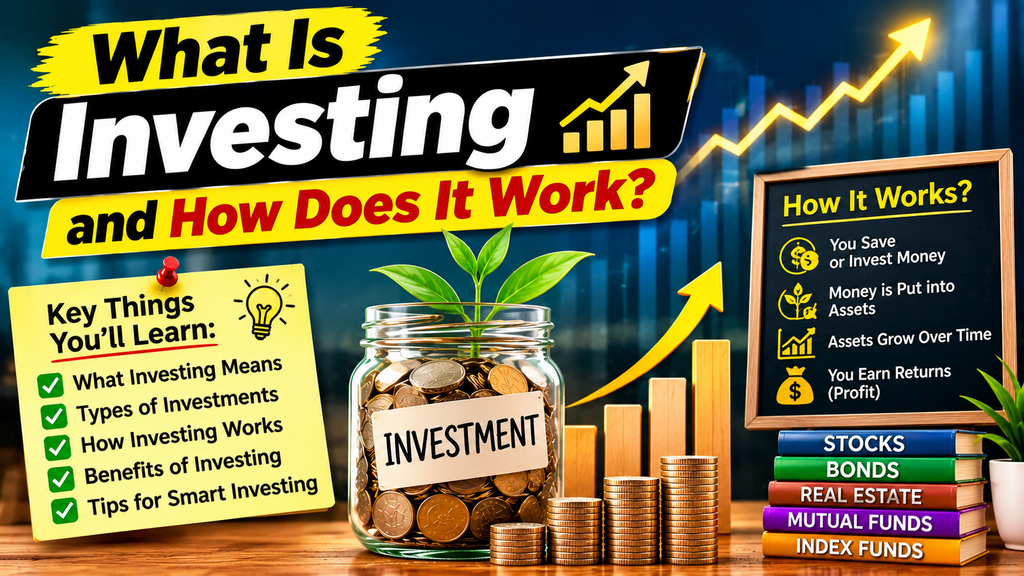
What Is Investing?
Investing is the process of using your money to purchase an asset that you hope will generate a financial return.
For example, you might purchase shares of a company. If the company grows and its stock price increases, your investment may become more valuable. Some companies may also pay dividends to shareholders.
Investing can potentially generate returns through:
- Capital appreciation
- Dividends
- Interest
- Capital gains distributions
- Other forms of investment income
The important point is that investment returns are not guaranteed. Every investment involves some level of risk, and you can lose some or all of the money you invest.
How Does Investing Work?
Investing works by putting capital into assets that have the potential to produce a return.
Imagine you invest $1,000 in a diversified investment. If the investments increase in value, your $1,000 could become more than $1,000. If the investments decline, however, your account value could fall below your original investment.
Over longer periods, investors may also benefit from compound growth.
Compound growth occurs when your investment earns a return and those earnings remain invested, allowing future returns to build on both your original money and previous earnings.
For example, if an investment earns money and you keep those earnings invested rather than spending them, your investment base can gradually become larger.
This is one reason time can be an important factor in long-term investing.
Why Do People Invest?
People invest for different financial goals.
Common reasons include:
Building Long-Term Wealth
Investing can give your money an opportunity to grow over many years.
Instead of keeping every dollar in cash, investors may allocate part of their long-term savings to investments that have greater growth potential.
Saving for Retirement
Retirement is one of the most common long-term investing goals.
Many people use employer-sponsored retirement plans or individual retirement accounts to invest for the future.
The appropriate investments can depend on factors such as your age, financial situation, risk tolerance, and retirement timeline.
Fighting the Effects of Inflation
Inflation reduces the purchasing power of money over time.
Investing does not guarantee that your returns will exceed inflation, but long-term investors may use investments with growth potential as part of an overall strategy for preserving and increasing purchasing power.
Reaching Major Financial Goals
Investing may also be used for goals such as:
- Building long-term wealth
- Funding future education
- Preparing for retirement
- Creating a long-term financial cushion
- Pursuing other financial objectives
The investment approach should generally match the time frame and risk associated with the goal.
Common Types of Investments
There are many different investment products available to investors. Some of the most common include stocks, bonds, mutual funds, ETFs, and U.S. Treasury securities.
Stocks
A stock represents an ownership interest in a company.
When you buy shares of a publicly traded company, you become a shareholder.
Stocks can offer significant long-term growth potential, but their prices can fluctuate substantially. Investors can lose money if the value of their shares falls.
Stocks can therefore be useful for long-term growth, but investors need to understand that higher potential returns generally come with greater risk.
Bonds
Bonds are debt investments.
When you buy a bond, you are generally lending money to an issuer such as a corporation or government entity.
In exchange, the issuer generally agrees to make interest payments and return principal according to the bond’s terms.
Bonds can play an important role in a diversified portfolio, although they are not completely risk-free.
For example, bond investments can face credit risk and interest-rate risk.
Mutual Funds
A mutual fund pools money from many investors and invests that money in a portfolio of assets such as stocks, bonds, or other securities.
This structure can make it easier for investors to own a diversified group of investments through one fund.
Mutual funds can have different objectives, investment strategies, fees, and levels of risk.
Exchange-Traded Funds
Exchange-traded funds, commonly called ETFs, also pool money from investors and invest in portfolios of securities or other assets.
Many ETFs provide exposure to numerous companies or securities through a single investment.
However, not every ETF is broadly diversified. Some ETFs focus on a particular industry, market segment, or even a single security. Investors should understand what an ETF actually owns before investing.
Investing vs. Saving
Saving and investing are related, but they serve different purposes.
Saving generally focuses on protecting money and keeping it accessible for short-term needs.
Investing generally focuses on growing money over a longer period, while accepting the possibility of losses.
For example, money needed soon for an emergency may be better suited to an accessible savings vehicle rather than a volatile investment.
Money intended for a long-term goal may have more time to withstand market fluctuations.
This distinction is important because the best place for your money depends on when you expect to need it.
Understanding Risk and Return
One of the most important investing principles is the relationship between risk and potential return.
Generally, investments with greater potential returns also involve greater risk. However, taking more risk does not guarantee that you will receive a higher return.
Investment risks can include:
- Market risk
- Business risk
- Interest-rate risk
- Credit risk
- Inflation risk
- Liquidity risk
Different investments have different combinations of these risks.
For example, a single company’s stock can fall significantly if the company performs poorly. A bond can be affected by changes in interest rates. A narrowly focused fund can be heavily affected by problems in a particular industry.
Understanding these risks can help investors make better decisions.
What Is Diversification?
Diversification means spreading your investments across different assets, companies, industries, or other categories rather than putting all your money into one investment.
The idea is simple: if one investment performs poorly, other investments may help reduce the impact on your overall portfolio.
For example, owning one company’s stock exposes you heavily to that individual company’s performance. Owning a diversified collection of investments can reduce the effect that one company’s problems have on your overall portfolio.
Mutual funds and ETFs can make diversification easier because many of them hold multiple securities.
However, simply owning several funds does not automatically mean you are fully diversified. Two funds may hold many of the same companies or focus on the same industry.
What Is Asset Allocation?
Asset allocation refers to how you divide your investment portfolio among different asset classes.
Common asset classes include:
- Stocks
- Bonds
- Cash or cash equivalents
The appropriate allocation depends on factors such as your financial goals, time horizon, and tolerance for investment risk.
For example, someone investing for a goal several decades away may be able to tolerate more short-term market volatility than someone who needs the money soon.
There is no single asset allocation that is appropriate for everyone.
How Much Money Do You Need to Start Investing?
There is no universal amount required to begin investing.
The amount you need depends on the investment platform, account, investment product, and your personal financial situation.
Some investments may have minimum requirements, while others can be purchased in relatively small dollar amounts.
Instead of focusing only on a specific starting amount, beginners should focus on developing good financial habits.
A small amount invested consistently can be more practical than waiting until you have a large amount of money.
Steps to Start Investing as a Beginner
If you’re new to investing, consider following a basic process.
1. Understand Your Financial Situation
Before investing, know how much money you earn, spend, save, and owe.
Your basic financial foundation should come first.
For example, your budgeting and emergency-fund plans can help determine how much money is actually available for long-term investing.
You can review our guide on how to create a personal budget as a starting point.
2. Define Your Goal
Ask yourself why you are investing.
Your goal could be:
- Retirement
- Long-term wealth building
- Another future financial objective
A specific goal makes it easier to determine an appropriate time horizon and strategy.
3. Determine Your Time Horizon
Your time horizon is how long you expect to keep the money invested before needing it.
A longer time horizon may allow an investor to tolerate more short-term volatility.
A shorter time horizon generally provides less time to recover from a major market decline.
4. Understand Your Risk Tolerance
Risk tolerance describes how comfortable you are with potential investment losses.
If a temporary market decline would cause you to panic and sell everything, an investment strategy that exposes you to excessive volatility may not be appropriate.
Your investment choices should reflect both your financial capacity for risk and your ability to tolerate market fluctuations.
5. Research the Investment
Never invest simply because someone online says an investment is guaranteed to make money.
Research:
- What the investment owns
- How it makes money
- Historical performance
- Fees and expenses
- Potential risks
- Investment objective
- Liquidity
- Whether it fits your overall portfolio
The SEC recommends understanding the risks and fees associated with an investment before committing money.
6. Diversify Your Portfolio
Avoid putting all of your long-term investment money into one company or narrow investment.
A diversified portfolio can spread exposure across different investments and potentially reduce the impact of individual investment losses.
7. Invest Consistently
Many long-term investors choose to invest regularly instead of trying to predict the perfect time to enter the market.
Consistency can help turn investing into a financial habit.
The exact strategy should depend on your circumstances, goals, and investment account.
Common Investing Mistakes Beginners Should Avoid
Investing Without an Emergency Fund
Investing money that you may need immediately can create problems if the market falls when you need to withdraw.
Consider building an appropriate emergency fund before aggressively investing for long-term goals.
Chasing Quick Profits
Investing should not automatically be treated as a way to get rich quickly.
Trying to make fast profits can encourage excessive risk-taking and emotional decisions.
Putting Everything Into One Stock
A single stock can perform extremely well, but it can also suffer major losses.
Concentration creates additional risk.
Ignoring Fees
Investment fees may appear small, but ongoing costs can reduce long-term returns.
The SEC specifically advises investors to understand investment fees and expenses before investing.
Making Emotional Decisions
Markets move up and down.
Selling investments simply because prices fall can turn a temporary decline into a permanent loss.
Long-term investors should understand their strategy before market volatility occurs.
Assuming Past Performance Guarantees Future Returns
An investment’s historical performance does not guarantee future results.
Investors should consider the investment’s objectives, risks, fees, and overall suitability rather than choosing an investment simply because it performed well in the past.
How Investing Can Build Wealth Over Time
One of the biggest advantages of long-term investing is the potential for compound growth.
Suppose you invest money and earn a return. If you leave the earnings invested, future growth can occur on both your original investment and previous earnings.
Over many years, this can create a compounding effect.
However, real investment returns vary from year to year. Markets can experience significant declines, and investors should never assume that a particular annual return is guaranteed.
The goal of long-term investing is generally not to predict every market movement. Instead, it is to create a sensible strategy that matches your goals, risk tolerance, and time horizon.
A Simple Beginner Investing Framework
A beginner can think about investing using this basic framework:
Step 1: Build a solid personal finance foundation.
Step 2: Create an emergency fund appropriate for your circumstances.
Step 3: Pay attention to expensive debt.
Step 4: Define your investment goals.
Step 5: Determine your time horizon.
Step 6: Understand your risk tolerance.
Step 7: Research investment options.
Step 8: Build a diversified portfolio.
Step 9: Invest consistently.
Step 10: Review your strategy periodically.
This approach is much more sustainable than constantly chasing the newest stock, fund, or market trend.
Final Thoughts
Investing is the process of putting money into assets with the expectation of earning a return over time. Common investments include stocks, bonds, mutual funds, and ETFs.
The potential for higher returns comes with investment risk, so beginners should understand what they are buying before putting money into the market.
A strong investing strategy starts with the basics: understand your financial situation, establish clear goals, consider your time horizon and risk tolerance, diversify your investments, pay attention to fees, and avoid emotional decisions.
Most importantly, investing should be viewed as a long-term financial process, not a shortcut to getting rich quickly.
For beginners, learning how investments work may be one of the most valuable steps toward making more informed financial decisions.
Recommended Internal Links for Dexine
- How to Create a Personal Budget That Actually Works
- How to Manage Money as a Beginner
- How to Build an Emergency Fund From Scratch
- How to Set Financial Goals and Actually Achieve Them
- How to Reduce Monthly Expenses: 15 Practical Ways
Reliable Sources
- SEC Investor.gov — Introduction to Investing
- SEC Investor.gov — Investment Products
- SEC Investor.gov — Asset Allocation and Diversification
- SEC Investor.gov — Stocks
- SEC Investor.gov — ETFs and Mutual Funds