
Buying a stock is easy. Understanding whether a stock is worth buying is much harder.
With just a few clicks, investors can purchase shares through a brokerage account. But successful investing requires more than finding a stock that is trending on social media or hearing a recommendation from a friend.
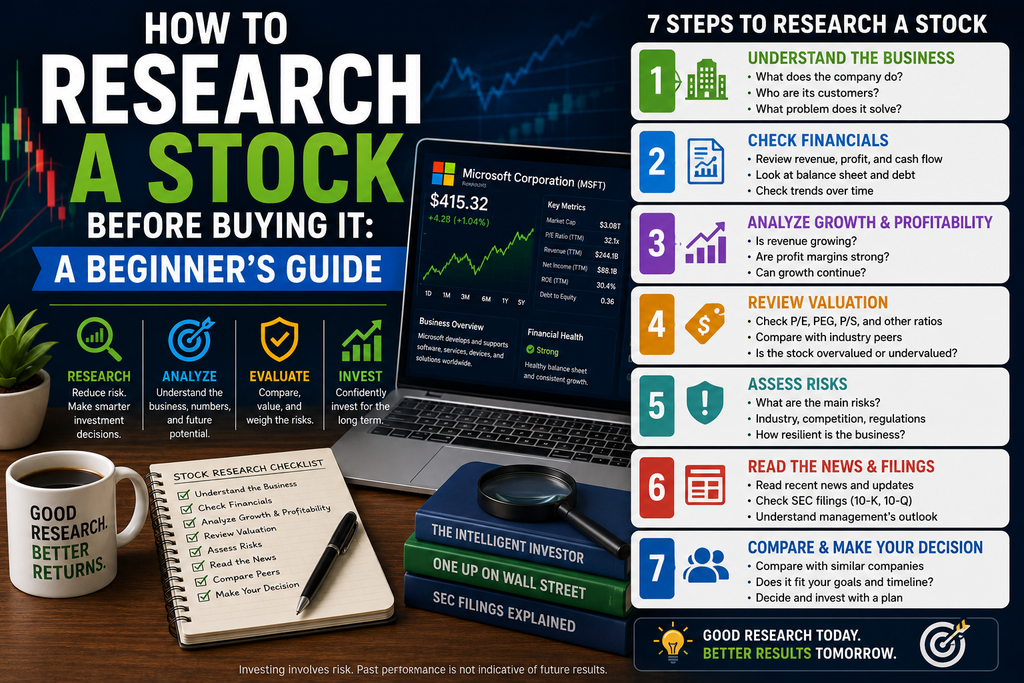
Learning how to research a stock can help beginners make more informed investment decisions. Instead of focusing only on a stock’s current price, you can examine the company behind the stock, its financial performance, competitive position, valuation, debt, risks, and future opportunities.
This guide explains a simple stock research process beginners can use before buying individual stocks.
Why Should You Research a Stock Before Buying?
When you buy shares of a company, you are purchasing an ownership interest in that business.
That means you should understand what the company does and why you believe its future prospects justify the price you are paying.
Stock research can help you answer questions such as:
- What does this company actually do?
- How does it make money?
- Is revenue growing?
- Is the company profitable?
- How much debt does it have?
- Does it generate cash?
- Does it have a competitive advantage?
- Is the stock reasonably valued?
- What could go wrong?
- Does the investment fit my portfolio?
Investor.gov recommends researching investments and performing due diligence before investing rather than relying solely on tips or recommendations.
Step 1: Understand the Company’s Business
Before looking at financial ratios, understand the business itself.
Start with a simple question:
How does this company make money?
For example, a company might generate revenue by:
- Selling products
- Providing subscriptions
- Advertising
- Charging transaction fees
- Licensing technology
- Providing financial services
- Selling software
- Operating physical stores
If you cannot explain how a company makes money in simple language, you may not understand the investment well enough yet.
Questions to Ask
Research:
- What products or services does the company sell?
- Who are its customers?
- Where does it operate?
- What are its main sources of revenue?
- Who are its biggest competitors?
- Is demand for its products increasing or declining?
Understanding the business provides context for everything else you discover.
Step 2: Look at Revenue Growth
Revenue is the money a company generates from its business activities before expenses are deducted.
When researching a company, look at revenue over several years rather than focusing on a single quarter.
For example:
| Year | Revenue |
|---|---|
| Year 1 | $10 billion |
| Year 2 | $11 billion |
| Year 3 | $13 billion |
| Year 4 | $15 billion |
This company has demonstrated revenue growth in this simplified example.
However, rising revenue alone does not automatically make a stock a good investment.
A company could increase sales while its costs increase even faster.
That is why revenue should be analyzed alongside profitability and cash flow.
Step 3: Examine Earnings and Profitability
Next, look at the company’s earnings.
A company can generate billions of dollars in revenue but still lose money.
Important profitability measures include:
- Net income
- Earnings per share
- Operating income
- Gross profit
- Profit margin
What Is Earnings Per Share?
Earnings per share, or EPS, represents a company’s earnings attributable to each outstanding share.
For example, if a company earns $1 billion and has 100 million shares, simplified EPS would be:
$1 billion ÷ 100 million = $10 per share
Investors often examine EPS trends to determine whether profitability is improving or weakening.
A company with consistently rising earnings may be attractive, but investors should still consider the price being paid for those earnings.
Step 4: Check Profit Margins
Profit margin tells you how much of the company’s revenue remains as profit after expenses.
Suppose a company generates $100 million in revenue and earns $10 million in net income.
Its net profit margin is:
$10 million ÷ $100 million × 100 = 10%
Margins can help investors understand how efficiently a business converts revenue into profit.
When researching a company, compare its margins over time and, when appropriate, against competitors in the same industry.
A declining margin may deserve investigation.
It could result from:
- Higher labor costs
- Rising raw material prices
- Increased competition
- Lower selling prices
- Higher operating expenses
Step 5: Study the Company’s Cash Flow
Profit is important, but cash flow is also critical.
Cash flow statements show how cash moves into and out of a business.
Investors often pay particular attention to free cash flow, which broadly represents cash available after certain capital expenditures required to maintain or grow the business.
Strong and consistent cash generation can provide a company with financial flexibility.
Cash can potentially be used to:
- Reinvest in the business
- Pay dividends
- Repurchase shares
- Reduce debt
- Make acquisitions
- Build financial reserves
A company reporting accounting profits while consistently struggling to generate cash deserves closer examination.
Step 6: Check the Company’s Debt
Debt can help companies expand, but excessive debt can increase financial risk.
When researching a stock, examine:
- Total debt
- Short-term debt
- Long-term debt
- Interest expenses
- Debt-to-equity ratio
- Ability to generate cash for debt obligations
A company with manageable debt may have greater flexibility during difficult economic periods.
A highly leveraged company may face more pressure if interest costs rise or revenue falls.
There is no single debt level that is appropriate for every company. Capital-intensive industries naturally tend to use more debt than some other businesses.
The important point is to understand whether the company’s debt appears manageable relative to its financial resources.
Step 7: Understand the Company’s Competitive Advantage
A strong business usually has something that helps it compete.
This is sometimes called an economic moat or competitive advantage.
Potential advantages include:
Strong Brand
Customers may prefer a company’s products even when competitors offer alternatives.
Network Effects
A service can become more valuable as more people use it.
Cost Advantage
A company may be able to produce or distribute products more efficiently than competitors.
Switching Costs
Customers may find it expensive or inconvenient to move to another provider.
Intellectual Property
Patents, technology, or specialized knowledge can provide an advantage.
A competitive advantage can help a company maintain profitability and market share.
However, advantages can weaken over time, so investors should continually evaluate them.
Step 8: Research the Industry
Never research a company in isolation.
Look at the industry in which it operates.
Ask:
- Is the industry growing?
- Is competition increasing?
- Are customers changing their behavior?
- Are new technologies disrupting the industry?
- Are regulations changing?
- Are profit margins improving or declining?
- Is the company gaining or losing market share?
A strong company operating in a declining industry can face significant challenges.
Likewise, a company operating in a growing industry may have additional opportunities.
Step 9: Analyze the Stock’s Valuation
One of the most important parts of stock research is valuation.
A great company can still be a poor investment if its stock price is far above what its future performance can reasonably justify.
Common valuation measures include:
Price-to-Earnings Ratio
The P/E ratio compares a company’s stock price with its earnings per share.
For example, if a stock trades at $100 and earns $5 per share:
$100 ÷ $5 = 20
The stock has a P/E ratio of 20.
Price-to-Sales Ratio
The P/S ratio compares a company’s market value with its revenue.
This can sometimes be useful for companies that have limited or negative earnings.
Price-to-Book Ratio
The P/B ratio compares a company’s market value with its book value.
It can be particularly useful in certain asset-heavy industries.
Enterprise Value to EBITDA
EV/EBITDA is another valuation measure used by investors and analysts to compare companies while considering factors such as debt and cash.
No single ratio tells you whether a stock is cheap or expensive.
Valuation should be considered in the context of the company’s growth, profitability, industry, balance sheet, and future prospects.
Step 10: Compare the Company With Competitors
A company’s financial numbers become more meaningful when compared with similar companies.
Suppose one company has:
- 20% profit margin
- 15% revenue growth
- Low debt
while its major competitors have:
- 10% profit margin
- 5% revenue growth
- Higher debt
The first company may have stronger fundamentals.
But valuation still matters.
A stronger business may already have a much higher stock price because investors recognize its advantages.
This is why investors should compare both quality and valuation.
Step 11: Look at Dividends and Share Buybacks
If you are interested in income or shareholder returns, research how the company returns money to investors.
Companies can return capital through:
- Dividends
- Share repurchases
For dividend-paying companies, examine:
- Dividend yield
- Dividend history
- Dividend growth
- Payout ratio
- Cash flow supporting the dividend
For companies buying back shares, investigate whether the number of shares outstanding is actually declining.
Share buybacks can potentially increase each remaining shareholder’s ownership percentage, but their effectiveness depends on factors such as the price paid for the shares and the company’s financial position.
Step 12: Read the Company’s Financial Reports
Public companies provide financial information that investors can use for research.
Important documents include:
- Annual reports
- Quarterly reports
- Earnings releases
- Financial statements
- Management discussions
- Risk disclosures
For U.S. public companies, the SEC’s EDGAR database provides access to company filings.
Investor.gov recommends reviewing company disclosures and conducting research before making investment decisions.
You do not need to read every page immediately.
Beginners can start with:
- Business overview
- Revenue and earnings
- Balance sheet
- Cash flow
- Risk factors
- Management discussion
- Major recent developments
Step 13: Read the Risk Factors
Investors often focus on potential gains and ignore risks.
Do the opposite.
Ask:
What could cause this investment to lose money?
Potential risks include:
- Strong competition
- Economic recession
- High debt
- Regulatory changes
- Product failures
- Customer concentration
- Technological disruption
- Supply-chain problems
- Management problems
- Overvaluation
Every company has risks.
The goal is not to find a company with zero risk. Such an investment generally does not exist.
The goal is to understand the risks and determine whether they are acceptable for your strategy.
Step 14: Examine Management
Management decisions can have a major effect on a business.
Research the company’s leadership and consider:
- Their experience
- Business strategy
- Capital allocation
- Track record
- Communication with shareholders
- Compensation
- Major acquisitions
- Shareholder dilution
You do not need to agree with every management decision.
But you should understand what leadership is trying to accomplish and whether its past actions support its stated strategy.
Step 15: Understand the Stock’s Share Structure
A company’s total number of shares can change over time.
For example, a company might issue new shares to raise capital.
This can create share dilution, meaning existing shareholders own a smaller percentage of the company.
On the other hand, share repurchases can reduce the number of outstanding shares.
When researching a company, examine whether its share count is increasing, decreasing, or remaining relatively stable.
Step 16: Look at Institutional and Insider Ownership Carefully
You may also encounter information about institutional investors and company insiders.
Institutional investors can include:
- Mutual funds
- Pension funds
- Asset managers
- Other large investment organizations
Insider ownership refers to shares held by company executives, directors, or other insiders.
This information can provide useful context, but it should not be treated as a standalone buy or sell signal.
Large investors can make mistakes too.
Step 17: Avoid Relying on Stock Tips
One of the biggest mistakes beginners make is buying stocks because someone online says:
“This stock is going to explode.”
A prediction is not research.
Social media posts, newsletters, videos, forums, and conversations with friends can provide ideas for further investigation, but investors should verify important information independently.
Investor.gov specifically warns investors against buying solely because of stock tips.
Instead of asking:
“Who says I should buy this stock?”
ask:
“What evidence supports this investment?”
Step 18: Build a Simple Stock Research Checklist
You can simplify the entire process into a checklist.
Before buying an individual stock, ask:
Business
- Do I understand what the company does?
- How does it make money?
- Who are its customers?
Growth
- Is revenue growing?
- Are earnings growing?
- What could drive future growth?
Profitability
- Are profit margins healthy?
- Is profitability improving?
Cash Flow
- Does the company generate cash?
- Is free cash flow strong or improving?
Debt
- How much debt does the company have?
- Can it comfortably manage its obligations?
Competition
- What makes the company different?
- Does it have a durable competitive advantage?
Valuation
- What is the P/E ratio?
- How does valuation compare with competitors?
- What growth expectations are already reflected in the price?
Risks
- What could go wrong?
- What would cause the stock price to fall?
Portfolio Fit
- Does this stock fit my investment strategy?
- Am I already heavily exposed to this industry?
- Would buying it make my portfolio too concentrated?
If you cannot answer these questions, spend more time researching before investing.
How Long Should You Research a Stock?
There is no fixed amount of time.
A simple company may be easier to understand than a complicated multinational business.
For beginners, the goal should not be to rush.
Start with basic information and gradually learn more.
A practical process might look like:
Step 1: Understand the business
Step 2: Review financial performance
Step 3: Analyze debt and cash flow
Step 4: Research competitors
Step 5: Evaluate valuation
Step 6: Identify risks
Step 7: Decide whether it fits your portfolio
This approach is much better than buying first and researching afterward.
Stock Research vs. Stock Prediction
There is an important difference between researching a stock and predicting its future price.
Research asks:
“Is this a strong business at a reasonable valuation?”
Prediction asks:
“Will this stock rise next month?”
The first question can be investigated using financial information and business analysis.
The second is much harder because stock prices are influenced by countless unpredictable factors.
Long-term investors may benefit from focusing more on business fundamentals and portfolio construction than trying to predict short-term market movements.
Common Stock Research Mistakes
Looking Only at the Stock Price
A $10 stock is not necessarily cheaper than a $500 stock.
The share price alone tells you very little about valuation.
Using One Ratio
A P/E ratio cannot tell you everything about a business.
Ignoring Debt
Debt can become a serious problem when business conditions deteriorate.
Ignoring Valuation
A great business can still be overpriced.
Following Social Media Hype
Popularity does not equal investment quality.
Ignoring Diversification
Even a high-quality company can experience unexpected problems.
Assuming Past Performance Will Continue
Historical returns do not guarantee future results.
Final Thoughts
Learning how to research a stock is one of the most valuable skills a beginner investor can develop.
You do not need to become a professional financial analyst overnight.
Start by understanding the business. Then examine revenue, earnings, profitability, cash flow, debt, competitive advantages, valuation, management, and risks.
Most importantly, understand what you are paying for the business.
A good company is not automatically a good investment at every price.
Likewise, a stock that looks cheap is not automatically a bargain.
The best stock research process combines business quality, financial strength, valuation, risk analysis, and portfolio fit.
Instead of asking whether a stock is going to rise tomorrow, ask a more useful question:
“If I owned a piece of this entire business for the next several years, would I be comfortable with what I own and the price I paid for it?”
That mindset can help beginners move away from speculation and toward a more disciplined approach to investing.