
When you start investing in stocks, you will often hear the terms growth stocks and value stocks. These are two common ways investors categorize companies based on their business characteristics, expected growth, and valuation.
Growth investors generally look for companies they believe can increase earnings and revenue faster than the broader market. Value investors, on the other hand, generally look for stocks they believe are trading below what the company is fundamentally worth.
Neither strategy is automatically better. Both can perform well or poorly depending on market conditions, company fundamentals, valuations, and the investor’s time horizon.
Understanding growth stocks vs. value stocks can help beginners make more informed decisions and better understand how different stocks fit into a portfolio.
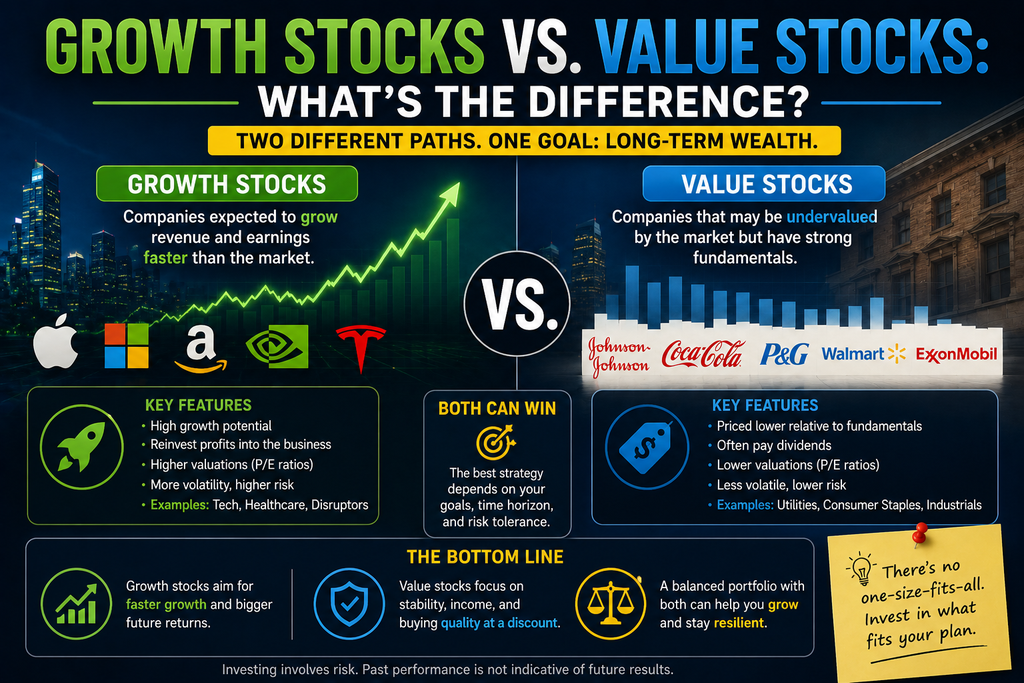
What Is a Growth Stock?
A growth stock is generally a company whose earnings are growing, or are expected to grow, faster than the market average.
Investors who buy growth stocks typically expect the company’s future growth to increase the value of its shares.
Growth companies may operate in industries such as:
- Technology
- Software
- Artificial intelligence
- Healthcare
- Consumer products
- Communication services
- Emerging industries
A growth company may choose to reinvest much of its available cash into expanding the business rather than paying large dividends.
Investor.gov describes growth stocks as stocks with earnings growing faster than the market average and notes that they generally appeal to investors seeking capital appreciation.
Example of a Growth Stock
Imagine a technology company that is rapidly increasing its revenue by expanding into new markets.
The company earns $5 billion today but analysts and investors expect its earnings to become significantly larger over the next several years.
Investors may be willing to pay a relatively high price for the stock because they believe the company’s future earnings will justify that valuation.
That is the basic idea behind growth investing.
What Is a Value Stock?
A value stock is generally a stock that investors believe is trading at a price below its underlying or intrinsic value.
Value investors look for companies that may be temporarily unpopular, misunderstood, or undervalued by the market.
Common valuation measures include:
- Price-to-earnings ratio
- Price-to-book ratio
- Price-to-sales ratio
- Free cash flow
- Dividend yield
However, a low valuation does not automatically mean a stock is a good investment.
A company can have a low P/E ratio because its business is genuinely deteriorating.
FINRA notes that value investing involves looking for securities that appear to trade below their intrinsic worth, but also warns that some apparently cheap stocks can be value traps when their underlying business prospects are weakening.
Growth Stocks vs. Value Stocks
The simplest difference is this:
Growth investors focus heavily on future growth potential, while value investors focus heavily on what they believe a stock is worth compared with its current market price.
Here is a basic comparison:
| Feature | Growth Stocks | Value Stocks |
|---|---|---|
| Main focus | Future growth | Current valuation |
| Typical valuation | Often higher | Often lower |
| Investor expectation | Strong future expansion | Price may recover toward intrinsic value |
| Dividends | Often lower or none | May be more common |
| Risk | High valuation and growth expectations | Value traps and weak fundamentals |
| Typical approach | Growth-oriented | Fundamental/value-oriented |
| Time horizon | Often long term | Often long term |
These are broad categories rather than strict rules. A company can have both growth and value characteristics.
How Growth Investing Works
Growth investing is based on the belief that a company can expand significantly over time.
Investors may look for businesses with:
- Rapid revenue growth
- Increasing earnings
- Large addressable markets
- Strong competitive advantages
- Innovative products
- Growing customer bases
- Opportunities to expand internationally
The goal is usually capital appreciation.
For example, suppose an investor buys shares for $40 because they believe the company could eventually become much larger.
If the shares later rise to $80, the investor has a $40 per-share unrealized gain, before considering taxes, fees, and other factors.
However, the opposite can also happen.
If the company’s expected growth fails to materialize, investors may lower their expectations and the stock price could fall significantly.
How Value Investing Works
Value investing takes a different approach.
Instead of focusing primarily on rapid future growth, value investors may search for companies whose current share prices appear low relative to their financial fundamentals.
A value investor might examine:
- Earnings
- Assets
- Cash flow
- Debt
- Profit margins
- Competitive position
- P/E ratio
- P/B ratio
- Historical valuations
The investor then forms an opinion about what the business may actually be worth.
If the investor believes a stock is worth $100 but it trades for $70, they may consider it potentially undervalued.
However, the market may have a reason for assigning the $70 price.
The company’s profits may be declining. Its industry may be shrinking. Competition may be increasing.
This is why value investing requires more than simply finding stocks with low valuation ratios.
Growth Stocks Often Have Higher Valuations
One important characteristic of growth stocks is that investors may be willing to pay higher valuation multiples for them.
Suppose two companies each earn $5 per share.
Company A trades at $50.
Its P/E ratio is:
$50 ÷ $5 = 10
Company B trades at $150.
Its P/E ratio is:
$150 ÷ $5 = 30
Company B has a much higher P/E ratio.
Why might investors pay more?
They may expect Company B’s earnings to grow substantially faster in the future.
This does not mean Company B is automatically overvalued. It simply means investors are assigning a higher valuation to its expected future performance.
Why Growth Stocks Can Be Risky
Growth stocks can carry significant risk because their valuations may depend heavily on future expectations.
Suppose investors expect a company to grow earnings by 25% annually.
If the company’s growth slows to 10%, investors may decide the stock is no longer worth its previous valuation.
The stock price could decline even if the company remains profitable.
This is sometimes called valuation risk.
Growth stocks can also be sensitive to:
- Interest rates
- Economic conditions
- Competition
- Changes in consumer behavior
- Technological disruption
- Disappointing earnings reports
Stocks in general carry investment risk, and their prices can fluctuate substantially. Investor.gov emphasizes that stock investors can lose money and that diversification can help reduce some portfolio risk.
Why Value Stocks Can Be Risky
Value stocks have their own risks.
A stock may appear cheap because the company’s business is genuinely struggling.
For example, imagine a company that once generated $10 billion in annual revenue.
Its stock falls dramatically, and its valuation becomes very low.
An investor might think:
“This stock is cheap, so it must be a bargain.”
But if the company’s revenue continues falling, its competitive position deteriorates, and its debt increases, the stock could become even cheaper.
This is a classic example of a potential value trap.
The key lesson is:
Cheap does not always mean undervalued.
What Is a Value Trap?
A value trap is a stock that appears inexpensive based on traditional valuation measures but continues to decline because its underlying business is weaker than investors realize.
For example:
A company trades at a P/E ratio of 8 while competitors trade at 20.
At first glance, the company may look cheap.
But suppose:
- Revenue is declining
- Profit margins are shrinking
- Debt is increasing
- Customers are leaving
- The industry is being disrupted
The low valuation may be justified.
This is why value investors need to examine the business itself rather than relying on one financial ratio.
Growth vs. Value During Different Market Conditions
Growth and value stocks can perform differently during different periods.
There have been periods when growth stocks strongly outperform value stocks.
There have also been periods when value stocks outperform growth stocks.
Market conditions can influence the relative performance of different investment styles.
Factors such as:
- Interest rates
- Inflation
- Economic growth
- Investor sentiment
- Corporate earnings
- Industry trends
can influence stock valuations.
However, predicting which category will outperform next is difficult.
Investors should avoid building an entire portfolio around the assumption that one style will always win.
Growth Stocks and Dividends
Growth companies may pay little or no dividend because they prefer to reinvest cash into the business.
For example, a company may use its money to:
- Build new facilities
- Hire employees
- Develop products
- Expand internationally
- Acquire other businesses
- Invest in research and development
This can make sense if management believes reinvesting the money can produce attractive future returns.
By contrast, mature companies with fewer opportunities for rapid expansion may return more money to shareholders through dividends.
However, these are general patterns rather than universal rules.
Some growth companies pay dividends, and some value companies do not.
Can a Stock Be Both Growth and Value?
Yes.
Growth and value are not completely separate boxes.
A company may have:
- Strong earnings growth
- A reasonable valuation
- A growing dividend
- A strong balance sheet
Such a company could have characteristics associated with both categories.
Stock classifications can also change over time.
A fast-growing company today may become a mature company later.
Likewise, a mature company may improve its business and return to stronger growth.
How to Identify Growth Stocks
When researching a potential growth stock, investors may examine:
Revenue Growth
Is the company’s revenue increasing?
Earnings Growth
Are profits growing consistently?
Market Opportunity
Does the company have room to expand?
Competitive Advantage
Does the business have something that competitors struggle to replicate?
Cash Flow
Is the company generating enough cash to support its operations and growth?
Valuation
Even an excellent company can become a risky investment if investors pay an extremely high price for expected future growth.
Investors should consider both the quality of the business and the price being paid.
How to Identify Value Stocks
Value investors may examine:
P/E Ratio
The price-to-earnings ratio compares a company’s share price with its earnings per share.
P/B Ratio
The price-to-book ratio compares the market value of shares with the company’s book value.
Free Cash Flow
Free cash flow can help investors understand how much cash a company generates after necessary capital expenditures.
Debt
High debt can increase financial risk.
Dividend Yield
A dividend can provide income, although dividend payments are not guaranteed.
Industry Position
Investors should understand why the stock is trading at a lower valuation than competitors.
A low valuation can represent an opportunity, but it can also signal real problems.
Growth vs. Value: Which Is Better?
There is no universal answer.
The better strategy depends on your:
- Financial goals
- Risk tolerance
- Investment time horizon
- Portfolio structure
- Investment knowledge
- Personal preferences
A younger investor with a long time horizon might be comfortable owning more volatile growth-oriented investments.
Another investor may prefer established companies trading at lower valuations.
However, age alone should not determine your investment strategy.
Investor.gov explains that asset allocation should reflect factors such as time horizon and risk tolerance.
Should Beginners Choose Growth or Value Stocks?
Beginners do not necessarily need to choose one category exclusively.
A diversified portfolio can contain different types of companies and assets.
For example, an investor could have exposure to:
- Growth stocks
- Value stocks
- Dividend-paying companies
- International stocks
- Bonds
- Broad-market ETFs
The appropriate combination depends on the investor’s circumstances.
For many beginners, understanding diversification may be more important than trying to predict whether growth or value stocks will outperform next.
Growth and Value ETFs
Investors who do not want to research individual companies can also gain exposure to growth or value strategies through ETFs and mutual funds.
A growth ETF may hold a collection of companies selected using growth-oriented criteria.
A value ETF may focus on companies that meet certain valuation-related criteria.
This can make diversification easier than selecting individual stocks.
However, funds still have risks, fees, and investment strategies that investors should understand before buying.
Common Mistakes Beginners Make
Mistake 1: Buying Only Because a Stock Is Cheap
A low stock price or low P/E ratio does not automatically make a company undervalued.
Mistake 2: Assuming Growth Always Wins
Strong historical growth does not guarantee future performance.
Mistake 3: Ignoring Valuation
A great company can still be an expensive investment if the market price reflects unrealistic expectations.
Mistake 4: Ignoring Business Fundamentals
Investors should understand how a company makes money and what risks could affect its future.
Mistake 5: Concentrating Too Much
Owning several companies from the same sector may still leave an investor exposed to significant concentration risk.
Mistake 6: Following Stock Tips
Investment decisions should be based on research rather than social media hype or unverified recommendations. Investor.gov specifically recommends researching investments and not buying solely because of stock tips.
A Simple Example
Imagine two companies.
Company A — Growth
- Revenue growth: 25%
- P/E ratio: 35
- Dividend: $0
- Business expanding rapidly
Company B — Value
- Revenue growth: 5%
- P/E ratio: 12
- Dividend yield: 3%
- Established business
An investor focused on future expansion might prefer Company A.
An investor looking for a lower valuation and potential income might prefer Company B.
Neither choice is automatically correct.
The important question is whether the investment’s potential reward justifies its risks and whether it fits the investor’s overall strategy.
How to Research Before Investing
Before purchasing either a growth or value stock, investors should research the company carefully.
Useful information can include:
- Annual reports
- Quarterly reports
- Revenue trends
- Earnings
- Cash flow
- Debt
- Industry conditions
- Competitive advantages
- Management
- Valuation
- Major business risks
Public companies provide financial disclosures that investors can use for research. Investor.gov recommends performing investment research and due diligence before making investment decisions.
Final Thoughts
The debate over growth stocks vs. value stocks is not about finding one strategy that always wins.
Growth investing focuses heavily on companies with strong or expected future expansion. Value investing focuses more heavily on finding securities that appear inexpensive relative to their underlying fundamentals.
Both approaches have potential benefits and risks.
Growth stocks can offer significant capital appreciation potential, but high expectations can make them sensitive to disappointing results and valuation changes.
Value stocks can provide opportunities when the market has undervalued a company, but some apparently cheap stocks may be struggling businesses or value traps.
For beginners, the most important step is to understand what you are buying, evaluate the risks, maintain appropriate diversification, and choose investments that fit your financial goals and time horizon.
Rather than asking which strategy is always better, ask a more useful question:
Does this investment make sense for my financial plan, risk tolerance, and long-term goals?