
Dividends are one of the ways investors can potentially earn money from stocks. When a company distributes part of its profits or other available funds to shareholders, the payment is generally called a dividend.
For investors, dividends can provide income while they continue to own shares. Some investors also choose to reinvest dividends to purchase additional shares, potentially increasing their long-term investment over time.
However, dividends are not free money, and companies are not required to maintain the same dividend forever. A company can reduce, suspend, or eliminate its dividend.
In this guide, you will learn what dividends are, how dividends work, how dividend yield is calculated, what ex-dividend dates mean, and what beginners should consider before investing in dividend-paying stocks.
What Is a Dividend?
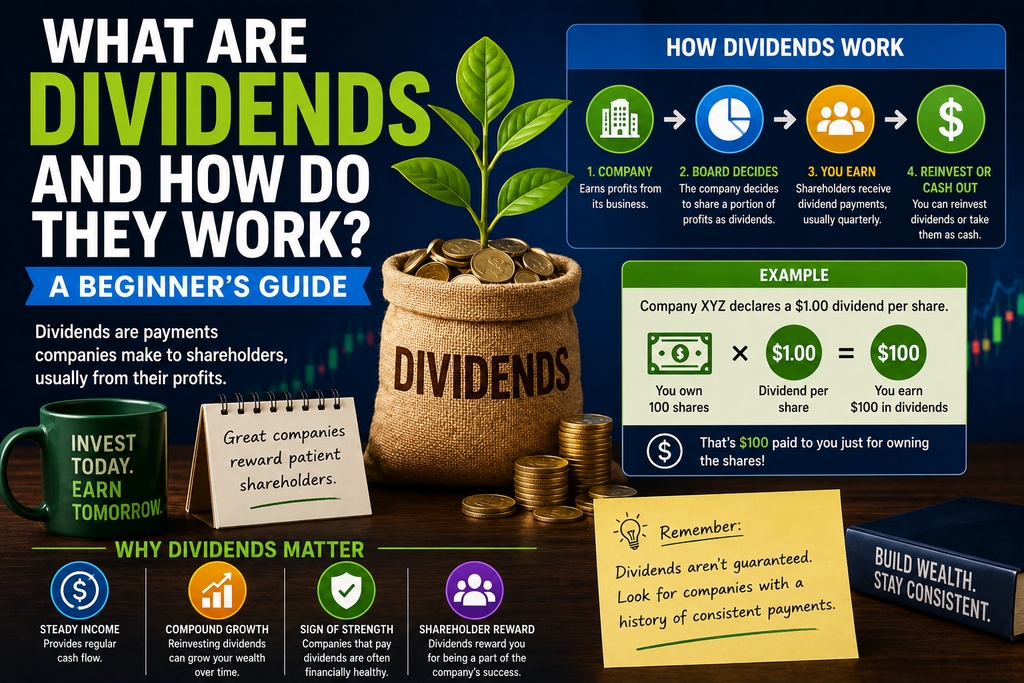
A dividend is a payment made by a company to its shareholders.
When you own shares of a dividend-paying company, you may receive cash payments based on the number of shares you own. For example, suppose a company declares a dividend of $1 per share and you own 100 shares.
Your dividend would be:
100 shares × $1 = $100
The company determines whether to pay a dividend, how much to pay, and how frequently to pay it.
Dividends are commonly associated with established companies, although dividend-paying companies can exist across many industries and business sizes.
How Do Dividends Work?
The basic process is relatively simple.
A company announces a dividend and provides important dates that determine which shareholders are entitled to receive it.
A typical dividend process includes:
- Declaration date
- Ex-dividend date
- Record date
- Payment date
Understanding these dates is important because simply buying a stock around the dividend date does not automatically mean you will receive the upcoming payment.
1. Declaration Date
The declaration date is when a company’s board announces that it intends to pay a dividend.
The announcement generally includes information such as the dividend amount and relevant dates.
For example, a company might announce a dividend of $0.50 per share.
2. Ex-Dividend Date
The ex-dividend date is especially important for investors.
If you purchase a stock on or after its ex-dividend date, you generally will not receive the upcoming dividend. If you purchase the stock before the ex-dividend date, you generally qualify for that dividend.
Investor.gov explains that the ex-dividend date determines whether a buyer is entitled to an upcoming dividend.
3. Record Date
The record date is the date the company uses to determine which shareholders are officially entitled to receive the dividend.
The company checks its shareholder records on this date.
The relationship between the ex-dividend date and record date can sometimes be confusing, so investors should always check the specific dates for the stock they own.
4. Payment Date
The payment date is when the dividend is actually distributed to eligible shareholders.
Depending on the company and brokerage account, the money may appear as cash in your investment account.
Example of How a Dividend Works
Imagine you own 200 shares of a company.
The company declares a dividend of:
$0.75 per share
Your dividend would be:
200 × $0.75 = $150
If the company pays the dividend four times per year at the same rate, your annual dividend income would be:
$150 × 4 = $600
This example assumes the company keeps the dividend unchanged throughout the year.
In reality, dividend amounts can change, and companies can increase, reduce, or stop dividend payments.
What Is Dividend Yield?
Dividend yield helps investors compare the annual dividend payment with a stock’s current share price.
The basic formula is:
Dividend Yield = Annual Dividend per Share ÷ Stock Price × 100
For example, suppose a stock trades at $50 and pays $2 in annual dividends.
The dividend yield would be:
$2 ÷ $50 × 100 = 4%
So the stock has a dividend yield of approximately 4%.
Dividend yield can be useful, but it should not be the only factor you consider when evaluating a stock.
A very high dividend yield can sometimes indicate that the stock price has fallen significantly or that the dividend may be difficult for the company to maintain.
Why Do Companies Pay Dividends?
Companies may pay dividends for several reasons.
Returning Money to Shareholders
A profitable company may decide that it does not need to use all of its available cash for business expansion.
Instead, it may return some money to shareholders through dividends.
Attracting Income-Focused Investors
Some investors prefer investments that can provide regular income.
Companies with established dividend policies may therefore appeal to investors looking for potential income from their portfolios.
Demonstrating Financial Stability
A consistent dividend history can sometimes indicate that a company has generated enough cash to make regular distributions.
However, a dividend alone does not prove that a company is financially strong. Investors should still examine the company’s financial condition and business prospects.
Can Companies Stop Paying Dividends?
Yes.
A dividend is not guaranteed.
A company may reduce or eliminate its dividend if business conditions change, profits decline, cash becomes limited, or management decides to use available money for other purposes.
This is one reason investors should not choose stocks based solely on their dividend yield.
A stock offering a 7% dividend yield is not automatically better than a stock offering a 2% yield.
The sustainability of the dividend matters.
What Is Dividend Reinvestment?
Dividend reinvestment means using dividend payments to purchase additional shares instead of taking the money as cash.
For example, imagine you receive a $50 dividend.
Instead of withdrawing the $50, you could use it to buy additional shares if your brokerage and investment plan allow it.
Over many years, reinvested dividends can increase the number of shares you own.
Those additional shares may potentially generate additional dividends in the future.
This creates a compounding effect when the investment performs well and dividends continue.
Some brokerage accounts offer dividend reinvestment programs, although the specific features and rules vary between brokers.
Dividends and Compound Growth
Dividend reinvestment can be particularly interesting for long-term investors.
Suppose you own 100 shares of a dividend-paying company. Over time, you receive dividends and use them to purchase more shares.
Now you may own slightly more than 100 shares.
If the company continues paying dividends, those additional shares may also produce dividends.
This does not guarantee profits, and stock prices can decline. But reinvesting income can be one component of a long-term investing strategy.
What Is a Dividend Aristocrat?
You may hear the term Dividend Aristocrat when researching dividend stocks.
The term is commonly used for companies in the S&P 500 that have increased their regular dividend payments for at least 25 consecutive years, subject to the applicable index methodology.
These companies are often discussed by investors interested in dividend growth.
However, a company’s inclusion in a dividend-focused category does not guarantee that it will continue performing well in the future.
Past dividend history should be treated as information for research, not a promise of future results.
Dividend Stocks vs. Growth Stocks
Dividend stocks and growth stocks can have different characteristics.
Dividend Stocks
Dividend-focused companies may appeal to investors who want:
- Potential regular income
- Established businesses
- Dividend growth
- A combination of income and potential price appreciation
Growth Stocks
Growth-oriented companies may prioritize reinvesting money into the business rather than distributing large amounts of cash to shareholders.
They may focus on:
- Expanding into new markets
- Developing products
- Increasing revenue
- Growing market share
Some companies can have both growth characteristics and dividends.
There is no universal rule that one approach is better than the other. The right choice depends on an investor’s goals, risk tolerance, time horizon, and overall portfolio.
What Happens to the Stock Price on the Ex-Dividend Date?
A common misconception is that investors can simply buy a stock immediately before the ex-dividend date, collect the dividend, and automatically make an easy profit.
Markets do not work that way.
A stock’s price may adjust downward by approximately the dividend amount on the ex-dividend date, although actual price movements depend on market conditions.
Investor.gov notes that for significant dividends, the stock price may fall by the amount of the dividend on the ex-dividend date.
For example, if a stock trades at $50 and pays a $1 dividend, its market price may adjust around the ex-dividend date. Other market factors can cause the actual price movement to differ.
Therefore, investors should not assume that dividends create a guaranteed short-term profit.
What Is a Dividend Payout Ratio?
The dividend payout ratio measures how much of a company’s earnings are distributed as dividends.
A simplified formula is:
Dividend Payout Ratio = Dividends ÷ Earnings × 100
For example, if a company earns $10 per share and pays $4 per share in dividends:
$4 ÷ $10 × 100 = 40%
The company is paying out 40% of its earnings as dividends under this simplified calculation.
Investors often examine payout ratios when evaluating whether a dividend may be sustainable.
However, payout ratios should be considered alongside cash flow, debt, earnings stability, industry conditions, and other financial information.
What Is Dividend Growth?
Dividend growth refers to increases in the amount a company pays shareholders over time.
For example, a company might increase its annual dividend from:
- $1.00 per share
- $1.10 per share
- $1.20 per share
- $1.30 per share
A growing dividend can be attractive to long-term investors because the income generated from the same number of shares can increase.
However, dividend growth is not guaranteed.
Companies can slow, stop, or reverse dividend increases depending on their financial circumstances.
How to Research a Dividend Stock
Before buying a dividend-paying stock, beginners should look beyond the dividend yield.
Consider researching:
1. Dividend History
Has the company maintained its dividend over many years?
2. Dividend Growth
Has the dividend increased consistently?
3. Earnings
Does the company generate enough earnings to support its dividend?
4. Cash Flow
A company’s ability to generate cash can be important when evaluating its ability to make distributions.
5. Payout Ratio
A very high payout ratio may deserve additional investigation.
6. Debt
High debt levels can affect a company’s financial flexibility.
7. Business Quality
Understand how the company makes money and what could cause its business to weaken.
Investors should perform research and due diligence before making investment decisions. FINRA similarly emphasizes evaluating a company’s fundamentals, goals, and risk before investing.
Common Dividend Investing Mistakes
Chasing the Highest Yield
A high yield can look attractive, but it may come with significant risk.
Ignoring the Business
A dividend should never replace research into the underlying company.
Assuming Dividends Are Guaranteed
Companies can reduce or eliminate dividends.
Forgetting About Diversification
Owning several dividend stocks from the same industry does not necessarily create a well-diversified portfolio.
Focusing Only on Income
Total return can come from both dividends and changes in the investment’s market value.
Buying Only for the Ex-Dividend Date
Trying to buy stocks solely to capture a dividend does not eliminate market risk.
Are Dividends Taxable?
Dividend taxation depends on factors such as the type of dividend, account type, and the investor’s tax situation.
For U.S. investors, certain dividends may receive different tax treatment from others.
Because tax rules can change and individual circumstances vary, investors should review current IRS guidance or consult a qualified tax professional when making tax-related decisions.
Taxes should also be considered when comparing investments in taxable accounts.
Should Beginners Invest in Dividend Stocks?
Dividend stocks can be part of a diversified investment strategy, but beginners should first understand their overall financial goals.
Before investing, consider:
- Your investment time horizon
- Your risk tolerance
- Your emergency savings
- Your existing investments
- Your need for current income
- Your long-term financial goals
A beginner does not necessarily need to build a portfolio entirely around dividend stocks.
Broadly diversified funds can also provide exposure to many companies, including companies that pay dividends.
A Simple Dividend Investing Example
Imagine an investor purchases 50 shares of a company.
The company pays an annual dividend of $2 per share.
The investor’s annual dividend income would be:
50 × $2 = $100
If the investor chooses to reinvest the $100 and the investment allows fractional or additional-share purchases, the investor may gradually increase their ownership.
Over a long period, the combination of investment growth and reinvested dividends could contribute to total returns.
But neither dividend payments nor investment returns are guaranteed.
Frequently Asked Questions About Dividends
What are dividends?
Dividends are payments that companies make to eligible shareholders. They are commonly paid in cash, although companies can also make certain distributions in stock or other forms.
How often are dividends paid?
Many U.S. companies pay dividends quarterly, but payment schedules vary. Some companies pay monthly, semiannually, annually, or on other schedules.
Can I live off dividends?
Some investors aim to generate enough portfolio income to cover living expenses. However, this requires substantial capital, careful planning, diversification, and consideration of taxes and investment risks.
Do all stocks pay dividends?
No. Many companies do not pay dividends, particularly businesses that choose to reinvest available money into growth.
Is a higher dividend yield better?
Not necessarily. A high yield can sometimes reflect a falling stock price or financial problems. Dividend sustainability is often more important than simply choosing the highest yield.
Do ETFs pay dividends?
Some ETFs distribute dividend income received from stocks or other securities held in their portfolios. The amount and frequency depend on the fund.
What is the most important dividend date?
For many investors, the ex-dividend date is particularly important because it determines whether a new purchaser is generally entitled to the upcoming dividend.
Final Thoughts
Dividends can be an important part of investing, especially for investors interested in generating potential income or reinvesting earnings for long-term growth.
Understanding what dividends are is only the beginning. Investors should also understand dividend yield, payout ratios, dividend growth, ex-dividend dates, and the risks associated with relying on dividend income.
The most important lesson is that a dividend should not be viewed in isolation. A strong investment decision requires looking at the underlying company, its financial condition, valuation, business model, risks, and your own financial goals.
For beginners, the goal should not simply be to find the stock with the highest dividend yield. Instead, focus on building a diversified portfolio that matches your long-term objectives and risk tolerance.
Dividends can contribute to total investment returns, but they are only one part of the larger investing picture.