
Introduction
When you open a brokerage account and decide to buy your first stock or ETF, you may encounter terms such as market order and limit order.
These terms can seem confusing at first, but understanding them is an important part of learning how to invest.
A market order and a limit order both allow you to buy or sell an investment, but they work differently.
A market order generally prioritizes executing the trade, while a limit order gives you more control over the price but does not guarantee that the trade will execute.
Knowing the difference can help you avoid placing an order without understanding what might happen next.
In this guide, we will explain market orders and limit orders in simple terms, compare their advantages and disadvantages, and show how beginners can think about using each type.
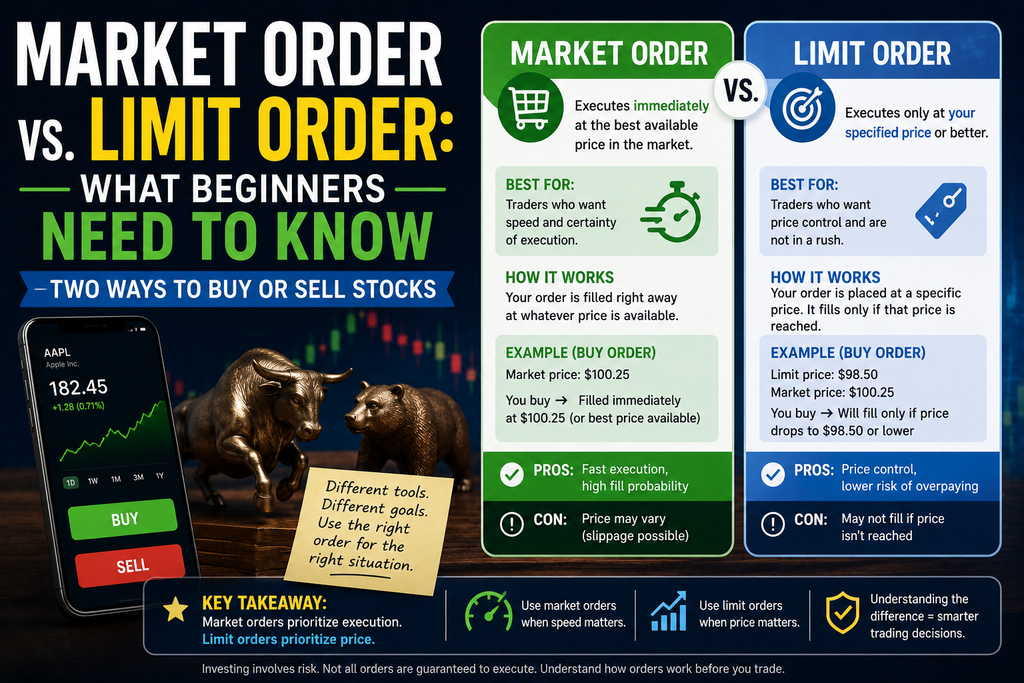
What Is a Market Order?
A market order is an instruction to buy or sell a security at the best available price in the market.
The main priority of a market order is generally execution.
For example, suppose a stock is currently trading around $50.
You place a market order to buy 10 shares.
Your order may execute near $50, but the actual execution price can be different because stock prices can change between the moment you place the order and the moment the trade is executed.
Investor.gov explains that market orders generally execute at or near the current market price, but investors cannot guarantee the exact price at which the order will execute. (investor.gov)
What Is a Limit Order?
A limit order is an instruction to buy or sell a security only at a specified price or a better price.
For a buy limit order, you specify the maximum price you are willing to pay.
For a sell limit order, you specify the minimum price you are willing to accept.
For example, suppose a stock is trading at $50.
You place a buy limit order at $47.
Your order can execute at $47 or lower, depending on market conditions and available sellers.
However, if the stock never reaches your specified price, the order may not execute.
This is the key trade-off:
A limit order provides price control, but it does not guarantee execution.
Investor.gov notes that a limit order may execute only at the specified price or better and may remain unfilled if the market never reaches that price. (investor.gov)
Market Order vs. Limit Order
The simplest comparison looks like this:
| Feature | Market Order | Limit Order |
|---|---|---|
| Main priority | Execution | Price control |
| Price guaranteed? | No | Yes, if executed |
| Execution guaranteed? | Generally higher likelihood, but not absolute | No |
| Buy example | Buy at best available price | Buy only at specified price or lower |
| Sell example | Sell at best available price | Sell only at specified price or higher |
| Useful for | Investors prioritizing execution | Investors prioritizing price |
The exact behavior of an order can depend on market conditions and brokerage rules, so investors should understand the order instructions before submitting a trade.
How a Market Order Works
Imagine a stock is trading at approximately $100.
You want to buy five shares immediately.
You submit a market order.
Your brokerage sends the order to the market for execution.
If the available price changes before your order is filled, you may receive a price different from the $100 quote you saw.
For a highly liquid stock with many buyers and sellers, the difference may be small.
For less liquid securities or during periods of rapid price movement, the difference can potentially be larger.
This is one reason investors should understand that the displayed market price is not necessarily the exact price at which a market order will execute.
How a Limit Order Works
Now imagine the same stock is trading at $100.
You decide you do not want to pay more than $95.
You place a buy limit order at $95.
If the stock falls to $95 or below and there is sufficient availability, the order may execute.
If the stock remains above $95, the order may remain unfilled.
For example:
- Current price: $100
- Your buy limit: $95
- Stock falls to $95: order may execute
- Stock stays above $95: order may not execute
The important point is that a limit order gives you control over the price you are willing to accept.
Buy Limit Order vs. Sell Limit Order
Limit orders can be used for both purchases and sales.
Buy Limit Order
A buy limit order sets the maximum price you are willing to pay.
Example:
A stock trades at $60.
You set a buy limit at $55.
You are saying:
“I am willing to buy this stock at $55 or less.”
Sell Limit Order
A sell limit order sets the minimum price you are willing to accept.
Example:
You own a stock trading at $60.
You set a sell limit at $70.
You are saying:
“I am willing to sell this stock at $70 or more.”
If the market never reaches your limit price, the order may not execute.
Why Would an Investor Use a Market Order?
A market order may be considered when getting the trade executed is more important than obtaining a specific price.
For example, an investor may decide that they want to purchase a highly liquid investment immediately rather than wait for a particular price.
However, investors should still understand that market orders do not guarantee a specific execution price.
The market can move quickly.
Why Would an Investor Use a Limit Order?
A limit order can be useful when price is particularly important.
For example, suppose you are willing to buy a stock, but only if you can purchase it for $40 or less.
Instead of submitting a market order and accepting the available market price, you could place a buy limit order at $40.
The trade-off is that the stock might never fall to $40.
You could therefore miss the purchase entirely.
The Biggest Difference Between Market and Limit Orders
The easiest way to remember the difference is:
Market order = prioritize execution
Limit order = prioritize price
Neither order type is automatically better.
The appropriate choice depends on the situation and what matters most to you.
What Happens if a Limit Order Does Not Execute?
A limit order does not necessarily execute just because the market price appears to reach your limit.
Execution depends on factors such as available buyers or sellers and market conditions.
For example, suppose you place a buy limit order at $50.
The stock briefly reaches $50 but there may not be enough shares available for your order to be filled.
Your order could remain open or be canceled depending on the instructions you selected.
This is why investors should understand how their brokerage handles unfilled orders.
What Is a Stop Order?
Beginners may also encounter stop orders.
A stop order is different from both a standard market order and a limit order.
A stop order becomes a market order once the security reaches a specified stop price.
For example, an investor who owns a stock may use a sell stop order with a specified stop price.
However, once triggered, the order becomes a market order, so the eventual execution price is not guaranteed.
Because stop orders can behave differently in rapidly moving markets, beginners should learn how they work before using them.
What Is a Stop-Limit Order?
A stop-limit order combines features of a stop order and a limit order.
Once the stop price is reached, the order becomes a limit order rather than a market order.
This can provide more control over the eventual price.
However, it also introduces the possibility that the order will not execute.
For example, suppose you own a stock trading at $100.
You establish:
- Stop price: $90
- Limit price: $88
If the stock reaches the stop price, the order becomes a limit order with the specified limit.
If the market moves below the limit too quickly, the order may not execute.
The exact rules can vary, so investors should review their brokerage’s order descriptions before using advanced order types.
Market Orders and Volatility
Market volatility is especially important when using market orders.
During rapidly changing markets, prices can move quickly.
Suppose a stock is quoted at $100 when you submit a market order.
By the time the order executes, the available price might be $101 or $102.
The difference is known as price movement between the displayed quote and execution.
For this reason, investors should not assume that the price shown on their screen is guaranteed for a market order.
Market Orders and Liquidity
Liquidity also matters.
A highly liquid stock generally has many buyers and sellers.
A less liquid security may have fewer participants and wider differences between available buy and sell prices.
This can affect how orders are executed.
Investors should be especially careful when trading securities that have:
- Low trading volume
- Wide bid-ask spreads
- Large price fluctuations
- Limited market participation
A limit order can provide additional price control, but it still does not guarantee execution.
What Is the Bid-Ask Spread?
To understand stock orders, it helps to know about the bid and ask.
The bid is generally the highest price a buyer is currently willing to pay.
The ask is generally the lowest price a seller is currently willing to accept.
The difference between them is called the bid-ask spread.
For example:
- Bid: $49.95
- Ask: $50.00
- Spread: $0.05
A smaller spread can indicate greater liquidity, although investors should consider other factors as well.
Market orders interact with available bids and asks when they are executed.
Why the Price Can Change After You Click Buy
Many beginners are surprised when their order executes at a slightly different price from the quote they saw.
This can happen because stock prices are constantly changing.
Between:
- Looking at the price
- Clicking buy
- Sending the order
- Routing the order
- Executing the trade
the available market price can change.
Investor.gov warns investors to understand how their orders will be handled and that online trading can happen quickly, while making a sound investment decision requires more than simply executing a trade. (investor.gov)
Common Mistakes Beginners Make With Orders
1. Assuming a Market Order Guarantees the Displayed Price
It does not.
The displayed quote can change before execution.
2. Using a Limit Price Without Understanding It
A limit order can remain unfilled if the market does not reach your specified price.
3. Forgetting to Check the Order Quantity
Always verify how many shares or units you are purchasing.
4. Ignoring Order Duration
Some orders may remain active only for a specified period, while others may remain open longer depending on the instructions.
5. Trading Without Understanding Fees
Even when a brokerage advertises commission-free trading, other costs or fund expenses may apply.
6. Using Advanced Orders Too Early
Stop and stop-limit orders can be useful, but beginners should understand them before using them.
7. Making Decisions Based on Small Price Movements
Long-term investors should avoid turning every minor price change into a reason to trade.
How Beginners Can Place a Stock Order
A basic process may look like this:
Step 1: Research the Investment
Understand what you are buying.
Step 2: Decide How Much to Invest
Determine how many shares or how much money you want to allocate.
Step 3: Select the Order Type
Decide whether a market order or limit order fits your objective.
Step 4: Enter the Quantity
Check the number of shares or units carefully.
Step 5: Review the Order
Confirm:
- Investment name
- Buy or sell
- Quantity
- Order type
- Limit price, if applicable
- Duration
- Estimated cost
Step 6: Submit the Order
Only submit after checking the details.
Step 7: Confirm Execution
After submitting the order, check whether it was:
- Filled
- Partially filled
- Pending
- Canceled
- Rejected
Do not assume that submitting an order automatically means the entire transaction was completed.
Market Order Example
Suppose an investor wants to buy 10 shares of a stock.
The current quote is around $80.
The investor places a market order.
The order executes at an average price of $80.10.
The investor paid slightly more than the displayed quote.
This can happen because the market changed while the order was being executed.
The investor prioritized execution over a guaranteed maximum price.
Limit Order Example
Now suppose another investor wants to buy the same stock.
The current price is around $80.
The investor does not want to pay more than $78.
They place a buy limit order at $78.
If the stock falls to $78 or below and the order can be matched, it may execute.
If the stock rises to $90 instead, the order may never execute.
The investor prioritized price over guaranteed execution.
Which Is Better: Market Order or Limit Order?
There is no universal winner.
A Market Order May Make Sense When:
- You prioritize execution.
- The investment is highly liquid.
- You understand that the execution price can change.
- You are comfortable accepting the available market price.
A Limit Order May Make Sense When:
- You want greater control over the price.
- You are willing to wait.
- You understand that the order may not execute.
- The price is more important to you than immediate execution.
The decision should be based on your investing strategy rather than a belief that one order type is always superior.
Order Types and Long-Term Investing
If you are a long-term investor, order types are only one small part of your overall strategy.
Your larger priorities may include:
- Choosing appropriate investments
- Diversifying your portfolio
- Managing risk
- Keeping costs reasonable
- Investing consistently
- Maintaining a suitable asset allocation
- Avoiding emotional decisions
Understanding how to place an order is important, but choosing what to own and why you own it is generally much more important for a long-term investment plan.
A Beginner Checklist Before Placing an Order
Before buying or selling, ask yourself:
1. What am I buying?
Make sure you understand the investment.
2. Why am I buying it?
Know how it fits your financial plan.
3. How much am I investing?
Avoid investing more than you can reasonably afford.
4. Which order type am I using?
Understand the difference between market and limit orders.
5. If using a limit order, what happens if it does not execute?
Have a clear understanding of your instructions.
6. Have I checked the fees and costs?
Understand the costs associated with the transaction and investment.
7. Am I making this decision emotionally?
Avoid making trades simply because of fear, excitement, or social media hype.
Final Thoughts
Understanding market order vs. limit order is an important step for anyone learning how to invest.
A market order generally prioritizes execution but does not guarantee a specific price.
A limit order provides greater control over the price but does not guarantee that the trade will execute.
The simplest way to remember the difference is:
Market order: “Execute the trade at the best available price.”
Limit order: “Execute the trade only at this price or better.”
Neither method eliminates investment risk.
Before placing an order, make sure you understand what you are buying, how much you are investing, what order type you are using, and what could happen if the market moves quickly.
For long-term investors, order types are just one part of a much larger strategy. Building a diversified portfolio, investing consistently, managing risk, and staying focused on long-term financial goals are equally important.
Frequently Asked Questions
What is the difference between a market order and a limit order?
A market order generally prioritizes execution at the best available price, while a limit order prioritizes a specified price but may not execute.
Is a limit order safer than a market order?
Not necessarily. A limit order gives you more price control, but it does not eliminate investment risk. It can also remain unfilled.
Can a market order execute at a different price?
Yes. Market prices can change quickly, so the execution price may differ from the quote you saw when placing the order.
Can a limit order fail to execute?
Yes. If the market never reaches your specified limit price, the order may remain unfilled.
Should beginners use market or limit orders?
There is no universal answer. Beginners should understand both order types and choose based on whether execution or price control is more important for the specific trade.
What is a stop order?
A stop order generally becomes a market order once the security reaches the specified stop price.
What is a stop-limit order?
A stop-limit order becomes a limit order after the specified stop price is reached. It provides price control but may not execute.
Do order types affect investment returns?
Order execution can affect the price at which you buy or sell, but order type is only one component of investing. Your investment selection, diversification, costs, risk management, and time horizon can have much greater importance for a long-term strategy.
Disclaimer: This article is for educational purposes only and does not provide personalized financial, investment, or tax advice. Investment decisions should be based on your individual financial circumstances, goals, time horizon, and risk tolerance.