
Retirement planning in your 60s is different from planning in your 30s, 40s, or 50s. At this stage, retirement may be approaching quickly, or you may already be retired. Instead of focusing only on building wealth, you need to think about how your savings will support your lifestyle for potentially several decades.
The goal is to create a retirement plan that balances income, spending, investments, taxes, healthcare, and long-term financial security.
If you are wondering how to plan for retirement in your 60s, this guide explains the most important steps to consider.
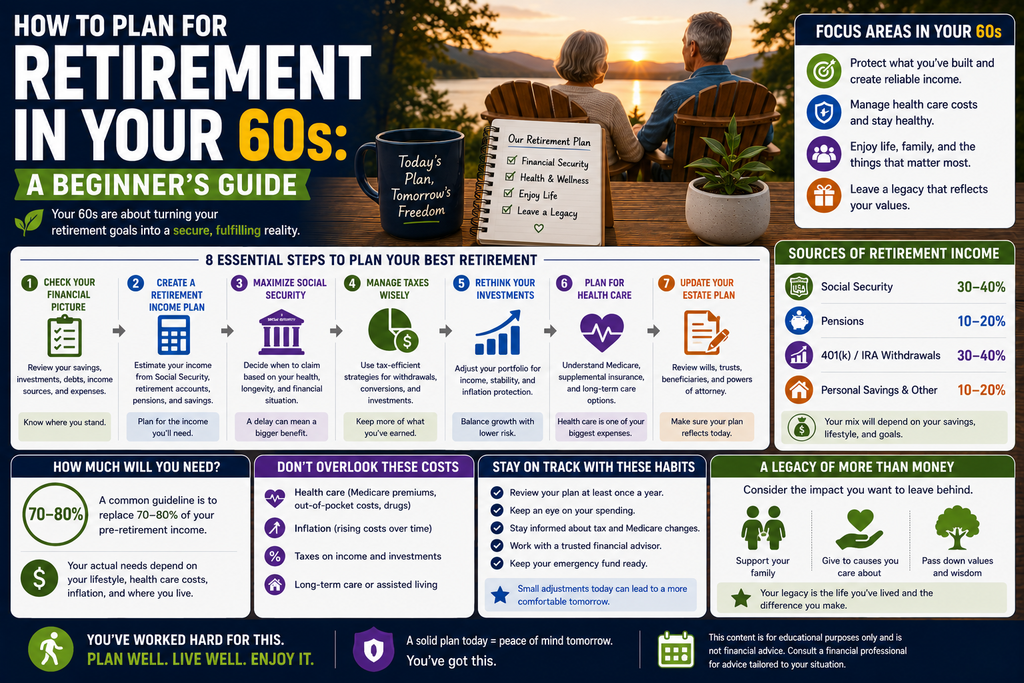
1. Determine When You Want to Retire
The first step is deciding when you actually want to stop working.
You might retire at 62, your full retirement age, 65, 67, or even later. There is no single retirement age that works for everyone.
Your retirement date affects:
- How long your savings need to last
- How much you can continue contributing
- When you claim Social Security
- Your healthcare costs
- How much income you need from investments
- Your tax situation
Even working one or two additional years can give your portfolio more time to grow while reducing the number of years your savings need to support you.
2. Calculate Your Retirement Income
Before retiring, estimate how much reliable income you expect to receive each month.
Potential retirement income sources may include:
- Social Security
- 401(k) withdrawals
- IRA withdrawals
- Pension income
- Taxable investment accounts
- Annuity income
- Part-time employment
- Other personal savings
Create a simple retirement income estimate and compare it with your expected expenses.
For example:
| Monthly Income Source | Example Amount |
|---|---|
| Social Security | $2,200 |
| Pension | $1,000 |
| Investment withdrawals | $1,500 |
| Other income | $300 |
| Total | $5,000 |
These numbers are only an illustration. Your actual retirement income will depend on your savings, benefits, investments, and personal circumstances.
3. Estimate Your Retirement Expenses
Your retirement budget should be based on what you realistically expect to spend—not simply a percentage of your current income.
Consider expenses such as:
- Housing
- Utilities
- Food
- Transportation
- Healthcare
- Insurance
- Travel
- Entertainment
- Taxes
- Home repairs
- Family support
- Emergency expenses
Some costs may decrease after retirement, while others can increase.
For example, commuting expenses may disappear, but healthcare and travel expenses could become more important.
4. Understand Social Security Timing
Social Security can become an important part of your retirement income strategy.
You generally have options regarding when to claim retirement benefits. Claiming earlier can provide income sooner, while delaying benefits can result in a higher monthly benefit, subject to Social Security rules.
The right decision depends on factors such as:
- Your health and life expectancy
- Spousal benefits
- Other retirement income
- Your need for cash flow
- Your planned retirement age
- Tax considerations
Do not automatically claim Social Security simply because you reach your early 60s.
Instead, compare different claiming strategies and consider how the decision affects your overall retirement income.
5. Make a Healthcare Plan
Healthcare is one of the biggest issues to consider when planning retirement in your 60s.
If you retire before becoming eligible for Medicare, you need to determine how you will obtain health insurance.
Once Medicare becomes available, you still need to budget for premiums, deductibles, supplemental coverage, prescriptions, and other healthcare costs.
Your retirement plan should also consider the possibility of higher medical expenses later in life.
Healthcare planning should therefore be treated as a core part of retirement planning rather than an afterthought.
6. Review Your Retirement Accounts
Take inventory of all your retirement accounts.
These may include:
- Traditional 401(k)
- Roth 401(k)
- Traditional IRA
- Roth IRA
- SEP IRA
- SIMPLE IRA
- Pension accounts
Write down the approximate balance of each account and identify whether the money is pre-tax or after-tax.
This matters because different accounts can have different tax consequences when you withdraw money.
Having a clear picture of your accounts makes it easier to develop a withdrawal strategy.
7. Create a Retirement Withdrawal Strategy
Having a large retirement balance is only part of the equation.
You also need to decide how you will turn that balance into income.
For example, you might use a combination of:
- Social Security
- Pension income
- Cash savings
- Taxable investments
- Traditional retirement accounts
- Roth accounts
The order in which you use different accounts can affect taxes and how long your savings last.
Instead of withdrawing randomly, create a basic plan for where your retirement income will come from each year.
8. Review Required Minimum Distributions
If you have certain tax-deferred retirement accounts, required minimum distributions, commonly called RMDs, may eventually require you to take withdrawals.
The starting age depends on applicable law and your birth year, so people in their 60s should understand when their RMD requirements may begin.
RMD planning matters because withdrawals can affect:
- Taxable income
- Medicare-related costs
- The amount remaining in retirement accounts
- Your estate
- Your overall retirement income strategy
Do not wait until the year your RMDs begin to think about them.
9. Review Your Investment Risk
Investment strategy becomes especially important when retirement is close.
You may not want your entire portfolio exposed to the same level of risk you accepted decades earlier.
However, becoming extremely conservative can also create problems.
If you retire in your 60s and your money needs to last 20 or 30 years, inflation and long-term growth still matter.
A balanced portfolio may include a combination of:
- Stocks
- Bonds
- Cash
- Diversified funds
- Other appropriate investments
Your exact allocation should reflect your goals, risk tolerance, income needs, and time horizon.
10. Keep Enough Cash for Near-Term Expenses
Retirees may benefit from maintaining enough readily available money to cover near-term expenses.
Cash reserves can help you avoid selling investments during a major market decline.
For example, if stocks fall sharply and you need money immediately, having some cash or short-term reserves may give your long-term investments more time to recover.
The goal is not necessarily to keep all your retirement savings in cash. Too much cash can reduce long-term growth potential.
Instead, think about how much liquidity you realistically need.
11. Plan for Taxes
Taxes do not disappear when you retire.
You may still owe taxes on:
- Traditional 401(k) withdrawals
- Traditional IRA withdrawals
- Investment gains
- Dividends
- Interest
- Certain Social Security benefits
- Other taxable income
Retirement can provide opportunities to manage taxable income more strategically.
For example, depending on your circumstances, you may have years with lower taxable income before required distributions begin.
Tax planning can become particularly valuable when you have multiple types of retirement accounts.
12. Consider Roth Accounts
Roth accounts can be useful in retirement because qualified withdrawals can generally be tax-free.
Having a combination of traditional and Roth assets can provide flexibility.
For example, instead of relying entirely on taxable withdrawals from a traditional account, you may be able to use Roth assets strategically in certain years.
However, Roth conversions and other tax strategies can have complicated consequences.
Consider the tax impact before moving large amounts of money between account types.
13. Pay Attention to Housing Costs
Housing can have a major impact on retirement security.
If you still have a mortgage, determine how it fits into your retirement budget.
You may consider:
- Keeping the mortgage
- Paying it down faster
- Downsizing
- Moving to a lower-cost area
- Staying in your current home
There is no universally correct choice.
A paid-off home can reduce monthly expenses, but using a large portion of your investment savings to eliminate a low-interest mortgage may not always be the best financial decision.
Consider your entire financial situation rather than focusing on one expense.
14. Prepare for a Long Retirement
One of the biggest mistakes retirees can make is assuming retirement will last only a short time.
Someone retiring in their 60s could potentially spend several decades in retirement.
That means your plan needs to account for:
- Inflation
- Market volatility
- Healthcare costs
- Longevity
- Unexpected expenses
- Changes in lifestyle
Your portfolio should therefore be designed for both today’s needs and your future needs.
15. Avoid Making Major Investment Decisions Based on Fear
Market declines can be especially stressful when you are retired or close to retirement.
Seeing your portfolio fall can tempt you to sell everything and move into cash.
However, panic selling can turn a temporary market decline into a permanent loss.
Instead, establish an investment strategy before a major downturn occurs.
Know:
- How much you need from investments
- How much cash you have available
- What your target allocation is
- When you will rebalance
- Which investments are intended for long-term growth
Having a plan can make market volatility easier to handle.
16. Think About Working Longer
If your financial situation is not where you want it to be, working longer may be one of the most powerful options available.
Working longer can potentially allow you to:
- Save more money
- Increase retirement contributions
- Delay withdrawals
- Delay Social Security
- Continue employer healthcare coverage
- Reduce the number of years your portfolio needs to support you
Even part-time work can provide useful income during the transition into retirement.
17. Build a Simple Retirement Budget
Create a monthly retirement budget before leaving work.
For example:
| Expense | Monthly Estimate |
|---|---|
| Housing | $1,500 |
| Food | $600 |
| Healthcare | $500 |
| Transportation | $400 |
| Utilities | $300 |
| Entertainment | $300 |
| Travel | $400 |
| Miscellaneous | $300 |
| Total | $4,300 |
This example does not represent a recommended retirement budget. It simply shows how you can organize your expected expenses.
Once you have the number, compare it with your expected retirement income.
18. Create a Backup Plan
A strong retirement plan should include a backup strategy.
Ask yourself:
What happens if the market falls 25%?
What happens if healthcare costs increase?
What happens if I live longer than expected?
What happens if I need to help a family member financially?
What happens if I need long-term care?
Thinking about these situations before they occur can make your retirement plan more resilient.
Common Retirement Planning Mistakes in Your 60s
Avoid these common mistakes:
Claiming Social Security Without Comparing Options
Taking benefits early may not always fit your long-term income needs.
Keeping Everything in Cash
Cash feels safe, but excessive cash holdings may make it harder to maintain purchasing power over a long retirement.
Taking Too Much Investment Risk
Aggressive investing can expose retirement savings to significant losses at an inconvenient time.
Taking Too Little Investment Risk
Going completely conservative can expose your retirement to inflation and longevity risk.
Ignoring Taxes
Your retirement income strategy should consider taxes, not just account balances.
Forgetting Healthcare
Healthcare expenses can significantly affect retirement spending.
Having No Withdrawal Strategy
Knowing your account balance is not the same as having a plan for turning savings into sustainable income.
A Simple Retirement Plan for Your 60s
If you want a straightforward starting point, follow this process:
Step 1: Choose a target retirement date.
Step 2: Calculate your expected monthly retirement expenses.
Step 3: List all retirement and investment accounts.
Step 4: Estimate Social Security and other guaranteed income.
Step 5: Review your investment allocation.
Step 6: Create a withdrawal strategy.
Step 7: Plan for healthcare expenses.
Step 8: Review potential taxes and RMD requirements.
Step 9: Build an emergency and cash reserve strategy.
Step 10: Review the plan at least once a year.
What If You Are Behind on Retirement Savings?
Being behind does not necessarily mean retirement is impossible.
You still have several options.
You could:
- Work longer
- Save more aggressively
- Reduce major expenses
- Increase retirement contributions
- Take advantage of employer matching contributions
- Delay Social Security
- Reduce your expected retirement spending
- Consider part-time income
- Review unnecessary investment fees
- Reevaluate your retirement date
The important thing is to identify the gap early and make a realistic plan.
Final Thoughts
Learning how to plan for retirement in your 60s is about more than choosing investments.
You need to understand your retirement income, expenses, Social Security strategy, healthcare costs, taxes, withdrawal plan, investment risk, and long-term needs.
Your goal should be to create a retirement system that provides enough income while giving your savings a reasonable opportunity to last.
You do not need a perfect plan on day one. Start with a clear picture of your finances, make practical adjustments, and review your strategy regularly as your circumstances change.
A well-organized retirement plan can help you enter your next stage of life with greater financial confidence and fewer surprises.
Frequently Asked Questions
Is it too late to plan for retirement in your 60s?
No. Even in your 60s, you can improve your retirement position by increasing savings, reducing expenses, adjusting your retirement date, reviewing investments, and creating a better income strategy.
How much money do I need to retire in my 60s?
There is no universal amount. Your target depends on your expected expenses, Social Security, pensions, investment income, healthcare costs, retirement age, and expected lifespan.
Should I invest in stocks in my 60s?
Stocks can still have a role in a retirement portfolio because retirement may last decades. However, the appropriate allocation depends on your risk tolerance, income needs, and overall financial situation.
Should I pay off my mortgage before retirement?
It depends. Paying off a mortgage can reduce monthly expenses, but using a large portion of your savings to eliminate a low-interest loan may not always be optimal. Compare the decision with your broader retirement plan.
When should I claim Social Security?
The best age depends on your circumstances, including your income needs, health, life expectancy, marital situation, and other retirement assets. Compare multiple claiming scenarios before deciding.
What is the biggest retirement mistake to avoid in your 60s?
One major mistake is entering retirement without a clear income and withdrawal strategy. Knowing how your savings will support your expenses is just as important as knowing how much you have saved.