
Retirement planning is not only about saving enough money. Once you retire, you also need a strategy for turning your savings into reliable income.
A retirement income plan helps answer one of the most important questions: How will I pay for my life after I stop working?
Without a plan, it can be difficult to know how much you can safely spend, which accounts to use, when to claim Social Security, or how to respond to market declines.
The good news is that creating a retirement income plan does not have to be complicated. By organizing your income sources, expenses, investments, taxes, and withdrawals, you can build a practical framework for managing your retirement savings.
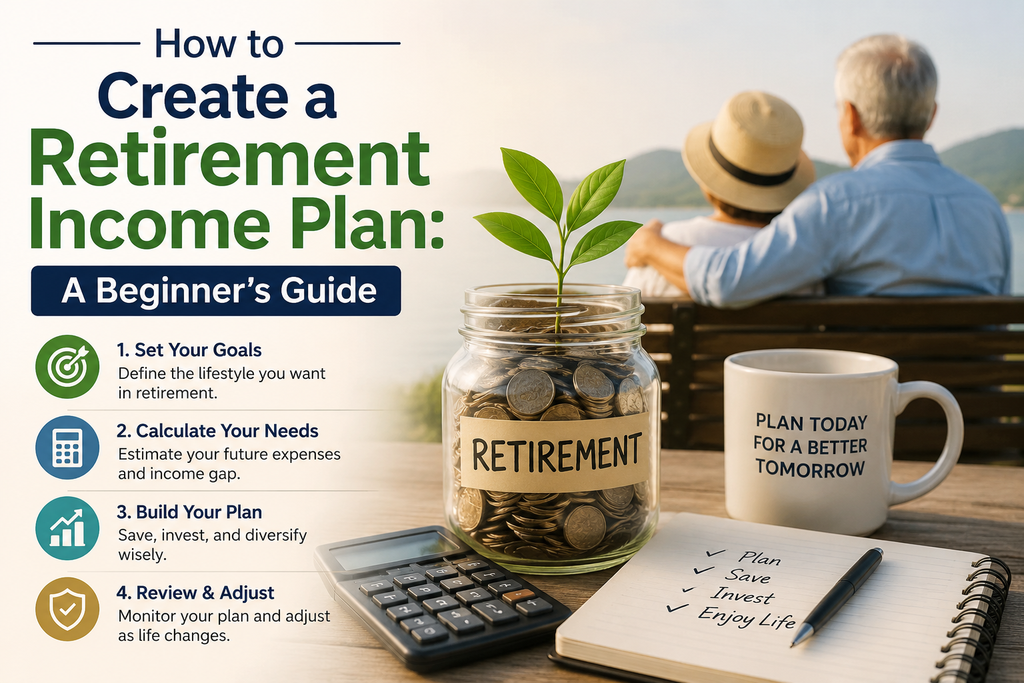
What Is a Retirement Income Plan?
A retirement income plan is a strategy for generating money to cover your expenses after you stop working.
Your income may come from several sources, including:
- Social Security
- Pension payments
- 401(k) withdrawals
- IRA withdrawals
- Roth IRA withdrawals
- Taxable investment accounts
- Annuities
- Part-time employment
- Cash savings
The purpose is to coordinate these sources so your money can support your lifestyle throughout retirement.
A good plan should consider both your current needs and the possibility that retirement could last for several decades.
1. Calculate How Much Income You Need
Start by determining how much you expect to spend each month.
Separate your expenses into categories such as:
- Housing
- Food
- Utilities
- Transportation
- Healthcare
- Insurance
- Travel
- Entertainment
- Taxes
- Family support
- Home maintenance
- Emergency expenses
For example:
| Expense | Monthly Amount |
|---|---|
| Housing | $1,500 |
| Food | $600 |
| Healthcare | $500 |
| Transportation | $400 |
| Utilities | $300 |
| Travel | $400 |
| Entertainment | $250 |
| Miscellaneous | $350 |
| Total | $4,300 |
This is only an example. Your actual retirement budget will depend on your lifestyle and location.
The important thing is to establish a realistic spending target.
2. Identify Your Reliable Income Sources
Next, list the income sources you expect to receive.
For example:
| Income Source | Monthly Amount |
|---|---|
| Social Security | $2,200 |
| Pension | $1,000 |
| Investment Income | $500 |
| Portfolio Withdrawals | $1,000 |
| Total | $4,700 |
If your expected expenses are $4,300 and your expected income is $4,700, you have a starting surplus.
If your expenses are higher than your reliable income, you need to determine how much additional income must come from your investment portfolio.
3. Understand the Difference Between Guaranteed and Variable Income
Not all retirement income works the same way.
Some income sources may be relatively predictable, such as:
- Social Security
- Pensions
- Certain annuity payments
Other sources can fluctuate, including:
- Stock investments
- Bond funds
- ETFs
- Mutual funds
- Interest income
- Dividends
Understanding this difference is important because market-based income can change.
Your retirement plan should not assume that investment returns will be identical every year.
4. Decide When to Claim Social Security
Social Security can be an important part of your retirement income strategy.
The age at which you claim benefits can affect your monthly benefit amount.
Instead of automatically claiming as soon as you become eligible, consider how different claiming ages fit with your overall financial plan.
Think about:
- Your health
- Expected longevity
- Other income
- Retirement savings
- Spousal benefits
- Your spending needs
- Tax considerations
Social Security should be viewed as one part of the overall retirement income strategy rather than a separate decision.
5. Create a Withdrawal Strategy
Your retirement accounts may contain significant savings, but you need a plan for withdrawing that money.
You might use:
- Taxable investments
- Traditional IRA or 401(k) assets
- Roth accounts
- Cash reserves
- Other income sources
The order can matter because different withdrawals may have different tax consequences.
Rather than withdrawing from whichever account is easiest, consider creating a coordinated strategy.
6. Use a Sustainable Withdrawal Approach
One common retirement planning concept is the withdrawal rate.
For example, someone with a $1 million investment portfolio who withdraws $40,000 during the first year would have a 4% initial withdrawal rate.
This does not mean a 4% withdrawal rate is automatically safe for everyone.
The appropriate withdrawal amount depends on:
- Portfolio allocation
- Retirement length
- Market performance
- Inflation
- Taxes
- Spending flexibility
- Other income sources
- Personal circumstances
A flexible approach may be more useful than treating one percentage as a guaranteed rule.
7. Build a Cash Reserve
Retirees may benefit from keeping some money in easily accessible savings or other low-volatility assets.
A cash reserve can help cover short-term expenses without forcing you to sell long-term investments during a market decline.
For example, if the stock market falls significantly, you may prefer to use your cash reserve for immediate expenses rather than selling stocks after a large decline.
However, holding too much cash can reduce your portfolio’s long-term growth potential.
The goal is to balance liquidity with long-term growth.
8. Consider the Sequence of Returns Risk
One important retirement concept is sequence of returns risk.
This refers to the danger that poor investment returns occur early in retirement while you are also withdrawing money.
Imagine two retirees who experience the same average investment return over many years. If one experiences major losses at the beginning of retirement while the other experiences them later, their outcomes can be very different.
This is why retirement income planning should consider both portfolio growth and the timing of withdrawals.
A diversified portfolio, cash reserves, and flexible spending can help manage this risk.
9. Plan for Inflation
Your retirement income needs may increase over time because the cost of goods and services can rise.
For example, if your monthly retirement expenses are $4,000 today, they may be considerably higher decades from now.
Inflation can affect:
- Food
- Housing
- Healthcare
- Utilities
- Transportation
- Travel
Your income plan should therefore consider purchasing power rather than focusing only on today’s dollar amount.
10. Account for Healthcare Costs
Healthcare deserves special attention in a retirement income plan.
Depending on your circumstances, retirement healthcare expenses can include:
- Medicare premiums
- Supplemental coverage
- Prescription medications
- Dental care
- Vision care
- Out-of-pocket expenses
- Long-term care
Do not assume that Medicare will cover every healthcare expense.
Including healthcare in your retirement budget can help prevent unexpected expenses from disrupting your income strategy.
11. Understand Taxes on Retirement Income
Your retirement income may have different tax treatments.
For example, withdrawals from traditional retirement accounts are generally taxable as ordinary income, while qualified Roth withdrawals can generally be tax-free.
Taxable investment accounts may generate:
- Interest
- Dividends
- Capital gains
Because different income sources can affect your tax bill differently, tax planning should be part of your retirement income strategy.
12. Coordinate Traditional and Roth Accounts
If you have both traditional and Roth retirement accounts, you may have additional flexibility.
Traditional accounts can provide taxable withdrawals, while qualified Roth withdrawals can generally provide tax-free income.
You may be able to use different account types strategically depending on your income and tax situation.
The objective is not simply to minimize taxes in one year. The goal is to manage your overall tax burden while preserving retirement assets.
13. Review Required Minimum Distributions
Certain retirement accounts eventually become subject to required minimum distribution rules.
These required withdrawals can affect your taxable income and overall retirement strategy.
Instead of waiting until RMDs begin, consider incorporating them into your long-term income plan.
Understanding when your withdrawals will be required can help you coordinate:
- Social Security
- Retirement account withdrawals
- Roth conversions
- Taxable investments
- Charitable giving
- Other income
14. Create Different Spending Categories
Not all retirement spending is equally flexible.
A useful approach is to divide expenses into three categories.
Essential Expenses
These are expenses you need to maintain your basic lifestyle.
Examples include:
- Housing
- Food
- Utilities
- Healthcare
- Basic transportation
Flexible Expenses
These expenses can potentially be reduced during difficult financial periods.
Examples include:
- Dining out
- Entertainment
- Travel
- Hobbies
Discretionary or Luxury Expenses
These may include:
- Expensive vacations
- Major purchases
- Luxury hobbies
- Large gifts
This classification gives you flexibility if markets perform poorly.
15. Build a Flexible Spending Strategy
Retirement income does not necessarily need to be identical every year.
Suppose your investments experience a significant decline.
Instead of continuing to increase spending, you could temporarily reduce discretionary expenses.
For example, you might:
- Delay a major vacation
- Reduce entertainment spending
- Postpone a large purchase
- Use more cash reserves
- Reduce portfolio withdrawals
Flexible spending can make it easier to manage unpredictable investment returns.
16. Diversify Your Income Sources
Relying on one source of income can create additional risk.
A diversified retirement income plan might combine:
- Social Security
- Pension income
- Investment withdrawals
- Dividends
- Interest
- Taxable investments
- Roth assets
Having multiple sources can provide greater flexibility.
However, diversification does not eliminate investment risk or guarantee income.
17. Review Your Investment Portfolio
Your retirement income plan and investment portfolio should work together.
Your portfolio should reflect:
- Retirement timeline
- Risk tolerance
- Income requirements
- Growth needs
- Inflation concerns
- Diversification
Some retirees make the mistake of becoming extremely conservative immediately after retirement.
But retirement can last many years, meaning some long-term growth may still be necessary.
The right portfolio depends on your individual situation.
18. Plan for Market Downturns
Every retirement income plan should include a strategy for bad market years.
Ask yourself:
What will I do if my portfolio falls 20%?
Possible strategies may include:
- Using cash reserves
- Reducing discretionary spending
- Delaying large purchases
- Rebalancing the portfolio
- Continuing to follow your long-term investment strategy
The important thing is to make decisions based on your plan rather than reacting emotionally to headlines.
19. Consider Working Part-Time
Retirement does not have to be an immediate transition from full-time employment to zero income.
Part-time work can provide:
- Additional income
- Social interaction
- A slower transition
- More time for investments to grow
- Reduced portfolio withdrawals
Even modest employment income can make a difference during the early years of retirement.
20. Review Your Plan Every Year
Your retirement income plan should not be a one-time document.
Review it regularly.
Check:
- Investment performance
- Spending
- Account balances
- Social Security income
- Taxes
- Healthcare costs
- Withdrawal rates
- Inflation
- Changes in your lifestyle
You may need to adjust the plan as your circumstances change.
Example of a Simple Retirement Income Plan
Imagine a retiree has:
- $700,000 in retirement accounts
- $150,000 in taxable investments
- $50,000 in cash
- $2,500 monthly Social Security
- $1,000 monthly pension
- $4,500 monthly retirement expenses
Their reliable income would be:
$2,500 + $1,000 = $3,500 per month
Their estimated income gap would therefore be:
$4,500 − $3,500 = $1,000 per month
The portfolio would need to provide approximately $12,000 per year before considering taxes and investment changes.
This example shows why retirement planning should focus on both income and expenses.
Common Retirement Income Planning Mistakes
Spending Too Much Early
Large withdrawals during the first years of retirement can put unnecessary pressure on your portfolio.
Ignoring Taxes
A $5,000 withdrawal does not necessarily mean you get to spend $5,000 after taxes.
Relying Entirely on Investment Returns
Markets do not produce predictable returns every year.
Keeping Everything in Cash
Too much cash can reduce your ability to maintain purchasing power over a long retirement.
Ignoring Inflation
Your future expenses may be significantly higher than today’s expenses.
Forgetting Healthcare
Healthcare costs can become a major part of retirement spending.
Having No Backup Plan
Unexpected expenses and market downturns can disrupt an income strategy that has no flexibility.
A Simple Retirement Income Planning Checklist
Use this checklist to create your own basic plan:
- Determine your target retirement date
- Calculate expected monthly expenses
- List every income source
- Estimate Social Security benefits
- Review pension income
- List retirement account balances
- Review taxable investments
- Maintain appropriate cash reserves
- Create a withdrawal strategy
- Consider taxes
- Plan for healthcare
- Account for inflation
- Review investment risk
- Prepare for market downturns
- Consider flexible spending
- Review the plan annually
Final Thoughts
Learning how to create a retirement income plan is one of the most important steps you can take before and during retirement.
The goal is not simply to accumulate a large portfolio. Your savings need to provide income while also supporting your long-term financial needs.
A strong retirement income plan combines reliable income sources, investments, withdrawals, taxes, healthcare, inflation, and flexible spending.
You do not need to predict exactly what the market will do or how long you will live. Instead, build a flexible plan that can adapt to changing circumstances.
The earlier you create and review your retirement income strategy, the more prepared you can be for the transition from earning a paycheck to relying on your accumulated wealth.
Frequently Asked Questions
What is the purpose of a retirement income plan?
A retirement income plan helps you determine where your money will come from and how you will use your savings to cover expenses throughout retirement.
How much should I withdraw from retirement savings?
There is no single withdrawal rate that works for everyone. Your withdrawal strategy should consider your age, portfolio, expenses, other income, taxes, inflation, and expected retirement length.
Should I use my 401(k) or IRA first in retirement?
There is no universal answer. The decision depends on taxes, account types, Social Security, required distributions, and your overall financial situation.
Should I keep cash in retirement?
Maintaining some accessible cash can help cover short-term expenses and reduce the need to sell investments during market downturns. However, keeping too much cash can limit long-term growth.
Can Social Security be my only retirement income?
Some people may have relatively low expenses and substantial Social Security benefits, but many retirees need additional income from savings, pensions, investments, or other sources.
How often should I review my retirement income plan?
At minimum, review it annually and whenever there is a major change in your income, expenses, investments, health, family situation, or retirement timeline.