
Reaching your 50s without as much retirement savings as you hoped for can feel stressful. You may look at your retirement account balance and wonder whether you still have enough time to build the financial foundation you need.
The good news is that being behind does not mean you have to give up on your retirement goals.
Your 50s can be an important decade for improving your financial position. You may have higher earnings, fewer expenses than earlier in life, and the ability to make larger retirement contributions under applicable rules.
The key is to understand where you stand, identify the biggest gaps, and create a realistic plan.
In this guide, you’ll learn how to catch up on retirement savings in your 50s, increase contributions, manage expenses, review investments, reduce debt, and make better decisions about your retirement timeline.
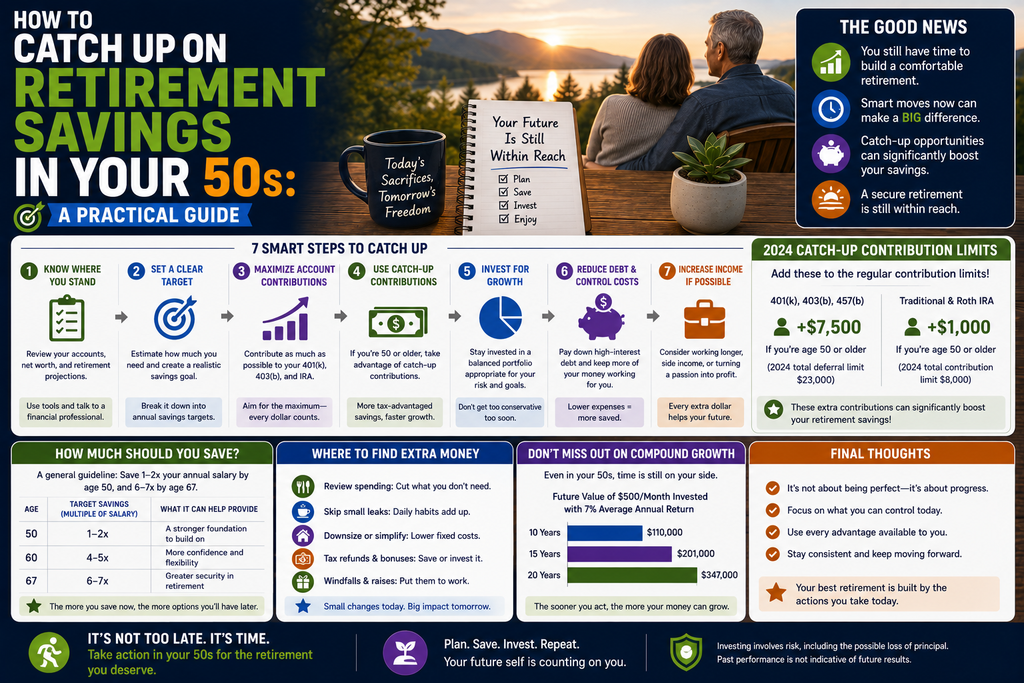
Are You Too Late to Save for Retirement in Your 50s?
No.
Starting later means you have less time for compound growth than someone who started in their 20s or 30s, but you may still have many years to save and invest.
You can potentially improve your retirement position by combining several strategies:
- Increasing retirement contributions
- Taking advantage of employer matching
- Reducing unnecessary expenses
- Increasing income
- Paying down expensive debt
- Reviewing your investment strategy
- Delaying retirement if necessary
- Creating a realistic retirement budget
You don’t need one dramatic change.
Several smaller improvements can work together.
Step 1: Find Out Where You Stand
Before deciding how much you need to save, calculate your current financial position.
List your:
- 401(k) balances
- Traditional IRA balances
- Roth IRA balances
- Other retirement accounts
- Taxable investments
- Cash savings
- Major debts
- Expected Social Security income
- Pension income, if applicable
Then calculate your approximate net worth.
This gives you a starting point.
You should also determine how much you’re currently contributing every month.
Step 2: Estimate Your Retirement Expenses
Your retirement savings target depends heavily on your future spending.
Start by estimating what you’ll need for:
- Housing
- Food
- Healthcare
- Transportation
- Insurance
- Taxes
- Travel
- Entertainment
- Family support
- Home maintenance
- Emergency expenses
Some expenses may decline after retirement, while others may increase.
For example, commuting costs may disappear, while healthcare and travel expenses could become more important.
Create a realistic annual retirement budget instead of relying entirely on a generic percentage of your current income.
Step 3: Determine Your Retirement Timeline
Your expected retirement age can have a major impact on your savings plan.
Suppose you’re 52.
Retiring at 60 gives you a shorter savings period than retiring at 67.
Working a few additional years can provide more time to:
- Save money
- Receive employer contributions
- Reduce debt
- Increase Social Security benefits depending on your claiming strategy
- Allow investments more time to grow
- Build additional cash reserves
This doesn’t mean everyone should work longer.
Instead, understand how your retirement date affects the numbers.
Step 4: Increase Your Retirement Contributions
One of the most direct ways to catch up is to increase the amount you’re saving.
Review your current 401(k) contribution rate.
For example, if you’re currently contributing 7% of your salary, you could consider increasing it gradually.
Possible increases might include:
- 8%
- 9%
- 10%
- 12%
- 15%
The right amount depends on your income and financial circumstances.
Even if you can’t make a large increase immediately, raising your contribution by one percentage point can be a useful starting point.
Step 5: Understand Catch-Up Contributions
Workers who reach certain ages may have access to additional retirement contribution opportunities known as catch-up contributions.
These allow eligible participants to contribute more than the standard employee contribution limit under applicable retirement plan rules.
For 2026, the IRS provides specific catch-up contribution rules for eligible participants age 50 and older, with additional rules applying to certain individuals in their early 60s. Because contribution limits can change, check current IRS guidance and your employer’s plan before making large contributions.
Catch-up contributions can be particularly useful for people who started saving later or want to accelerate retirement savings.
Step 6: Capture the Full Employer Match
If your employer offers a 401(k) match, find out exactly how it works.
For example, suppose your employer matches:
100% of the first 4% of your salary that you contribute.
If you earn $75,000:
$75,000 × 4% = $3,000
Under this hypothetical example, contributing at least 4% could qualify you for a $3,000 employer contribution.
The exact formula, vesting schedule, and contribution rules depend on your plan.
Don’t leave available employer contributions unused if you can reasonably afford to contribute enough to receive them.
Step 7: Consider Increasing Income
Saving more becomes easier when you have more income.
In your 50s, consider whether there are realistic opportunities to increase earnings.
Potential options include:
- Negotiating a salary increase
- Changing roles
- Working additional hours
- Freelancing
- Consulting
- Starting a small side business
- Taking on project-based work
You don’t necessarily need to permanently increase your lifestyle when your income increases.
Directing part of additional income toward retirement can accelerate your savings.
Step 8: Use Raises and Bonuses Strategically
A raise or bonus can disappear quickly if it immediately becomes lifestyle spending.
Instead, consider dividing additional income between current needs and retirement.
For example, if you receive a $5,000 annual raise, you might use part of it for lifestyle improvements and direct another portion toward retirement savings.
The exact percentage depends on your circumstances.
The important idea is to avoid automatically spending every increase in income.
Step 9: Reduce Major Expenses
Reducing expenses can be just as powerful as increasing income.
Look for large recurring costs rather than focusing only on small purchases.
Review:
- Housing
- Vehicles
- Insurance
- Debt payments
- Subscriptions
- Dining
- Travel
- Utilities
- Recurring services
For example, eliminating a few small subscriptions may save some money, but refinancing or paying off expensive debt could have a much larger effect on your cash flow.
Focus on the expenses that can make a meaningful difference.
Step 10: Pay Down High-Interest Debt
High-interest debt can make catching up for retirement more difficult.
Credit card balances are particularly important because high interest charges can consume money that could otherwise be used for saving or investing.
Review your debts and interest rates.
You may consider prioritizing high-interest debt while continuing appropriate retirement contributions.
The best approach depends on your financial situation, but expensive debt should not be ignored.
Step 11: Build an Emergency Fund
Don’t put every available dollar into retirement accounts while leaving yourself financially vulnerable.
An emergency fund can help cover unexpected expenses without forcing you to use credit cards or sell investments at an unfavorable time.
Potential emergencies include:
- Home repairs
- Vehicle repairs
- Medical bills
- Job loss
- Family emergencies
- Unexpected travel
The appropriate emergency reserve depends on your expenses, income stability, and personal circumstances.
Step 12: Review Your Investment Allocation
Catching up doesn’t necessarily mean taking extreme investment risk.
Some investors may feel tempted to choose aggressive investments because they believe they need higher returns to make up for lost time.
This can backfire.
A large investment loss close to retirement can be difficult to recover from.
Instead, review your portfolio based on:
- Retirement timeline
- Risk tolerance
- Financial goals
- Expected income
- Current savings
- Diversification
Your portfolio should be designed around your situation rather than a desire to make up losses quickly.
Step 13: Avoid “Get Rich Quick” Investments
Being behind on retirement savings can make risky investments look attractive.
Be careful with promises of:
- Guaranteed high returns
- Instant wealth
- No-risk profits
- Secret investment strategies
- Guaranteed stock picks
- Unusually high income
Investments with high potential returns generally involve meaningful risk.
If you are trying to catch up, taking an enormous risk with your retirement savings may create an even larger problem.
Step 14: Review Your Investment Fees
Investment costs matter, especially when you have many years left to invest.
Review:
- Expense ratios
- Advisory fees
- Account fees
- Trading costs
- Administrative fees
If you have similar investment choices available at different costs, understanding the fee difference can help you make a more informed decision.
Don’t choose investments based solely on fees, however. Consider costs alongside diversification, strategy, risk, and overall suitability.
Step 15: Review Your Social Security Strategy
Social Security may become an important source of retirement income.
Your benefit depends on factors including your earnings history and claiming decision.
Instead of assuming Social Security will cover a particular percentage of your expenses, review your estimated benefits and compare them with your retirement budget.
Delaying benefits can affect the amount you receive, but the right claiming strategy depends on your personal circumstances.
Consider your health, household income, retirement assets, other income sources, and expected longevity when evaluating your options.
Step 16: Don’t Forget Healthcare
Healthcare should be an important part of your retirement planning.
As you approach retirement, consider:
- Insurance premiums
- Deductibles
- Prescription costs
- Dental care
- Vision care
- Out-of-pocket expenses
- Potential long-term care needs
Healthcare costs can be difficult to predict, so maintaining financial flexibility can be valuable.
Step 17: Consider Your Housing Plan
Housing can have a major impact on retirement expenses.
Ask yourself:
- Will my mortgage be paid off?
- Should I downsize?
- Do I want to move?
- Will property taxes remain affordable?
- What will maintenance cost?
- Should I rent instead?
- Is my current home appropriate for aging?
A housing decision can change your retirement budget significantly.
However, don’t assume downsizing automatically saves money. Moving can involve transaction costs, taxes, repairs, and other expenses.
Analyze the complete financial picture.
Step 18: Consider Working Longer
Working longer isn’t the ideal solution for everyone, but it can be a powerful financial tool.
An additional few years of work can potentially provide:
- More retirement contributions
- More employer matching
- Additional investment growth time
- More time to pay down debt
- More time to build emergency savings
- Less time relying on retirement assets
It can also affect Social Security claiming decisions.
If you’re behind, compare different retirement ages rather than assuming you must retire at a predetermined age.
Step 19: Consider a Gradual Retirement
Retirement doesn’t always have to be an immediate transition from full-time work to no work.
Some people may prefer a gradual approach.
For example:
Full-time work → Part-time work → Retirement
Part-time work can provide additional income while allowing you to reduce working hours.
It may also provide benefits such as:
- Continued social interaction
- More flexible schedules
- Additional time for hobbies
- Reduced dependence on investment withdrawals
Again, this depends entirely on your career, health, preferences, and financial needs.
Step 20: Use Multiple Retirement Accounts Strategically
You may have more than one type of retirement account.
For example:
- 401(k)
- Roth IRA
- Traditional IRA
- Taxable brokerage account
Each account has different tax rules and withdrawal considerations.
Having a combination of account types may provide flexibility when managing retirement income.
Don’t make account decisions based solely on the account balance. Consider taxes, investment options, fees, withdrawal rules, and your overall retirement strategy.
A Hypothetical Catch-Up Example
Imagine a 52-year-old worker has:
$250,000 in retirement savings
They currently contribute:
$10,000 per year
Their employer contributes:
$3,000 per year
They expect to retire around age 67.
Instead of assuming they are permanently behind, they create a catch-up plan.
They decide to:
- Increase employee contributions.
- Capture the full employer match.
- Use eligible catch-up contribution opportunities.
- Reduce unnecessary monthly expenses.
- Pay down high-interest debt.
- Review their investment allocation.
- Work until 67 rather than retiring at 62.
- Reevaluate the plan every year.
The example does not predict a specific future account balance.
Investment returns are uncertain, and actual results depend on contributions, market performance, fees, taxes, inflation, and many other factors.
The purpose is to show how several improvements can work together.
What If You Are Very Far Behind?
If you have little or no retirement savings in your 50s, focus on what you can control.
Start with the basics:
1. Create a Retirement Budget
Determine what you realistically expect to spend.
2. Calculate Your Income Sources
Include Social Security, pensions, investments, and potential work income.
3. Increase Savings
Contribute as much as reasonably possible.
4. Reduce High-Cost Debt
Lowering expensive debt can improve future cash flow.
5. Review Your Retirement Date
Working longer may significantly change your financial picture.
6. Avoid Extreme Investment Risk
Don’t gamble your retirement savings trying to catch up quickly.
7. Consider Professional Advice
If your situation is complicated, a qualified financial professional may help you evaluate your options.
Common Mistakes When Catching Up for Retirement
Trying to Make Up for Lost Time With Risky Investments
Taking excessive risk can create larger losses.
Ignoring Current Expenses
You need to know how much you actually spend before determining how much retirement income you need.
Forgetting Employer Matching
Make sure you understand your workplace retirement plan.
Taking on More Debt
Increasing debt to maintain a lifestyle can make retirement planning harder.
Assuming Social Security Will Cover Everything
Social Security may provide important income, but your overall retirement plan should consider all sources of income.
Retiring Based on Age Alone
Your financial readiness matters more than simply reaching a certain age.
Never Updating the Plan
Your income, expenses, investment returns, health, and goals can change.
Review your strategy regularly.
A Simple 50s Retirement Catch-Up Checklist
Use this checklist to organize your next steps:
- Calculate current retirement savings
- Estimate annual retirement expenses
- Choose a target retirement age
- Review your 401(k)
- Check your employer match
- Understand catch-up contribution rules
- Increase retirement contributions if possible
- Review investment diversification
- Check investment fees
- Build an emergency fund
- Pay down high-interest debt
- Review Social Security estimates
- Plan for healthcare costs
- Review housing expenses
- Consider whether working longer makes sense
- Revisit the plan annually
Frequently Asked Questions
Can I still retire comfortably if I am behind in my 50s?
Possibly. Your outcome depends on your current savings, income, expenses, investment strategy, retirement age, Social Security, and other income sources. The sooner you create a realistic plan, the more options you have.
How can I catch up on retirement savings quickly?
Consider increasing contributions, capturing employer matching contributions, using eligible catch-up contributions, reducing major expenses, increasing income, and reviewing your retirement timeline.
Should I invest more aggressively if I am behind?
Not automatically. Taking excessive risk can lead to large losses. Your investment allocation should reflect your time horizon, risk tolerance, and financial goals.
Should I work longer if I haven’t saved enough?
Working longer can provide additional time to save and may reduce the number of years your retirement savings need to support you. Whether it makes sense depends on your circumstances.
What are catch-up contributions?
Catch-up contributions are additional retirement contributions available to eligible participants who reach certain ages, subject to applicable rules and annual limits.
Should I prioritize debt or retirement savings?
The answer depends on the type of debt, interest rate, employer matching opportunities, cash reserves, and overall financial situation. High-interest debt generally deserves serious attention.
Is it too late to start investing in my 50s?
No. You may still have years before retirement. The key is to create an investment strategy that matches your timeline and risk tolerance.
Final Thoughts
Learning how to catch up on retirement savings in your 50s starts with replacing uncertainty with a clear plan.
Calculate where you stand, estimate your retirement expenses, review your income sources, and determine how much you can realistically save.
Then look for opportunities to increase contributions, take advantage of employer matching, use eligible catch-up contribution opportunities, reduce expensive debt, control major expenses, and improve your income.
Don’t try to solve a retirement savings gap by taking extreme investment risks.
Instead, focus on the factors you can control and review your strategy regularly.
Your retirement plan doesn’t have to be perfect. It needs to be realistic, sustainable, and flexible enough to change as your financial situation evolves.