
One of the most common questions people have about retirement planning is simple: How much should you save for retirement?
Unfortunately, there is no single number that works for everyone.
The amount you need depends on your desired lifestyle, retirement age, current income, expenses, expected Social Security benefits, healthcare costs, taxes, inflation, investment returns, and how long your retirement lasts.
Instead of relying on a random retirement number, it is better to build a personalized estimate and create a savings plan around it.
This guide explains how to estimate your retirement needs, how much you may want to save, and how to improve your retirement strategy over time.
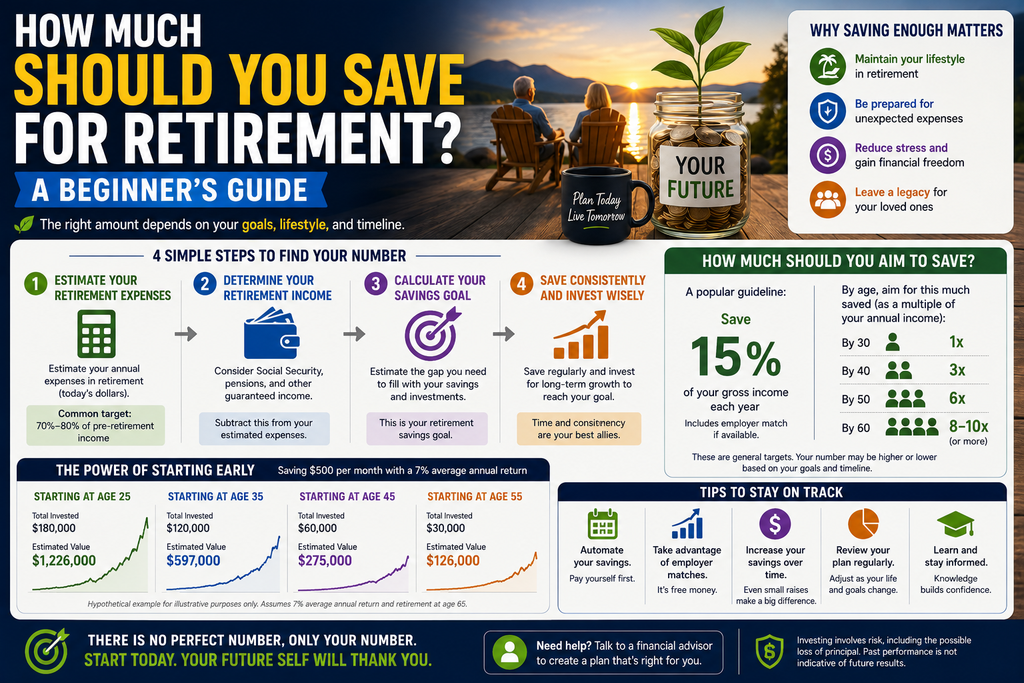
Why Retirement Savings Matter
When you stop working, your regular paycheck may decrease or disappear.
You may need to rely on a combination of:
- Retirement savings
- 401(k) accounts
- IRAs
- Social Security
- Pensions
- Other investments
- Other sources of income
The more dependent you are on your personal savings, the more important it becomes to build a sufficient retirement portfolio.
Retirement savings can also provide flexibility.
A larger financial cushion may give you more choices about when to retire, where to live, and how much you want to work.
There Is No Universal Retirement Number
You may see rules online suggesting that everyone should have a specific amount saved by a certain age.
These guidelines can be useful as general benchmarks, but they are not personalized financial plans.
Consider two people:
Person A earns $50,000 per year and expects to live a relatively modest retirement.
Person B earns $150,000 per year and wants to travel extensively after retiring.
They are unlikely to need the same amount of retirement savings.
Your retirement target should be based on your own expected financial needs.
Step 1: Estimate Your Retirement Expenses
One of the best starting points is estimating how much you may spend each year in retirement.
Think about expenses such as:
- Housing
- Food
- Utilities
- Transportation
- Healthcare
- Insurance
- Travel
- Entertainment
- Taxes
- Personal expenses
- Family support
- Debt payments
Some expenses may decrease after retirement.
For example, you may no longer have commuting costs.
Other expenses could increase.
Healthcare and travel are two examples that may require additional planning.
Step 2: Think About Your Desired Lifestyle
Retirement does not look the same for everyone.
Some people want a simple lifestyle close to home.
Others want to travel frequently, pursue expensive hobbies, or help family members financially.
Ask yourself:
What do I want my retirement to look like?
Your answer can help determine how much income you may need.
A useful approach is to separate retirement spending into three categories:
Essential Expenses
These are costs you expect to need regardless of lifestyle.
Examples include:
- Housing
- Food
- Utilities
- Healthcare
- Basic transportation
Flexible Expenses
These are expenses you can adjust if necessary.
Examples include:
- Dining out
- Entertainment
- Travel
- Shopping
Optional Expenses
These are expenses that may be reduced or eliminated during difficult financial periods.
Understanding these categories can help you build a more realistic retirement plan.
Step 3: Estimate Your Retirement Income
Your retirement savings do not necessarily have to cover every dollar of your retirement expenses.
You may receive income from several sources.
Common examples include:
- Social Security
- Pension income
- Rental income
- Part-time employment
- Annuities
- Investment income
For example, imagine you estimate that you will need $60,000 per year in retirement.
If you expect $25,000 per year from other income sources, your investment portfolio may need to help cover the remaining amount.
The exact numbers depend on your circumstances.
Step 4: Consider Social Security
Social Security can be an important part of retirement planning for many Americans.
However, your expected benefit depends on factors such as your earnings history and when you claim benefits.
Do not simply assume that Social Security will cover all of your retirement expenses.
Instead, include your estimated benefit as one part of your overall retirement income plan.
You can review your Social Security information through the official Social Security Administration resources.
Step 5: Consider When You Want to Retire
Your desired retirement age can significantly affect how much you need to save.
Retiring earlier may mean:
- Fewer years to save
- More years of retirement expenses
- A longer period before certain retirement benefits become available
Retiring later may give you:
- More time to contribute
- More time for potential investment growth
- Fewer years that your portfolio needs to support you
This is why retirement age is an important part of your calculation.
Step 6: Understand the Power of Compound Growth
Retirement investing benefits from long-term compounding.
When investment returns remain invested, they can potentially generate additional returns over time.
For example, imagine you invest $10,000 and it earns an average hypothetical return of 7% per year.
After one year, the balance would be approximately $10,700.
If the money remains invested, future growth can occur on both the original contribution and previous investment earnings.
Actual investment returns are not guaranteed and will vary from year to year.
The key point is that time can have a major effect on long-term wealth building.
Step 7: Decide How Much of Your Income to Save
There is no universal savings percentage.
Some people may begin with 5% of income.
Others may target 10%, 15%, or more.
Your appropriate savings rate depends on:
- Age
- Income
- Current savings
- Debt
- Retirement goal
- Employer contributions
- Expected retirement age
- Investment strategy
If you are starting late, you may need to save a larger percentage of income than someone who started investing decades earlier.
Step 8: Take Advantage of Employer Matching
If your employer offers matching contributions through a 401(k), understand the plan’s rules.
For example, an employer might contribute additional money based on your contributions up to a certain limit.
If you are eligible, contributing enough to receive the available employer match can be an important part of your retirement strategy.
Check your specific plan because matching formulas, eligibility, and vesting rules vary.
Step 9: Use Retirement Accounts
Common retirement accounts include:
- 401(k)
- Roth 401(k)
- Traditional IRA
- Roth IRA
Each account has different tax rules and contribution limits.
A workplace 401(k) may provide employer matching and relatively high contribution limits.
An IRA may provide additional retirement savings opportunities and potentially a wider range of investments.
Some investors use multiple account types as part of their overall retirement plan.
Step 10: Consider Inflation
Inflation is an important part of long-term retirement planning.
If prices rise over time, the same amount of money may purchase fewer goods and services in the future.
For example, $50,000 may cover a certain lifestyle today, but that same amount may not provide the same purchasing power decades from now.
This is one reason retirement projections should account for inflation rather than simply using today’s expenses.
Step 11: Don’t Forget Healthcare Costs
Healthcare can be one of the most important retirement expenses.
Depending on your situation, you may need to account for:
- Medicare-related costs
- Supplemental coverage
- Prescription medications
- Dental care
- Vision care
- Long-term care
- Out-of-pocket expenses
Healthcare costs can vary substantially from person to person.
Building additional flexibility into your retirement plan can help you prepare for unexpected expenses.
Step 12: Consider Your Housing Situation
Housing can have a major impact on retirement expenses.
Think about whether you expect to:
- Own your home outright
- Continue paying a mortgage
- Rent
- Downsize
- Move to a lower-cost area
Someone entering retirement without a mortgage may have a very different expense structure from someone who expects to rent indefinitely.
Your housing plan should therefore be part of your retirement calculation.
A Simple Retirement Savings Example
Imagine James is 35 years old.
He earns $70,000 per year and wants to retire around age 65.
He currently has $30,000 invested for retirement.
Instead of choosing an arbitrary retirement number, he estimates:
- Expected retirement expenses
- Expected Social Security income
- Potential employer contributions
- Current retirement savings
- Monthly investment contributions
- Expected investment growth
- Inflation
- Healthcare expenses
He then reviews his plan every year.
If his income increases, he may increase his contributions.
If his expected retirement age changes, he can update the plan.
This is a hypothetical example, not a prediction of future investment results.
What If You Are Behind on Retirement Savings?
If you are worried that you have not saved enough, avoid assuming that your situation cannot improve.
Start by reviewing your current numbers.
Consider:
Increase Your Savings Rate
Even a small increase can make a difference over many years.
Reduce Unnecessary Expenses
Money saved from recurring expenses can potentially be redirected toward retirement.
Increase Savings After Raises
Instead of spending the entire increase, consider directing part of it toward retirement.
Review Your Investment Fees
High investment costs can reduce long-term returns.
Reassess Your Retirement Age
Working longer may provide additional time to save and may reduce the number of years your portfolio needs to support you.
Consider Professional Advice
A qualified financial professional may help you create a more detailed retirement plan if your situation is complicated.
Should You Follow the 15% Rule?
You may hear a common guideline suggesting that people save around 15% of their income for retirement.
This can be a useful starting point, but it is not a universal requirement.
For someone who starts saving very young, 15% may produce a strong long-term savings habit.
For someone who starts later, 15% may not be enough.
For another person with a pension and substantial existing savings, a different percentage may be appropriate.
Think of savings-rate rules as benchmarks—not guarantees.
How Your Age Can Affect Your Strategy
Your age is an important factor because it influences your time horizon.
In Your 20s
You generally have a long time horizon.
Focus on:
- Starting early
- Building good savings habits
- Using employer retirement benefits
- Investing consistently
- Learning about diversification
In Your 30s
You may have increasing income and expenses.
Focus on:
- Increasing retirement contributions
- Avoiding lifestyle inflation
- Reviewing investment allocation
- Building long-term savings
In Your 40s
Retirement may feel closer.
Focus on:
- Checking whether your savings are on track
- Increasing contributions when possible
- Reviewing fees
- Estimating future retirement expenses
In Your 50s
Retirement planning becomes more immediate.
Focus on:
- Retirement income planning
- Healthcare costs
- Social Security decisions
- Portfolio allocation
- Withdrawal strategies
- Reducing unnecessary debt
These are general guidelines, not individualized financial advice.
What About Investing Too Conservatively?
Being conservative can reduce portfolio volatility, but an overly conservative portfolio may not provide enough long-term growth to meet your retirement needs.
On the other hand, taking excessive investment risk can cause large losses.
The appropriate balance depends on your time horizon, goals, risk tolerance, and overall financial situation.
As retirement approaches, many investors review their asset allocation and consider whether their portfolio still matches their changing circumstances.
What About Investing Too Aggressively?
Higher-risk investments can potentially produce higher returns, but they can also experience larger losses.
A retirement portfolio that is too aggressive may be difficult to maintain during a severe market decline.
Ask yourself:
Could I stay invested if my portfolio dropped substantially?
If the answer is no, your investment strategy may need to be reconsidered.
How Often Should You Review Your Retirement Plan?
You do not need to change your retirement strategy every week.
A periodic review may be more useful.
Consider reviewing your plan when:
- Your income changes
- You change jobs
- You get married
- You have children
- You buy a home
- You pay off major debt
- Your retirement date changes
- Your investment goals change
An annual review can be a practical starting point for many people.
Common Retirement Planning Mistakes
Saving Whatever Is Left Over
If you only save money after spending everything else, retirement contributions may become inconsistent.
Ignoring Inflation
Future expenses may be higher than today’s expenses.
Forgetting Healthcare
Healthcare can represent a significant retirement expense.
Relying Entirely on Social Security
Social Security can be an important income source, but it may not cover your desired retirement lifestyle.
Taking Too Much Investment Risk
Higher returns are not guaranteed.
Taking Too Little Investment Risk
Overly conservative investing can create its own long-term challenges.
Never Updating Your Plan
Your income, expenses, investments, and retirement goals can change.
Your retirement plan should change when your circumstances change.
A Simple Retirement Savings Checklist
If you are wondering how much should you save for retirement, start with this checklist:
1. Estimate your future retirement expenses.
2. Decide when you want to retire.
3. Estimate Social Security and other income sources.
4. Calculate the amount your investments may need to provide.
5. Review your current retirement savings.
6. Choose appropriate retirement accounts.
7. Contribute consistently.
8. Take advantage of available employer matching.
9. Invest according to your time horizon and risk tolerance.
10. Review your plan regularly.
11. Increase savings when your income rises.
12. Update your plan as your circumstances change.
Frequently Asked Questions
How much should I save for retirement each month?
There is no universal monthly amount. Your contribution should reflect your income, age, retirement goal, current savings, debt, and expected retirement expenses.
Is saving 10% enough for retirement?
It may or may not be. Starting age, investment returns, employer contributions, retirement age, and lifestyle all affect how much you need.
Is 15% a good retirement savings target?
It can be a useful benchmark for some people, but it is not a guarantee or universal requirement.
How much should I have saved by age 30?
There is no single correct number. Instead of focusing only on an age-based target, consider whether your savings rate and overall retirement plan are moving you toward your personal goal.
What if I have nothing saved for retirement?
Start by reviewing your budget and determining how much you can consistently contribute. Consider employer retirement benefits and gradually increase your savings rate as your financial situation improves.
Should I pay off debt or save for retirement?
The answer depends on the type and interest rate of the debt, employer matching, emergency savings, and your overall financial situation. High-interest debt may deserve significant attention, while an available employer match can also be valuable.
Final Thoughts
The answer to how much should you save for retirement depends on your personal financial situation.
Instead of chasing a single retirement number, build your estimate around your expected expenses, desired lifestyle, retirement age, income sources, inflation, healthcare needs, and current savings.
Then create a sustainable contribution plan.
Start with what you can afford, take advantage of available employer benefits, use appropriate retirement accounts, invest consistently, and increase your savings when your income grows.
Most importantly, review your retirement plan regularly.
Your financial situation will change throughout your career, and your retirement strategy should evolve with it.