
Retirement can seem far away when you are young or just starting your career. But the earlier you understand how retirement saving works, the more time you have to build a strong financial foundation.
Learning how to start saving for retirement does not require you to be an expert investor. You can begin with a simple plan: understand your goals, create room in your budget, choose appropriate retirement accounts, invest consistently, and gradually increase your savings.
The most important part is getting started.
This guide explains the basic steps beginners can take to begin preparing financially for retirement.
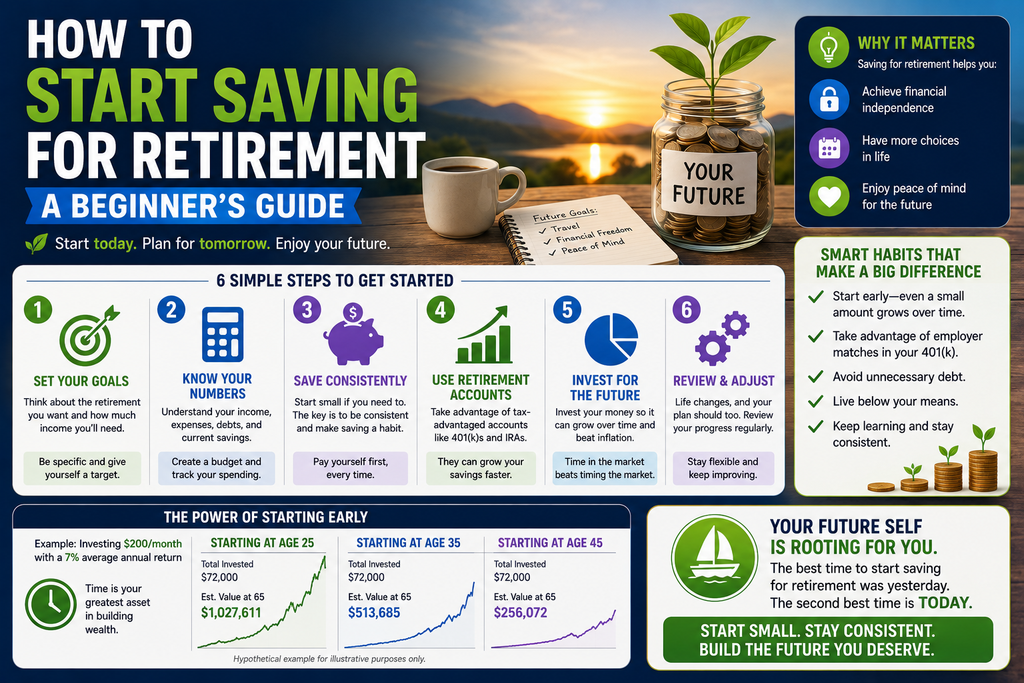
Why Should You Start Saving for Retirement Early?
One of the biggest advantages of starting early is time.
Money invested for retirement can potentially grow over many years. When investment earnings remain invested, they can generate additional earnings over time. This is one reason compound growth can become powerful over long periods.
Consider two hypothetical investors.
Investor A starts investing $300 per month at age 25.
Investor B waits until age 35 and then invests $500 per month.
Even though Investor B contributes more each month, Investor A has an additional decade for contributions and potential investment growth.
The example does not guarantee a particular outcome because investment returns vary. The main lesson is that time can be an important part of retirement investing.
Step 1: Determine Your Retirement Goal
Before deciding how much to save, think about the retirement lifestyle you want.
You might want to:
- Stop working completely
- Work part-time
- Travel
- Start a small business
- Spend more time with family
- Maintain your current lifestyle
- Live in a lower-cost location
Your retirement goal affects how much you may eventually need.
You do not need an exact number immediately.
Start by asking:
What kind of life do I want in retirement?
Then you can gradually create a more detailed estimate.
Step 2: Review Your Current Finances
Retirement saving works best when it fits into your overall financial plan.
Before deciding how much to invest, review:
- Monthly income
- Essential expenses
- Debt payments
- Emergency savings
- Existing retirement accounts
- Other financial goals
If your finances are unstable, you may need to strengthen your emergency savings or address expensive debt before dramatically increasing retirement contributions.
The goal is to create a sustainable financial system rather than investing an amount that makes your monthly budget impossible to maintain.
Step 3: Build an Emergency Fund
An emergency fund can help protect your long-term investments from unexpected expenses.
Imagine you invest most of your available cash for retirement and then your car needs an expensive repair.
Without emergency savings, you may be forced to sell investments at an inconvenient time.
A separate emergency fund can provide accessible cash for unexpected expenses.
The appropriate amount depends on your income, expenses, job stability, family situation, and other circumstances.
Step 4: Understand Your Employer’s Retirement Plan
If your employer offers a 401(k), learn how the plan works.
Check:
- Whether the employer offers matching contributions
- How much you need to contribute to receive the match
- Available investment options
- Investment expenses
- Administrative fees
- Vesting rules
- Traditional and Roth options
Employer matching can be a valuable benefit.
For example, if an employer matches part of an employee’s contribution, contributing enough to receive the available match may be worth considering.
Read your plan documents carefully because matching formulas and eligibility requirements vary.
Step 5: Choose the Right Retirement Account
There are several retirement account options.
Common choices include:
- Traditional 401(k)
- Roth 401(k)
- Traditional IRA
- Roth IRA
- Other employer-sponsored retirement plans
Each account has different rules.
A Traditional account generally provides tax benefits that occur before retirement, while Roth accounts generally use after-tax contributions and may provide tax-free qualified withdrawals.
The right choice depends on your income, tax situation, employer plan, eligibility, and long-term goals.
Step 6: Decide How Much to Save
There is no single savings percentage that works for everyone.
A beginner might start with an amount they can comfortably maintain and increase contributions over time.
For example, you might begin by contributing:
- 3% of income
- 5% of income
- 10% of income
The exact percentage depends on your circumstances.
The important thing is to create a habit.
If your income increases later, consider increasing your retirement contribution as well.
Step 7: Automate Your Contributions
One of the easiest ways to make retirement saving consistent is automation.
If money is automatically transferred from your paycheck or bank account into a retirement account, you do not have to remember to invest every month.
Automation can help reduce the temptation to spend money that you intended to save.
For example:
Paycheck → Retirement contribution → Remaining money → Monthly expenses
This approach can make saving part of your normal financial routine.
Step 8: Understand What You Are Investing In
Opening a retirement account does not automatically mean your money is invested.
Depending on the account, money may initially sit in cash or another default option.
You need to understand what investments are available and how your contributions are being allocated.
Common retirement investments include:
- Stock index funds
- ETFs
- Mutual funds
- Bond funds
- Target-date funds
- Other investments offered through the plan
Before choosing an investment, understand its strategy, costs, diversification, and risk.
Step 9: Consider Diversification
Diversification means spreading your investments across different assets, companies, industries, or markets.
For example, instead of investing your entire retirement portfolio in one company, you could use diversified funds that hold many investments.
Diversification can reduce the impact of a poor performance from any single investment, although it cannot eliminate market risk.
A diversified portfolio can still decline significantly during a market downturn.
Step 10: Understand Your Risk Tolerance
Your retirement portfolio should reflect your ability and willingness to handle investment losses.
Stocks can experience substantial price fluctuations.
Bonds can also lose value and have their own risks.
Cash generally has less market volatility but may not provide enough long-term growth to meet every retirement goal.
Your appropriate asset allocation can depend on:
- Age
- Time until retirement
- Financial goals
- Income
- Other assets
- Risk tolerance
- Ability to recover from losses
Someone with several decades until retirement may have a different investment strategy from someone who expects to retire soon.
Step 11: Learn About Target-Date Funds
Target-date funds are designed around an approximate future retirement date.
For example, a fund might be designed for investors expecting to retire around a particular year.
The fund’s asset allocation typically changes over time according to its investment strategy.
Target-date funds can be useful for investors who want a professionally managed, diversified approach without selecting every investment themselves.
However, different target-date funds can have different:
- Fees
- Investment strategies
- Risk levels
- Asset allocations
Always review the fund before investing.
Step 12: Increase Your Contributions Over Time
You do not have to reach your ideal retirement savings rate immediately.
Instead, consider increasing your contributions gradually.
For example:
Year 1: Save 5%
Year 2: Increase to 6%
Year 3: Increase to 7%
A small increase may feel manageable.
You can also consider increasing contributions after:
- A raise
- Paying off a major debt
- Receiving a bonus
- Reducing monthly expenses
- Reaching another financial milestone
The goal is to allow retirement savings to grow alongside your income.
Step 13: Pay Attention to Investment Fees
Investment fees can reduce long-term returns.
Common costs include:
- Expense ratios
- Administrative fees
- Advisory fees
- Account fees
- Trading-related costs
A fund with a lower expense ratio is not automatically better, but when two investments offer similar exposure and quality, costs can be an important factor.
Review the fees associated with your retirement plan and investments.
Step 14: Avoid Trying to Time the Market
New investors sometimes wait for the “perfect” time to invest.
They may think:
“I’ll start when the market falls.”
The problem is that consistently predicting short-term market movements is extremely difficult.
A long-term retirement strategy often focuses on regular contributions and maintaining an appropriate investment allocation instead of making decisions based on daily market predictions.
Market declines can be uncomfortable, but they are part of investing.
Step 15: Avoid Panic Selling
A major market decline can make investors nervous.
Seeing a retirement account fall in value can create a strong temptation to sell everything.
However, selling during a downturn can turn temporary declines into realized losses and may cause investors to miss future market recoveries.
Your investment strategy should be designed with market volatility in mind.
If you cannot tolerate the potential fluctuations of your portfolio, your asset allocation may need to be reconsidered.
How Much Do You Need for Retirement?
There is no universal retirement number.
The amount you need depends on factors such as:
- Desired retirement lifestyle
- Expected expenses
- Retirement age
- Income sources
- Social Security
- Healthcare costs
- Housing
- Taxes
- Investment returns
- Inflation
- Life expectancy
Instead of focusing on a random target number, build an estimate based on your expected expenses and income sources.
You can then adjust your savings strategy as your circumstances change.
A Simple Retirement Savings Example
Imagine Michael earns $60,000 per year.
He decides to contribute 5% of his income to his employer’s retirement plan.
That equals:
$60,000 × 5% = $3,000 per year
If his employer provides a matching contribution, his total retirement savings could be higher depending on the plan’s matching formula.
Over time, Michael increases his contribution whenever his income rises.
This example is purely illustrative. Actual retirement growth depends on contributions, investment returns, fees, taxes, inflation, and many other factors.
Retirement Saving When You Have Debt
Having debt does not necessarily mean you should stop retirement saving completely.
The type and interest rate of the debt matter.
High-interest debt can be particularly expensive because interest can grow rapidly.
A reasonable financial plan may involve balancing:
- Emergency savings
- Retirement contributions
- High-interest debt repayment
- Other financial goals
If your employer provides a retirement match, the potential value of that benefit may also be part of the decision.
There is no single strategy that works for everyone.
What If You Started Saving Late?
If you are in your 30s, 40s, 50s, or later and have little retirement savings, do not assume it is too late.
You can still take action.
Consider:
- Reviewing your current retirement accounts
- Increasing contributions if affordable
- Taking advantage of employer benefits
- Reviewing investment fees
- Creating a realistic retirement target
- Reducing unnecessary expenses
- Increasing savings when income rises
- Considering professional financial advice when appropriate
The best time to start may have been earlier, but the second-best time is to create a plan now.
Common Retirement Saving Mistakes
Waiting Until You Earn More
You may always find new expenses.
Starting with a manageable amount can help establish the habit.
Ignoring Employer Matching
Understand whether your employer provides matching contributions.
Choosing Investments You Do Not Understand
Never invest simply because a fund or stock is popular.
Taking Too Much Risk
Higher potential returns usually come with higher risk.
Taking Too Little Risk
Being overly conservative for decades may make it harder for your savings to keep pace with inflation and long-term goals.
Checking Your Portfolio Every Day
Retirement investing is generally a long-term process.
Constantly reacting to short-term market movements can encourage emotional decisions.
Forgetting to Increase Contributions
As your income grows, consider increasing your retirement savings.
A Simple Retirement Saving Plan for Beginners
If you want a straightforward starting framework, consider these steps:
1. Create an emergency fund.
2. Pay attention to high-interest debt.
3. Learn about your employer’s retirement plan.
4. Contribute enough to take advantage of available employer matching, when appropriate.
5. Learn about Traditional and Roth retirement accounts.
6. Choose diversified investments that match your time horizon and risk tolerance.
7. Automate contributions.
8. Increase contributions gradually.
9. Review fees and investments periodically.
10. Stay focused on your long-term plan.
Frequently Asked Questions
How much should a beginner save for retirement?
There is no universal amount. Start with a contribution you can maintain consistently and increase it as your income and financial situation improve.
Is it too late to start saving for retirement?
No. Starting later may require a different savings strategy, but taking action can still improve your financial position.
Should I invest in a 401(k) or IRA?
You may be able to use both. Consider employer matching, tax treatment, contribution limits, investment choices, fees, and your individual goals.
Should I invest aggressively when I am young?
Younger investors often have a longer time horizon, but the appropriate risk level depends on the individual’s financial situation and ability to tolerate losses.
What is the easiest way to save for retirement?
Automating contributions through a workplace retirement plan or other retirement account can make saving more consistent.
Can retirement investments lose money?
Yes. Retirement accounts can hold investments that decline in value. Long-term investors should understand and plan for market risk.
Final Thoughts
Learning how to start saving for retirement does not require a complicated strategy.
Start by understanding your financial situation, setting a realistic goal, learning about available retirement accounts, and contributing an amount you can maintain.
If your employer offers a 401(k) match, understand how it works. Consider whether a Traditional or Roth account fits your tax situation. Choose investments carefully, pay attention to fees, diversify appropriately, and increase your savings over time when possible.
Most importantly, do not wait for the perfect financial situation before getting started.
Retirement saving is a long-term process. Small, consistent actions today can help build the foundation for your future financial goals.