
A 401(k) match is one of the most valuable benefits an employer can offer. It allows your employer to contribute money to your retirement account based on how much you contribute yourself.
For example, an employer might say that it will match 50% of your contributions up to 6% of your salary. If you contribute enough to receive the full match, your employer adds additional money to your retirement savings.
Understanding how a 401(k) match works can help you avoid leaving valuable retirement benefits on the table.
In this guide, you’ll learn what a 401(k) match is, how matching formulas work, what vesting means, how to calculate your potential match, and common mistakes to avoid.
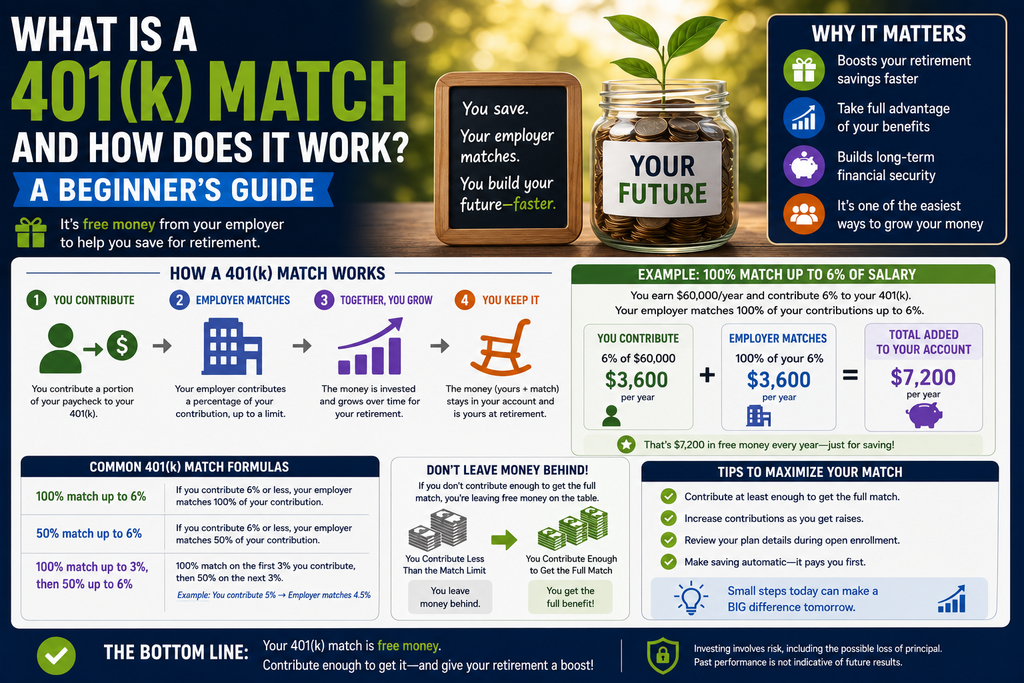
What Is a 401(k) Match?
A 401(k) match is an employer contribution to your workplace retirement plan that is based on your own 401(k) contributions.
You contribute part of your paycheck to your 401(k), and your employer contributes additional money according to the rules of the company’s retirement plan.
The exact matching formula varies from employer to employer.
Some employers match a percentage of your contributions, while others may match a portion of your contributions up to a certain percentage of your salary.
Simple Example
Imagine you earn $60,000 per year and your employer offers this benefit:
50% match on contributions up to 6% of salary.
Six percent of your salary is:
$60,000 × 6% = $3,600
If you contribute $3,600 to your 401(k), your employer could contribute:
$3,600 × 50% = $1,800
Your total retirement contribution would therefore be:
$3,600 from you + $1,800 from your employer = $5,400
The actual rules of your plan may differ, so always check your employer’s plan documents.
How Does a 401(k) Match Work?
A typical 401(k) matching arrangement works in several steps.
Step 1: You Enroll in the 401(k)
First, you must participate in your employer’s 401(k) plan.
Depending on the employer, enrollment may be automatic or require you to sign up.
Step 2: You Choose Your Contribution Percentage
You decide how much of your paycheck to contribute.
For example, you might contribute:
- 3% of your salary
- 5% of your salary
- 6% of your salary
- 10% of your salary
Your plan may allow a different range.
Step 3: Your Employer Calculates the Match
The employer applies its matching formula to your contribution.
For example:
Employer matches 100% of the first 3% you contribute and 50% of the next 2%.
This means contributing 5% could potentially qualify you for a total employer match of 4% of your salary.
Step 4: Employer Contributions Enter Your Account
The employer deposits its matching contribution into your 401(k) according to the plan’s schedule.
The money can then be invested according to the investment options available in your retirement plan.
Common 401(k) Matching Formulas
Employers use different matching formulas.
Here are some common examples.
100% Match Up to 3%
An employer might match every dollar you contribute up to 3% of your salary.
If you earn $70,000 and contribute at least 3%, the maximum employer match under this formula would be:
$70,000 × 3% = $2,100
50% Match Up to 6%
Another employer might match 50% of your contributions up to 6% of salary.
If you contribute 6%, the employer match could equal 3% of your salary.
For someone earning $70,000:
$70,000 × 3% = $2,100
Tiered Matching
Some plans use multiple levels.
For example:
- 100% match on the first 3%
- 50% match on the next 2%
If you contribute 5%, the employer could contribute 4%.
This is why understanding the exact wording of your plan is important.
How Much Should You Contribute to Get the Full Match?
If your employer offers a match, a common priority is to contribute enough to receive the full available match, assuming doing so fits your financial situation.
For example, suppose your employer matches contributions up to 5% of your salary.
If you contribute only 3%, you may not receive the maximum employer contribution available under the plan.
Contributing enough to capture the full match can increase the amount going toward retirement without requiring you to provide all of the money yourself.
However, don’t assume every plan uses the same formula.
Check your plan documents to determine the contribution percentage required to receive the full match.
What Does “Vesting” Mean?
Vesting determines how much of your employer contributions you are entitled to keep if you leave the company.
Your own 401(k) contributions generally belong to you. Employer contributions may be subject to a vesting schedule.
Immediate Vesting
With immediate vesting, employer contributions become fully yours as soon as they are contributed.
Graded Vesting
Under graded vesting, your ownership percentage increases over time.
For example, a hypothetical plan might provide:
- Year 1: 20%
- Year 2: 40%
- Year 3: 60%
- Year 4: 80%
- Year 5: 100%
The actual schedule depends on the retirement plan.
Cliff Vesting
A cliff vesting schedule can require you to complete a certain period of service before you become fully vested.
For example, a hypothetical plan could provide no ownership of employer contributions until a specified date, followed by 100% vesting.
Always check your plan’s specific vesting rules before making decisions about changing jobs.
What Happens If You Leave Your Job?
If you leave your employer, your ability to keep employer matching contributions depends on your vesting status.
Your own contributions generally remain yours, while unvested employer contributions may be forfeited according to the plan’s rules.
This is one reason vesting can matter when evaluating a job offer or considering whether to leave an employer.
Your retirement account may also have several options after leaving a job, such as leaving the money in the existing plan if permitted, rolling it into another eligible retirement account, or taking another option allowed by the plan.
Each choice can have tax and investment consequences.
Does a 401(k) Match Count Toward Contribution Limits?
Yes, employer contributions are part of the overall contribution rules for a 401(k) plan.
However, employee contribution limits and total contribution limits are not identical.
The IRS adjusts retirement contribution limits periodically, so the limits that apply to you can change from year to year.
If you’re making large contributions, check the current IRS limits and your plan rules rather than relying on an old number.
Traditional 401(k) vs. Roth 401(k) Contributions
Some employers offer both traditional and Roth 401(k) options.
The main difference is generally when taxes are paid.
With a traditional 401(k), contributions are generally made before federal income taxes, while withdrawals in retirement are generally taxable.
With a Roth 401(k), contributions are made with after-tax money, and qualified withdrawals can generally be tax-free.
Employer matching rules can vary depending on the plan and current plan provisions.
If your employer offers both options, understand how your specific plan handles matching contributions.
What Is a 401(k) True-Up?
Some employers calculate matching contributions each paycheck. Others may include a year-end adjustment called a true-up.
A true-up can matter when your contributions change during the year or when you reach the employee contribution limit before the end of the year.
For example, imagine you contribute enough early in the year to reach your annual employee contribution limit. If your employer normally matches each paycheck, you could potentially miss matching opportunities later in the year depending on the plan’s rules.
A true-up provision may correct certain situations by calculating the match based on your contributions over the entire year.
Not every plan offers a true-up, so check your plan documents.
How to Calculate Your 401(k) Match
You can estimate your potential employer match using a simple process.
Step 1: Find Your Annual Salary
Suppose your salary is:
$80,000
Step 2: Find the Matching Percentage
Suppose your employer matches:
100% of contributions up to 4% of salary.
Step 3: Calculate the Maximum Matching Amount
$80,000 × 4% = $3,200
Under this hypothetical example, contributing at least 4% could potentially qualify you for a maximum employer match of $3,200 for the year.
That’s additional money going toward your retirement account.
Why a 401(k) Match Is Valuable
The biggest advantage of a 401(k) match is that your employer is contributing money toward your retirement based on your contributions.
That additional money can potentially grow over many years if it remains invested.
For example, imagine you receive an additional $2,000 in employer contributions every year.
Over decades, those contributions could become significantly more valuable if they remain invested and generate returns.
Investment returns are never guaranteed, and account values can rise or fall. But receiving employer contributions can give your retirement savings an additional source of growth.
Common 401(k) Match Mistakes
1. Not Contributing Enough to Receive the Full Match
One of the most common mistakes is contributing less than the amount required to receive the full employer match.
Review your plan’s formula so you know how much you need to contribute.
2. Not Understanding Vesting
Employer contributions may not immediately belong entirely to you.
Understand your plan’s vesting schedule.
3. Assuming Every Employer Matches the Same Way
Matching formulas can vary significantly.
Never assume your new employer uses the same formula as your previous employer.
4. Ignoring Investment Choices
Receiving an employer match is helpful, but you still need to understand how the money in your 401(k) is invested.
Review your available investment options, diversification, fees, and risk level.
5. Forgetting About Contribution Limits
Retirement contribution limits can change.
If you contribute significant amounts, make sure you understand the current limits and how your plan handles contributions.
6. Ignoring the Plan Documents
Your employer’s benefits summary may provide a quick explanation, but the official plan documents contain the rules that apply to your account.
If something is unclear, contact your plan administrator or benefits department.
How to Make the Most of Your 401(k) Match
A simple approach is:
- Find out whether your employer offers a match.
- Read the matching formula.
- Determine the contribution percentage needed for the full match.
- Check the vesting schedule.
- Review the plan’s investment options.
- Understand the fees.
- Increase contributions gradually as your income grows.
- Review your account periodically.
You don’t necessarily need to maximize your 401(k) immediately.
Building the habit of contributing consistently can be more realistic for many beginners.
A Simple Example of the Long-Term Impact
Imagine a worker earns $60,000 and contributes 5% of salary to a 401(k).
Their annual contribution would be:
$60,000 × 5% = $3,000
Suppose the employer contributes another $1,500 through its matching formula.
The account receives:
$4,500 total
The worker provided $3,000, while the employer provided $1,500.
If those contributions remain invested for many years, future investment growth could increase the account balance.
This is only a hypothetical illustration. Actual investment returns, taxes, fees, contribution timing, and employer rules will affect real results.
Should You Always Contribute to Get the Match?
For many workers, receiving the full employer match can be an attractive retirement-saving priority.
However, personal circumstances matter.
You may need to consider:
- High-interest debt
- Emergency savings
- Short-term financial needs
- Other retirement accounts
- Your income stability
- Employer plan fees
- Investment choices
- Your overall financial goals
A retirement contribution strategy should fit your broader financial plan rather than being considered in isolation.
Frequently Asked Questions
What is a 401(k) match?
A 401(k) match is an employer contribution to your retirement plan based on your own contributions, subject to the employer’s plan rules.
Is a 401(k) match free money?
It is often described as “free money” because the employer contributes additional money when you contribute. However, the match comes with plan rules, including possible vesting requirements.
How much should I contribute to get the full 401(k) match?
You need to contribute the percentage specified by your employer’s matching formula. Check your plan documents for the exact requirement.
Do all employers offer a 401(k) match?
No. Employer matching is a benefit offered by some employers, but not every workplace retirement plan provides a match.
What happens to my 401(k) match if I leave my job?
Your own contributions generally remain yours. Employer contributions may be subject to vesting rules, so the amount you keep can depend on how long you’ve worked for the employer and the plan’s vesting schedule.
Can employer matching contributions grow?
Yes. Once contributed to your retirement account, employer contributions can be invested along with the rest of your account, subject to the investment options available in the plan. Investment values can rise or fall.
Can I get a 401(k) match if I contribute to a Roth 401(k)?
Potentially, yes. Whether and how matching contributions work with Roth contributions depends on the employer’s plan rules.
Final Thoughts
A 401(k) match can be an important part of a retirement strategy because it allows you to receive additional employer contributions when you save through your workplace retirement plan.
The key is understanding your specific plan.
Find out how much you need to contribute to receive the full match, understand the vesting schedule, review the investment choices and fees, and keep track of annual contribution rules.
For many beginners, simply understanding the 401(k) match and consistently contributing enough to take advantage of the available employer contribution can be an important step toward building long-term retirement savings.
The best strategy depends on your income, goals, financial situation, employer plan, and other retirement resources.