
Saving for retirement can feel complicated when you see different account types, tax rules, contribution limits, and investment choices.
Two of the most common retirement accounts in the United States are 401(k)s and IRAs.
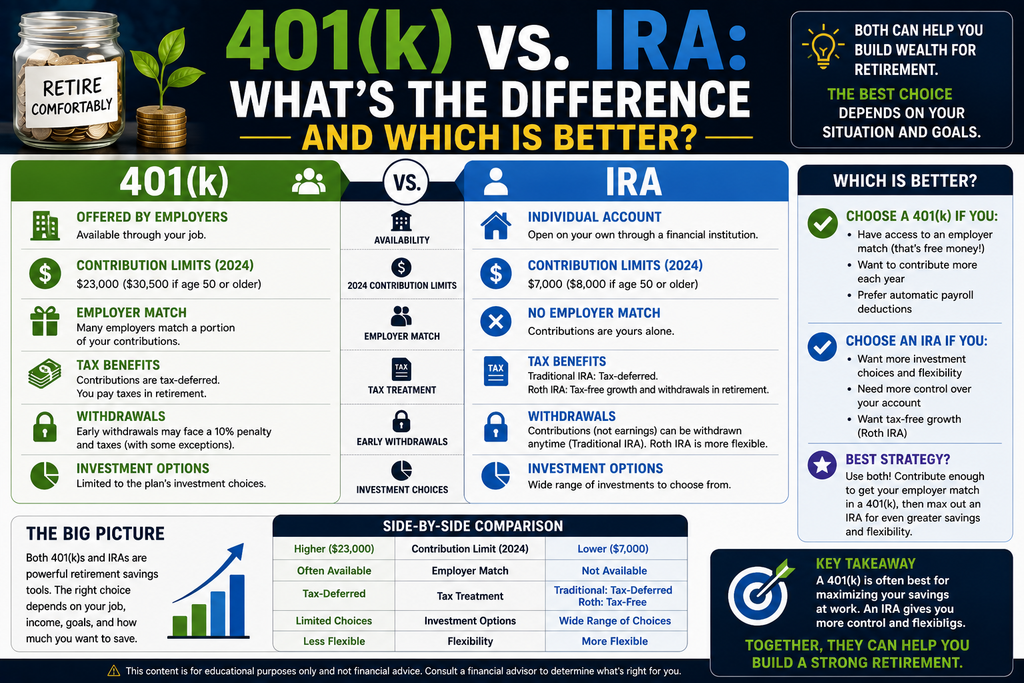
Both can help you invest for retirement, but they are structured differently. A 401(k) is generally offered through an employer, while an IRA is typically opened by an individual.
Understanding 401(k) vs. IRA can help you decide how these accounts may fit into your overall retirement strategy.
The good news is that you do not necessarily have to choose only one. Depending on your circumstances, you may be able to use both.
What Is a 401(k)?
A 401(k) is an employer-sponsored retirement plan.
Employees can generally contribute money from their paychecks into the plan, subject to annual contribution limits and plan rules.
Depending on the employer’s plan, contributions may be made as:
- Traditional 401(k) contributions
- Roth 401(k) contributions
- Or both
Some employers also provide matching contributions.
For example, an employer might contribute additional money when an employee contributes to the plan.
Employer matching can be an important retirement benefit because it may provide additional money toward retirement savings.
What Is an IRA?
An Individual Retirement Account, or IRA, is a retirement account that an individual can generally open through a financial institution.
The two most common types are:
- Traditional IRA
- Roth IRA
A Traditional IRA may provide a tax deduction for eligible contributions, while withdrawals are generally taxable.
A Roth IRA is generally funded with after-tax money, while qualified withdrawals can generally be tax-free.
IRAs can provide investors with additional retirement savings options outside an employer-sponsored plan.
401(k) vs. IRA: Quick Comparison
| Feature | 401(k) | IRA |
|---|---|---|
| Usually opened through | Employer | Individual |
| Contribution limits | Generally higher | Generally lower |
| Employer matching | May be available | No employer match |
| Investment choices | Plan-dependent | Often broader |
| Traditional option | Common | Available |
| Roth option | May be available | Roth IRA available |
| Early withdrawal rules | Restrictions may apply | Restrictions may apply |
| Main purpose | Retirement savings | Retirement savings |
Specific rules, limits, and tax treatment can change, so investors should check current IRS guidance and their plan documents.
The Biggest Difference Between a 401(k) and an IRA
The biggest structural difference is how the account is established.
A 401(k) is generally connected to your employer.
An IRA is generally opened by you.
This means your employer controls many features of a 401(k) plan, such as the investment menu, available account options, and plan-specific rules.
With an IRA, you generally have more control over where you open the account and what investments are available.
Contribution Limits
One major advantage of a 401(k) is its generally higher annual contribution limit compared with an IRA.
This can make a 401(k) particularly useful for investors who want to save a substantial amount for retirement.
IRA contribution limits are generally lower.
Because contribution limits can change each year, investors should check the latest IRS limits before making retirement contributions.
Also remember that different rules can apply to different types of retirement accounts.
Employer Matching
One of the strongest advantages of some 401(k) plans is employer matching.
Suppose your employer offers a matching contribution based on the amount you contribute.
If you contribute enough to qualify for the full match, the employer may add additional money to your retirement account according to the plan’s formula.
This is one reason many employees consider contributing enough to their 401(k) to receive the available employer match, assuming it fits their financial situation.
However, every employer plan is different.
Check your plan documents to understand:
- Matching percentage
- Contribution requirements
- Vesting rules
- Matching limits
- Eligible compensation
Investment Choices
Investment selection can vary significantly between 401(k)s and IRAs.
A 401(k) usually offers a menu of investments selected by the employer’s plan.
These may include:
- Index funds
- Mutual funds
- Target-date funds
- Bond funds
- Other investment options
An IRA may offer a broader range of investments depending on the financial institution.
For example, an IRA may provide access to a large selection of:
- ETFs
- Mutual funds
- Stocks
- Bonds
- Other eligible investments
More choices can provide flexibility, but having more options does not automatically lead to better investment results.
Fees and Expenses
Fees are another important consideration.
A 401(k) can have several types of costs, including:
- Administrative fees
- Investment expenses
- Recordkeeping costs
- Other plan-related fees
An IRA can also have fees, depending on the provider and investments selected.
For example, an ETF or mutual fund held inside an IRA may charge an expense ratio.
When comparing accounts, look at the total cost rather than assuming one account type is always cheaper.
Even relatively small investment expenses can reduce long-term returns.
Traditional 401(k) vs. Traditional IRA
A Traditional 401(k) and Traditional IRA share some similarities.
Both can provide tax advantages for retirement saving.
With a Traditional 401(k), employee contributions are generally made on a pre-tax basis, subject to applicable rules.
With a Traditional IRA, contributions may be deductible depending on factors such as income and whether you or your spouse participate in an employer retirement plan.
In both cases, taxes generally become relevant when money is withdrawn.
However, the exact rules are different, so do not assume the accounts are interchangeable.
Roth 401(k) vs. Roth IRA
Roth 401(k)s and Roth IRAs both use an after-tax contribution structure.
With a Roth 401(k), contributions are generally made with after-tax money, while qualified withdrawals can generally be tax-free.
A Roth IRA also generally uses after-tax contributions, with qualified withdrawals potentially being tax-free.
However, Roth 401(k) and Roth IRA rules are not identical.
For example, Roth IRA contributions have income eligibility rules, while Roth 401(k) contributions generally do not have the same income restriction for making contributions.
Current rules should always be checked before making retirement decisions.
Can You Have a 401(k) and an IRA?
Yes.
Many investors use both.
For example, an employee might:
- Contribute to a workplace 401(k)
- Receive available employer matching contributions
- Contribute to an IRA if eligible
- Continue increasing retirement contributions over time
Using both accounts can provide additional savings capacity and different investment options.
However, contribution limits apply separately according to the rules for each account type.
Which Should You Fund First?
There is no universal order that works for everyone.
A common framework is to first consider whether your employer offers a 401(k) match.
If so, contributing enough to qualify for the available match may be worth considering because employer contributions can add to your retirement savings.
After that, some investors may consider an IRA because of its potential investment flexibility.
They may then return to increasing their 401(k) contributions.
But the appropriate order depends on your:
- Income
- Tax situation
- Debt
- Emergency savings
- Employer plan
- Investment options
- Retirement goals
- Risk tolerance
401(k) vs. IRA for Beginners
If you are new to retirement investing, do not feel pressured to optimize every detail immediately.
Start with the basics.
Step 1: Build an Emergency Fund
Before aggressively investing for retirement, consider keeping enough accessible savings for unexpected expenses.
Step 2: Understand Your Employer Plan
Check whether your employer offers a 401(k), whether there is a match, and what investments are available.
Step 3: Learn About IRAs
Understand the differences between Traditional and Roth IRAs.
Step 4: Compare Investment Costs
Look at expense ratios and other fees.
Step 5: Choose a Diversified Investment Strategy
Your investment choices should reflect your time horizon and risk tolerance.
Step 6: Automate Contributions
Automatic contributions can make retirement saving more consistent.
Example: Using Both Accounts
Imagine Emily works for a company that offers a 401(k) with an employer match.
She decides to contribute enough to her 401(k) to qualify for the full available match.
After that, she opens a Roth IRA because she wants additional retirement savings and access to a broader range of investments.
She then continues contributing to her retirement accounts as her income and budget allow.
This is only a hypothetical example. The best combination depends on individual circumstances.
401(k) vs. IRA: Which Has Better Tax Benefits?
Neither account is automatically better.
It depends on the type of account and your circumstances.
A Traditional 401(k) can provide potential tax benefits today, while a Roth 401(k) generally provides after-tax contributions and potentially tax-free qualified withdrawals.
A Traditional IRA may provide a deduction for eligible contributions.
A Roth IRA generally does not provide a deduction for contributions, but qualified withdrawals can generally be tax-free.
The important question is not simply:
“Which account has better tax benefits?”
Instead ask:
“Which tax treatment makes sense for my current and expected future financial situation?”
Withdrawal Rules
Retirement accounts are designed for long-term retirement savings.
Taking money out before meeting applicable requirements can result in taxes, penalties, or both.
The rules differ between 401(k)s and IRAs.
Some exceptions may allow early withdrawals without the usual additional tax, but the requirements can be specific.
Before taking money from a retirement account, understand the tax consequences and applicable rules.
Required Minimum Distributions
Required minimum distributions, or RMDs, are another important retirement-planning consideration.
Traditional retirement accounts generally have RMD rules once the account owner reaches the applicable age under current law.
Roth accounts have different rules.
For example, Roth IRAs generally do not have lifetime RMD requirements for the original owner under current rules.
Roth 401(k) rules have also changed over time, so investors should check current requirements rather than relying on outdated information.
What Happens When You Change Jobs?
Changing employers can create several options for an old 401(k), depending on the plan and circumstances.
Possible choices can include:
- Leaving the money in the old plan
- Moving it into a new employer’s plan
- Rolling it into an IRA
- Taking a distribution, which can have tax consequences
A rollover can be useful, but it should be handled carefully.
Before moving retirement money, understand the fees, investment choices, tax consequences, and rules associated with each option.
Common 401(k) and IRA Mistakes
Not Taking Advantage of an Available Employer Match
If your plan offers matching contributions, understand how they work.
Ignoring Investment Fees
High expenses can reduce long-term returns.
Choosing Investments Without Understanding Them
Do not select a fund simply because it appears popular.
Keeping Too Much Money in Cash
Cash can have an important role, but retirement accounts are generally designed for long-term investing.
Taking Early Withdrawals
Early withdrawals can create taxes and potential penalties.
Forgetting About Old 401(k) Accounts
Changing jobs can leave you with multiple retirement accounts that become difficult to manage.
Trying to Time the Market
Retirement investing is generally a long-term process. Constantly changing investments based on short-term market movements can make your strategy harder to maintain.
How to Decide Between a 401(k) and IRA
Use this simple checklist:
Choose or prioritize a 401(k) when:
- Your employer offers a valuable match
- You want higher contribution capacity
- Your plan has good, low-cost investment options
- Payroll contributions make saving easier
Consider an IRA when:
- You want additional retirement savings
- You want potentially broader investment choices
- You qualify for a Roth IRA
- You want another account with different tax characteristics
Consider using both when:
- You want to maximize retirement savings
- You qualify for both
- Your financial situation allows additional contributions
- You want flexibility between different account structures
Frequently Asked Questions
Is a 401(k) better than an IRA?
Not necessarily. A 401(k) may offer employer matching and higher contribution limits, while an IRA may provide greater investment flexibility. Many investors use both.
Can I have a 401(k) and a Roth IRA?
Yes, eligible investors can generally have both a workplace 401(k) and a Roth IRA.
Can I contribute to a 401(k) and Traditional IRA?
Yes, but the deductibility of a Traditional IRA contribution can depend on income and workplace retirement-plan coverage.
Does an IRA have an employer match?
No. An IRA is an individual account and does not generally provide an employer matching contribution.
Which is better for retirement: Roth or Traditional?
The answer depends on your current tax situation, expected future tax situation, income, eligibility, and retirement goals.
Can I lose money in a 401(k) or IRA?
Yes. Both accounts can hold investments that decline in value. The retirement account itself does not guarantee investment returns.
Final Thoughts
Understanding 401(k) vs. IRA is an important part of retirement planning.
A 401(k) can provide valuable benefits such as employer matching and higher contribution limits, while an IRA can provide additional retirement savings opportunities and potentially broader investment choices.
You do not necessarily have to choose between them.
For many investors, the two accounts can work together as part of a diversified retirement strategy.
The most important steps are to understand your employer’s plan, learn the tax rules, compare investment costs, choose investments appropriate for your goals and risk tolerance, and contribute consistently.
Retirement investing is a long-term process. You do not need to make every decision perfectly on day one. Building good financial habits and increasing your savings over time can be more important than constantly searching for the perfect account or investment.