
Saving for retirement is one of the most important parts of long-term financial planning. For many U.S. investors, an Individual Retirement Account, commonly called an IRA, can be a useful way to invest for retirement while receiving potential tax advantages.
Two of the most common choices are the Traditional IRA and the Roth IRA.
Both accounts can be used to invest for retirement, but they work differently from a tax perspective. Understanding those differences can help you decide which account may fit your financial situation and long-term goals.
This guide explains Roth IRA vs. Traditional IRA, how each account works, the major differences between them, and important factors beginners should consider.
What Is an IRA?
An IRA is a tax-advantaged retirement account designed to help individuals save and invest for retirement.
Depending on the type of IRA, you may be able to invest in assets such as:
- Stocks
- ETFs
- Mutual funds
- Bonds
- Other investments offered by the financial institution
An IRA itself is not an investment. It is an account that can hold investments.
The two major types discussed here are:
- Traditional IRA
- Roth IRA
The biggest difference is generally when you receive the tax benefit.
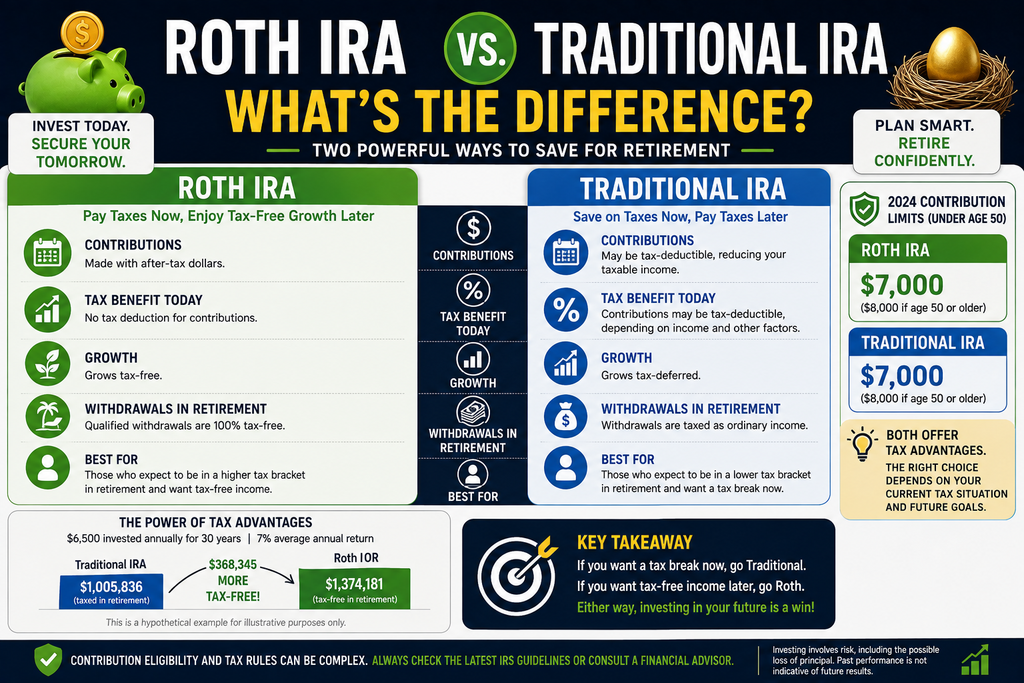
Roth IRA vs. Traditional IRA at a Glance
| Feature | Traditional IRA | Roth IRA |
|---|---|---|
| Contributions | May be tax-deductible depending on circumstances | Generally not deductible |
| Investment growth | Generally tax-deferred | Generally tax-free if requirements are met |
| Qualified withdrawals | Generally taxable | Generally tax-free |
| Required minimum distributions | Generally apply | Generally do not apply to the original owner under current rules |
| Best-known tax advantage | Potential tax deduction now | Potential tax-free qualified withdrawals later |
Tax rules can depend on income, filing status, workplace retirement plans, age, and other factors.
How Does a Traditional IRA Work?
With a Traditional IRA, contributions may be deductible depending on your circumstances.
This can potentially reduce your taxable income for the year in which you make a deductible contribution.
The investments inside the account can generally grow without you paying annual taxes on every transaction.
Taxes generally become relevant when money is withdrawn.
For example, if you contribute money to a Traditional IRA and invest it, you generally do not pay ordinary income tax every year simply because the investments increased in value.
When you eventually take taxable withdrawals, those withdrawals are generally included in your taxable income.
How Does a Roth IRA Work?
A Roth IRA works differently.
Contributions are generally made with money that has already been taxed, meaning you generally do not receive a tax deduction for the contribution.
However, qualified withdrawals can generally be tax-free.
This can make a Roth IRA attractive to investors who expect their tax rate to be higher in the future or who value tax-free retirement withdrawals.
As with any retirement account, specific rules and requirements apply.
The Biggest Difference: When You Pay Taxes
The simplest way to understand the difference is to think about the timing of taxes.
Traditional IRA
Potential tax benefit now → taxes generally paid later
You may receive a deduction for eligible contributions, while withdrawals in retirement are generally taxable.
Roth IRA
Taxes generally paid now → qualified withdrawals can be tax-free later
You contribute after-tax money, but qualified withdrawals can generally be tax-free.
This difference is central to the Roth IRA vs. Traditional IRA decision.
Example of the Tax Difference
Imagine two investors each contribute money to a retirement account.
Investor A uses a Traditional IRA.
Investor B uses a Roth IRA.
Investor A may receive a tax deduction for an eligible contribution. Later, withdrawals are generally subject to income tax.
Investor B does not generally receive a deduction for the contribution. However, if the withdrawal is qualified, the money can generally be withdrawn tax-free.
The better option depends on factors such as current tax rates, expected future tax rates, income, eligibility, and retirement plans.
Roth IRA Contribution Rules
Roth IRAs have income-related eligibility rules for making direct contributions.
This means not everyone can necessarily contribute the full amount directly to a Roth IRA.
The contribution limits and income thresholds can change over time.
Because of this, investors should check current IRS rules before making contributions.
It is also important to distinguish between:
- Contribution limits
- Income eligibility
- Tax deductibility
- Withdrawal rules
These are separate concepts.
Traditional IRA Contribution Rules
Traditional IRA contributions can generally be made by eligible individuals who have qualifying compensation, but whether the contribution is deductible depends on several factors.
For example, your deduction may be affected by whether you or your spouse are covered by a retirement plan at work and by your income.
Therefore, making a Traditional IRA contribution does not automatically mean the entire contribution is deductible.
Always check the current rules that apply to your circumstances.
What Happens to Your Investments?
Once money is inside either type of IRA, you can generally invest it according to the investment options available through your account provider.
For example, an investor might use an IRA to hold:
- Diversified stock ETFs
- Index funds
- Individual stocks
- Bond funds
- Other eligible investments
The tax treatment of the account does not make an investment automatically safe.
If you invest in stocks, the value can fall.
If you invest in bonds, they can also carry different types of risk.
The IRA is simply the account structure. Your investment choices determine much of the portfolio’s market exposure.
Roth IRA Qualified Withdrawals
Roth IRA withdrawals have specific rules.
Generally, qualified distributions can be taken tax-free if applicable requirements are satisfied.
One important concept is the five-year rule, which can apply to Roth IRA distributions.
Other rules can also apply depending on factors such as age and the reason for the withdrawal.
Because Roth IRA withdrawal rules can become complicated, investors should check current IRS guidance before taking money out.
Traditional IRA Withdrawals
Traditional IRA withdrawals are generally taxable as ordinary income.
Taking money out before meeting applicable requirements may also result in an additional tax unless an exception applies.
This is one reason retirement accounts should generally be viewed as long-term accounts rather than short-term savings accounts.
Before making an early withdrawal, understand the potential taxes and penalties.
Required Minimum Distributions
Another major difference concerns required minimum distributions, commonly called RMDs.
Traditional IRAs generally become subject to RMD rules once the account owner reaches the applicable age under current law.
Roth IRAs are different for the original owner because they generally do not have lifetime RMD requirements under current rules.
RMD rules can change, so investors should verify the current requirements when planning retirement withdrawals.
Which Is Better: Roth IRA or Traditional IRA?
There is no universal answer.
The better choice depends on your personal financial situation.
A Traditional IRA may be attractive if:
- You qualify for a tax deduction
- You value a potential tax benefit today
- You expect your tax rate to be lower in retirement
- You want to defer taxes on investment growth
A Roth IRA may be attractive if:
- You qualify to make direct contributions
- You expect your future tax rate to be higher
- You value potentially tax-free qualified withdrawals
- You want to avoid lifetime RMDs as the original account owner
These are general considerations rather than personalized financial advice.
Current Tax Rate vs. Future Tax Rate
One useful way to think about the decision is to compare your current and expected future tax situations.
If your tax rate is relatively high today and you expect it to be lower in retirement, the potential deduction from a Traditional IRA may be valuable.
If your tax rate is relatively low today and you expect it to be higher later, paying taxes now through Roth contributions may be attractive.
Of course, predicting future tax rates is difficult.
Your income, retirement plans, legislation, and personal circumstances can all change.
Can You Have Both a Roth IRA and Traditional IRA?
Yes, an investor may have both types of IRA.
However, annual contribution limits generally apply across your Traditional and Roth IRAs rather than giving you a completely separate contribution limit for each account.
For example, an investor might decide to divide eligible contributions between the two accounts based on their financial strategy.
Having both accounts can also provide different sources of retirement money with different tax characteristics.
Roth IRA vs. Traditional IRA for Beginners
A beginner should avoid choosing an IRA simply because someone online says it is always better.
Instead, consider:
- Your current income
- Your tax situation
- Whether you have an employer retirement plan
- Your expected retirement income
- Your age and time horizon
- Your eligibility for Roth contributions
- Whether a Traditional IRA contribution would be deductible
- Your preference for tax benefits now or potentially later
These factors can make the answer different for different investors.
IRA vs. 401(k)
An IRA is not the same as an employer-sponsored 401(k).
A 401(k) is typically offered through an employer, while an IRA is generally opened individually.
A 401(k) may offer benefits such as:
- Employer matching contributions
- Payroll contributions
- Higher contribution limits than IRAs
- Traditional or Roth options depending on the plan
An IRA may provide additional investment choices and flexibility.
Some investors use both workplace retirement plans and IRAs as part of their overall retirement strategy.
Common IRA Mistakes
Ignoring Contribution Limits
Retirement account contribution limits can change.
Always verify the current limits before contributing.
Assuming Every Traditional IRA Contribution Is Deductible
Deductibility depends on your circumstances.
Ignoring Roth Income Limits
Direct Roth IRA contributions can be subject to income limitations.
Treating an IRA Like a Savings Account
Retirement accounts are designed for long-term investing.
Taking Early Withdrawals Without Understanding the Rules
Taxes and potential penalties can apply.
Choosing Investments Without Research
An IRA does not guarantee investment returns.
The investments inside the account still carry risk.
Forgetting About Fees
Account fees and investment expenses can reduce long-term returns.
A Simple Decision Framework
If you are comparing a Roth IRA and Traditional IRA, ask yourself these questions:
Question 1: Do I qualify to contribute to a Roth IRA?
Question 2: Would my Traditional IRA contribution be deductible?
Question 3: Do I want a potential tax benefit today?
Question 4: Would I prefer potentially tax-free qualified withdrawals in retirement?
Question 5: What do I expect my retirement tax situation to look like?
Question 6: Do I already have a 401(k) or another retirement plan?
Question 7: How much can I realistically save for retirement each year?
Answering these questions can help you understand which account structure deserves further consideration.
Frequently Asked Questions
Is a Roth IRA better than a Traditional IRA?
Not necessarily. Both accounts have different tax advantages, and the better option depends on your income, tax situation, retirement goals, and eligibility.
Can I contribute to both?
You may be able to have and contribute to both, but annual IRA contribution limits generally apply across your Traditional and Roth IRAs combined.
Are Roth IRA withdrawals tax-free?
Qualified Roth IRA distributions can generally be tax-free when applicable requirements are met.
Are Traditional IRA withdrawals taxable?
Generally, yes. Traditional IRA withdrawals are generally included in taxable income, although specific circumstances can affect the tax treatment.
Which IRA is better for young investors?
A Roth IRA may be attractive to some younger investors because they may have many years for potential tax-free qualified withdrawals. However, individual circumstances matter.
Can I lose money in an IRA?
Yes. An IRA is an account, not a guaranteed investment. The investments inside the account can lose value.
Final Thoughts
Understanding Roth IRA vs. Traditional IRA can make retirement planning much easier.
The key difference is the timing of the tax benefit.
A Traditional IRA may provide a potential tax deduction today, with taxes generally paid when money is withdrawn.
A Roth IRA generally provides no deduction for contributions, but qualified withdrawals can be tax-free.
Neither account is automatically the right choice for everyone.
The best decision depends on your income, tax situation, eligibility, retirement goals, investment strategy, and expectations about the future.
Before contributing, check the latest IRS rules and consider getting professional tax or financial advice if your situation is complicated.
Most importantly, remember that choosing the account is only one part of retirement planning. Building a consistent saving and investing habit is equally important.