
Learning how to manage money is an important life skill. Whether you have just started earning your first paycheck, are trying to stop overspending, or simply want to become more organized financially, developing good money habits can make a significant difference over time.
Money management does not require complicated financial strategies. The basics are relatively simple: understand your income, control your expenses, save consistently, manage debt carefully, and make thoughtful decisions about long-term investing.
The challenge is turning these ideas into habits that work in everyday life.
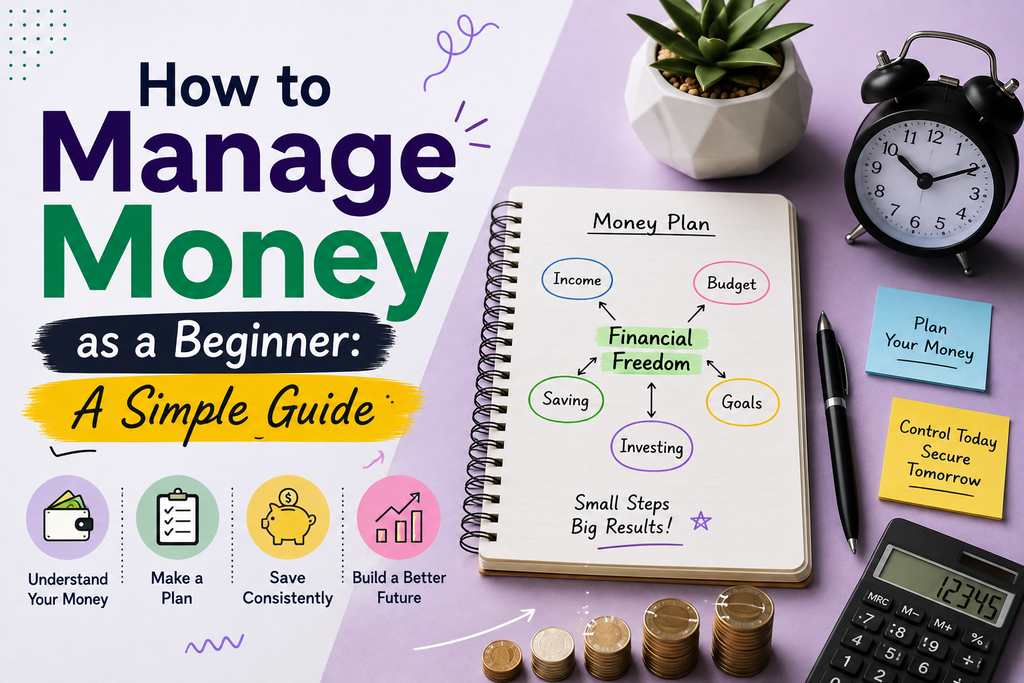
This beginner-friendly guide explains how to manage money step by step and provides practical strategies you can use to build a stronger financial foundation.
What Does Money Management Mean?
Money management means making deliberate decisions about how you earn, spend, save, borrow, and invest your money.
Good money management involves knowing:
- How much money you receive
- How much you spend
- Where your money goes
- How much you save
- How much debt you have
- What financial goals you are working toward
- How you plan to build long-term wealth
You do not need to earn a high income to start managing money effectively.
Someone earning a modest income can develop strong financial habits, while someone earning substantially more can still experience financial problems if spending consistently exceeds income.
Step 1: Know Exactly How Much You Earn
The first step in managing money is understanding your income.
If you receive a regular paycheck, look at your take-home pay rather than focusing only on your annual salary.
Take-home pay is the amount that actually reaches your bank account after taxes and other deductions.
If you have multiple income sources, calculate a realistic monthly estimate.
For example, your income could include:
- Employment income
- Freelance work
- Business income
- Part-time work
- Other regular sources
If your income changes from month to month, avoid building your spending plan around your highest-earning month.
A conservative estimate can give you more financial flexibility.
Step 2: Track Where Your Money Goes
You cannot manage money effectively if you do not know where it is going.
For at least one month, track your spending.
Review your:
- Bank transactions
- Credit card purchases
- Cash spending
- Automatic payments
- Subscriptions
- Online purchases
Group your expenses into categories such as housing, food, transportation, entertainment, debt, savings, and other personal expenses.
You may discover that some expenses are much larger than you expected.
This information gives you a starting point for making better decisions.
Step 3: Create a Realistic Budget
Once you understand your income and spending, create a monthly budget.
Your budget should include both expenses and financial goals.
A simple structure could include:
Essential Expenses
These are expenses necessary for everyday life and financial obligations.
Examples include:
- Housing
- Utilities
- Basic groceries
- Transportation
- Insurance
- Required debt payments
Discretionary Spending
These are expenses that provide convenience or entertainment but can generally be adjusted.
Examples include:
- Restaurants
- Entertainment
- Hobbies
- Shopping
- Vacations
- Streaming services
Financial Goals
This category can include:
- Emergency savings
- Debt repayment
- Retirement contributions
- Other long-term investments
A useful budget does not have to be perfect. It needs to be realistic enough that you can follow it consistently.
Step 4: Build an Emergency Fund
An emergency fund is money set aside for unexpected expenses.
Examples could include:
- Car repairs
- Unexpected household expenses
- Temporary loss of income
- Other significant unplanned costs
Without emergency savings, an unexpected expense may force you to rely on credit cards or loans.
Start with an achievable target.
If saving several months of expenses immediately feels impossible, begin with a smaller amount and increase your savings over time.
The important part is developing the habit of keeping money available for emergencies rather than spending every dollar you receive.
Step 5: Learn to Control Spending
Managing money does not mean avoiding every enjoyable purchase.
Instead, focus on intentional spending.
Before making a purchase, ask yourself:
- Do I actually need this?
- Is it included in my budget?
- Will this purchase affect an important financial goal?
- Am I buying it because I need it or because it is convenient?
- Have I compared alternatives?
For larger purchases, consider waiting before buying.
A short waiting period can help you determine whether something is genuinely important or simply an impulse purchase.
Step 6: Manage Credit Cards Carefully
Credit cards can be useful financial tools, but they can also become expensive when balances are carried and interest accumulates.
If you use a credit card, understand:
- Your interest rate
- Your payment due date
- Your minimum payment
- Your current balance
- Any annual or other applicable fees
Whenever possible, avoid treating your available credit as additional income.
Instead, consider purchases against money you can realistically afford to repay.
Paying attention to credit card balances can also help you avoid allowing high-interest debt to interfere with savings and investing goals.
Step 7: Prioritize High-Interest Debt
Not all debt has the same financial impact.
High-interest debt can make it difficult to build wealth because interest charges can grow faster than your savings.
If you have multiple debts, organize them by:
- Balance
- Interest rate
- Minimum payment
- Due date
Two common approaches to debt repayment are the debt avalanche and debt snowball methods.
Debt Avalanche
The debt avalanche method prioritizes the debt with the highest interest rate while continuing minimum payments on other debts.
This approach can reduce the amount of interest paid over time.
Debt Snowball
The debt snowball method focuses on paying off the smallest balance first.
Once that balance is eliminated, you move the money toward the next debt.
The best approach is the one you can follow consistently while keeping required payments current.
Step 8: Start Saving Automatically
Saving becomes easier when you make it automatic.
Instead of waiting until the end of the month to see what remains, consider scheduling an automatic transfer shortly after receiving your income.
You can use separate savings accounts or categories for different goals.
For example:
- Emergency fund
- Travel
- Car expenses
- Home expenses
- Annual bills
- Long-term goals
Automation reduces the number of decisions you need to make each month.
Step 9: Understand the Difference Between Saving and Investing
Saving and investing serve different purposes.
Savings are generally designed for money you may need relatively soon or for emergency reserves.
Investing is generally intended for longer-term goals and involves market risk.
Investments can include assets such as stocks, bonds, mutual funds, and ETFs.
For beginners, learning about diversification, risk, fees, and time horizon is important before making investment decisions.
Do not invest money you may need immediately simply because you want to grow it faster.
Step 10: Begin Learning About Retirement
Retirement may seem far away when you are young, but starting early can provide more time for your investments to potentially compound.
If your employer offers a retirement plan, learn how it works.
Understand:
- Employee contribution options
- Employer matching policies
- Investment choices
- Fees
- Vesting rules where applicable
For U.S. investors, retirement accounts can have different tax rules and contribution structures.
Before making decisions, review the current rules that apply to your specific situation.
The earlier you understand retirement planning, the easier it can be to make informed long-term decisions.
Step 11: Avoid Lifestyle Inflation
Lifestyle inflation occurs when spending increases as income increases.
For example, someone may receive a raise and immediately upgrade their car, apartment, restaurants, vacations, and subscriptions.
Higher income can improve your financial situation, but spending every additional dollar can prevent your wealth from growing.
When your income increases, consider directing part of the increase toward:
- Savings
- Debt repayment
- Retirement
- Investing
- Other financial goals
You can still improve your lifestyle while increasing your financial security.
Step 12: Protect Your Financial Information
Money management also involves protecting your accounts.
Use strong, unique passwords for financial accounts and enable multi-factor authentication when available.
Be cautious with unexpected emails, messages, phone calls, or websites asking for financial information.
Regularly review your bank and credit card accounts for transactions you do not recognize.
Good financial habits are not only about making money decisions; they also include protecting the money you already have.
Common Money Management Mistakes
Spending More Than You Earn
Consistently spending more than your income can create a cycle of debt.
A budget can help you identify areas where spending needs to change.
Ignoring Small Expenses
A single small purchase may not matter much, but repeated spending can become significant over time.
Having No Emergency Savings
Unexpected expenses are part of life. Without a cash reserve, they can quickly become debt.
Making Only Minimum Debt Payments
Minimum payments may keep an account current, but high-interest balances can take a long time to repay.
Investing Without Understanding Risk
Investing is not guaranteed to produce profits.
Before investing, understand that the value of investments can rise and fall.
Trying to Get Rich Quickly
Promises of guaranteed high returns or effortless wealth should be treated with skepticism.
Building wealth generally requires time, disciplined saving, sensible investing, and risk management.
A Simple Money Management Routine
You do not need to spend hours managing your finances every week.
A simple routine might look like this:
Weekly:
Review recent transactions and check whether your spending is on track.
Monthly:
Create or update your budget, review savings, and evaluate debt payments.
Every few months:
Review subscriptions, recurring expenses, financial goals, and investment contributions.
Annually:
Review your overall financial progress and update your long-term goals.
This routine can help prevent small financial problems from becoming larger ones.
How to Improve Your Money Management Over Time
Start with the basics rather than trying to change everything at once.
A practical order might be:
- Understand your income.
- Track your spending.
- Create a realistic budget.
- Build emergency savings.
- Manage high-interest debt.
- Automate savings.
- Learn about investing.
- Contribute toward long-term goals.
- Review your financial plan regularly.
As these habits become normal, you can gradually make your financial system more sophisticated.
Final Thoughts
Learning how to manage money as a beginner is less about finding a perfect financial strategy and more about developing consistent habits.
Know what you earn, understand what you spend, create a realistic budget, build emergency savings, manage debt responsibly, and learn how investing works before putting money at risk.
You do not need to accomplish everything immediately.
Small improvements made consistently can create a stronger financial foundation over time. The most important step is to start understanding your money and make each financial decision more intentional than the last.