
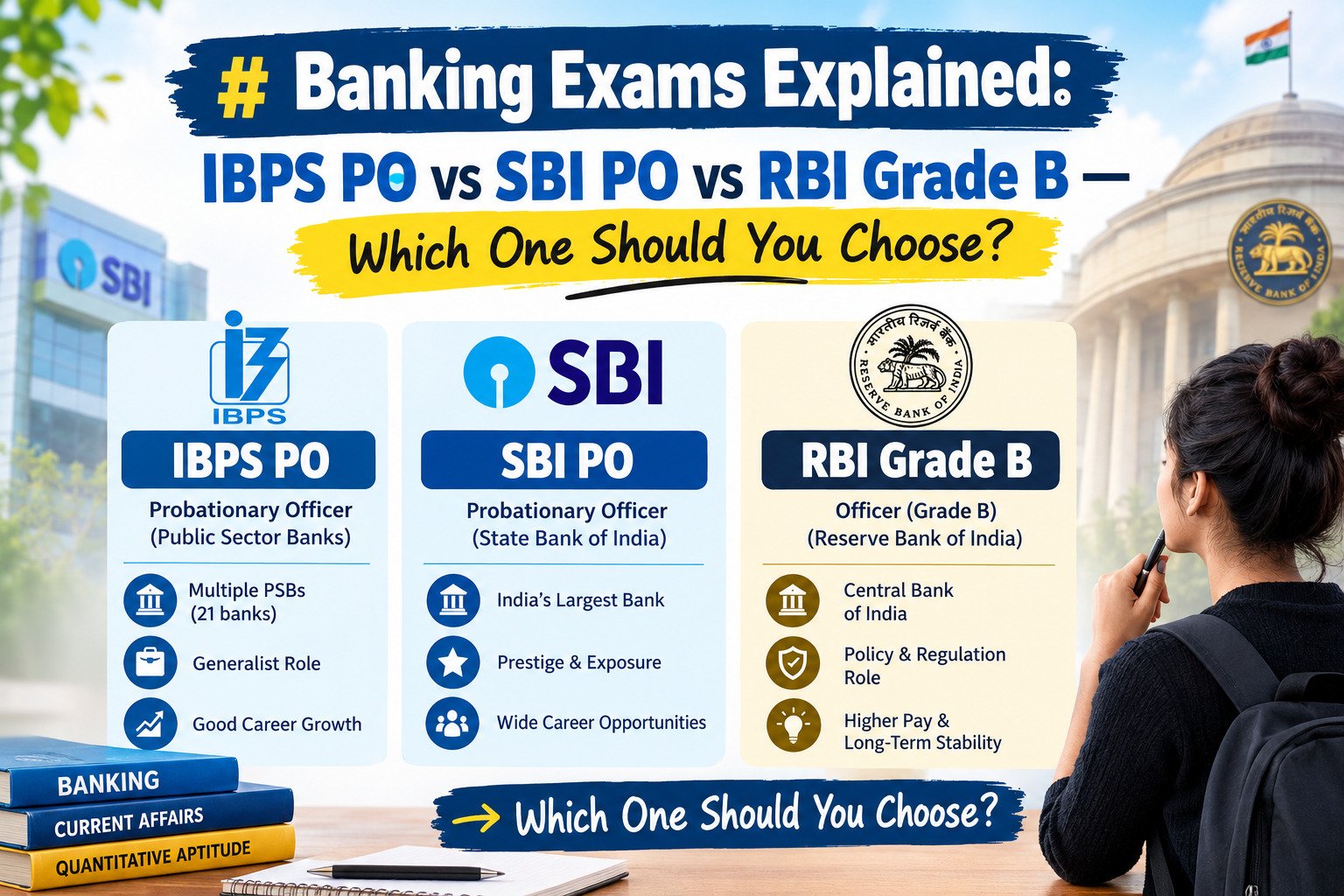
Ask any banking aspirant which exam they’re preparing for, and you’ll often get a vague answer: “banking exams.” But IBPS PO, SBI PO, and RBI Grade B are three very different exams, leading to three very different jobs, with different work cultures, salaries, and promotion tracks. Preparing for all three at once without understanding these differences is how a lot of aspirants end up spreading themselves too thin and clearing none.
This guide breaks down what each exam actually leads to, so you can decide where to focus your energy.
The Core Difference: What Job Are You Actually Getting?
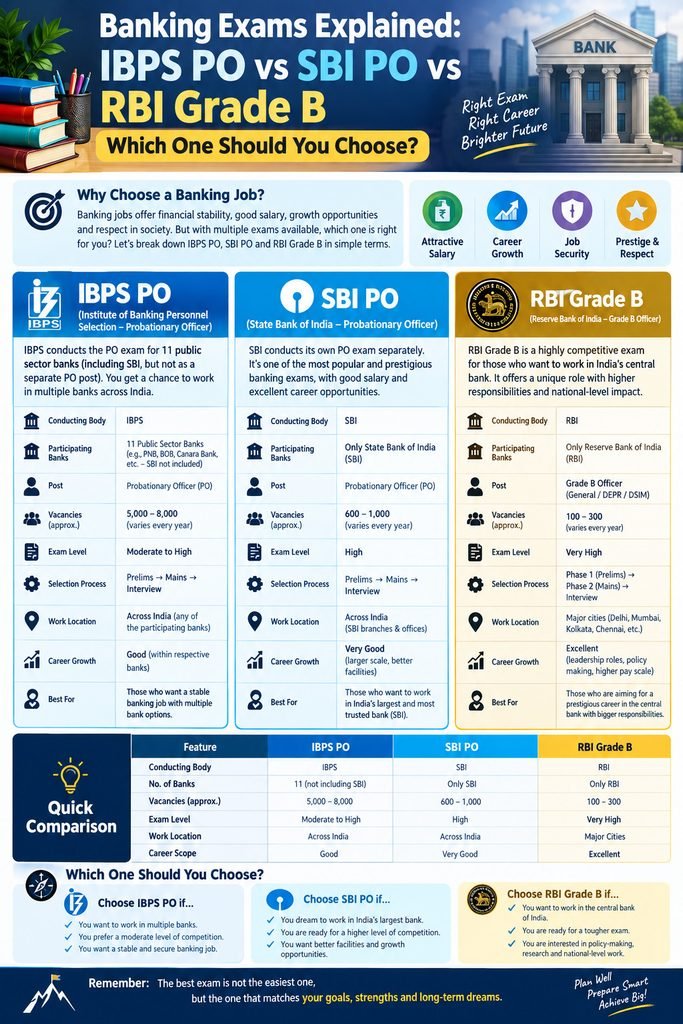
IBPS PO recruits Probationary Officers for a group of public sector banks (excluding SBI) — think Bank of Baroda, Punjab National Bank, Canara Bank, and others under the IBPS umbrella. You apply once, and based on your score and preferences, you get allotted to one of these banks.
SBI PO recruits Probationary Officers specifically for the State Bank of India — the country’s largest public sector bank. It’s a separate exam conducted by SBI itself, not through IBPS.
RBI Grade B is a different category altogether — you’re not joining a commercial bank, you’re joining the Reserve Bank of India as an officer, working on monetary policy, banking regulation, and financial market functions. It’s a central bank job, closer to a policy and administrative role than day-to-day branch banking.
Understanding this distinction matters because your daily work life differs enormously between these three. PO roles (IBPS and SBI) involve branch banking, loan processing, customer service, and eventually branch management. RBI Grade B involves regulatory and policy work, often in RBI’s regional or central offices, with far less direct customer interaction.
Eligibility Criteria Compared
| Criteria | IBPS PO | SBI PO | RBI Grade B |
|---|---|---|---|
| Age Limit | 20–30 years | 21–30 years | 21–30 years |
| Qualification | Graduate in any discipline | Graduate in any discipline | Graduate with 60% marks (50% for reserved categories) |
| Attempts | Limited by age relaxation | Limited by age relaxation | 4 attempts (unreserved), more for reserved categories |
RBI Grade B has a noticeably stricter qualification requirement — the 60% marks criterion in graduation trips up many otherwise strong candidates who don’t check eligibility before investing months of preparation. Always verify your own percentage against the exact requirement before committing to this exam.
Exam Pattern: How the Selection Process Differs
IBPS PO
Three stages: Preliminary exam (100 marks, objective — English, Reasoning, Quantitative Aptitude), Mains exam (200 marks, objective — Reasoning & Computer Aptitude, General/Economy/Banking Awareness, English, Data Analysis & Interpretation, plus a descriptive test for letter and essay writing), and an Interview stage.
SBI PO
Also three stages, structurally similar to IBPS PO: Preliminary exam, Mains exam (which includes a descriptive paper), and Group Exercise/Interview. The key difference is difficulty level — SBI PO’s Mains exam is widely considered tougher than IBPS PO’s, particularly in Data Interpretation and Reasoning, and SBI’s cut-offs tend to be higher because of the prestige and vacancy competition.
RBI Grade B
Two phases plus an interview: Phase 1 (objective, screening in nature — General Awareness, English, Quantitative Aptitude, Reasoning), Phase 2 (descriptive papers — Economic and Social Issues, English Writing Skills, and Finance & Management), followed by an Interview. The descriptive nature of Phase 2 makes RBI Grade B fundamentally different from the largely objective PO exams — it rewards strong writing and analytical ability, not just speed and accuracy on MCQs.
Salary and Perks: The Real Numbers
Starting basic pay for IBPS PO typically falls in a similar range across participating banks, with total in-hand salary (including allowances) generally landing in the ₹48,000–55,000 per month range in metro postings, though this varies by bank and location.
SBI PO salary is broadly comparable at the entry level but tends to have a slight edge due to SBI-specific allowances and a generally faster increment structure, along with strong pension and post-retirement benefits given SBI’s scale.
RBI Grade B offers a noticeably higher starting package, often significantly above PO-level salaries, along with substantial perks — subsidized housing or house rent allowance, medical benefits, and a defined benefit pension scheme in many cases. This is one of the biggest reasons RBI Grade B attracts even candidates who already hold PO-level jobs elsewhere.
Beyond the number on paper, consider the full package — HRA, DA, CCA, medical benefits, and loan facilities differ across these employers, so always check current official notifications for exact figures rather than relying on outdated numbers circulating online.
Career Growth and Work-Life Balance
IBPS PO and SBI PO careers follow a fairly similar trajectory: from Probationary Officer to Assistant Manager, then progressively to Manager, Senior Manager, and beyond, with promotions tied to internal exams, seniority, and performance. Branch banking can mean long hours, especially around month-end targets and customer-facing responsibilities, particularly in the early years.
RBI Grade B offers a different rhythm — generally more structured working hours, less direct sales/target pressure, and a career path that can lead toward specialized policy roles, deputation opportunities, or even higher administrative positions within the central banking ecosystem. Many aspirants specifically choose RBI Grade B for this better predictability in work-life balance, alongside the pay advantage.
Which One Should You Prepare For?
If you enjoy analytical and policy-oriented work, don’t mind a demanding descriptive exam, and want a comparatively better long-term work-life balance with a considerably higher entry package, RBI Grade B deserves serious consideration — but be honest about whether you meet the stricter 60% qualification cut-off and whether you’re comfortable with descriptive writing under exam pressure.
If you want to start with high-volume branch banking, don’t mind customer-facing target-driven work initially, and prefer a faster hiring cycle with broader vacancy numbers, IBPS PO offers more opportunities across multiple banks in a single exam attempt.
If you specifically want to work at India’s largest and most prestigious public sector bank, and you’re confident about competing in one of the toughest banking exams in the country, SBI PO is worth the extra preparation intensity it demands.
A practical approach many successful candidates follow: prepare a strong common foundation in Quant, Reasoning, and English first (which overlaps significantly across all three exams), then specialize your final months of preparation based on which exam’s descriptive/interview stage you’re targeting.
Frequently Asked Questions
Q1. Can I prepare for IBPS PO, SBI PO, and RBI Grade B simultaneously? Yes, especially in the early stages, since the Prelims-level syllabus overlaps significantly. Most aspirants diverge in preparation only closer to the Mains stage of each exam.
Q2. Which exam has better job security — PO roles or RBI Grade B? Both are government/PSU-backed roles with strong job security. The difference lies more in work culture, pay scale, and career trajectory than in security itself.
Q3. Is RBI Grade B harder to clear than SBI PO? It’s differently hard rather than simply “harder” — RBI Grade B demands stronger writing and analytical skills through its descriptive papers, while SBI PO demands speed and accuracy under strict time pressure in a largely objective format.
Q4. Do I need a specific degree background for RBI Grade B? No specific stream is mandatory for the General category posts, but you must meet the 60% marks criterion (50% for reserved categories) in your graduation.
Q5. How many vacancies are typically released each year for these exams? Vacancy numbers vary year to year based on organizational requirements — IBPS PO generally has the highest vacancy count since it covers multiple banks, while RBI Grade B tends to have comparatively fewer seats. Always check the current year’s official notification for exact figures.
The Bottom Line
There’s no universally “better” exam among these three — only a better fit for your interests, strengths, and career priorities. Understand what each job actually involves day-to-day, honestly assess which exam pattern plays to your strengths, and build your preparation strategy around that choice rather than chasing all three exams with divided focus.
For a deeper look at how government exam cut-offs are calculated, check out our guide on How Government Exam Cut-Offs Are Decided, or explore Government Job Age Relaxation & Reservation Rules to check your exact eligibility.