
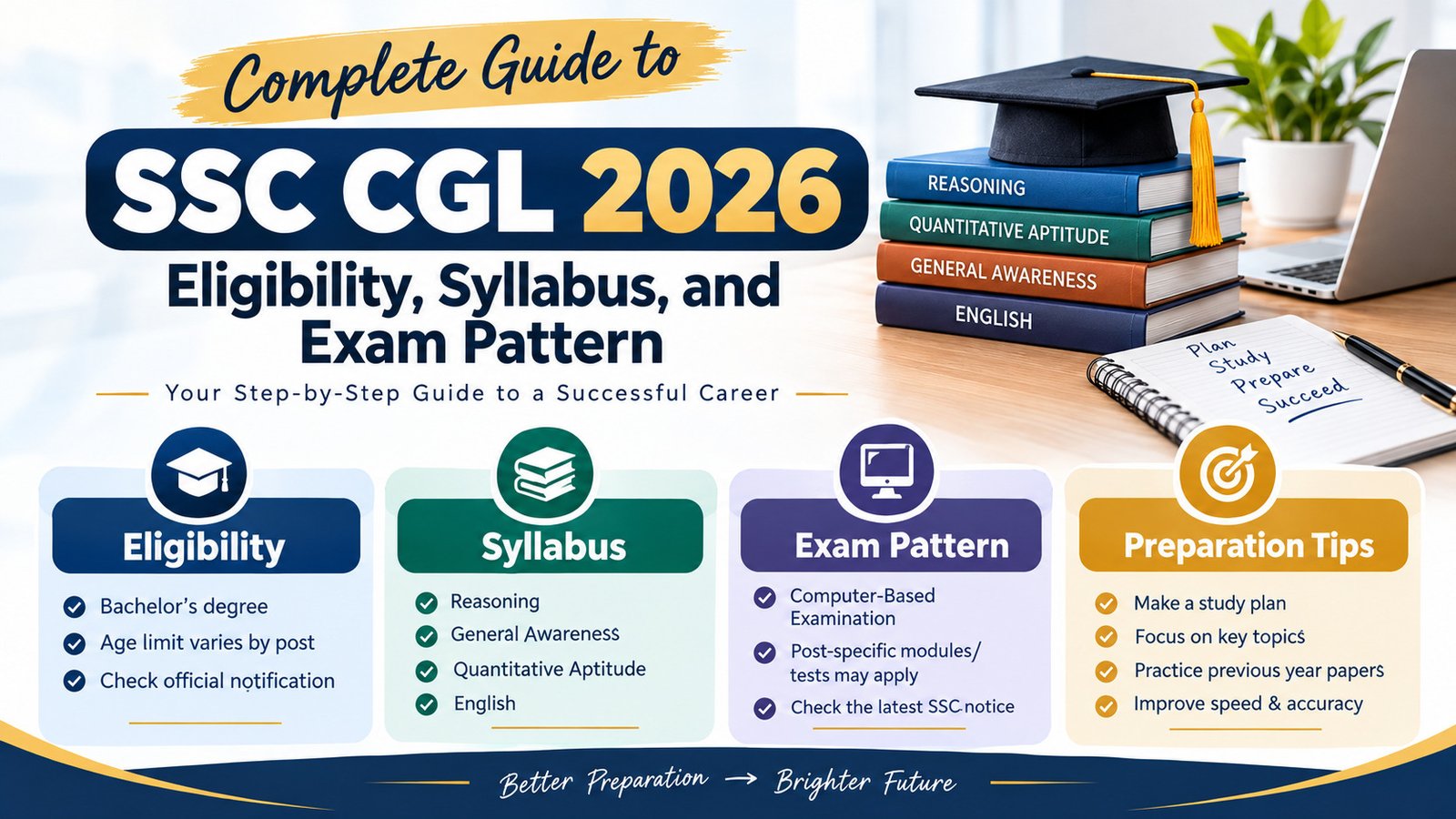
Every year, lakhs of graduates apply for the SSC CGL exam hoping to land a stable, well-paying government job — and every year, a large number of them drop out midway simply because they didn’t understand the exam properly before they started preparing. If you’re serious about cracking SSC CGL 2026, the first step isn’t buying twelve books at once. It’s understanding exactly what you’re up against: who’s eligible, how the exam is structured, what’s actually tested, and how much time you realistically need.
This guide walks through all of that, without the fluff.
What Is SSC CGL, and Which Posts Does It Cover?
SSC CGL — Combined Graduate Level exam — is conducted by the Staff Selection Commission to recruit graduates into Group B and Group C posts across various central government ministries and departments. This isn’t one single job; it’s a gateway to dozens of different roles, including Assistant Section Officer, Income Tax Inspector, Excise Inspector, Auditor, Assistant in the Ministry of External Affairs, and Sub-Inspector in the CBI, among others.
This matters because your final posting depends on two things: your overall rank and the choices you fill during the post-preference stage. Two candidates who clear the exam with different scores can end up in very different departments, with different pay scales, postings, and career growth paths. It’s worth researching the post list early, not after your result — because some roles need physical fitness tests (like CBI Sub-Inspector) and others don’t, and that changes how you should prepare.
Eligibility Criteria: Who Can Actually Apply
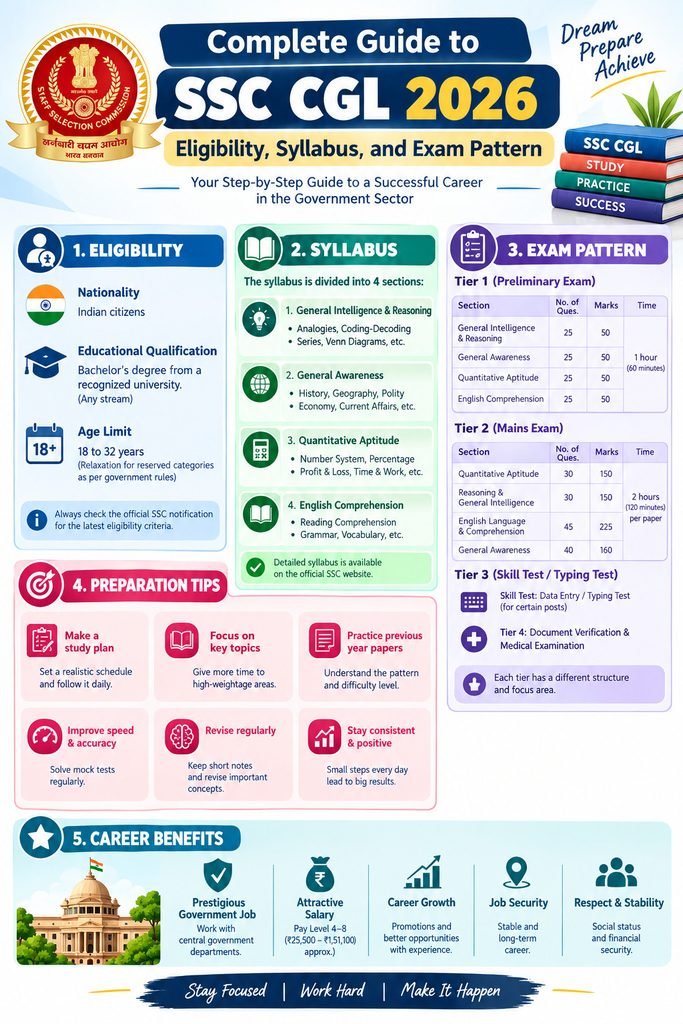
The basic eligibility requirements are:
- Nationality: Indian citizen (some posts allow citizens of Nepal, Bhutan, or Tibetan refugees settled before 1962, with conditions)
- Educational Qualification: A bachelor’s degree from a recognized university in any discipline. Some specific posts (like Statistical Investigator) require a degree with Mathematics/Statistics as a subject
- Age Limit: Varies by post, generally between 18–27 years or 20–30 years, as of a specified cut-off date
- Age Relaxation: OBC candidates get 3 years relaxation, SC/ST candidates get 5 years, and additional relaxation applies for PwD candidates and ex-servicemen
One detail candidates often miss: your final year results don’t need to be out at the time of application, but you must have your qualifying degree in hand by the date specified in the notification (usually around the time of document verification). Applying without checking this deadline is one of the most common — and completely avoidable — mistakes freshers make.
Exam Pattern: Tier 1, Tier 2, and What Changed
SSC CGL is conducted in two tiers now (the commission merged what used to be four tiers into two, starting a few recruitment cycles back).
Tier 1 — Computer-Based Test
Tier 1 has 100 questions worth 200 marks, split across four sections:
| Section | Questions | Marks |
|---|---|---|
| General Intelligence & Reasoning | 25 | 50 |
| General Awareness | 25 | 50 |
| Quantitative Aptitude | 25 | 50 |
| English Comprehension | 25 | 50 |
You get 60 minutes for the full test, and there’s a negative marking of 0.50 marks for every wrong answer. Tier 1 is qualifying-cum-merit — your score here decides whether you move to Tier 2, and it also gets added to your final merit in many recruitment cycles, so it’s not something to take lightly even though it “just” gets you to the next stage.
Tier 2 — Computer-Based Test (Multiple Papers)
Tier 2 is more detailed and post-specific. It typically includes:
- Paper 1 (compulsory for all): Mathematical Abilities, Reasoning & General Intelligence, English Language & Comprehension, General Awareness
- Paper 2 (for specific posts): Statistics — required for Junior Statistical Officer
- Paper 3 (for specific posts): General Studies (Finance and Economics) — required for Assistant Audit Officer / Assistant Accounts Officer
This tiered structure means your prep plan should depend on which posts you’re targeting. If you’re not aiming for JSO or AAO, you can skip the specialized papers entirely and focus your energy on Paper 1.
Syllabus Breakdown: What to Actually Study
Quantitative Aptitude covers number systems, percentages, profit & loss, simple and compound interest, time-speed-distance, ratio and proportion, algebra, geometry, trigonometry, and data interpretation. Most candidates find this the most time-consuming section to master, simply because it needs consistent daily practice rather than last-minute revision.
General Intelligence & Reasoning includes analogies, coding-decoding, series completion, blood relations, direction sense, syllogisms, and non-verbal reasoning like mirror images and paper folding. This is often the highest-scoring section if practiced regularly, since question types repeat in predictable patterns year after year.
English Comprehension tests grammar, vocabulary, sentence correction, fill in the blanks, synonyms-antonyms, and reading comprehension passages. Candidates from non-English medium backgrounds shouldn’t panic here — this section rewards consistent daily reading (newspapers, short articles) more than rote grammar rules.
General Awareness covers current affairs, static GK, Indian history, geography, polity, economics, and science. This is the one section where daily updates matter — static portions can be covered from standard books, but current affairs needs a running habit of reading news through the year, not a two-month cram session.
A Realistic Preparation Timeline
If you’re starting from scratch with no prior competitive exam background, here’s a workable structure:
Months 1–3: Foundation building. Cover NCERT-level basics for Quant and General Awareness, start a daily reasoning practice habit, and begin reading one newspaper daily for current affairs and vocabulary.
Months 4–6: Topic-wise practice. Move to SSC-level difficulty questions, topic by topic, and start timed sectional tests. This is also when you should begin tracking your accuracy, not just your speed.
Months 7–9: Mock tests and analysis. Take full-length Tier 1 mocks at least twice a week, and spend more time analyzing mistakes than taking the next test. Most candidates plateau here because they keep attempting mocks without reviewing errors properly.
Final 2 months before exam: Focus entirely on revision, weak areas, and speed-building under exam conditions. Stop learning new topics at this stage — consolidate what you already know.
If you’re a working professional or final-year student with limited daily hours, stretch this timeline to 12–14 months rather than compressing your study hours unsustainably.
Common Mistakes That Slow Candidates Down
Many aspirants spend excessive time on Quant while ignoring Reasoning, even though Reasoning typically has a higher accuracy ceiling with less study time. Others skip current affairs until the last month, which almost never works because retention needs repetition over months. And a surprising number of candidates don’t practice full-length mocks under real time pressure until very close to the exam — by then, it’s too late to fix pacing issues.
Frequently Asked Questions
Q1. Is there an age limit relaxation for government employees applying for SSC CGL? Yes, government servants get age relaxation, but the extent depends on the specific post and category — check the official notification for post-wise details.
Q2. Can final-year students apply for SSC CGL 2026? Yes, final-year students can apply, but they must be able to produce proof of passing before the document verification deadline mentioned in the official notification.
Q3. How many attempts are allowed for SSC CGL? There’s no fixed limit on attempts, but the age limit for specific posts effectively caps how many times you can apply.
Q4. Is coaching necessary for SSC CGL? No — many successful candidates prepare through self-study using standard books, previous year papers, and online mock test series. Coaching can help with structure and doubt-solving, but it’s not mandatory.
Q5. What is a good score to clear Tier 1? This varies by year based on difficulty and vacancies, but scoring above 130–140 out of 200 generally puts you in a safer zone for most posts, though cut-offs shift category-wise.
The Bottom Line
SSC CGL rewards consistency more than raw intelligence. Candidates who build a steady daily habit across all four sections — rather than binge-studying one subject and neglecting others — tend to clear it faster. Start with a clear eligibility check, understand exactly which posts you’re targeting, and build your study plan backward from the exam date rather than studying randomly and hoping it adds up.
If you found this useful, check out our guide on Banking Exams: IBPS PO vs SBI PO vs RBI Grade B, or explore the full Government Job Age Relaxation & Reservation Rules breakdown to understand your specific eligibility better.