
Search “UPSC preparation strategy” and you’ll find thousands of results promising a shortcut to success in a year. Most of them are vague — “study smart, not hard,” “stay consistent,” “believe in yourself.” None of that tells you what to actually do on a Tuesday afternoon in March when you’re three months into preparation and don’t know whether to revise Polity or start Current Affairs.
This roadmap is different. It’s built around what the exam actually tests, broken into a realistic 12-month structure, assuming you’re starting close to zero and have around 8–10 hours a day to dedicate — adjust the timeline proportionally if you have fewer hours available.
Understanding What You’re Preparing For
UPSC Civil Services Examination has three stages: Preliminary Examination (two objective papers — General Studies and CSAT, where CSAT is qualifying), Main Examination (nine descriptive papers, including four General Studies papers, an Essay paper, a compulsory Indian language and English paper, plus an optional subject with two papers), and a Personality Test (interview).
Most candidates underestimate how much the exam rewards writing ability and structured thinking over raw factual memory. You can know an enormous amount and still perform poorly if you can’t organize that knowledge into a 150-word answer within roughly 7-8 minutes during Mains. Keep this in mind from day one — reading without writing practice is one of the biggest reasons aspirants stagnate after their first attempt.
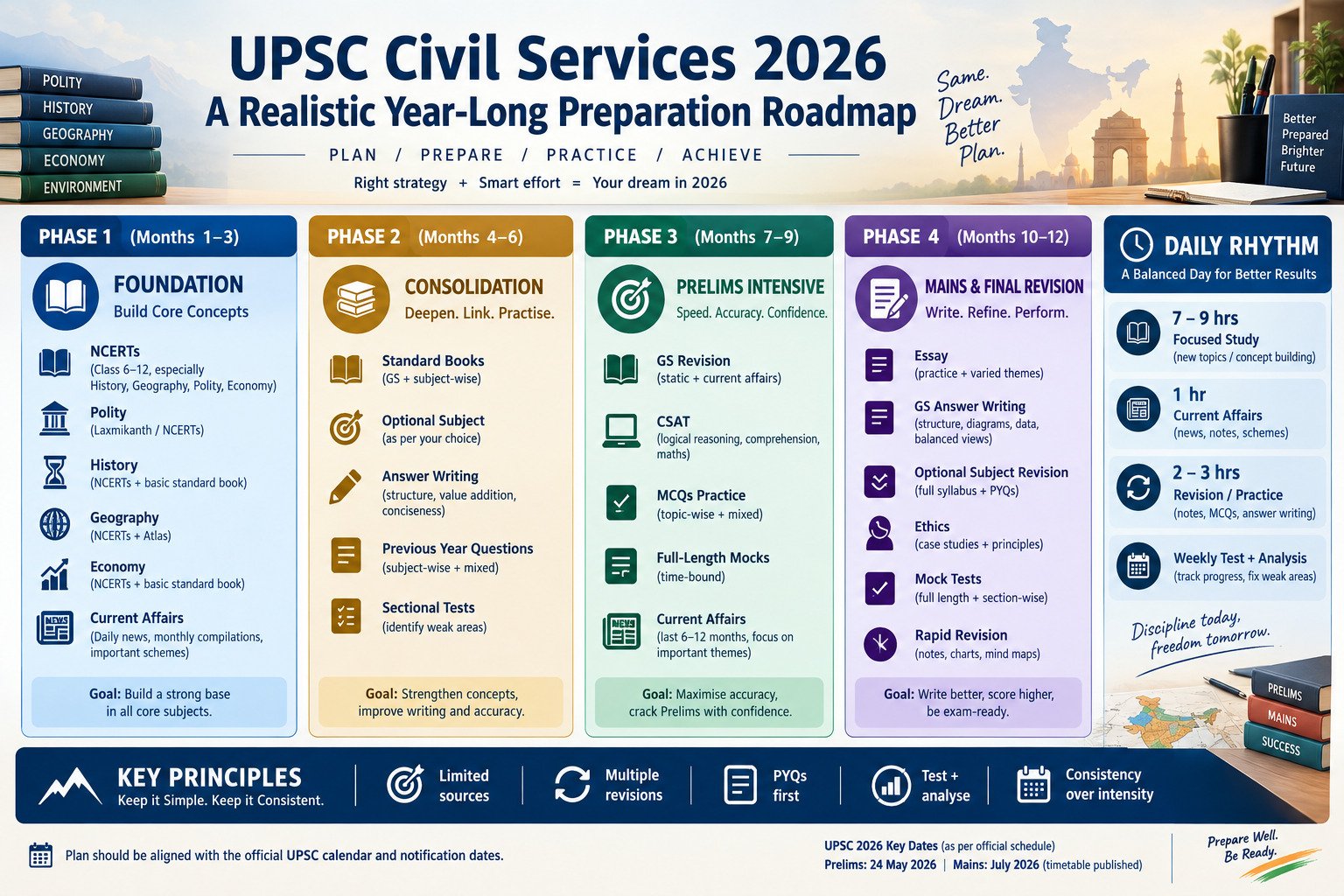
Months 1–3: Building the NCERT Foundation
Almost every successful UPSC candidate, regardless of their final rank, starts the same way — with NCERT textbooks from Class 6 to 12, across History, Geography, Polity, Economics, and Science. These aren’t “basic” books to rush through; they build the conceptual clarity that standard reference books assume you already have.
During these three months:
- Read NCERTs subject-wise, making concise notes as you go (not copying — summarizing in your own words)
- Start a daily newspaper habit (one national daily, read with a highlighter for anything relevant to Polity, Economy, International Relations, or Environment)
- Begin static GK alongside — Indian Polity by Laxmikanth and a standard Geography reference can start in parallel with NCERTs once you’ve built basic comfort
- Choose your optional subject during this phase, not later — this decision affects nearly 500 marks in Mains and shouldn’t be rushed or changed repeatedly
Resist the urge to jump into advanced reference books before finishing this foundation. Skipping NCERTs to save time almost always costs more time later, when concepts don’t stick.
Months 4–6: Standard Reference Books and Answer Writing Begins
Once your foundation is solid, move to standard reference texts for each GS subject — but more importantly, this is when answer writing should start, even if it feels premature.
- Begin writing 2–3 Mains-style answers daily, even on topics you’ve only partially covered — the skill of structuring an answer develops through repetition, not readiness
- Start Current Affairs compilation seriously now, either through a monthly magazine or curated notes, and revise previous months regularly rather than treating each month as isolated
- Introduce your optional subject study in a dedicated daily slot (roughly 2 hours), rather than leaving it for later in the year
- Start basic CSAT practice for 30–45 minutes, a few times a week, so it doesn’t become a last-minute scramble closer to Prelims
A common mistake here is treating optional subject and GS preparation as sequential rather than parallel — by month six, both should be running simultaneously in your daily schedule.
Months 7–9: Prelims-Focused Intensity
If your exam cycle timing means Prelims falls around month 9 or 10, shift a significant portion of your daily hours toward Prelims-specific practice during this phase.
- Take weekly sectional and full-length Prelims mock tests, focusing as much on error analysis as on the test itself
- Revise static portions systematically — Polity, Geography, Economy, Environment, and Science & Technology basics — using your self-made notes rather than re-reading full books
- Continue answer writing for Mains at a reduced frequency (a few times a week) so the skill doesn’t go cold, even while Prelims dominates your schedule
- Track your CSAT accuracy specifically — many capable candidates have failed Prelims purely due to CSAT underperformance, so don’t treat it as guaranteed-safe
By the end of month 9, you should be taking full-length Prelims mocks under real exam timing at least twice a week, with a clear system for reviewing every wrong answer — not just checking the score.
Months 10–12: Mains-Focused Preparation
Once Prelims is behind you (or if your cycle allows dedicated Mains-focused months before the exam), shift almost entirely to Mains-style preparation.
- Intensify answer writing — aim for at least one full test series paper per week under strict timing
- Revise your optional subject thoroughly, focusing on writing full-length answers, not just re-reading material
- Work specifically on the Essay paper — this is one of the most neglected areas, yet carries significant marks and rewards structured, well-linked argumentation
- Compile a final current affairs revision resource covering the past 12–15 months, rather than trying to revise scattered monthly notes individually
This is also the stage to start mock interviews if your Mains results are pending or recently cleared, since Personality Test preparation benefits from starting early rather than cramming in the final weeks before the interview.
What This Timeline Assumes — and How to Adjust It
This roadmap assumes a first attempt with no prior serious preparation. If you’re a working professional with 3–4 hours daily instead of 8–10, stretch this into an 18–20 month plan rather than compressing your study hours unsustainably — burnout is a bigger risk to your preparation than a slightly longer timeline.
If you’re a repeat candidate who has already built the NCERT foundation, you can compress Months 1–3 significantly and move directly into standard references and answer writing, freeing up more months for revision cycles and mock tests.
Common Mistakes That Derail UPSC Preparation
Many aspirants collect an excessive number of books and sources without finishing any of them properly — for GS papers specifically, a smaller number of sources revised multiple times consistently outperforms a large pile of books read once.
Delaying answer writing until “I know enough” is another frequent trap — the skill of writing under time pressure needs to be built over months, not developed suddenly in the final weeks before Mains.
Treating current affairs as separate from static syllabus is a third common error — the exam increasingly integrates current events with static topics (a Polity question tied to a recent constitutional amendment, for example), so your notes should actively link the two rather than keeping them in separate silos.
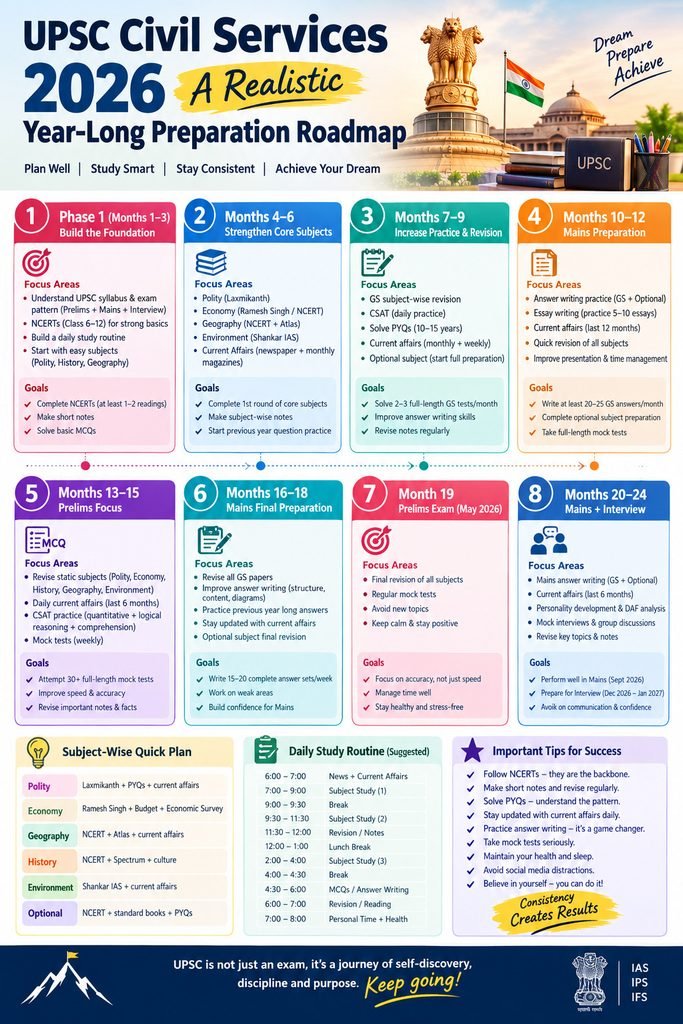
Frequently Asked Questions
Q1. Is coaching necessary for UPSC preparation? No — a significant number of successful candidates prepare through self-study, especially with the abundance of quality free and paid resources now available online. Coaching can help with structure and peer accountability, but isn’t mandatory for success.
Q2. How many hours of daily study are realistically needed? This varies by individual, but most serious aspirants study 8–10 hours daily during dedicated preparation phases, adjusting based on their starting point and available time.
Q3. When should I choose my optional subject? Ideally within the first 2–3 months, based on genuine interest, available study material, and your comfort with the subject — not purely based on other candidates’ scoring trends, which shift over time.
Q4. How important is CSAT, really? Very — while it’s qualifying in nature (you just need to clear a minimum threshold), a significant number of candidates have failed Prelims solely due to CSAT, so it needs genuine practice, not casual attention.
Q5. Should I start with Current Affairs or static syllabus first? Start with static syllabus (NCERTs and basics) in the first few months, and layer current affairs on top progressively — trying to do both intensively from day one often leads to fragmented, disconnected knowledge.
The Bottom Line
UPSC preparation rewards structure and consistency over intensity spikes. A realistic 12-month plan, adjusted honestly to your actual available hours, will consistently outperform an ambitious but unsustainable schedule that collapses after a few months. Build your foundation properly, start answer writing earlier than feels comfortable, and revise systematically rather than constantly consuming new material.
For related reading, check out our guide on State PSC Exams: How State-Level Government Jobs Differ From Central Government Jobs, or explore Government Job Age Relaxation & Reservation Rules for category-wise eligibility details.