
Building a stock portfolio can seem complicated when you are just starting to invest. There are thousands of stocks, ETFs, investment strategies, and opinions available online.
The good news is that you do not need to own dozens of individual stocks or constantly monitor the market to build a sensible portfolio.
A beginner-friendly portfolio starts with a clear financial goal, an appropriate level of risk, diversification, and investments you actually understand.
Learning how to build a stock portfolio can help you move from randomly buying individual stocks to creating a more organized long-term investment strategy.
This guide explains how beginners can think about portfolio construction, diversification, stock selection, risk management, and long-term investing.
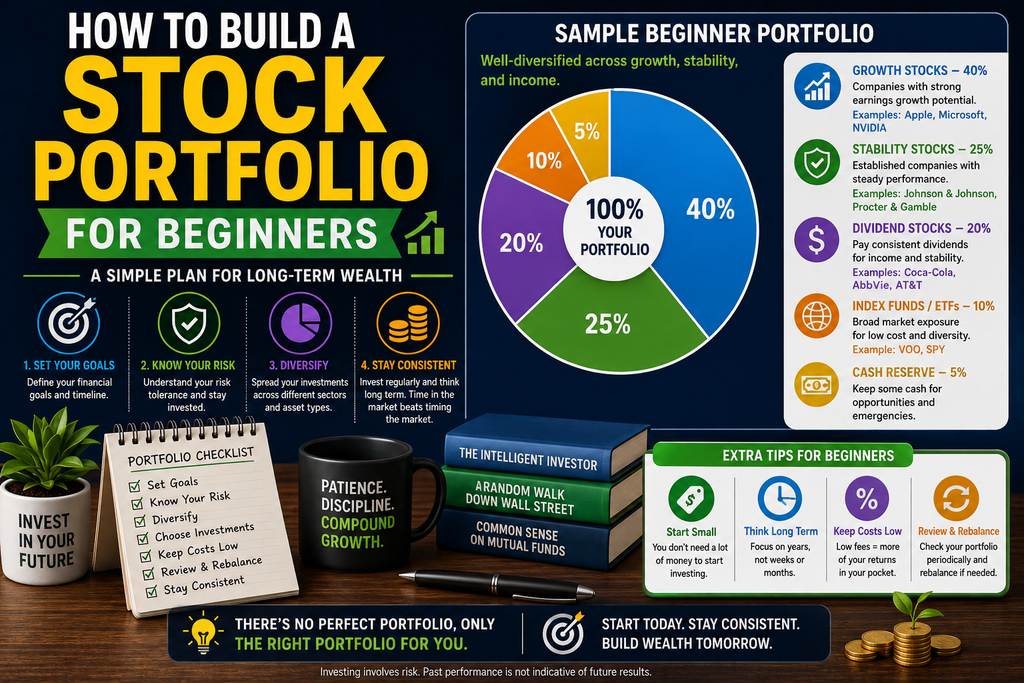
What Is a Stock Portfolio?
A stock portfolio is a collection of investments owned by an investor.
A portfolio can contain:
- Individual stocks
- ETFs
- Mutual funds
- Bonds
- Cash
- Other investments
A portfolio does not have to contain only stocks.
For example, one investor might own several broad-market ETFs, while another might own individual companies along with bonds and other investments.
The appropriate portfolio depends on the investor’s goals, time horizon, risk tolerance, and financial circumstances.
Why Build a Portfolio Instead of Buying One Stock?
Putting all your money into one company creates significant concentration risk.
If that company experiences serious problems, a large portion of your investment could decline.
Diversification spreads your money across multiple investments.
For example, instead of investing $10,000 into one company, an investor could spread exposure across multiple companies, sectors, or funds.
Diversification cannot eliminate investment losses, but it can reduce the impact of a single investment performing poorly.
Investor.gov emphasizes diversification as a way to reduce risk by spreading investments across different assets and securities.
Step 1: Determine Your Investment Goal
Before choosing stocks, determine why you are investing.
Your goal could be:
- Building long-term wealth
- Retirement
- A future major purchase
- Generating potential investment income
- Growing savings over many years
Your goal influences how you construct your portfolio.
For example, someone investing for several decades may have a different portfolio from someone who expects to need the money within a few years.
Step 2: Understand Your Time Horizon
Your time horizon is how long you expect to keep your money invested before needing it.
A long time horizon generally gives investors more opportunity to withstand temporary market declines.
A shorter time horizon may require greater attention to volatility and the possibility that you will need to sell during a market downturn.
Before investing heavily in stocks, ask:
When will I need this money?
That question is often more important than trying to predict what the market will do next month.
Step 3: Understand Your Risk Tolerance
Risk tolerance refers to how much investment loss or volatility you are financially and emotionally able to handle.
Imagine your portfolio falls 25% during a market decline.
If you have $20,000 invested, that could temporarily become approximately $15,000.
Would you panic and sell?
Or could you remain invested according to your long-term plan?
Your answer matters.
A portfolio that looks good on paper is not useful if its volatility causes you to abandon the strategy during a market decline.
Investor.gov notes that asset allocation should consider factors such as an investor’s time horizon and risk tolerance.
Step 4: Decide Between Individual Stocks and Funds
One of the biggest decisions for beginners is whether to buy individual stocks or diversified funds.
Individual Stocks
Buying individual stocks means selecting specific companies.
Advantages can include:
- Greater control
- Ability to research specific businesses
- Potential for significant growth
- Direct ownership of selected companies
However, individual stocks also create more company-specific risk.
ETFs
An ETF can hold many securities in a single investment.
For example, a broad-market ETF may provide exposure to hundreds or thousands of companies.
Advantages can include:
- Diversification
- Simplicity
- Lower company-specific risk
- Easy portfolio construction
However, ETFs still carry market risk and expenses, and not every ETF is broadly diversified.
Step 5: Consider a Core-and-Satellite Approach
One possible portfolio structure is a core-and-satellite approach.
The core consists of broadly diversified investments.
The satellite portion contains smaller investments in specific areas or individual companies.
For example, a hypothetical portfolio could have:
- 80% broad-market funds
- 10% individual growth stocks
- 10% individual value or dividend stocks
This is only an illustration, not a recommended allocation for every investor.
The purpose is to show how a diversified core can potentially reduce the impact of individual stock selections.
Step 6: Choose How Many Stocks to Own
There is no magic number of stocks that every investor should own.
Owning only one or two stocks can create significant concentration.
Owning dozens of individual stocks can become difficult to research and manage.
If you choose individual stocks, focus on quality and diversification rather than simply trying to increase the number of holdings.
An ETF can also provide exposure to many companies without requiring you to individually purchase every stock.
Step 7: Diversify Across Industries
Owning several companies does not automatically mean you are diversified.
Imagine a portfolio containing:
- 5 semiconductor companies
- 4 software companies
- 3 technology hardware companies
That may look diversified because it contains many stocks.
But a large portion of the portfolio is still exposed to the technology sector.
Instead, investors can consider exposure across different industries and sectors.
Examples include:
- Technology
- Healthcare
- Financial services
- Consumer goods
- Industrials
- Energy
- Utilities
- Real estate
- Communication services
The goal is not to own every sector equally.
The goal is to understand where your portfolio is exposed.
Step 8: Consider Geographic Diversification
Investors can also diversify across countries and regions.
A portfolio concentrated entirely in one country may be exposed to risks specific to that economy.
International investments can provide exposure to businesses outside the United States.
However, international investing also introduces additional considerations, including:
- Currency movements
- Political risks
- Different regulations
- Economic conditions
- Foreign market risks
A globally diversified portfolio may therefore contain both domestic and international exposure.
Step 9: Research Every Individual Stock You Buy
If you decide to include individual stocks, research each company carefully.
At minimum, understand:
- What the company does
- How it makes money
- Revenue growth
- Earnings
- Profit margins
- Cash flow
- Debt
- Competitive advantages
- Valuation
- Major risks
Do not buy a stock simply because its price has increased recently.
Do not buy it solely because someone online calls it a “strong buy.”
Research should come before the purchase.
Step 10: Think About Valuation
A company can be excellent and still be an expensive investment.
Suppose a company is growing rapidly and has excellent financial results.
If investors already expect extremely high growth, the stock price may reflect those expectations.
If future results disappoint, the stock could fall even if the business remains profitable.
When evaluating valuation, investors may examine:
- P/E ratio
- P/S ratio
- P/B ratio
- EV/EBITDA
- Free cash flow yield
- Expected earnings growth
No single valuation metric is enough by itself.
Compare the valuation with the company’s growth, profitability, industry, competitors, and risks.
Step 11: Decide How Much to Invest
You do not need to invest a large amount of money to begin learning.
The appropriate amount depends on your financial situation.
Before investing, consider whether you have:
- Money for regular expenses
- Emergency savings
- Manageable high-interest debt
- A clear financial plan
Investing money that you may need immediately can create problems if the market declines.
Your investment amount should fit your broader financial situation.
Step 12: Avoid Overconcentration
Concentration can happen in several ways.
Too Much in One Stock
If one company represents a huge percentage of your portfolio, problems at that company can have a major effect.
Too Much in One Sector
A portfolio containing many technology stocks may still be highly concentrated.
Too Much in One Theme
Investing heavily in one trend, such as artificial intelligence or electric vehicles, creates thematic concentration.
Too Much Employer Stock
Employees who receive company stock through compensation should also consider their existing exposure to their employer.
Your salary may already depend on the same company, creating another layer of financial concentration.
Step 13: Think About Asset Allocation
Asset allocation refers to how your portfolio is divided among different asset categories.
For example:
- Stocks
- Bonds
- Cash
- Other assets
A more aggressive portfolio might contain a larger stock allocation.
A more conservative portfolio might contain more bonds and cash.
There is no single allocation that works for everyone.
The right mix depends on your:
- Time horizon
- Risk tolerance
- Financial goals
- Need for liquidity
- Overall financial situation
Step 14: Consider Bonds and Cash
Building a stock portfolio does not mean putting every dollar into stocks.
Bonds can potentially provide diversification and income, while cash can provide liquidity and stability.
For example, an investor might hold:
- 70% stocks
- 20% bonds
- 10% cash
Another investor could have a very different allocation.
The purpose of asset allocation is to build a portfolio whose potential risk and return characteristics match the investor’s circumstances.
Step 15: Use Dollar-Cost Averaging if It Fits Your Plan
Dollar-cost averaging involves investing a predetermined amount at regular intervals.
For example, an investor might invest $500 every month.
Sometimes the market will be high.
Sometimes it will be low.
The investor continues following the predetermined schedule instead of trying to predict the perfect entry point.
Dollar-cost averaging does not eliminate market risk or guarantee profits.
Its main potential benefit is helping investors maintain a consistent investing habit.
Step 16: Rebalance Your Portfolio
Portfolio allocations can change over time.
Imagine your target allocation is:
60% stocks / 40% bonds
Suppose stocks perform strongly.
Your portfolio might eventually become:
75% stocks / 25% bonds
Your portfolio is now more aggressive than originally intended.
Rebalancing means adjusting the portfolio back toward your desired allocation.
Some investors rebalance on a regular schedule, while others use predetermined percentage thresholds.
The appropriate approach depends on the investor’s strategy and account circumstances.
Step 17: Keep Investment Costs in Mind
Fees and expenses can reduce investment returns over time.
Potential costs include:
- Expense ratios
- Trading costs
- Advisory fees
- Account fees
- Bid-ask spreads
- Other fund or brokerage expenses
A fund with a slightly higher expense ratio may still be appropriate in some circumstances, but investors should understand what they are paying.
FINRA notes that investors should consider investment costs and that “zero commission” does not necessarily mean an investment has no costs.
Step 18: Choose a Brokerage Account
To purchase stocks and ETFs, investors generally use a brokerage account.
When comparing brokers, look at:
- Trading costs
- Account fees
- Available investments
- Research tools
- Customer support
- Fractional shares
- Automatic investing features
- Security features
For U.S. investors, it is also important to understand whether the account is taxable or tax-advantaged.
Different account types can have different tax rules and contribution requirements.
Example of a Beginner Portfolio
Consider a hypothetical investor with a long-term goal.
Instead of selecting 20 individual companies, the investor chooses a simple structure:
- 70% broad U.S. stock ETF
- 15% international stock ETF
- 10% bond fund
- 5% individual stocks
This example is not a recommendation.
It simply demonstrates how an investor could combine broad diversification with a small allocation to individual stock selections.
Another investor may reasonably choose a completely different structure based on their goals and risk tolerance.
Should Beginners Pick Individual Stocks?
Beginners can research and own individual stocks, but it requires more work.
You must understand:
- Company financials
- Valuation
- Industry trends
- Competitive risks
- Management
- Earnings reports
- Business developments
A diversified fund can make portfolio construction simpler because one investment may contain many underlying securities.
If you enjoy researching companies and can accept additional risk, individual stocks may have a place in your strategy.
If you prefer simplicity, diversified funds may be easier to manage.
Common Stock Portfolio Mistakes
Trying to Get Rich Quickly
Investing is generally a long-term activity, not a guaranteed shortcut to wealth.
Buying Too Many Stocks
More stocks do not necessarily mean a better portfolio.
Chasing Recent Winners
A stock that performed extremely well recently may not repeat that performance.
Ignoring Valuation
Strong businesses can become expensive investments.
Selling During Every Market Drop
Frequent emotional decisions can damage a long-term strategy.
Checking the Portfolio Constantly
Daily price movements can create unnecessary stress.
Ignoring Taxes
Investment taxes can affect after-tax returns, especially in taxable accounts.
Forgetting to Rebalance
A portfolio can gradually become much riskier than originally intended.
How Often Should You Review Your Portfolio?
You do not necessarily need to check your portfolio every day.
A long-term investor might review investments periodically to determine whether:
- Goals have changed
- Risk tolerance has changed
- Asset allocation has drifted
- Individual companies still meet the original investment thesis
- Fees remain reasonable
- Major financial circumstances have changed
The appropriate review frequency depends on your strategy.
The important thing is to avoid confusing regular portfolio maintenance with short-term market prediction.
What If the Market Crashes?
Market declines are a normal part of investing.
A diversified stock portfolio can lose significant value during a major market downturn.
This is why investors should consider their risk tolerance before investing.
If a 30% decline would cause you to sell everything in panic, your portfolio may be more aggressive than you can comfortably handle.
Preparing for volatility before it happens is usually easier than making decisions in the middle of a market crash.
Final Thoughts
Learning how to build a stock portfolio is less about finding the perfect stocks and more about creating a strategy you can realistically maintain.
Start with your financial goals, time horizon, and risk tolerance.
Then think about diversification, asset allocation, investment costs, and whether you want to own individual stocks, ETFs, or a combination.
If you choose individual stocks, research the businesses carefully and understand their financial performance, valuation, competitive position, and risks.
Most importantly, avoid building a portfolio based entirely on hype or short-term market predictions.
A strong portfolio is not necessarily the one with the most exciting investments.
For many long-term investors, a better portfolio is one that is diversified, understandable, appropriately risked, and simple enough to stick with through different market conditions.