
Introduction
Investing in the stock market can be difficult when you are constantly wondering whether today is the right time to buy.
What if prices fall tomorrow?
What if the market has already reached its peak?
What if you wait for a better opportunity and prices rise instead?
These questions can make beginners hesitant to invest.
Dollar-cost averaging, often called DCA, is one approach that can make the process more systematic. Instead of trying to predict the perfect time to invest, an investor puts a predetermined amount of money into an investment at regular intervals.
For example, an investor might invest $200 every month regardless of whether the market is rising or falling.
This approach does not guarantee profits, prevent losses, or eliminate market risk. Its main purpose is to create a consistent investing process rather than relying on short-term market predictions.
In this guide, we will explain what dollar-cost averaging is, how it works, its potential advantages and disadvantages, and how beginners can decide whether it fits their investing strategy.
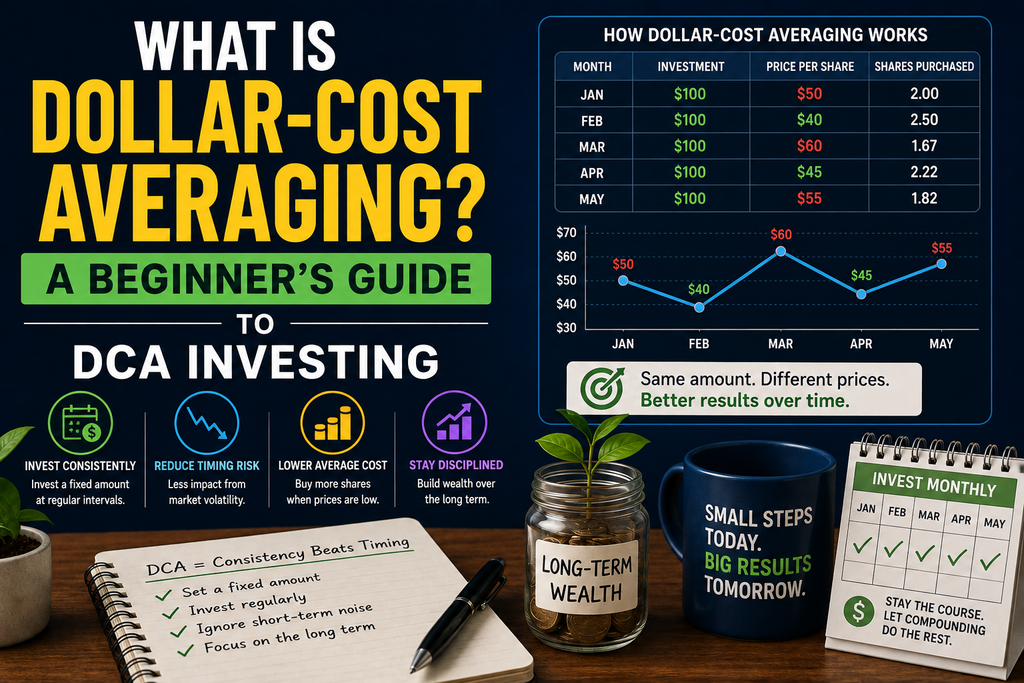
What Is Dollar-Cost Averaging?
Dollar-cost averaging is an investment strategy where you invest a fixed amount of money at regular intervals, regardless of the investment’s current price.
For example, suppose you decide to invest $300 in a particular investment every month.
You invest:
- $300 in January
- $300 in February
- $300 in March
- $300 in April
- $300 in May
The price of the investment will probably change from month to month.
When prices are higher, your $300 buys fewer shares.
When prices are lower, the same $300 buys more shares.
Over time, the strategy results in purchasing different amounts of the investment at different prices.
The key idea is consistency.
Instead of trying to determine exactly when the market will rise or fall, you follow a predetermined schedule.
How Does Dollar-Cost Averaging Work?
The easiest way to understand DCA is through an example.
Imagine you invest $200 every month in an investment.
During four months, the investment has these prices:
| Month | Investment Price | Monthly Investment | Approx. Units Purchased |
|---|---|---|---|
| January | $20 | $200 | 10 |
| February | $25 | $200 | 8 |
| March | $10 | $200 | 20 |
| April | $16 | $200 | 12.5 |
You invested the same $200 every month.
However, you purchased different amounts because the price changed.
When the price was $10, your $200 purchased more units.
When the price was $25, your $200 purchased fewer units.
This is one of the central features of dollar-cost averaging.
Why Do Investors Use Dollar-Cost Averaging?
One reason investors use DCA is to reduce the pressure of trying to time the market.
Market timing involves attempting to predict when prices will rise or fall.
For a beginner, consistently making accurate short-term market predictions can be extremely difficult.
With DCA, the investor establishes a schedule ahead of time.
Instead of asking:
“Is this the perfect day to invest?”
The investor follows a predetermined plan.
This can make investing more systematic and may help reduce emotional decision-making.
Dollar-Cost Averaging and Market Timing
Market timing sounds attractive.
Imagine knowing exactly when the market will reach its lowest point and investing all your money at that moment.
In reality, investors do not know the future.
Markets can move unexpectedly because of economic conditions, company performance, interest rates, investor sentiment, geopolitical events, and many other factors.
DCA does not attempt to predict these movements.
Instead, it accepts that prices will fluctuate and continues investing according to a schedule.
This can be particularly useful for people who receive income regularly and want to invest part of each paycheck.
Benefits of Dollar-Cost Averaging
DCA has several potential advantages.
1. Creates an Investing Habit
Regular investing can become part of your financial routine.
For example, you could schedule an automatic investment after receiving your paycheck.
Over time, investing becomes a habit rather than something you need to remember every month.
2. Reduces the Pressure of Timing the Market
You do not need to decide whether today is the perfect day to invest.
Your strategy already determines when you invest.
3. Can Reduce Emotional Decisions
Investors sometimes make poor decisions because of fear or excitement.
They may buy aggressively after prices rise or sell because they become worried during a market decline.
A predetermined investment schedule can provide structure.
4. Works Well With Regular Income
Many people receive income on a predictable schedule.
DCA can allow them to invest a portion of each paycheck or monthly income.
5. Automatically Buys More When Prices Are Lower
When you invest the same dollar amount, lower prices allow you to purchase more shares or units.
This does not mean lower prices are always better or that an investment will eventually recover.
It simply describes how fixed-dollar investing works.
What Are the Disadvantages of Dollar-Cost Averaging?
DCA is not automatically the best strategy in every situation.
There are important disadvantages to understand.
1. You May Miss Out on Growth
Suppose you have a large amount of money available to invest.
If the market rises while you slowly invest that money over several months, some of your money remains outside the market during that period.
A strategy that invests a lump sum immediately could potentially benefit more if prices rise.
This creates an important trade-off between investing gradually and investing a large amount at once.
2. DCA Does Not Prevent Losses
Dollar-cost averaging cannot protect you from losing money.
If the investment continues to decline, your portfolio can still lose value.
3. It Does Not Guarantee Better Returns
DCA is a method of investing, not a return guarantee.
It cannot predict which investments will perform well.
4. Frequent Investing May Create Costs
Depending on your brokerage and investment, transactions or other costs may apply.
Many modern brokerage platforms offer low-cost or commission-free trading, but investors should still review the actual costs associated with their accounts and investments.
5. It Can Create a False Sense of Security
Some beginners may believe that using DCA makes an investment safe.
It does not.
A poorly chosen investment remains risky even if you purchase it gradually.
Dollar-Cost Averaging vs. Lump-Sum Investing
The difference is straightforward.
Dollar-Cost Averaging
You divide the money into multiple investments made over time.
Lump-Sum Investing
You invest the available money all at once.
For example, suppose you have $12,000.
With DCA, you might invest $1,000 per month for 12 months.
With lump-sum investing, you might invest the entire $12,000 immediately.
Neither approach guarantees a profit.
The better choice depends on factors such as your financial situation, risk tolerance, investment goals, and the source of the money.
When Can Dollar-Cost Averaging Make Sense?
DCA can be especially straightforward when you are investing money as you earn it.
For example, suppose you receive a paycheck every two weeks.
You could automatically invest a portion of each paycheck.
In this situation, you are not necessarily choosing between investing a large lump sum today and spreading it over time.
You are simply investing new money as it becomes available.
This can make DCA a natural part of a long-term investing strategy.
Dollar-Cost Averaging With ETFs
Many investors use DCA with ETFs.
For example, an investor might decide to invest $250 every month into a diversified ETF.
The ETF’s price will change over time.
Some months, $250 may buy more shares.
Other months, it may buy fewer.
Before using this strategy, investors should understand what the ETF owns, what index or strategy it follows, its fees, and its risks.
An ETF is not automatically a diversified or low-risk investment.
Dollar-Cost Averaging With Index Funds
DCA can also be used with index funds.
Suppose an investor wants long-term exposure to a broad market index.
Instead of trying to determine the perfect entry point, the investor contributes a fixed amount on a regular schedule.
This approach combines two concepts:
Index investing + consistent contributions
For beginners, this can create a relatively simple investment routine.
However, the underlying index fund can still experience market declines.
How Often Should You Use Dollar-Cost Averaging?
There is no universal schedule that every investor should follow.
Common schedules include:
- Weekly
- Every two weeks
- Monthly
- Quarterly
The schedule should fit your income and financial situation.
For someone paid every two weeks, investing with each paycheck may be convenient.
Someone with monthly income may prefer monthly contributions.
The most important factor is consistency rather than choosing a specific day of the month.
How Much Should You Invest With DCA?
There is no universal dollar amount.
Your investment amount should fit within your overall financial plan.
For example, a beginner might start with:
- $25 per week
- $50 per week
- $100 per month
- $250 per month
- $500 per month
The amount is less important than making sure you are not investing money you need for essential expenses or near-term financial obligations.
Before increasing investment contributions, consider your emergency savings, debt, monthly expenses, and other financial priorities.
Should You Stop DCA When the Market Falls?
This is one of the biggest challenges for investors.
When markets fall, it can be emotionally difficult to continue investing.
However, the purpose of DCA is to follow the predetermined strategy regardless of short-term price movements.
If the underlying investment still fits your financial plan, continuing your regular contributions may be consistent with the strategy.
That does not mean every declining investment should automatically be held.
If your original investment thesis has changed or your financial circumstances have changed, you may need to reassess your portfolio.
The key is to make decisions based on your overall strategy rather than panic caused by short-term market movements.
Dollar-Cost Averaging Does Not Mean Buying Anything Automatically
This is an important distinction.
DCA is not a reason to keep purchasing an investment regardless of its quality.
Imagine an investor chooses a company that later experiences severe financial problems.
Continuing to buy shares every month does not automatically make that investment a good choice.
The first step is choosing an investment that fits your strategy.
DCA simply determines how and when you contribute money to that investment.
Common Dollar-Cost Averaging Mistakes
Mistake 1: Investing Without an Emergency Fund
You should consider your cash needs before committing money to investments that can fluctuate in value.
Mistake 2: Using DCA to Justify a Poor Investment
A regular schedule cannot turn a bad investment into a good one.
Mistake 3: Stopping Every Time Prices Fall
Constantly changing your plan can undermine the consistency that makes DCA useful.
Mistake 4: Investing Money Needed Soon
Money needed for a near-term expense may not be appropriate for volatile investments.
Mistake 5: Ignoring Fees
Check your brokerage and investment costs.
Mistake 6: Believing DCA Guarantees Profits
It does not.
Mistake 7: Forgetting Your Overall Asset Allocation
Regularly investing in one asset can eventually make your portfolio more concentrated than intended.
DCA and Emotional Investing
One of the less obvious benefits of a systematic strategy is behavioral.
Investors are human.
Fear can encourage selling during market declines.
Excitement can encourage buying after prices have already risen.
A predefined investment schedule can reduce the number of emotional decisions you need to make.
Instead of deciding what to do based on every market headline, you can follow a strategy created when you were thinking more calmly about your long-term goals.
That does not eliminate emotions, but it can create a useful layer of discipline.
A Simple Dollar-Cost Averaging Plan for Beginners
A beginner could create a DCA plan using the following steps.
Step 1: Review Your Finances
Make sure your regular expenses and important financial obligations are covered.
Step 2: Define Your Goal
Determine why you are investing and how long you expect the money to remain invested.
Step 3: Choose an Appropriate Investment
Research the investment carefully.
Understand its holdings, risks, fees, and strategy.
Step 4: Select an Affordable Contribution
Choose an amount you can realistically invest on a regular basis.
Step 5: Pick a Schedule
Decide whether weekly, biweekly, or monthly investing works best for your income.
Step 6: Automate When Appropriate
If your brokerage allows automatic contributions or investments, automation can make it easier to stay consistent.
Step 7: Review Periodically
Check whether the investment and asset allocation still match your goals.
Avoid reacting to every daily price movement.
Example of DCA Investing
Consider Michael, who earns a regular monthly income.
After reviewing his finances, he decides that he can invest $300 each month.
He chooses a diversified investment that fits his long-term strategy.
Instead of waiting for what he believes is the perfect market opportunity, Michael invests $300 every month.
Some months the investment price is high.
Some months it is lower.
Over time, Michael accumulates shares at different prices.
If the investment increases in value over the long term, his accumulated shares may also increase in value.
If the investment falls, his portfolio can lose money.
The example shows the main purpose of DCA: creating a consistent investment process rather than predicting short-term market movements.
Is Dollar-Cost Averaging Good for Beginners?
DCA can be a useful strategy for beginners who want to build a consistent investing habit.
It can be particularly practical for people who invest money from regular income.
However, beginners should understand that DCA is not a substitute for financial planning.
Before investing, consider:
- Your emergency savings
- High-interest debt
- Investment goals
- Time horizon
- Risk tolerance
- Investment costs
- Diversification
- Tax considerations
The strategy should support your overall financial plan.
DCA and Long-Term Wealth Building
Long-term investing often requires consistency.
Trying to predict every market movement can make investing stressful and complicated.
A systematic approach can help investors focus on the bigger picture.
When combined with an appropriate investment, diversification, reasonable costs, and a long-term time horizon, regular investing can become an important part of a wealth-building strategy.
But there is no guarantee that the strategy will produce a particular return.
Markets can decline, and investments can lose value.
Frequently Asked Questions
What is dollar-cost averaging in simple terms?
Dollar-cost averaging means investing a fixed amount of money at regular intervals regardless of the investment’s current price.
Does dollar-cost averaging guarantee profits?
No. DCA does not guarantee profits or protect investors from losses.
Is DCA better than investing a lump sum?
Not necessarily. If a large amount of money is already available, lump-sum investing can provide more time in the market, while DCA may reduce the pressure of investing everything at once. The better approach depends on the investor’s circumstances.
Can I use DCA with ETFs?
Yes. Investors can make regular purchases of ETFs, provided the investment and strategy fit their financial goals and risk tolerance.
Can I use DCA with individual stocks?
Yes, but DCA does not reduce the underlying risks of an individual company. Investors should research the company before repeatedly purchasing its stock.
How often should I use dollar-cost averaging?
You can invest weekly, biweekly, monthly, or according to another schedule that fits your financial plan and income.
Does DCA work when the stock market is falling?
DCA continues purchasing according to the predetermined schedule during both rising and falling markets. However, the investment can still lose value, and investors should periodically evaluate whether it remains appropriate.
Is dollar-cost averaging the same as diversification?
No. DCA describes when and how you invest money. Diversification describes how you spread your investments to reduce concentration risk.
Final Thoughts
Dollar-cost averaging is a straightforward investing strategy built around consistency.
Instead of trying to predict the perfect time to enter the market, you invest a predetermined amount on a regular schedule.
The approach can help create investing habits, reduce the pressure of market timing, and make regular investing easier to manage.
However, DCA is not a magic formula.
It does not guarantee returns, eliminate market risk, or make a poor investment safe.
A strong approach starts with choosing appropriate investments and understanding your financial goals, risk tolerance, time horizon, diversification, and costs.
For many beginners, the most important lesson is simple:
You do not need to predict every market movement to become a disciplined long-term investor.
A clear plan, consistent contributions, and a long-term perspective can be more useful than constantly searching for the perfect time to buy.
Disclaimer: This article is for educational purposes only and does not provide personalized financial, investment, or tax advice. Investment decisions should be based on your individual financial circumstances, goals, time horizon, and risk tolerance.