
Introduction
If you are new to investing, you may have heard people talk about index funds as a simple way to invest in the stock market.
But what is an index fund, and why do so many long-term investors use them?
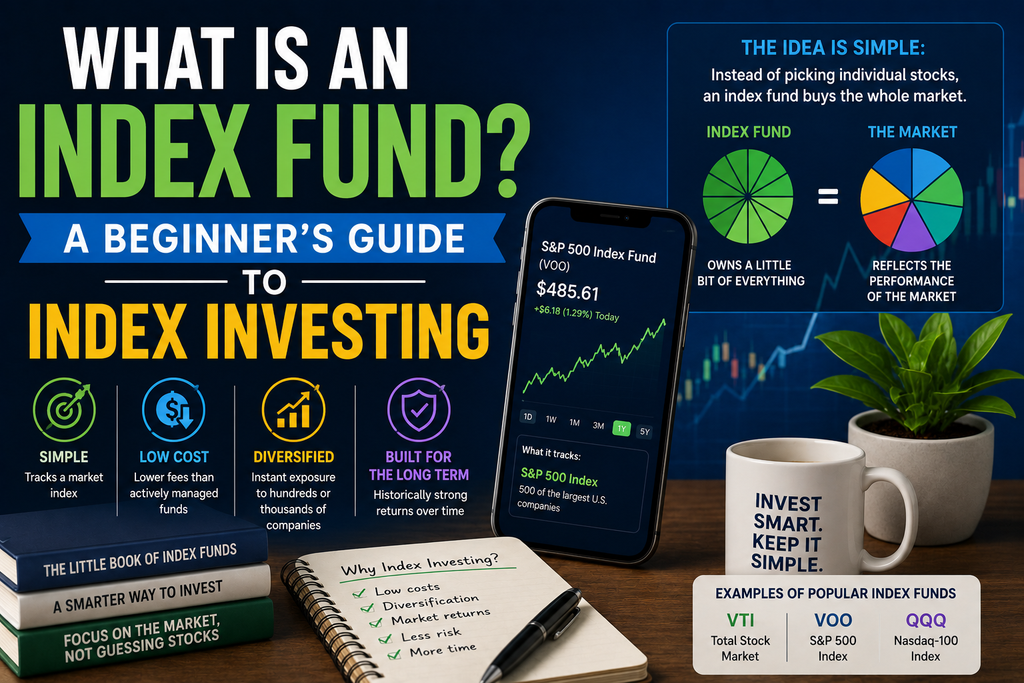
An index fund is a type of investment fund designed to track the performance of a particular market index. Instead of trying to select individual investments that will outperform the market, an index fund generally attempts to follow a specific index.
For beginners, index funds can provide a relatively simple way to gain exposure to a broad group of stocks or bonds through a single investment. However, index funds still involve risk, and not every index fund is the same.
The U.S. Securities and Exchange Commission explains that index funds can be mutual funds, ETFs, or other investment vehicles designed to approximately track an index before fees.
Understanding how index funds work can help you decide whether they fit your long-term investing strategy.
What Is an Index Fund?
An index fund is an investment fund that seeks to track a specific market index.
A market index is a collection of securities designed to represent a particular market, segment, or group of investments.
For example, an index may track:
- Large U.S. companies
- The overall U.S. stock market
- Small U.S. companies
- International companies
- Government bonds
- Corporate bonds
- A specific industry
You cannot directly buy a market index itself. Instead, you can invest in a fund designed to track that index.
For example, if an index tracks hundreds of companies, an index fund may invest in those companies or use a representative sample of them to attempt to follow the index’s performance.
How Do Index Funds Work?
The basic idea behind an index fund is relatively straightforward.
Imagine an index contains hundreds of stocks.
Instead of having a fund manager constantly decide which stocks to buy and sell in an attempt to beat the market, an index fund is designed to follow the predetermined rules of that index.
If companies are added to or removed from the index, the fund may adjust its holdings accordingly.
This approach is generally called passive investing.
Passive funds typically trade less frequently than actively managed funds because their primary goal is to track an index rather than continually select investments in an attempt to outperform it.
What Does an Index Actually Measure?
An index is essentially a measurement of a particular group of securities.
For example, a stock market index may track a group of companies based on specific rules.
Different indexes can be constructed in different ways.
Some indexes give larger companies greater weight based on market capitalization. Others may use different methods to determine how much influence each security has.
This means two funds that are both described as “index funds” can have very different investments and risk profiles.
Before investing, it is important to understand what index the fund follows.
Index Funds vs. Actively Managed Funds
One of the most important differences is how the investments are selected.
Index Funds
An index fund generally attempts to track a specific index.
The objective is not necessarily to beat the market.
Actively Managed Funds
An actively managed fund generally has a manager or management team making investment decisions with the goal of achieving a particular objective, which may include outperforming a benchmark.
Active management can involve more frequent buying and selling.
Why Does This Difference Matter?
The investment approach can affect:
- Fees
- Trading activity
- Portfolio management
- Investment strategy
- Potential performance relative to a benchmark
Passive management may reduce some costs because the fund is not relying on the same level of ongoing security selection and research as many actively managed funds. However, not every index fund is automatically cheaper than every actively managed fund.
The actual costs should always be checked before investing.
Index Funds vs. ETFs
Index funds and ETFs are not exactly the same thing.
An ETF, or exchange-traded fund, is a type of investment fund that trades on an exchange.
An index fund describes the investment strategy: the fund is designed to track an index.
An ETF can be an index fund, but an ETF can also use other strategies.
Similarly, a mutual fund can be an index fund.
Therefore:
ETF = structure
Index fund = investment strategy
Some investors may use index ETFs because they combine an index-tracking strategy with the structure of an exchange-traded fund.
Index Funds and Diversification
One major reason beginners consider index funds is diversification.
Instead of purchasing shares in one company, an index fund may give an investor exposure to many companies through a single investment.
For example, a broad-market index fund could contain hundreds or even thousands of securities.
This can make diversification easier.
However, diversification depends on the index.
A fund tracking a narrow technology index is very different from a fund tracking a broad stock market index.
The SEC warns that narrowly focused funds may not provide as much diversification as investors expect, so it is important to examine a fund’s actual holdings and strategy.
Why Do Investors Use Index Funds?
There are several reasons investors may choose index funds.
1. Simplicity
An index fund can provide exposure to a group of investments without requiring you to research and purchase every individual security yourself.
2. Diversification
Broad index funds can provide exposure to many securities through one investment.
3. Passive Strategy
Index funds generally follow a predetermined index rather than relying on frequent investment decisions.
4. Potentially Lower Costs
Passive funds may have lower operating costs than some actively managed funds, although costs vary from fund to fund.
5. Long-Term Approach
Index investing can fit naturally with a long-term investment strategy because the goal is generally to track a market rather than make frequent short-term trades.
However, these benefits do not mean index funds are risk-free or guaranteed to outperform other investments.
What Are the Costs of Index Funds?
Even if an index fund appears inexpensive, it still has costs.
One important cost is the expense ratio.
The expense ratio represents the fund’s annual operating expenses as a percentage of its assets.
For example, suppose two funds have similar investment objectives but different expense ratios.
The fund with the higher ongoing cost has a larger amount being used to cover expenses rather than remaining invested.
The SEC emphasizes that fees and expenses reduce investment returns and that even relatively small differences in costs can become meaningful over time.
This is why investors should not look only at a fund’s past performance.
Costs matter too.
What Is a Low-Cost Index Fund?
A low-cost index fund is an index fund with relatively low fees and expenses compared with similar alternatives.
Low cost does not automatically mean better.
You should also consider:
- What index does the fund track?
- How diversified is it?
- What does it actually own?
- How closely does it track its index?
- What risks does it have?
- What are its total costs?
- Does it fit your investment goals?
The cheapest fund is not automatically the right fund.
The goal is to find an investment whose strategy, diversification, risk, and costs fit your situation.
What Is Tracking Error?
An index fund is designed to follow an index, but its performance may not perfectly match the index.
The difference between the fund’s performance and the index’s performance can be influenced by several factors.
These may include:
- Fund expenses
- Trading costs
- Portfolio management
- The fund’s method of tracking the index
- Taxes
- Differences in holdings
This difference is commonly referred to as tracking error.
The SEC notes that index funds can underperform their underlying indexes because of fees, expenses, trading costs, and tracking differences.
Are Index Funds Safe?
Index funds are not guaranteed investments.
Their risk depends largely on what they invest in.
A broad stock-market index fund can fall substantially during a stock market decline.
A bond index fund can also lose value under certain market conditions.
An index fund does not eliminate investment risk.
It simply uses a particular method for investing.
Investor.gov states that all investments involve risk and that investors can lose some or all of the money they invest.
Therefore, choosing an index fund should still involve understanding your financial goals, investment time horizon, and risk tolerance.
Types of Index Funds
There are many different types of index funds.
Broad U.S. Stock Index Funds
These funds may track large portions of the U.S. stock market.
They can provide exposure to many American companies.
Large-Cap Index Funds
These funds focus primarily on larger companies.
Small-Cap Index Funds
These funds focus on smaller publicly traded companies.
Smaller companies can have different growth opportunities and risks compared with larger companies.
International Index Funds
These funds provide exposure to companies outside the United States.
International investing can introduce additional risks such as currency movements, political conditions, and differences between markets.
Bond Index Funds
These funds track bond indexes rather than stock indexes.
They can provide exposure to groups of bonds and may behave differently from stock investments.
Sector Index Funds
These funds focus on a particular industry or sector.
Examples may include:
- Technology
- Healthcare
- Energy
- Financial services
- Real estate
Sector funds can be useful for targeted exposure but may be less diversified than broad-market funds.
How to Choose an Index Fund
Choosing an index fund should involve more than searching for the highest historical return.
Consider these factors.
1. The Index
First, understand which index the fund tracks.
Ask:
What exactly am I investing in?
2. Diversification
Look at the number and type of holdings.
A broad index may provide much more diversification than a narrow industry index.
3. Expense Ratio
Compare the fund’s ongoing costs with similar funds.
4. Fund Holdings
Look at the actual companies or securities inside the fund.
This can reveal whether the fund is as diversified as you expected.
5. Investment Objective
Understand what the fund is designed to accomplish.
6. Risk
Consider how the fund could behave during different market conditions.
7. Tracking Performance
Review how closely the fund has historically followed its benchmark.
Past performance does not guarantee future results, but it can help you understand how the fund has behaved relative to its objective.
The SEC recommends reviewing a fund’s prospectus and shareholder information before investing and considering its costs, risks, index methodology, holdings, and fit with your investment goals.
How to Buy an Index Fund
Buying an index fund is generally similar to buying other investment products through a brokerage account.
A basic process may look like this:
Step 1: Open an Investment Account
Choose a brokerage or retirement account that fits your circumstances.
Step 2: Fund the Account
Transfer money into the account.
Step 3: Research Index Funds
Compare different funds based on their indexes, holdings, costs, and risks.
Step 4: Choose an Investment
Select an index fund that fits your strategy.
Step 5: Place an Order
Use your brokerage platform to purchase shares or units of the fund.
Step 6: Monitor Your Strategy
You generally do not need to constantly trade an index fund simply because the market moves from day to day.
The appropriate level of monitoring depends on your overall investment plan.
Index Funds and Long-Term Investing
Index funds are commonly associated with long-term investing.
The reason is simple.
Instead of trying to predict which individual companies will outperform next month, an investor can use an index fund to gain exposure to a broader market and hold the investment over a longer period.
Long-term investing still involves risk.
Markets can decline, sometimes significantly.
A long-term strategy does not guarantee that an investor will make money.
It simply means the investor is focusing more on long-term financial goals rather than trying to profit from every short-term market movement.
Are Index Funds Good for Beginners?
Index funds can be a useful option for some beginners because they can provide diversification and a relatively straightforward investment strategy.
A beginner does not necessarily need to research hundreds of individual companies to gain exposure to a broad market.
However, beginners should still understand what they are buying.
Before investing, ask:
- What index does this fund follow?
- What does the fund own?
- How diversified is it?
- What are the fees?
- What are the risks?
- Does it match my investment goals?
- How long do I expect to keep the money invested?
If you cannot explain what an investment does, take time to learn before putting money into it.
Common Index Fund Mistakes
Choosing a Fund Only Because It Had High Returns
Past performance does not guarantee future results.
Ignoring Fees
Even small ongoing costs can reduce long-term investment returns.
Assuming Every Index Fund Is Diversified
Some index funds focus on narrow industries or themes.
Not Checking Holdings
Two funds can have different names while owning many of the same companies.
Buying Without Understanding the Index
Always know what the fund is designed to track.
Thinking Index Funds Are Risk-Free
Index funds can lose value when the securities they hold decline.
Constantly Switching Funds
Frequent changes can make an otherwise simple investment strategy unnecessarily complicated.
Index Funds and Compound Growth
One reason long-term investors are interested in index investing is the potential for compound growth.
Compound growth occurs when returns remain invested and can themselves generate additional returns over time.
For example, if an investment earns a return and those earnings remain invested, future growth can occur on both the original investment and previous earnings.
Compounding is not guaranteed because investment returns fluctuate.
Still, time can be an important factor in long-term wealth building.
This is one reason starting early and maintaining a consistent investment strategy can matter.
A Simple Example of Index Investing
Imagine Alex wants to invest $300 every month for the long term.
Instead of trying to identify individual companies, Alex researches broad index funds and chooses one that fits his goals, risk tolerance, and investment strategy.
Each month, Alex contributes money to the investment account.
The value of the investment will rise and fall as the market changes.
Some periods may produce gains, while other periods may produce losses.
Alex’s strategy is based on long-term investing rather than trying to predict which company will perform best every month.
This approach does not guarantee a profit.
However, it provides a clear and repeatable investment process.
Index Funds vs. Individual Stocks
Index funds and individual stocks serve different purposes.
Individual Stocks
With individual stocks, you invest directly in specific companies.
Potential advantages include:
- Direct ownership
- Potential for significant company-specific growth
- Ability to select specific businesses
Potential disadvantages include:
- Higher company-specific risk
- Greater research requirements
- Less diversification if only a few stocks are owned
Index Funds
Index funds provide exposure to a group of securities according to the fund’s strategy.
Potential advantages include:
- Diversification
- Simplicity
- Passive investment approach
- Potentially lower costs
Potential disadvantages include:
- No guarantee of positive returns
- Market risk
- Limited ability to avoid poorly performing companies within the tracked index
- Possible tracking differences
The right choice depends on the investor.
Some investors use index funds as the core of their portfolio while holding individual stocks separately.
Final Thoughts
So, what is an index fund?
An index fund is an investment fund designed to track the performance of a particular market index.
Index funds can give investors a simple way to gain exposure to many securities without selecting each investment individually.
They can also provide diversification and may have relatively low costs, particularly when compared with some actively managed alternatives. However, costs vary, and investors should always review the actual fees.
Before choosing an index fund, understand:
- The index it tracks
- Its holdings
- Its diversification
- Its expense ratio
- Its risks
- Its investment strategy
- How it fits your financial goals
Index funds are not guaranteed investments, and they can lose value when the underlying securities decline.
For a beginner focused on long-term investing, however, learning how index funds work can be an important step toward understanding diversified investing and building a disciplined financial strategy.
Frequently Asked Questions
What is an index fund in simple terms?
An index fund is an investment fund that tries to follow a specific market index. Instead of selecting investments individually, the fund generally follows the index’s rules.
Are index funds good for beginners?
Index funds can be suitable for some beginners because they can provide diversification and a relatively simple investment strategy. However, investors should understand the fund’s risks, costs, holdings, and objectives before investing.
Are index funds safe?
Index funds are not risk-free. Their value can decline when the securities they track decline. Different index funds have different levels and types of risk.
What is the difference between an ETF and an index fund?
An ETF describes a type of investment fund that trades on an exchange, while an index fund describes a strategy designed to track an index. An ETF can be an index fund, but not every ETF is an index fund.
Do index funds pay dividends?
Some index funds may receive dividends from the stocks they hold and distribute income to investors, depending on the fund’s structure and holdings.
Can you lose money in an index fund?
Yes. Index funds can lose money when the securities they track decline in value. Diversification can reduce certain risks but cannot eliminate investment losses.
How much money do you need to invest in an index fund?
The minimum amount depends on the particular fund and brokerage account. Some investments may allow investors to start with relatively small amounts, while others may have minimum requirements.
Disclaimer: This article is for educational purposes only and does not provide personalized financial, investment, or tax advice. Investment decisions should be based on your individual financial situation, goals, time horizon, and risk tolerance.