
A monthly budget is one of the simplest tools for improving your financial habits. It can help you understand where your money goes, prepare for bills, control unnecessary spending, and make progress toward savings and investing goals.
The challenge is not usually creating a budget. The harder part is sticking to it.
Many budgets fail because they are too restrictive, unrealistic, complicated, or disconnected from a person’s actual spending habits.
A better approach is to create a simple monthly budget based on your real income and expenses, then review and adjust it regularly.
This guide explains how to make a monthly budget step by step and how to build habits that make it easier to follow.
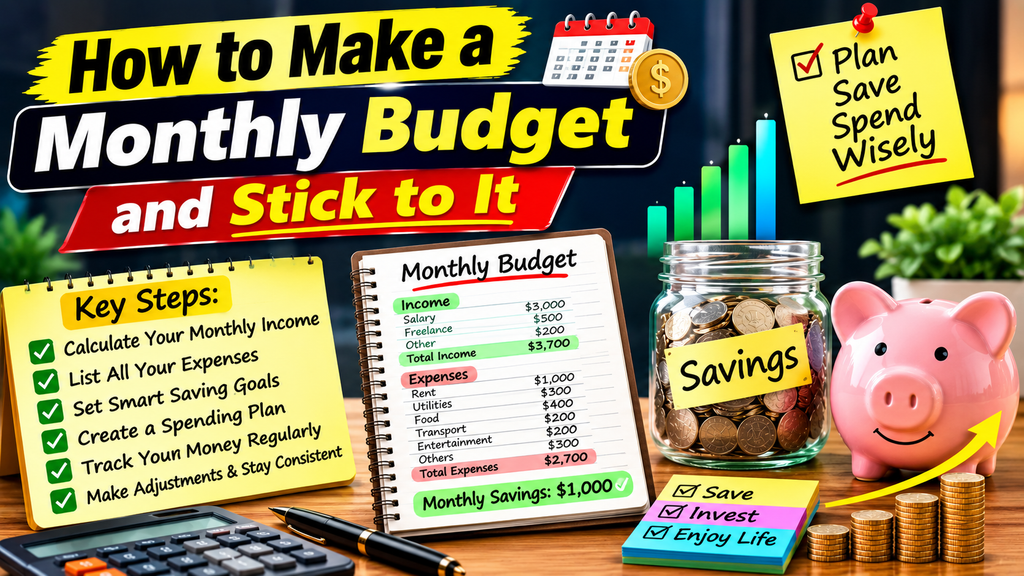
What Is a Monthly Budget?
A monthly budget is a plan for how you expect to use your income during a month.
It typically includes:
- Monthly take-home income
- Essential expenses
- Discretionary spending
- Debt payments
- Savings
- Investments
- Irregular expenses
A budget gives each part of your income a purpose.
It does not mean you cannot spend money on things you enjoy. Instead, it helps you decide how much you can reasonably spend without damaging your financial goals.
Why Should You Have a Monthly Budget?
Without a spending plan, it is easy to lose track of small purchases and recurring expenses.
A monthly budget can help you:
Control Spending
You know how much money is available for different categories.
Prepare for Bills
Planning ahead can reduce the chance of being surprised by regular expenses.
Build Savings
You can assign money to savings before spending the rest.
Manage Debt
A budget can help you make consistent debt payments and potentially accelerate repayment.
Plan for the Future
Once your basic expenses and financial obligations are organized, you can allocate money toward long-term goals such as retirement and investing.
Step 1: Calculate Your Monthly Take-Home Income
Start with the money you actually receive.
For employees, use your take-home pay rather than your gross salary.
If you are paid weekly or biweekly, determine a realistic monthly estimate.
If your income varies, consider using an average or conservative figure based on recent months.
Include reliable sources of income such as:
- Salary
- Freelance income
- Business income
- Part-time work
- Other predictable income
Avoid building your budget around an unusually high month.
A conservative estimate gives you more flexibility if income falls temporarily.
Step 2: List All Fixed Expenses
Next, identify expenses that are relatively consistent.
These might include:
- Rent
- Mortgage
- Car payments
- Insurance
- Phone service
- Internet
- Minimum debt payments
- Recurring subscriptions
Write down the actual amounts whenever possible.
If an expense changes slightly from month to month, use a reasonable average.
Add your fixed expenses together.
This tells you how much of your income is already committed.
Step 3: Estimate Variable Expenses
Variable expenses can change from one month to another.
Examples include:
- Groceries
- Gas
- Restaurants
- Entertainment
- Clothing
- Household purchases
- Personal care
Look at your recent bank and credit card statements.
Your past spending is often a better starting point than guessing.
If you spent an average of $500 on groceries during the previous three months, creating a $200 grocery budget may be unrealistic unless you have already identified specific changes that will reduce your spending.
Step 4: Separate Needs From Wants
Categorizing expenses can help you understand where you have flexibility.
Needs
These are expenses required for basic living or important obligations.
Examples include:
- Housing
- Basic food
- Utilities
- Transportation
- Insurance
- Required debt payments
Wants
These are optional expenses that improve your lifestyle.
Examples include:
- Restaurant meals
- Entertainment
- Hobbies
- Nonessential shopping
- Vacations
- Premium subscriptions
The purpose is not to eliminate wants.
Instead, knowing the difference helps you determine which expenses can be reduced when you need to create additional savings.
Step 5: Decide How Much to Save
Savings should have a place in your monthly budget.
Do not simply hope that money remains at the end of the month.
Choose an amount you can realistically save.
Your savings may be divided between goals such as:
- Emergency fund
- Short-term purchases
- Annual expenses
- Long-term financial goals
If you are starting from zero, even a modest amount can establish the habit.
As your income increases or expenses decrease, you can increase the amount.
Step 6: Include Debt Payments
If you have debt, include required payments in your budget.
List:
- Credit card balances
- Personal loans
- Student loans
- Auto loans
- Other debt
Record each minimum payment and due date.
Then determine whether additional money can be allocated toward repayment.
High-interest debt deserves particular attention because interest charges can make balances more expensive over time.
Step 7: Plan for Irregular Expenses
One of the most common budgeting mistakes is focusing only on monthly bills.
Some expenses occur periodically.
Examples include:
- Car maintenance
- Annual insurance
- Holiday spending
- Property expenses
- School costs
- Membership renewals
These expenses may not occur every month, but they still need to be paid.
Create a separate savings category for predictable irregular expenses.
For example, if you expect a $600 expense once per year, setting aside approximately $50 per month can make the future payment easier to handle.
Step 8: Choose a Budgeting Method
There are several ways to organize a monthly budget.
Zero-Based Budget
With a zero-based approach, you assign your expected income to expenses, savings, debt repayment, and investing until every dollar has a planned purpose.
This does not mean spending every dollar.
Money assigned to savings or investments is also given a purpose.
50/30/20 Framework
The 50/30/20 framework is a commonly used budgeting guideline.
It generally divides after-tax income into:
- 50% needs
- 30% wants
- 20% savings and debt repayment
These percentages should not be treated as universal rules.
Housing costs, family circumstances, income, debt, and location can make different percentages more realistic.
Pay-Yourself-First Method
This method prioritizes savings before discretionary spending.
For example, you might automatically transfer a set amount into savings after receiving your paycheck.
This can make saving more consistent.
Step 9: Make Your Budget Realistic
A budget should reflect your actual life.
If you regularly spend money on restaurants, entertainment, or hobbies, completely eliminating those categories may make the budget difficult to maintain.
Instead, set reasonable limits.
For example, rather than deciding that you will never eat at a restaurant again, determine an amount you can afford to spend each month.
A realistic budget is usually easier to follow than an extreme one.
Step 10: Use Separate Categories for Important Goals
Giving money a specific purpose can improve your financial organization.
Instead of having one general savings category, you might create:
- Emergency fund
- Car fund
- Vacation fund
- Home maintenance
- Annual expenses
- Retirement
- Long-term investing
You can use separate accounts, sub-accounts, or a budgeting system to organize these goals.
Step 11: Track Your Spending During the Month
Creating a budget at the beginning of the month is not enough.
Track your actual spending.
You can use:
- A spreadsheet
- Budgeting software
- A mobile app
- Your bank’s budgeting tools
- A simple notebook
The method matters less than consistency.
Check your spending regularly so you know whether you are approaching your limits.
Step 12: Create Weekly Spending Limits
A monthly budget can sometimes feel too distant.
Breaking discretionary spending into weekly limits can make it easier to manage.
Suppose you have $400 available for flexible spending during a month.
Instead of thinking about the entire $400, you might establish a weekly target.
This can help you recognize overspending earlier.
You can then adjust your spending before the month ends.
Step 13: Automate Important Payments
Automation can reduce missed payments and make your financial routine easier.
Where appropriate, consider automating:
- Savings transfers
- Retirement contributions
- Regular bill payments
- Debt payments
However, make sure enough money is available in your account before scheduled withdrawals.
Automation works best when combined with regular account monitoring.
Step 14: Review Your Budget Every Week
A quick weekly review can take only a few minutes.
Check:
- Current account balances
- Recent spending
- Upcoming bills
- Savings progress
- Credit card balances
- Unexpected expenses
This helps you identify problems before they become major issues.
Step 15: Adjust Your Budget When Necessary
A budget is not supposed to remain unchanged forever.
Your circumstances can change.
You may:
- Receive a raise
- Change jobs
- Move
- Pay off a loan
- Add a new recurring expense
- Experience a temporary income reduction
Update your budget when your financial situation changes.
If one category consistently exceeds its limit, determine why.
Perhaps the spending needs to be reduced, or perhaps the original budget was unrealistic.
How to Stick to Your Budget
Creating a budget is easier than maintaining one.
Here are several practical strategies.
Keep It Simple
Too many categories can make budgeting exhausting.
Use enough categories to understand your spending without making the system unnecessarily complicated.
Automate Savings
Automatic transfers reduce the need to remember to save.
Review Spending Frequently
A weekly review can keep you aware of your financial position.
Set Specific Goals
Saving for a clear purpose can be more motivating than simply trying to accumulate money.
Leave Room for Fun
A realistic budget should include some discretionary spending when your financial situation allows it.
Expect Mistakes
One overspending decision does not mean the entire budget has failed.
Adjust and continue.
What to Do If You Overspend
Overspending happens.
The worst response is often abandoning your budget completely.
Instead, identify the reason.
Was the expense:
- Unexpected?
- Necessary?
- An impulse purchase?
- A recurring expense you forgot?
- A category that was underfunded?
Then make an adjustment.
If groceries consistently exceed your budget, for example, you may need to review your grocery spending rather than repeatedly setting an unrealistically low limit.
Example of a Simple Monthly Budget
Suppose someone brings home $4,500 per month.
A simplified plan could look like this:
| Category | Monthly Amount |
|---|---|
| Housing | $1,400 |
| Utilities & Communication | $350 |
| Groceries | $500 |
| Transportation | $400 |
| Debt Payments | $300 |
| Emergency Savings | $500 |
| Investing | $400 |
| Entertainment & Personal | $350 |
| Miscellaneous | $300 |
| Total | $4,500 |
This is only an example.
A real budget should reflect your own income, expenses, debt, savings goals, and financial priorities.
Common Monthly Budgeting Mistakes
Forgetting Small Purchases
Frequent small purchases can add up.
Ignoring Annual Expenses
Non-monthly expenses still need to be planned.
Setting Unrealistic Limits
A budget that does not reflect reality is difficult to maintain.
Spending Savings
Savings should generally have a defined purpose.
Increasing Spending After a Raise
Consider directing part of additional income toward savings, debt repayment, or investing.
Not Reviewing the Budget
A budget becomes much more useful when you compare planned spending with actual spending.
When Should You Create Your Budget?
You can create a budget at any time.
The beginning of a month can be convenient because it gives you a clear planning period.
However, you do not need to wait for the first day of a new month.
If you recognize that your finances need improvement today, start today.
The first budget does not need to be perfect.
You can improve it after reviewing your actual spending.
Final Thoughts
Learning how to make a monthly budget is an important step toward taking control of your finances.
Start by calculating your take-home income, listing fixed and variable expenses, separating needs from wants, and assigning money toward savings and financial goals.
Then track your actual spending and review your budget regularly.
The most effective budget is not necessarily the most detailed one. It is the one you understand, use, and adjust when your circumstances change.
With consistent budgeting habits, you can create more room for emergency savings, debt repayment, retirement planning, and long-term investing.
The goal is not financial perfection.
The goal is to make your money decisions more intentional every month.