
Creating a personal budget is one of the simplest ways to take control of your money. A good budget can help you understand where your income goes, reduce unnecessary spending, build savings, and make progress toward long-term financial goals.
The problem is that many people create complicated budgets they cannot maintain. A budget only works when it fits your actual lifestyle and is simple enough to follow consistently.
In this guide, you’ll learn how to create a personal budget step by step, how to organize your income and expenses, how much to save, and how to make your budget easier to maintain.
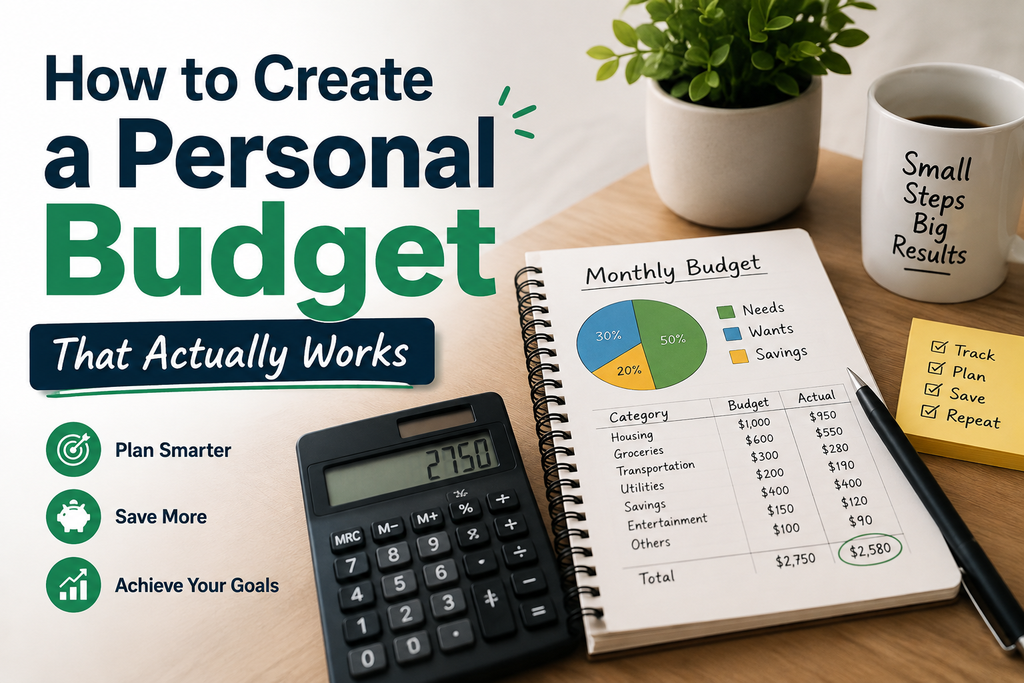
What Is a Personal Budget?
A personal budget is a plan for how you will use your income during a specific period, usually a month.
It typically includes:
- Monthly income
- Housing costs
- Food and groceries
- Transportation
- Utilities
- Debt payments
- Entertainment
- Savings
- Investments
- Other personal expenses
The goal is not to stop spending money. Instead, a budget helps you decide where your money should go before you spend it.
A successful budget should give you enough flexibility to handle normal expenses while still helping you work toward financial goals.
Why Is Creating a Budget Important?
Without a budget, it can be difficult to know whether you are spending more than you earn or whether you are making meaningful progress toward your financial goals.
A budget can help you:
Understand Your Spending
Tracking expenses shows you where your money is actually going. Small purchases can add up significantly over an entire month.
Build an Emergency Fund
A budget can create room for regular savings. Over time, those contributions can help you build an emergency fund for unexpected expenses.
Reduce Unnecessary Spending
Once you can see your spending patterns, it becomes easier to identify expenses you may want to reduce.
Pay Down Debt
A budget can help you allocate money toward credit cards, personal loans, student loans, or other debts.
Prepare for Investing
Once your basic financial needs are covered and you have a suitable cash reserve, your budget can help you consistently allocate money toward long-term investing.
Step 1: Calculate Your Monthly Income
Start by determining how much money you actually receive each month.
For someone with a regular salary, this may be relatively straightforward. Use your take-home pay rather than your gross salary because your budget should be based on the amount that reaches your bank account.
If your income varies from month to month, you may want to use a conservative estimate based on your typical income rather than assuming you will always earn your highest amount.
Your income may include:
- Salary
- Freelance income
- Business income
- Side-job income
- Other regular sources of income
Write down your expected monthly income before planning your expenses.
Step 2: List Your Fixed Expenses
Fixed expenses are costs that generally remain similar from month to month.
Examples include:
- Rent or mortgage payments
- Car payments
- Insurance premiums
- Internet bills
- Phone plans
- Minimum debt payments
- Subscription services
Add these expenses together to understand how much of your income is already committed.
Fixed expenses are important because they can be harder to change quickly. If they consume a very large portion of your income, you may need to examine your larger financial commitments rather than focusing only on small purchases.
Step 3: Estimate Your Variable Expenses
Variable expenses can change from month to month.
Common examples include:
- Groceries
- Restaurants
- Gas
- Clothing
- Entertainment
- Household purchases
- Personal care
- Hobbies
Look at your bank and credit card statements from the previous two or three months to estimate realistic amounts.
Do not simply guess.
Your historical spending can reveal patterns that you may not notice in everyday life.
Step 4: Separate Needs From Wants
One useful budgeting exercise is dividing expenses into needs and wants.
Needs are expenses that are necessary for basic living or important financial obligations. Wants are expenses that improve your lifestyle but are generally optional.
For example:
Needs:
- Housing
- Basic groceries
- Utilities
- Transportation
- Required debt payments
Wants:
- Dining out
- Streaming services
- Expensive hobbies
- Nonessential shopping
- Entertainment
This does not mean you should eliminate every want.
The purpose is to understand which expenses can be adjusted when money becomes tight.
Step 5: Set Savings Goals
Savings should be part of your budget rather than something you do only when money is left over.
Start by identifying your financial goals.
These could include:
- Building an emergency fund
- Saving for a car
- Saving for a home
- Preparing for annual expenses
- Paying down debt
- Investing for long-term goals
Give each goal a specific amount whenever possible.
For example, instead of saying, “I want to save more,” create a measurable target such as saving a specific amount every month.
This makes your progress easier to track.
Step 6: Include Investing in Your Budget
Investing can become part of a long-term financial plan.
However, investing should not replace basic financial stability. Before investing money you may need for immediate expenses, consider whether you have enough cash available for emergencies and whether high-interest debt needs attention.
Once your financial foundation is reasonably stable, you can determine how much of your monthly income you want to allocate toward long-term investments.
Depending on your situation, this could include diversified investments such as broad-market index funds or ETFs.
Investment decisions should take into account your goals, time horizon, risk tolerance, and overall financial situation.
Step 7: Choose a Budgeting Method
There is no single budgeting system that works for everyone.
Zero-Based Budgeting
With zero-based budgeting, you assign your expected income to different spending, saving, debt repayment, and investing categories until every dollar has a planned purpose.
This does not mean you spend everything. Savings and investments can also be assigned as part of the plan.
50/30/20 Budget
The 50/30/20 framework is another popular starting point.
It generally divides after-tax income into:
- 50% for needs
- 30% for wants
- 20% for savings and debt repayment
These percentages are guidelines, not strict rules.
Housing costs, income levels, debt obligations, family size, and location can make a different allocation more realistic.
Pay-Yourself-First Budget
This approach prioritizes savings before discretionary spending.
For example, you might automatically transfer a predetermined amount into savings shortly after receiving your paycheck.
Automation can make saving easier because the money is moved before you have an opportunity to spend it.
Step 8: Track Your Actual Spending
Creating a budget is only the beginning.
You also need to compare your planned spending with your actual spending.
At the end of each week or month, review your transactions and ask:
- Did I stay within my spending limits?
- Which categories were higher than expected?
- Did I save the amount I planned?
- Were there unexpected expenses?
- What should I change next month?
This process turns your budget into a system that improves over time.
Step 9: Create a Category for Unexpected Expenses
Unexpected costs are one of the biggest reasons budgets fail.
Your car may need repairs. A medical expense may occur. A household appliance may stop working.
Instead of pretending these costs will never happen, create room for irregular expenses.
You can also create separate savings categories for predictable but less frequent expenses, such as annual insurance payments, holidays, vehicle maintenance, or property expenses.
This can prevent a large bill from completely disrupting your monthly budget.
Step 10: Review Your Budget Every Month
Your financial situation can change.
Your income may increase. Rent may change. A debt may be paid off. Your savings goals may change.
Review your budget regularly and make adjustments when necessary.
A budget is not a contract that can never change. It is a financial plan that should evolve with your life.
Common Budgeting Mistakes to Avoid
Making the Budget Too Complicated
If your budget requires too much time to maintain, you may eventually stop using it.
Keep your categories simple enough to manage consistently.
Forgetting Irregular Expenses
Annual and occasional expenses can create major problems if they are not included in your financial plan.
Setting Unrealistic Spending Limits
A budget that allows no room for normal enjoyment may be difficult to maintain.
Give yourself reasonable limits instead of creating rules you are unlikely to follow.
Ignoring Small Purchases
Individual small purchases may seem insignificant, but frequent spending can become substantial over time.
Treating the Budget as a Punishment
A budget should help you make better decisions, not make you feel guilty about every purchase.
The goal is to spend intentionally.
A Simple Monthly Budget Example
Suppose someone takes home $4,000 per month.
A simplified plan might look like:
| Category | Monthly Amount |
|---|---|
| Housing | $1,300 |
| Utilities & Phone | $300 |
| Groceries | $450 |
| Transportation | $350 |
| Debt Payments | $300 |
| Savings | $500 |
| Investing | $400 |
| Entertainment & Personal | $250 |
| Miscellaneous | $150 |
| Total | $4,000 |
This is only an example. Your actual budget should reflect your income, expenses, financial goals, and personal circumstances.
How to Make Your Budget Easier to Follow
The best budget is one you can maintain.
A few simple habits can help:
Automate savings. Set up automatic transfers when practical.
Check your accounts regularly. A quick weekly review can help you stay aware of your spending.
Use realistic categories. Your budget should reflect how you actually live.
Adjust instead of quitting. If you consistently exceed a category, determine whether the limit needs to change or whether the spending needs to be reduced.
Give every dollar a purpose. Knowing what your money is supposed to accomplish can make spending decisions easier.
Final Thoughts
Learning how to create a personal budget is an important first step toward better money management.
A good budget does not require complicated spreadsheets or extreme spending restrictions. Start by calculating your income, listing your expenses, separating needs from wants, setting savings goals, and creating a realistic plan for spending and investing.
Most importantly, review your budget regularly and adjust it as your circumstances change.
The goal is not to create a perfect budget. The goal is to build a system that helps you consistently make informed decisions with your money.