
“I am writing to express my interest in the position of…” — if you’ve opened a cover letter with this line, so have 200 other applicants for the same job. Recruiters at any mid-size company read this exact sentence dozens of times a week, and by the second word they’ve already mentally filed your letter under “generic.” A cover letter isn’t a formality you attach because the job posting says “cover letter required” — it’s the one part of your application where you get to sound like an actual person instead of a resume bullet point.
This guide breaks down a cover letter structure that avoids the templates everyone recognizes, with real line examples you can adapt.
Table of Contents
- Why Most Cover Letters Fail Before Line Two
- The Opening Line — Replace the Cliché
- Paragraph 2: Connect Your Experience to Their Actual Problem
- Paragraph 3: Why This Company, Specifically
- The Closing — Skip the Desperate Tone
- A Full Example, Start to Finish
- FAQ
- Final Takeaway
Why Most Cover Letters Fail Before Line Two
Recruiters and hiring managers read cover letters looking for one thing: does this person understand what we actually need, or are they sending the same letter to 50 companies? A generic opener answers that question immediately — and not in your favor.
The fix isn’t “sound more enthusiastic.” It’s specificity. A cover letter that mentions the company’s actual product, a recent update to their app, or a specific line from the job description reads as researched. One that could be sent to any company in any industry reads as a template, even if you wrote it yourself from scratch.
The Opening Line — Replace the Cliché
Skip “I am writing to express my interest in…” and “I came across your job posting on LinkedIn and was excited to apply.” Neither tells the reader anything they don’t already know — they know you’re applying because you sent them an application.
Instead, open with one of these three approaches:
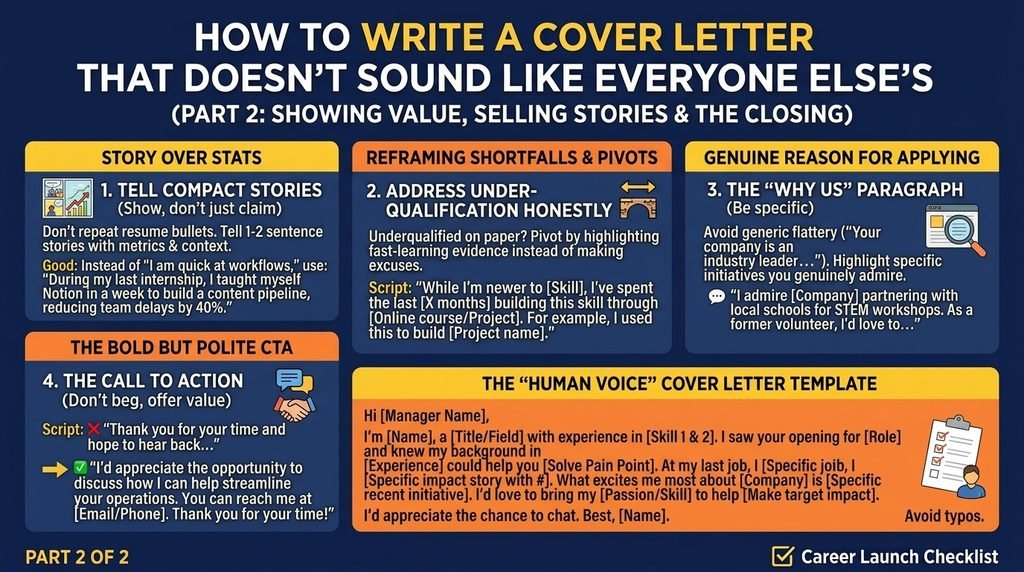
1. A specific observation about the company “Swiggy’s shift to hyperlocal dark stores in 2025 solved a supply-chain problem most competitors are still stuck on — it’s exactly the kind of operations challenge I want to work on.”
2. A direct connection to the role’s core requirement “Your job posting for a Data Analyst asks for someone comfortable turning messy retail data into dashboards leadership can act on fast — that’s the exact work I did for 8 months building a demand-forecasting sheet for my college’s placement cell.”
3. A brief, relevant personal detail (only if genuinely relevant) “I built my first automation script to solve a problem in my father’s small retail shop — tracking daily cash mismatches that used to take him an hour every night to reconcile manually.”
Any of these does more work in one sentence than a full paragraph of generic enthusiasm.
Paragraph 2: Connect Your Experience to Their Actual Problem
This is where most fresher cover letters just restate the resume — “I have completed my B.Com and have knowledge of Tally and Excel.” The recruiter already has your resume open in the next tab; repeating it wastes the one section where you’re supposed to add context the resume can’t show.
Instead, pick one specific project or experience and explain the reasoning behind it — the part a bullet point can’t capture.
Resume bullet (what they already saw): “Built an inventory tracking system reducing manual errors by 40%.”
Cover letter version (what a bullet can’t show): “When I built the inventory tracking system for my internship project, the harder part wasn’t the code — it was figuring out why the warehouse staff kept skipping steps in the old process. I sat with two of them for a shift before writing a single line, which is why the final version had a 40% drop in manual entry errors instead of just automating the existing broken workflow.”
This shows judgment, not just output — something a resume line genuinely cannot communicate.
Paragraph 3: Why This Company, Specifically
This paragraph is where “I really want to work at your esteemed organization” kills your letter. It’s the most copy-pasted line in Indian cover letters and immediately signals a template.
Instead, name something specific:
- A product feature or market move they made in the last 12 months
- A specific team or division you’d be joining and why it interests you
- A value or working style mentioned in their careers page or a founder’s interview, and why it matches how you work
Example: “I’ve been using CRED’s app since 2024, and what pulled me toward applying here specifically is how the product team treats small UX details — like the rent payment flow — as seriously as the core features. That attention to detail in the small stuff is the standard I try to hold myself to in my own project work.”
If you can’t write this paragraph with something specific to the company, it’s a sign you haven’t researched enough yet — spend 15 minutes on their website, app, or a recent news mention before finishing the letter.
The Closing — Skip the Desperate Tone
Avoid: “I hope you will consider my application favorably” or “I am eagerly awaiting your positive response.” Both read as anxious rather than confident, and neither adds information.
Close with a simple, forward-looking line:
“I’d welcome the chance to talk through how my project work on [specific thing] could fit into what your team is building. Thank you for your time reviewing my application.”
Short, direct, no over-explaining.
A Full Example, Start to Finish
Position: Junior Data Analyst, fintech startup
Your posting for a Junior Data Analyst mentions turning transaction data into fraud-pattern insights the compliance team can act on same-day — that’s close to the exact problem I worked on for my final-year project, building a rule-based flagging system for a simulated UPI transaction dataset of 50,000 records.
The technical part (Python, Pandas, basic anomaly-detection rules) took me about three weeks. The harder part was deciding which flagged transactions were worth a human review versus which ones were just noise — getting that balance wrong either buries the compliance team in false positives or lets real issues slip through. I ended up cutting my initial flag rate from 12% of all transactions to 3%, without missing any of the seeded fraud cases in the test set.
I’ve followed [Company Name]’s expansion into UPI-based lending over the past year, and fraud detection at that scale is a genuinely different problem than what I worked on academically — which is exactly why I want to work on it here rather than somewhere theoretical.
I’d welcome the chance to talk through how this project work could translate to your team’s actual data. Thank you for considering my application.
Rahul Sharma
Notice: no “I am writing to express,” no “esteemed organization,” and every paragraph does a different job instead of repeating the same enthusiasm three times.
Final Takeaway
A cover letter earns attention by being specific where your resume can’t be — the reasoning behind one project, a real observation about the company, and a closing that doesn’t beg. Skip the opening cliché, pick one story instead of restating your whole resume, and name something actual about the company in paragraph three. Rewrite your next cover letter using this structure before you send your next application, and see if your response rate changes.