
You’ve applied to 40 jobs. Maybe 2 replied. It’s not because you’re unqualified — it’s because your resume never made it past the first 6-second scan. Recruiters at companies like TCS, Deloitte, or a 50-person startup all do the same thing first: skim, not read. If your resume doesn’t answer “can this person do the job” in that window, it goes into the reject pile, no matter how good you actually are.
This isn’t a “resume tips” listicle. It’s a template — section by section — built around what actually gets fresher resumes shortlisted in India’s current hiring market, where ATS (Applicant Tracking System) software filters resumes before a human ever sees them.
Table of Contents
- The One-Page Rule and Why It’s Non-Negotiable
- Section 1: Header — What to Include (and Skip)
- Section 2: Resume Summary vs Objective
- Section 3: Education — Format That Recruiters Expect
- Section 4: Projects and Internships (This Is Where Freshers Win or Lose)
- Section 5: Skills — Listing Them Right for ATS
- Common Fresher Mistakes That Cause Rejection
- FAQ
- Final Takeaway
The One-Page Rule and Why It’s Non-Negotiable
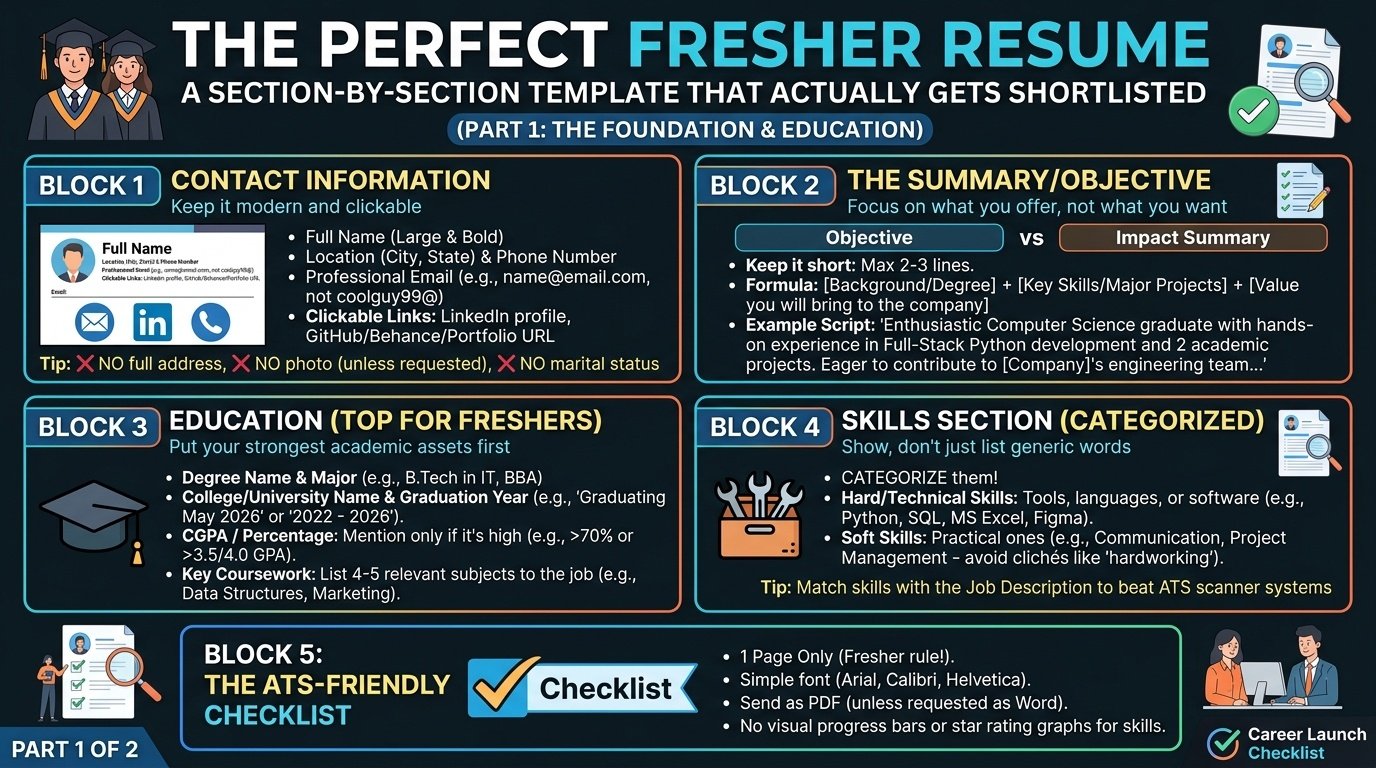
As a fresher, you have zero years of full-time experience — trying to stretch your resume to two pages usually means padding it with irrelevant coursework or generic soft-skill claims. Recruiters reviewing 200+ applications for a single opening spend an average of 6-8 seconds on the initial scan. A single, tightly written page with clear sections beats two pages of filler every time.
Use these formatting basics:
- Font: Calibri, Arial, or Garamond, 10.5–11.5 pt
- Margins: 0.5–0.75 inches on all sides
- File format: PDF, unless the job portal specifically asks for .docx (some older ATS systems parse Word files more reliably)
- File name: “Rahul_Sharma_Resume.pdf” — not “Resume_final_v3.pdf”
Section 1: Header — What to Include (and Skip)
Your header should have exactly five things: full name, phone number, email, city (not full address), and LinkedIn URL. If you have a relevant GitHub, portfolio site, or Behance profile, add it here too.
Skip these — they’re outdated and occasionally used as unconscious bias triggers by some recruiters:
- Photo (unless applying to acting, modeling, or specific hospitality roles)
- Date of birth
- Marital status
- Father’s name
- Full residential address
Example:
Rahul Sharma
Bengaluru, Karnataka | +91-98XXXXXX21 | rahul.sharma@email.com | linkedin.com/in/rahulsharma
Section 2: Resume Summary vs Objective
Most fresher resumes still open with a generic objective line like “Seeking a challenging position to utilize my skills for organizational growth.” This tells the recruiter nothing and wastes prime real estate — the top third of your resume is what gets read most carefully.
Replace it with a 3-line summary that mentions your degree, your strongest technical skill, and one measurable achievement or project outcome.
Weak (objective style): “To obtain a position in a reputed company where I can use my skills and grow professionally.”
Strong (summary style): “B.Tech Computer Science graduate (2026, VIT Vellore) with hands-on experience in Python and SQL through 3 academic projects, including a inventory management system that reduced manual entry errors by 40% in a simulated test environment. Seeking an entry-level data analyst role.”
The second version gives the recruiter three concrete facts to act on in under 10 seconds.
Section 3: Education — Format That Recruiters Expect
For freshers, education sits near the top since it’s your primary credential. List it in reverse chronological order — most recent degree first.
| Degree | Institution | Year | Score |
|---|---|---|---|
| B.Tech, Computer Science | VIT Vellore | 2022–2026 | CGPA 8.4/10 |
| Class XII (CBSE) | DAV Public School, Delhi | 2022 | 91% |
| Class X (CBSE) | DAV Public School, Delhi | 2020 | 94% |
Include your CGPA/percentage only if it’s above 7.0 CGPA or 70% — anything lower, it’s safer to omit and let your projects and skills carry the weight instead.
Section 4: Projects and Internships (This Is Where Freshers Win or Lose)
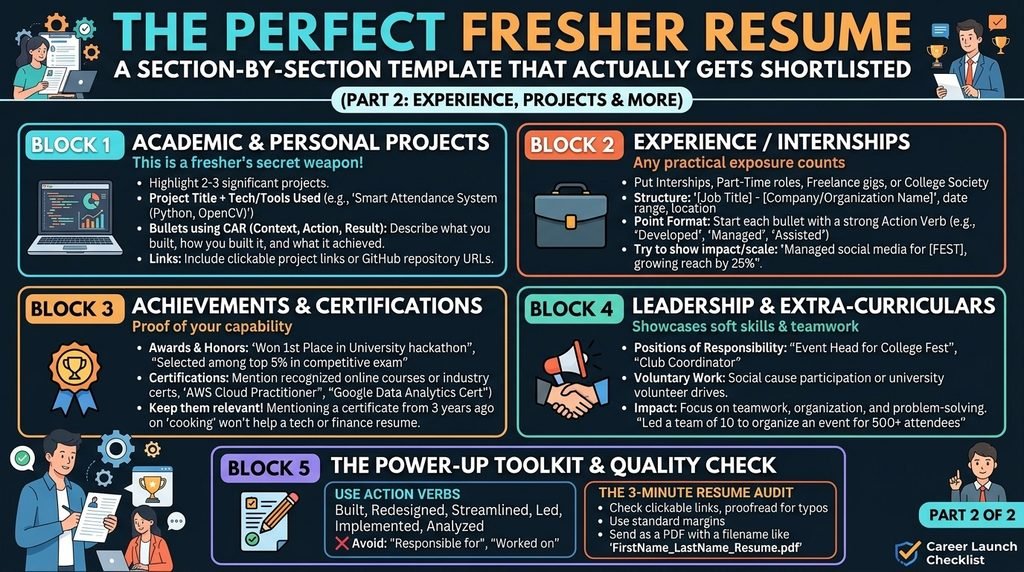
This is the single most important section on a fresher resume, and most candidates underuse it. Recruiters know you don’t have “real” work experience — projects and internships are your substitute proof of capability.
For each project or internship, use this three-line structure:
- What you built/did (one line, specific)
- Tools/tech used (specific names — “Python, Pandas, MySQL,” not “various programming languages”)
- Measurable outcome or scale (numbers, even estimated ones, beat vague claims)
Example:
E-commerce Price Tracker (Personal Project, Jan–Mar 2026) Built a Python-based web scraper using BeautifulSoup and Selenium to track price changes across 3 e-commerce sites; stored data in MySQL and visualized trends using Matplotlib. Tracked 200+ products daily with 98% scrape accuracy.
If you did a 2-month internship at a small company doing “general support work,” don’t write that. Break down what you actually did — even if it feels minor, like “prepared weekly MIS reports in Excel for a 12-person sales team” is far stronger than “assisted in sales operations.”
Section 5: Skills — Listing Them Right for ATS
Most companies with 100+ employees now use an ATS to filter resumes by keyword match against the job description before a human sees it. This means your skills section should mirror the exact terms used in the job posting — if the JD says “MS Excel,” don’t just write “spreadsheets.”
Split your skills into two clear groups:
Technical Skills: Python, SQL, Excel (Pivot Tables, VLOOKUP), Power BI, Tally ERP 9 Soft Skills: Keep this list short — 3 items max, and only ones you can back up in an interview with a specific example (e.g., “team coordination” only if you can describe an actual instance)
Avoid vague, unquantifiable soft-skill dumps like “hardworking, punctual, good communication skills, quick learner” — recruiters see this on almost every fresher resume and it has become background noise that adds no signal.
Common Fresher Mistakes That Cause Rejection
- Generic email IDs — “coolguy_rahul99@gmail.com” looks unprofessional; switch to firstname.lastname@gmail.com
- Listing every college course — nobody needs to see all 40 subjects you studied; only list specializations or electives relevant to the job
- Copy-pasted job descriptions as “skills” — writing “Java, Python, C++, Data Structures, OOPs, DBMS, Networking, Cloud Computing, Machine Learning” as one giant list signals nothing; pick 5-6 you’re genuinely proficient in
- No quantification anywhere — resumes without a single number (%, ₹, count, time saved) read as vague to recruiters trained to scan for impact
- Same resume for every job — sending an identical resume to a bank PO exam candidate role and a software developer role is an instant mismatch flag for ATS keyword scoring
FAQ
Q1: Should freshers include a photo on their resume in India? No, unless the specific job posting asks for it (some hospitality, aviation, or acting-adjacent roles do). For corporate and government jobs, a photo isn’t expected and occasionally slows down ATS parsing.
Q2: How long should a fresher resume be? One page. If you genuinely have extensive project work, internships, and certifications that justify more space, a page and a half is the absolute upper limit — never two full pages as a fresher.
Q3: Should I list my 10th and 12th marks if my degree CGPA is low? Yes, if your school marks are strong — it shows consistency isn’t zero, and some recruiters (especially in banking and PSU-adjacent private roles) still screen on 10th/12th percentage cut-offs.
Q4: Is a resume objective ever acceptable? Rarely. A tailored 2-3 line summary almost always performs better because it leads with proof (skills, projects, achievements) rather than a request.
Q5: Do I need a separate resume for government job applications vs private company applications? Often yes. Government job forms (like SSC or bank PO applications) usually require a structured, factual CV without design elements, while private companies respond better to a clean, slightly designed one-pager. Keep both versions ready.
Q6: Should I mention hobbies and extracurriculars? Only if directly relevant — leading a college tech fest team, winning a coding hackathon, or captaining a sports team that shows leadership. Generic hobbies like “reading” or “listening to music” add no value and take up space better used for skills or projects.
Final Takeaway
A fresher resume isn’t judged on how much you’ve done — it’s judged on how clearly you can prove what you’ve done. Cut the objective statement, quantify every project, mirror the job description’s language in your skills section, and keep it to one page. Update this resume for every single application based on the specific job description, and you’ll notice the shortlist rate change within your next 10 applications.
Next step: Pull up your current resume right now and check — does every bullet point have a number in it? If not, that’s your first fix before you send out another application.