
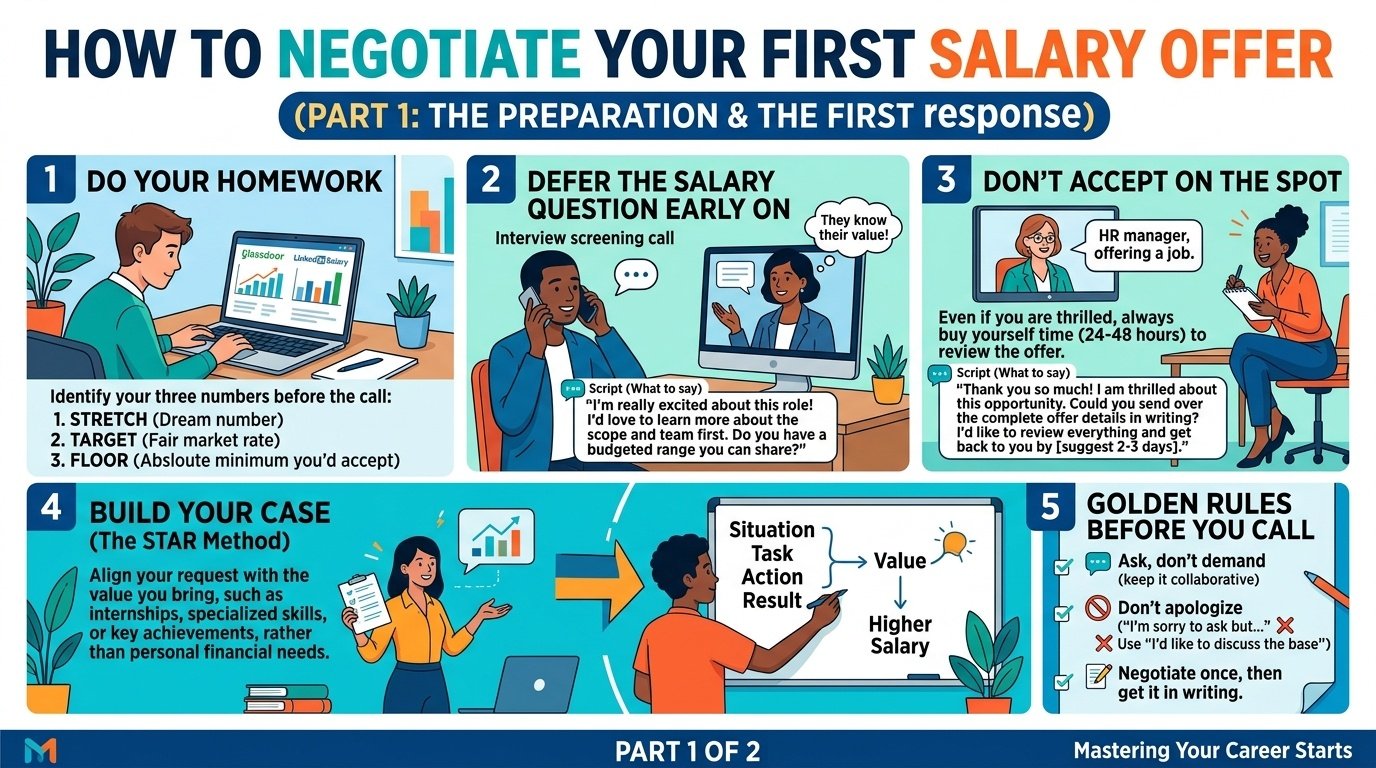
Most freshers accept their first job offer without negotiating at all — partly out of gratitude for landing a role, partly out of fear that asking for more might make the offer disappear entirely. This fear is largely misplaced. Reasonable, well-framed negotiation rarely costs candidates an offer, and the difference between your first accepted salary and a modestly negotiated one can compound significantly over your career, since future raises and job-switch offers are often calculated as a percentage of your current salary. Here’s how to approach this practically.
Why Negotiation Matters More Than It Feels Like It Does
A seemingly small difference at your first job — say, negotiating ₹4.2 LPA instead of accepting ₹3.8 LPA — might feel insignificant in the moment, but this baseline affects your compensation trajectory for years, since subsequent raises, bonuses, and even offers from future employers are frequently benchmarked against your current or most recent salary. Starting even modestly higher genuinely compounds over a multi-year career.
At the same time, it’s worth being realistic about how much negotiation room exists for entry-level fresher roles specifically — many companies, especially larger organizations, have relatively fixed fresher compensation bands with limited individual negotiation flexibility, unlike experienced-hire roles where negotiation ranges are typically wider. Understanding this distinction helps calibrate your expectations appropriately.
Before You Negotiate: Do Your Research
Understand the Market Rate for Your Specific Role and Location
Research typical starting salaries for your specific role, industry, and city using multiple sources — salary information shared by seniors or alumni from your college in similar roles, salary insight sections on platforms like Glassdoor and AmbitionBox, and, where available, informal conversations with current employees at your target company. City matters considerably — metro city salaries for the same role are often meaningfully higher than tier-2/3 city salaries, so ensure your research reflects your specific location.
Understand Your Own Leverage Honestly
Fresher negotiation leverage is generally more limited than experienced-hire negotiation, but it’s not zero — having multiple offers genuinely strengthens your negotiating position, as does a particularly strong, differentiated skill set or relevant experience (a strong internship, notable project work, or in-demand technical certification) that goes beyond typical fresher candidates. Being honest with yourself about your actual leverage, rather than overestimating it, helps you negotiate confidently without overreaching into territory that risks the relationship.
When to Negotiate — and When It’s Reasonable to Just Accept
If the offer is already at or above your researched market rate, and particularly if it’s your first offer with limited comparison points, it’s often reasonable to accept directly, especially if the role offers strong learning opportunities that matter more to your medium-term career than a marginal salary difference at this early stage.
If the offer is notably below your researched market range, or if you have another offer with different, potentially more favorable terms, negotiation becomes considerably more reasonable and worthwhile to attempt, following a respectful, professional approach.
The Negotiation Conversation: A Practical Script
Opening the Conversation
Once you receive a verbal or written offer, express genuine enthusiasm first, then transition into the negotiation conversation professionally:
“Thank you so much for this offer — I’m genuinely excited about the opportunity to join [Company] and the [Role]. Before I confirm, I wanted to discuss the compensation a bit further, if that’s alright.”
This opening does two things: it confirms genuine interest (which recruiters value and which reduces any concern that you’re negotiating insincerely) and signals a professional, expected conversation rather than an ultimatum.
If You Have Market Research Supporting a Higher Ask
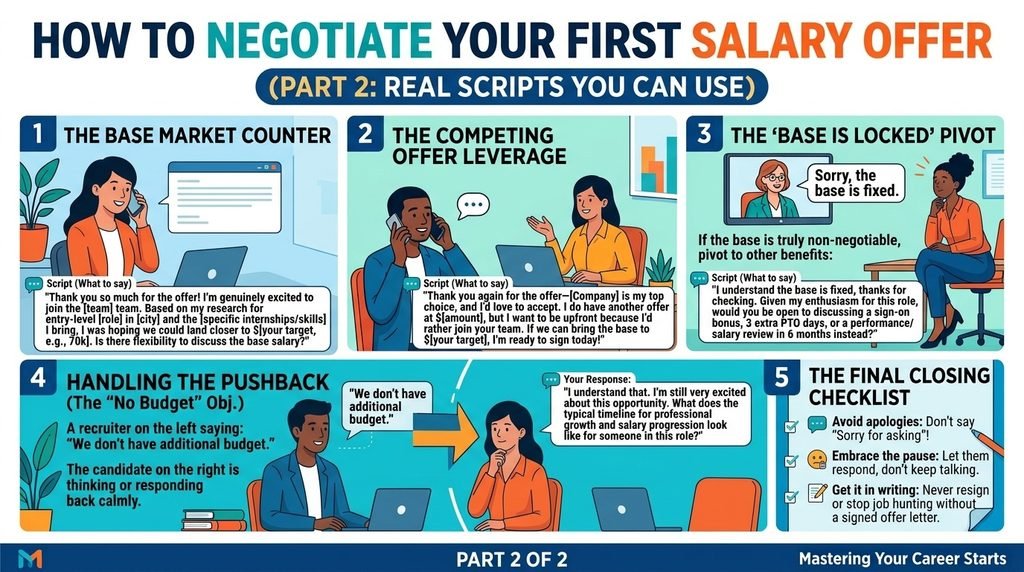
“Based on my research into similar roles at comparable companies in [city], I found that the typical range for this position is around [X to Y]. Given [specific relevant strength — a strong internship, relevant certification, project experience], I was hoping we could discuss a figure closer to [specific number] instead.”
Being specific with a researched number, rather than a vague “can you pay more,” makes your request considerably easier for the recruiter to evaluate and respond to constructively.
If You Have a Competing Offer
“I wanted to be transparent that I’ve also received an offer from another company at [figure, if you’re comfortable sharing, or simply “a higher figure” if you prefer not to disclose the exact number]. [Company] is genuinely my preferred choice given [specific reason — culture, role fit, growth opportunity], and I’d love to find a way to make this work if there’s any flexibility on the compensation side.”
This script is honest without being confrontational, and it gives the company a genuine opportunity to match or improve their offer if they have flexibility, while clearly signaling your authentic preference for their offer specifically (assuming that’s genuinely true).
If the Company Says There’s No Flexibility on Base Salary
“I understand if the base salary band is fixed. Are there other aspects of the offer — joining bonus, review timeline, learning and development budget, or any other benefits — where there might be some flexibility?”
Base salary isn’t the only negotiable element — joining bonuses, early performance review timelines (which can accelerate your first raise), and other benefits sometimes have more flexibility even when the base salary band is genuinely fixed for fresher roles.
Handling Common Pushback Scenarios
“This Is Our Standard Fresher Package, We Don’t Negotiate Individual Offers”
This is genuinely common at larger, more process-driven companies, and if the stated figure is reasonably in line with your market research, it’s often sensible to accept gracefully rather than pushing further against a genuinely fixed structural policy:
“That makes sense, thank you for clarifying. I’m happy to move forward with the offer as it stands.”
“We Can’t Match That Other Offer, But We’d Love to Have You”
If a company can’t match a competing offer but you still prefer them for genuine reasons beyond salary (role fit, growth trajectory, company reputation), it’s entirely reasonable to accept a lower offer consciously, provided you’re making that trade-off deliberately rather than out of negotiation discomfort:
“I appreciate you being upfront about that. I do think [Company] is the better fit for my long-term growth, so I’d like to move forward with your offer as discussed.”
The Offer Gets Rescinded After You Ask (Rare, But Worth Addressing)
Genuine, respectful salary negotiation very rarely results in an offer being withdrawn — companies that rescind offers over reasonable negotiation attempts are signaling a concerning culture that’s worth knowing about before joining, so while this outcome is uncommon, it’s not necessarily something to view purely as a loss if it does happen.
What Not to Do During Negotiation
Avoid presenting ultimatums you’re not genuinely prepared to follow through on (“give me X or I’m walking away”) unless you’re truly willing to walk away, since this approach can backfire significantly if the company doesn’t budge and you’re forced to either follow through uncomfortably or lose credibility by backing down.
Avoid fabricating competing offers that don’t actually exist — this is both an integrity issue and a genuine risk, since experienced recruiters sometimes ask follow-up questions that can expose an inconsistent fabricated story, damaging your credibility in a professional network that’s often smaller and more interconnected than it appears.
Avoid negotiating purely based on personal financial need (“I have loans to pay” or “my rent is high”) as your primary argument — while understandable, this framing is less persuasive to companies than market-rate research and demonstrated value, since compensation decisions are typically benchmarked against role value and market rates, not individual financial circumstances.
After the Negotiation: Confirming in Writing
Regardless of the outcome, always request the final agreed terms in writing (a formal offer letter reflecting any negotiated changes) before resigning from a current role (if applicable) or declining other offers. Verbal agreements during negotiation conversations should always be confirmed through official documentation before you take any binding action based on them.
Frequently Asked Questions
Q1. Is it normal to negotiate a fresher job offer, or does it look presumptuous? It’s increasingly normal and generally viewed professionally, especially when approached respectfully with genuine market research — recruiters expect and are prepared for reasonable negotiation conversations, even for fresher roles, though flexibility varies by company.
Q2. What if I don’t have a competing offer to leverage? You can still negotiate based on market research and specific relevant strengths alone — a competing offer strengthens your position, but it’s not the only valid basis for a respectful negotiation conversation.
Q3. How much of a salary increase is reasonable to ask for as a fresher? This varies considerably by role, company, and your specific research findings, but modest, well-justified requests (typically in a reasonable percentage range above the initial offer, backed by market data) tend to be received more constructively than large, unsubstantiated asks.
Q4. Should I negotiate over email or in a phone/video call? A phone or video call is generally preferable for the actual negotiation conversation, since it allows for more natural back-and-forth dialogue, though following up with a written summary via email afterward is good practice for both parties’ clarity.
Q5. What if the recruiter seems annoyed or dismissive when I bring up negotiation? While uncommon for reasonable, professional negotiation attempts, if this does happen, it’s worth considering as information about the company’s culture — a consistently dismissive response to a respectful, well-reasoned negotiation attempt isn’t necessarily a great sign about how the organization treats compensation conversations generally.
The Bottom Line
Negotiating your first salary offer, done respectfully and backed by genuine market research, rarely costs you the offer and can meaningfully improve your long-term compensation trajectory. Approach the conversation with authentic enthusiasm for the role, specific research-backed numbers rather than vague requests, and a clear sense of when it’s genuinely reasonable to simply accept a fair offer rather than negotiating purely for the sake of it.
For related reading, check out our guide on Top 15 In-Demand Private Sector Jobs in India for Freshers in 2026, or explore The Perfect Fresher Resume: A Section-by-Section Template That Actually Gets Shortlisted.