
Social media makes freelancing look like an easy path to financial freedom — flexible hours, higher hourly rates, work from anywhere. Meanwhile, career advice from an older generation often paints full-time employment as the only “safe” and sensible path. Both narratives are incomplete. This comparison looks honestly at the actual financial mechanics of both paths, so you can make a decision based on realistic numbers rather than either narrative.
Income Stability: The Most Underrated Factor
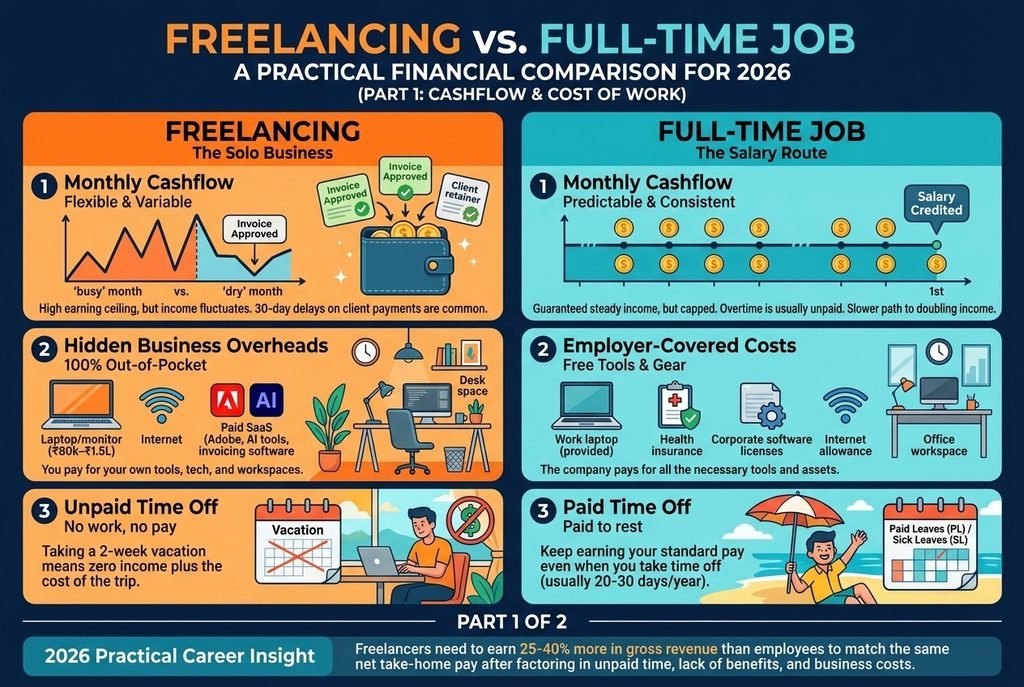
A full-time job provides a fixed, predictable monthly income, regardless of how much work genuinely comes in during any given week or month. This predictability has real financial value — it makes budgeting, loan eligibility, and financial planning considerably more straightforward, even if the absolute income figure might be lower than what a skilled freelancer could theoretically earn per project.
Freelancing income, by contrast, is inherently variable — some months bring multiple well-paying projects, while others might bring significantly less work, particularly when starting out or during broader economic slowdowns that affect client budgets. This variability isn’t just a minor inconvenience; it has genuine financial planning implications, particularly for major expenses like loan EMIs, family financial commitments, or long-term savings goals that benefit from predictable monthly cash flow.
Comparing Actual Take-Home Numbers
The Full-Time Employee Picture
A full-time employee’s salary, while subject to income tax, comes with employer-provided benefits that carry real monetary value beyond the headline salary figure — Provident Fund contributions (which build retirement savings with employer matching), health insurance coverage (which would otherwise cost a meaningful annual premium if purchased independently), and often additional benefits like gratuity (for employees completing 5+ years), paid leave, and sometimes performance bonuses.
When calculating your effective total compensation as a full-time employee, it’s worth adding the monetary value of these benefits to your gross salary figure — a ₹6 LPA salary with strong benefits might represent genuinely higher total value than the raw number suggests, once you account for employer PF contributions and health insurance that you’d otherwise need to fund independently.
The Freelancer’s Picture
A freelancer’s gross project income looks appealing on paper, but the actual take-home calculation needs to account for several factors employees don’t typically face directly: self-funded health insurance (a meaningful annual cost), no employer PF contribution (meaning retirement savings are entirely self-directed and self-funded), no paid leave (time off directly means no income during that period, unlike an employee’s paid leave), and often, periods of unpaid business development time spent finding new clients rather than billable project work.
Freelancers also typically need to account for irregular cash flow when calculating genuine “average” monthly income — a freelancer who earns ₹80,000 in one month and ₹20,000 the next has an average of ₹50,000, but the financial planning implications of that variability are quite different from an employee earning a steady ₹50,000 monthly.
Tax Considerations for Both Paths
Full-time employees have tax deducted at source (TDS) by their employer, with relatively straightforward tax filing, and access to specific salary-related deductions and exemptions (HRA, standard deduction, and others depending on the tax regime chosen).
Freelancers, operating as self-employed professionals, need to handle their own tax calculations and payments (including advance tax in many cases), but also gain access to business expense deductions — a portion of home office costs, equipment, software subscriptions, and internet expenses can often be deducted as legitimate business expenses, which employees generally cannot claim against salary income. This can meaningfully reduce a freelancer’s effective tax burden if expenses are tracked and claimed properly, though it also requires more diligent record-keeping and often benefits from professional accounting support, which is itself an additional cost to factor in.
The Skill and Rate Growth Trajectory
In a full-time job, salary growth typically follows a structured pattern — annual increments (often in a specific, sometimes limited percentage range), periodic promotions, and occasional larger jumps when switching employers strategically. This growth is generally predictable but can feel comparatively slow for individuals who build in-demand, specialized skills faster than their organization’s typical increment cycle rewards.
Freelancing income growth is less structured but can, for skilled and in-demand freelancers, scale faster — as you build a strong portfolio and reputation, you can often increase your rates for new clients more flexibly than waiting for an annual review cycle, and skilled freelancers with strong client relationships and referral networks can sometimes command rates that meaningfully exceed equivalent full-time salary levels in their field, particularly for specialized skills in high demand relative to available supply.
This growth potential, however, isn’t automatic or universal — it requires deliberate skill development, portfolio building, and client relationship management, and many freelancers, particularly in the early years, actually earn less than an equivalent full-time salary while building this reputation and client base.
Access to Credit and Financial Products
Full-time employees, particularly those with a stable employment history and payslips, generally find it easier to access home loans, personal loans, and credit cards, since lenders view stable salary income as a more straightforward risk assessment than variable freelance income.
Freelancers can access these financial products too, but often face more documentation requirements (income tax returns over multiple years, bank statements showing consistent income patterns) and sometimes less favorable loan terms or lower approved amounts compared to an equivalent-earning full-time employee, particularly for major loans like home loans where lenders prioritize income predictability.
The Non-Financial Factors That Affect Financial Decisions
While this comparison focuses on financial mechanics, it’s worth acknowledging that non-financial factors genuinely influence the practical financial outcome of each path — a freelancer who thrives on self-directed work and time management can build a genuinely successful, higher-earning practice, while someone who struggles with self-discipline and client acquisition might significantly underperform their theoretical earning potential, regardless of their raw skill level.
Similarly, someone who finds full-time employment genuinely draining or misaligned with their working style might see their career growth and earning potential suffer within that structure, even with objectively strong skills, simply due to reduced engagement and performance in an environment that doesn’t suit them.
A Practical Framework for Deciding
When Full-Time Employment Often Makes More Financial Sense
If you’re early in your career and still building foundational skills, the structured learning, mentorship, and skill development that many full-time roles provide (which freelancing typically doesn’t offer in the same structured way) often accelerates your long-term earning potential, even if immediate income feels lower.
If you have significant financial commitments requiring predictable monthly cash flow — home loan EMIs, family financial responsibilities, or limited savings buffer — the income stability of full-time employment carries genuine financial risk-reduction value that shouldn’t be discounted purely because freelancing’s theoretical upside looks appealing.
When Freelancing Can Make Strong Financial Sense
If you’ve already built specialized, in-demand skills with a track record (whether through prior full-time experience or a strong portfolio), and you have some financial buffer to manage income variability during the transition period, freelancing can offer genuinely higher earning potential, particularly if you’re able to command premium rates for specialized expertise.
If you have other income sources or financial support during an initial ramp-up period (savings runway, a partner’s stable income, or reduced immediate financial obligations), the risk of freelancing’s income variability is considerably more manageable, making this a lower-risk time to test and build a freelance practice.
A Hybrid Approach Worth Considering
Many professionals find that starting with full-time employment while building freelance skills and a client base on the side (where employment terms permit this) offers a lower-risk path toward eventually transitioning to freelancing, if that remains the goal — this allows skill and reputation building without the immediate financial pressure of replacing a full salary through freelance income alone from day one.
Frequently Asked Questions
Q1. How much savings buffer should I have before transitioning to full-time freelancing? A commonly recommended guideline is 6-12 months of essential living expenses saved before transitioning, though this can vary based on your specific financial obligations, existing client pipeline, and risk tolerance.
Q2. Can freelancers access Provident Fund benefits like employees do? Not through an employer, but freelancers can voluntarily contribute to retirement savings instruments like the Public Provident Fund (PPF) or National Pension System (NPS) to build comparable long-term savings, though this requires proactive self-direction rather than automatic employer contribution.
Q3. Is freelance income considered less reliable by landlords and lenders? Generally, yes, compared to salaried income with consistent payslips, though freelancers with a strong, documented income history (through IT returns and bank statements over a few years) can still access most financial products, sometimes with additional documentation requirements.
Q4. Which path offers better long-term earning potential? This genuinely depends on your specific field, skill level, and how effectively you build either a career track record (for full-time employment) or a client base and reputation (for freelancing) — there’s no universal answer, and both paths have examples of strong and modest earners.
Q5. Can I switch between freelancing and full-time employment later if my initial choice doesn’t work out? Yes, many professionals move between these paths at different career stages based on changing financial needs, life circumstances, and market opportunities — an initial choice doesn’t permanently lock you into that path if circumstances or preferences change.
The Bottom Line
Neither freelancing nor full-time employment is universally more financially sound — the right choice depends on your specific financial situation, risk tolerance, skill level, and stage of career. Full-time employment offers predictability and structured growth with real benefit value beyond the salary figure, while freelancing offers potentially higher earning ceilings alongside genuine income variability that requires careful financial planning to manage responsibly.
For related reading, check out our guide on Remote Jobs in India: Legitimate Platforms and How to Avoid Scams, or explore How to Negotiate Your First Salary Offer (With Real Scripts You Can Use).