
One of the most important questions in retirement planning is simple: How much will you actually need to spend each year after you stop working?
Your retirement expenses can be very different from your current expenses. Some costs may decrease, while others can increase. Housing, healthcare, travel, taxes, insurance, food, transportation, and unexpected expenses can all affect how much money you need.
Estimating retirement expenses does not require predicting every dollar decades in advance. The goal is to create a reasonable estimate that you can update as your financial situation changes.
In this guide, you’ll learn how to estimate retirement expenses, identify major spending categories, account for inflation and healthcare, and use your estimated expenses to create a more realistic retirement plan.
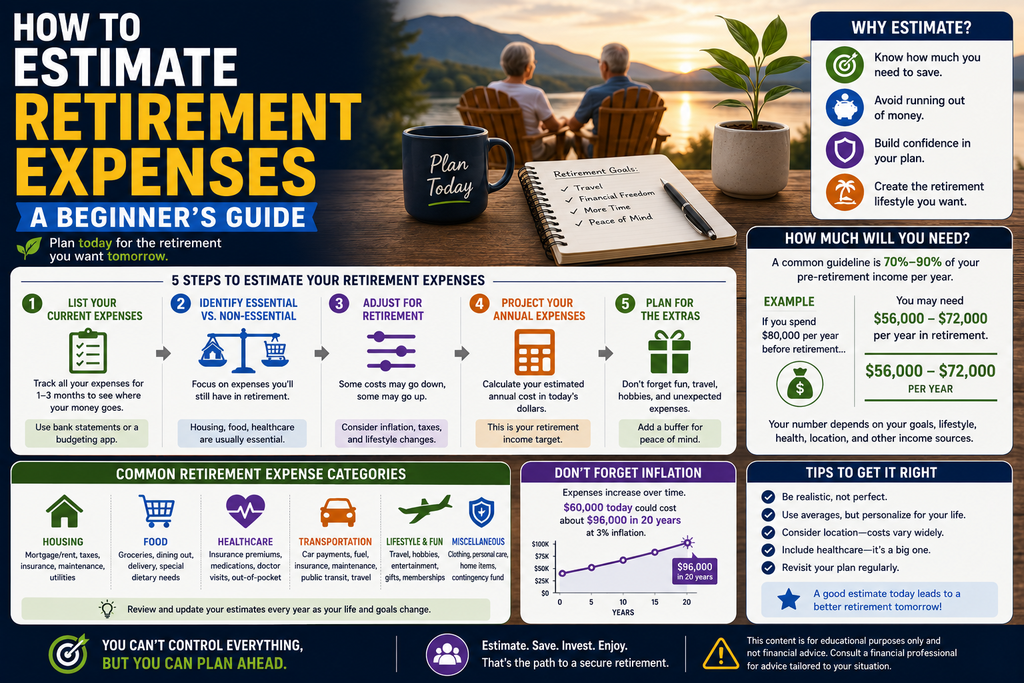
Why Retirement Expenses Matter
Your retirement savings goal should be connected to how much money you expect to spend.
For example, someone who expects to spend $40,000 per year in retirement will have a very different savings target from someone who expects to spend $100,000 per year.
Estimating expenses helps you answer important questions such as:
- How much should I save for retirement?
- Will my retirement income cover my expenses?
- Can I afford to retire at my target age?
- How much might I need from investments?
- Which expenses could increase after retirement?
- How much should I keep for unexpected costs?
A realistic expense estimate can make your retirement plan much more useful.
Step 1: Start With Your Current Spending
One of the easiest ways to estimate retirement expenses is to begin with what you spend today.
Review several months of bank and credit card transactions and organize your spending into categories.
For example:
- Housing
- Utilities
- Groceries
- Transportation
- Insurance
- Healthcare
- Debt payments
- Entertainment
- Travel
- Personal expenses
- Subscriptions
- Savings
This gives you a starting point.
You should not simply assume your current spending will remain exactly the same in retirement. Instead, use it as a baseline and adjust each category.
Step 2: Separate Needs From Wants
A useful retirement budget separates essential expenses from discretionary spending.
Essential Expenses
These are expenses you generally need to pay regardless of your lifestyle choices.
Examples include:
- Housing
- Utilities
- Food
- Healthcare
- Insurance
- Transportation
- Taxes
- Basic personal expenses
Discretionary Expenses
These are expenses that you may be able to increase, reduce, or eliminate depending on your financial situation.
Examples include:
- Vacations
- Dining out
- Hobbies
- Entertainment
- New technology
- Luxury purchases
- Gifts
- Recreational activities
This distinction is important because your retirement income should be sufficient to cover essential expenses even if discretionary spending changes.
Step 3: Think About Housing Costs
Housing can be one of the largest retirement expenses.
If you expect to have your mortgage completely paid off before retirement, your future housing costs may be lower than they are today.
However, owning a home does not mean housing becomes free.
You may still have:
- Property taxes
- Homeowners insurance
- Repairs
- Maintenance
- Utilities
- Home improvements
- HOA fees
If you plan to rent during retirement, rent could remain a significant ongoing expense.
You should also consider whether you expect to move to a smaller home, relocate to another area, or live in a retirement community.
Step 4: Estimate Healthcare Costs
Healthcare deserves special attention in retirement planning.
Even if you expect to have health insurance, you may still have premiums, deductibles, copayments, prescription costs, dental expenses, vision care, and other out-of-pocket expenses.
Healthcare needs can also change as you get older.
Instead of assuming healthcare will cost the same as it does today, include a separate healthcare category in your retirement budget.
You may also want to maintain additional savings for unexpected medical expenses.
Step 5: Consider Transportation Changes
Your transportation expenses may change significantly after retirement.
If you no longer commute to work, you may spend less on:
- Gas
- Public transportation
- Parking
- Vehicle maintenance
- Work-related travel
However, retirement may also give you more time for personal travel and activities.
You might drive more for:
- Vacations
- Family visits
- Hobbies
- Medical appointments
- Recreational activities
Also consider whether you expect to own one vehicle instead of two.
Step 6: Don’t Forget Taxes
Taxes can continue during retirement.
Depending on your circumstances, you may have taxes associated with:
- Traditional retirement account withdrawals
- Investment income
- Social Security benefits
- Pension income
- Other sources of taxable income
Your tax situation can also depend on where you live and the types of accounts you use.
This is one reason retirement planning should focus on after-tax income, not just the total amount of money in your retirement accounts.
Step 7: Account for Inflation
Inflation is one of the biggest challenges when estimating future retirement expenses.
Suppose your current annual expenses are $50,000.
If prices rise over time, $50,000 may not provide the same purchasing power when you retire.
For example, at a hypothetical 3% annual inflation rate, $50,000 today would require substantially more money in the future to purchase a similar basket of goods and services.
This is why retirement calculators and financial plans often include inflation assumptions.
You don’t need to predict the exact inflation rate decades into the future. Instead, use a reasonable assumption and review your plan regularly.
Step 8: Estimate Travel and Lifestyle Expenses
Retirement can create new spending opportunities.
You may want to:
- Travel more
- Visit family
- Eat at restaurants
- Start new hobbies
- Join clubs
- Attend events
- Take classes
- Spend more time on recreational activities
Some retirees spend more during the early years of retirement because they are healthier and more active.
Later, spending patterns may change.
Your retirement budget should reflect the lifestyle you actually want rather than assuming retirement automatically means spending less.
Step 9: Include Gifts and Family Support
Some people want to provide financial help to children, grandchildren, relatives, or other family members.
If this is part of your long-term plan, consider including it in your retirement expenses.
Potential expenses could include:
- Gifts
- Education assistance
- Family travel
- Weddings
- Emergency support
- Charitable donations
Helping family can be meaningful, but it should not put your own essential retirement needs at risk.
Step 10: Plan for Unexpected Expenses
No retirement budget is perfect.
Unexpected costs can occur, including:
- Major home repairs
- Vehicle replacement
- Medical expenses
- Family emergencies
- Insurance increases
- Major travel changes
Instead of assuming nothing unexpected will happen, build flexibility into your retirement plan.
An emergency fund or separate cash reserve can help you handle expenses without immediately selling investments.
A Simple Retirement Expense Example
Suppose someone currently spends:
| Expense | Current Annual Cost |
|---|---|
| Housing | $18,000 |
| Food | $7,000 |
| Transportation | $5,000 |
| Healthcare | $5,000 |
| Insurance | $3,000 |
| Entertainment | $4,000 |
| Travel | $3,000 |
| Other | $5,000 |
| Total | $50,000 |
This person should not automatically assume retirement expenses will be exactly $50,000.
Instead, they could review every category.
Perhaps the mortgage will be paid off, reducing housing costs. Transportation may decrease because there is no daily commute. At the same time, travel and healthcare expenses might increase.
The final retirement estimate could therefore be higher or lower than current spending.
This is a hypothetical illustration, not a prediction.
The 80% Rule: Is It Reliable?
You may have heard that retirees need around 80% of their pre-retirement income.
This can be a useful starting point, but it is not a universal rule.
Your retirement expenses depend on your individual situation.
For example, someone with a paid-off home and modest lifestyle may need substantially less than their working income.
Someone who plans to travel extensively or provide financial support to family may need considerably more.
Instead of relying entirely on a percentage of income, build your retirement estimate from actual expenses.
How to Estimate Retirement Expenses Using a Percentage
A percentage-based estimate can still be useful as a quick starting point.
For example, suppose you currently earn $80,000 per year.
If you use a hypothetical 80% estimate:
$80,000 × 80% = $64,000
You might use $64,000 as an initial annual retirement expense estimate.
Then compare that number with your actual spending.
If your current annual spending is only $50,000, the percentage method may overestimate your needs.
If you currently spend $75,000 and expect similar lifestyle costs in retirement, $64,000 may be too low.
Use percentage rules as a starting point rather than a final answer.
How Retirement Income Fits Into the Calculation
Once you estimate your expenses, compare them with your expected retirement income.
Potential income sources can include:
- Social Security
- Pension income
- 401(k) withdrawals
- IRA withdrawals
- Taxable investment accounts
- Annuity income
- Part-time work
- Rental income
- Other assets
For example, suppose your estimated retirement expenses are $60,000 per year.
You expect $30,000 from Social Security and another $10,000 from a pension.
That leaves:
$60,000 − $30,000 − $10,000 = $20,000
You would need to determine how the remaining amount could be funded from investments, savings, or other income sources.
Think About Retirement in Phases
Your spending may not remain constant throughout retirement.
You can think about retirement as different phases.
Early Retirement
You may spend more on:
- Travel
- Hobbies
- Entertainment
- Dining
- Activities
Middle Retirement
Your lifestyle may become somewhat less active.
Travel and entertainment spending may decline, while healthcare expenses could become more important.
Later Retirement
Healthcare, caregiving, housing assistance, or other support costs may become more significant.
This doesn’t happen to everyone, but considering different phases can make your retirement plan more realistic.
How to Create a Retirement Expense Worksheet
Create a simple worksheet with four columns:
| Category | Current Spending | Estimated Retirement Spending | Notes |
|---|---|---|---|
| Housing | $___ | $___ | Mortgage paid off? |
| Food | $___ | $___ | Lifestyle changes |
| Healthcare | $___ | $___ | Premiums + out-of-pocket |
| Transportation | $___ | $___ | Fewer commuting costs |
| Travel | $___ | $___ | Retirement lifestyle |
| Entertainment | $___ | $___ | Hobbies |
| Insurance | $___ | $___ | Coverage changes |
| Taxes | $___ | $___ | Depends on income |
| Other | $___ | $___ | Unexpected costs |
| Total | $___ | $___ |
Update this worksheet periodically.
As you approach retirement, your estimates can become more specific.
What If Your Retirement Expenses Are Too High?
If your estimated retirement expenses are higher than your expected retirement income, you have several potential options.
You could:
- Save more
- Increase retirement contributions
- Retire later
- Reduce discretionary expenses
- Pay down debt
- Consider part-time work
- Reevaluate housing costs
- Increase your emergency savings
- Review investment and account strategies
The earlier you identify a potential gap, the more time you have to make adjustments.
Common Mistakes When Estimating Retirement Expenses
1. Assuming Expenses Will Automatically Drop
Some costs may decrease, but others may increase.
2. Forgetting Healthcare
Healthcare can become an important part of retirement spending.
3. Ignoring Inflation
Future dollars may not have the same purchasing power as today’s dollars.
4. Forgetting Taxes
Retirement income may not equal after-tax spending money.
5. Underestimating Travel
If you plan to travel more after leaving work, include those costs.
6. Ignoring Home Maintenance
A paid-off mortgage does not eliminate property taxes, insurance, repairs, and maintenance.
7. Using a Single Number Forever
Your retirement estimate should change as your income, expenses, savings, and retirement date change.
How Often Should You Review Your Retirement Expense Estimate?
Review your estimate at least once a year.
You should also update it after major financial changes, such as:
- Buying or selling a home
- Paying off a mortgage
- Changing jobs
- Getting married
- Having children
- Receiving a major income increase
- Changing your retirement date
- Experiencing major lifestyle changes
Regular reviews help keep your retirement plan connected to reality.
Frequently Asked Questions
How much should I budget for retirement?
There is no single number that works for everyone. Start by analyzing your current spending and adjusting each category for expected retirement changes.
Is 80% of income enough for retirement?
It may be enough for some people but not others. Your actual retirement expenses, housing situation, healthcare needs, lifestyle, taxes, and income sources all matter.
What is the biggest retirement expense?
Housing and healthcare can be major expenses, but the largest category varies from person to person.
Should I include inflation in retirement planning?
Yes. Inflation can reduce purchasing power over time, so future retirement expenses should account for changing prices.
Should I include travel in my retirement budget?
Yes, especially if travel is an important part of your retirement plans.
How can I estimate healthcare costs in retirement?
Start with your expected insurance premiums and out-of-pocket expenses, then consider that healthcare needs and costs may change over time.
Can retirement expenses change over time?
Absolutely. Your spending can change because of lifestyle changes, healthcare needs, housing decisions, inflation, and other factors.
Final Thoughts
Learning how to estimate retirement expenses is an important part of building a realistic retirement plan.
Rather than choosing an arbitrary number, start with your current spending and examine each category individually. Consider housing, healthcare, transportation, food, taxes, travel, insurance, hobbies, family support, and unexpected expenses.
Then account for inflation and compare your estimated expenses with potential retirement income from Social Security, pensions, retirement accounts, investments, and other sources.
Your first estimate does not need to be perfect.
The most important thing is to create a reasonable starting point, review it regularly, and make adjustments as your retirement goals and financial situation change.