
If you want to buy stocks, ETFs, bonds, or other investments, you will generally need a place to hold and trade those investments. For many investors, that place is a brokerage account.
A brokerage account gives you access to financial markets through a brokerage firm. Depending on the account and brokerage, you may be able to buy and sell investments such as stocks, ETFs, mutual funds, and bonds.
For beginners, however, opening an account is only the first step. It is important to understand how brokerage accounts work, what types are available, what fees may apply, and how to choose an account that fits your financial goals.
This guide explains what a brokerage account is, how it works, and what beginners should know before opening one.
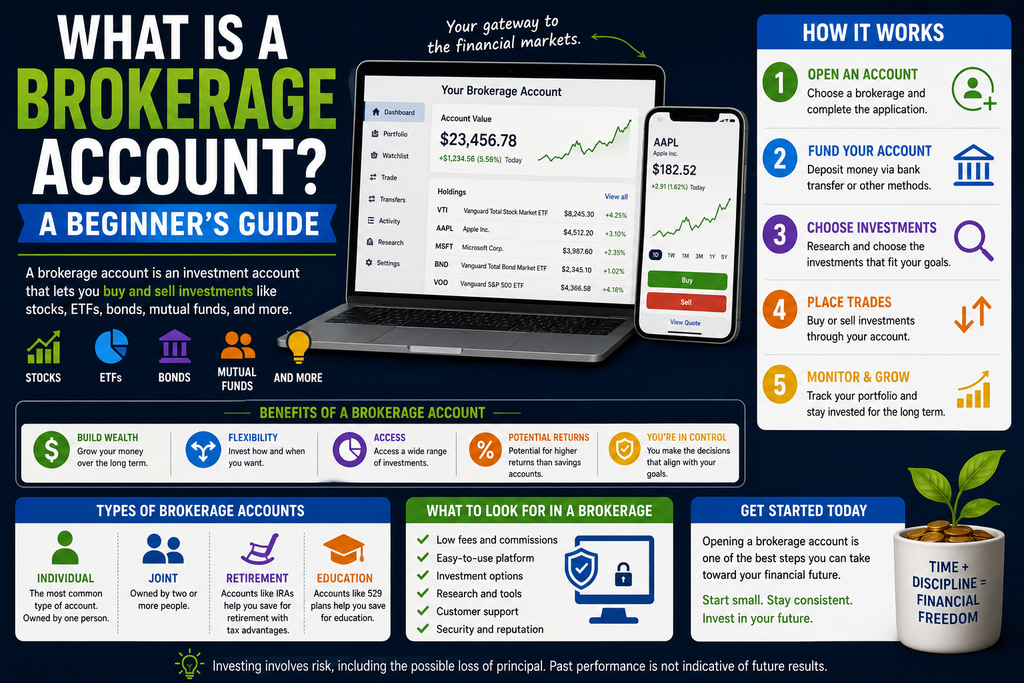
What Is a Brokerage Account?
A brokerage account is an investment account that allows you to buy, sell, and hold investments.
When you open an account with a brokerage firm, you can deposit money into the account and use those funds to purchase eligible investments.
For example, you might use a brokerage account to buy:
- Individual stocks
- ETFs
- Mutual funds
- Bonds
- Treasury securities
- Other investment products offered by the brokerage
The investments you purchase are generally held in your brokerage account.
A brokerage account is different from a regular bank checking or savings account because its primary purpose is investing rather than everyday banking.
How Does a Brokerage Account Work?
The basic process is relatively simple.
Step 1: Open an Account
You choose a brokerage firm and complete its application process.
You will typically provide personal and financial information required by the brokerage.
Step 2: Deposit Money
After your account is approved, you can transfer money into it from a linked bank account or another eligible source.
Step 3: Choose an Investment
You decide what you want to invest in based on your financial goals, risk tolerance, and investment strategy.
Step 4: Place an Order
You submit an order through the brokerage platform.
For example, you might place an order to purchase shares of an ETF.
Step 5: Monitor Your Investments
After purchasing an investment, you can monitor its value and performance through your brokerage account.
You can also make additional purchases or sell investments when appropriate for your strategy.
Brokerage Account vs. Bank Account
A brokerage account and bank account serve different purposes.
| Feature | Brokerage Account | Bank Account |
|---|---|---|
| Main purpose | Investing | Saving/spending |
| Stocks | Usually available | Generally not |
| ETFs | Usually available | Generally not |
| Checking services | Usually limited or unavailable | Common |
| Investment risk | Can lose value | Depends on account/product |
| Market exposure | Available | Usually limited |
A brokerage account is designed primarily for investing, while checking and savings accounts are designed for managing cash.
It is important not to treat invested money exactly like emergency savings because investments can fluctuate in value.
Types of Brokerage Accounts
There are several types of brokerage accounts.
Understanding the differences can help you choose an account that matches your needs.
Taxable Brokerage Account
A taxable brokerage account is a standard investment account where you can buy and sell investments.
There generally are no special retirement restrictions on when you can access the money.
However, investment income and gains may have tax consequences.
A taxable brokerage account can be useful for goals that do not fit within retirement accounts.
For example, someone might use one for:
- Long-term wealth building
- A financial goal before retirement
- Additional investing after using retirement accounts
- General investing
Your individual tax situation matters, so consider consulting a qualified tax professional when necessary.
Individual Brokerage Account
An individual brokerage account is owned by one person.
The account holder generally makes the investment decisions and controls the account.
This can be a straightforward option for an investor who wants to manage their own portfolio.
Joint Brokerage Account
A joint brokerage account is owned by multiple people, commonly spouses or partners.
The specific rights and responsibilities depend on the account agreement and ownership structure.
Anyone considering a joint account should understand how contributions, withdrawals, ownership, and investment decisions are handled.
Retirement Brokerage Accounts
Some brokerage firms offer retirement accounts that provide tax advantages under applicable rules.
Common examples include:
- Traditional IRAs
- Roth IRAs
These accounts are designed for retirement investing and have rules regarding contributions, withdrawals, taxes, and eligibility.
A retirement account can be different from a standard taxable brokerage account even though both may allow you to invest in similar assets.
Self-Directed vs. Managed Accounts
Another important distinction is whether you manage the investments yourself.
Self-Directed Brokerage Account
With a self-directed account, you decide which investments to buy and sell.
You are responsible for researching investments and managing your portfolio.
This can provide greater control but also requires more knowledge and discipline.
Managed Account
With a managed account, an investment professional or automated service may help manage your portfolio according to an agreed strategy.
Depending on the service, additional fees may apply.
Before using a managed service, understand exactly what services are provided and how much they cost.
What Can You Buy Through a Brokerage Account?
The investments available depend on the brokerage firm and account type.
Common investment choices include:
Stocks
Stocks represent ownership interests in companies.
They can provide potential growth but can also experience significant price declines.
ETFs
ETFs hold collections of investments and trade on exchanges.
They can provide diversification through a single investment.
Mutual Funds
Mutual funds pool money from investors to purchase a portfolio of investments.
Some mutual funds are actively managed while others track indexes.
Bonds
Bonds are debt investments issued by governments, municipalities, or companies.
They have different risks and potential returns from stocks.
The right combination depends on your financial objectives and risk tolerance.
How Much Money Do You Need to Open a Brokerage Account?
There is no single minimum amount required across all brokerage firms.
Some firms may allow investors to open accounts with relatively small amounts, while others may have different requirements.
Some brokerages also allow investors to purchase fractional shares of eligible investments.
However, the minimum amount should not be the only factor you consider.
Look at:
- Investment choices
- Fees
- Account features
- Customer support
- Research tools
- Security features
- Ease of use
- Educational resources
Brokerage Account Fees
One of the most important things to understand before opening an account is the fee structure.
Possible costs can include:
- Trading commissions
- Account fees
- Advisory fees
- Fund expense ratios
- Transfer fees
- Wire fees
- Other service charges
Some brokers advertise commission-free trading for certain investments, but that does not mean investing is completely free.
For example, an ETF may still have an expense ratio.
Always review the brokerage’s fee schedule and the costs associated with the investments you purchase.
What Is a Cash Account?
A cash brokerage account is an account where you generally pay for investments using money available in the account.
For a beginner, a cash account can be easier to understand because you are not borrowing money from the brokerage to make investments.
Investors should understand settlement rules and other trading requirements before placing trades.
What Is a Margin Account?
A margin account allows investors to borrow money from a brokerage to purchase investments, subject to applicable rules and requirements.
Margin can increase purchasing power, but it also increases risk.
If investments decline, losses can be larger than they would be when investing only your own cash.
Because of these risks, beginners should understand margin thoroughly before using it.
For many new investors, there is no need to use borrowed money simply to start investing.
How to Choose a Brokerage Account
Choosing a brokerage should involve more than picking the app with the most advertisements.
Consider these factors.
1. Investment Selection
Check whether the brokerage offers the stocks, ETFs, funds, and other investments you are interested in.
2. Fees
Compare commissions, account fees, advisory costs, fund expenses, and other charges.
3. Account Types
Make sure the brokerage offers the type of account you need.
For example, you may want both a taxable brokerage account and an IRA.
4. Research and Educational Tools
Beginners may benefit from access to:
- Investment research
- Market information
- Educational content
- Portfolio tools
- Screening tools
5. Customer Support
Good customer support can be valuable when you have questions about your account.
6. Security
Look at the brokerage’s security practices and account protection information.
7. Ease of Use
A platform should make it reasonably easy to understand your holdings, transactions, balances, and account information.
How to Open a Brokerage Account
Opening an account generally involves several steps.
Choose a Brokerage
Research several firms rather than choosing the first one you see.
Select an Account Type
Decide whether you need a taxable account, retirement account, individual account, joint account, or another option.
Complete the Application
The brokerage will request information needed to establish and verify the account.
Fund the Account
Transfer money into the account using an available funding method.
Select Investments
Once funds are available, research investments that fit your strategy.
Start Investing
Place your investment orders carefully and understand the order type you are using.
Brokerage Accounts and ETFs
Brokerage accounts are especially useful for ETF investors.
For example, an investor might use a brokerage account to purchase a diversified index ETF regularly.
Instead of selecting many individual companies, the investor could use an ETF to gain exposure to a broader group of investments.
However, the ETF still needs to be researched before purchasing.
You should understand:
- What index or strategy it follows
- What it owns
- Its expense ratio
- Its risks
- Its diversification
- Its historical tracking
- How it fits your portfolio
Brokerage Accounts and Long-Term Investing
A brokerage account can be an important tool for long-term investing.
However, the account itself does not create investment returns.
Your results depend on the investments you choose, the amount you invest, costs, taxes, market conditions, and other factors.
For long-term investors, a simple strategy may involve:
- Establishing financial goals
- Building an emergency fund
- Paying attention to high-interest debt
- Choosing an appropriate account
- Selecting diversified investments
- Investing consistently
- Keeping costs under control
- Reviewing the portfolio periodically
The exact strategy should match your individual situation.
Common Brokerage Account Mistakes
Investing Before Building a Financial Foundation
Money needed for immediate expenses or emergencies generally should not be treated the same way as long-term investment money.
Choosing a Brokerage Only Because It Is Popular
Popularity does not necessarily mean the platform is right for you.
Ignoring Fees
Small costs can reduce long-term investment results.
Using Margin Without Understanding It
Borrowing to invest can magnify losses.
Trading Too Frequently
Constant buying and selling can increase costs and make it harder to maintain a disciplined strategy.
Investing Without Research
Do not buy an investment simply because someone online says it will increase in value.
Checking the Account Constantly
Short-term market movements can encourage emotional decisions.
Long-term investors often benefit from focusing on their financial plan rather than reacting to every daily price change.
Example: How a Beginner Might Use a Brokerage Account
Imagine Daniel wants to invest for a long-term goal.
He first builds an emergency fund and makes sure his regular expenses are manageable.
He then opens a taxable brokerage account.
Instead of buying random stocks based on social media recommendations, Daniel researches diversified ETFs and considers their costs, holdings, risk, and investment strategy.
He decides on a portfolio that matches his personal goals and contributes regularly.
Over time, he reviews the portfolio rather than constantly changing investments based on short-term market movements.
This is only a hypothetical example. The right strategy varies from investor to investor.
Frequently Asked Questions
Is a brokerage account the same as an investment account?
A brokerage account is a type of investment account that allows you to buy, sell, and hold investments.
Is it safe to have a brokerage account?
Brokerage accounts are subject to regulations and protections, but investments themselves can lose value. Account protection does not mean your investments are guaranteed to increase.
Can I lose money in a brokerage account?
Yes. Stocks, ETFs, and other investments can decline in value.
Can I have more than one brokerage account?
Yes, investors can have multiple accounts, although managing several accounts can make your finances more complicated.
Should beginners use a margin account?
Beginners should be cautious with margin because borrowing to invest can substantially increase risk.
Can I use a brokerage account for retirement?
Yes. You can use certain retirement brokerage accounts, such as IRAs, for retirement investing. These accounts have specific rules that differ from standard taxable brokerage accounts.
Final Thoughts
Understanding what a brokerage account is is one of the first steps toward becoming a confident investor.
A brokerage account provides the infrastructure you need to buy and hold investments, but choosing the right account and using it responsibly matters.
Before opening an account, compare fees, investment choices, account types, security features, research tools, and customer support.
Once your account is open, focus on building a financial strategy rather than chasing short-term market movements.
The goal is not simply to open a brokerage account. The goal is to use it as part of a thoughtful, diversified, and long-term investment plan.