
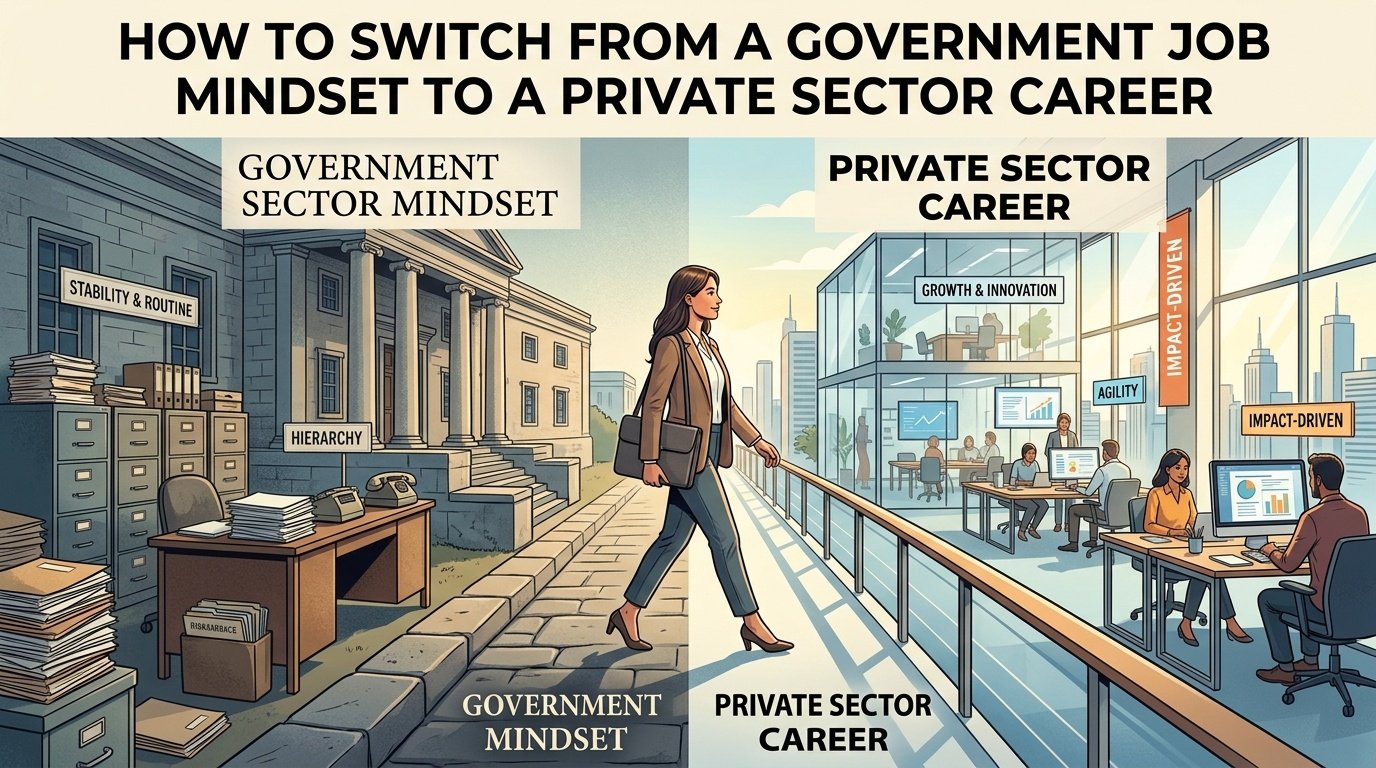
There are two kinds of people who search for this topic: candidates who’ve spent years preparing for government exams and are now considering pivoting to private sector jobs, and existing government employees exploring a move into private companies. Both face a similar underlying challenge — adjusting to a fundamentally different work culture, expectation structure, and career logic than what government preparation or government employment trains you for. This guide addresses both situations honestly.
Understanding the Real Differences First
Government jobs, both the preparation culture around them and the actual work environment, operate on fairly predictable structures — defined promotion timelines based on seniority and departmental exams, relatively stable job security, and generally more standardized working hours in many roles. Private sector work, by contrast, often ties growth more directly to individual performance, market conditions, and company-specific circumstances, with considerably more variability in job security, working hours, and career trajectory.
Neither structure is inherently better — they simply optimize for different things. Understanding this honestly, rather than assuming private sector work is just “the same thing but with more money,” is the first step toward a successful transition.
For Candidates Considering a Pivot Away From Government Exam Preparation
Recognizing When It Might Be Time to Reconsider
Years of government exam preparation without success is emotionally and financially difficult, and there’s no universally “right” number of attempts before considering a pivot — this depends on your specific exam’s attempt limits, your financial situation, your age relative to private sector hiring norms in your target field, and your own honest assessment of whether continued preparation remains the right path forward.
Some signals worth reflecting on honestly: consistently plateauing scores despite sustained effort over multiple attempts, growing financial strain on yourself or your family from extended preparation without income, and a genuine, considered interest in a private sector path rather than viewing it purely as a fallback born of frustration.
What Transfers From Your Preparation — More Than You Might Think
Years of exam preparation build genuinely valuable skills that transfer directly to many private sector roles — strong analytical thinking, disciplined self-study habits, structured writing ability (particularly valuable for UPSC Mains-level preparation), and often solid general knowledge and current affairs awareness that’s relevant to roles in media, policy research, content, and analysis-focused positions.
The challenge isn’t that your preparation was wasted — it’s translating these skills into a resume and interview narrative that a private sector recruiter, who doesn’t intimately understand government exam preparation, can clearly recognize as relevant to their specific role.
Building a Private-Sector-Ready Profile
Start by identifying which private sector roles genuinely align with skills you’ve already built — research and analysis roles, content and communication roles, and even certain government-adjacent private sector roles (policy consulting, public affairs, government relations at private companies) often value exactly the kind of preparation you’ve done.
Consider a short, focused certification or course relevant to your target role — this signals updated, practical skill to recruiters who might otherwise only see “years of exam preparation” without private sector context on your resume. Even a few months of dedicated skill-building in a specific direction (digital marketing, data analysis, content strategy, whatever aligns with your target role) meaningfully strengthens your transition.
Rewrite your resume specifically for private sector formats and expectations — government exam preparation doesn’t translate well as a standalone resume section, but the skills built during that time (research, writing, analytical rigor, sustained self-discipline) can be reframed effectively when described in terms of outcomes and capabilities rather than exam names alone.
For Government Employees Considering a Move to the Private Sector
Honestly Weighing the Trade-Offs
If you’re currently employed in a government role and considering a private sector move, be clear-eyed about what you’re trading — generally higher job security and defined pension benefits in government roles, against potentially faster compensation growth, different work culture, and different skill development opportunities in private sector roles. Neither is a universally correct choice; it depends on your personal risk tolerance, career goals, and life stage.
Research your target private sector industry’s actual compensation and growth patterns carefully rather than relying on assumptions — some private sector roles offer dramatically faster growth than government service, while others don’t meaningfully outperform government compensation once you account for total benefits, particularly pension and job security value.
Addressing the Skill and Culture Gap
Private sector roles, particularly in competitive industries, often expect faster-paced execution, more frequent measurable output, and greater comfort with ambiguity and change compared to many government work environments. This isn’t a criticism of either system — it’s a genuine cultural and pace difference that requires conscious adjustment, not just a change of employer.
If you’re making this transition, actively seek out or build experience with tools, software, and working styles common in your target private sector field before or during your transition — this might mean taking evening courses, freelancing on the side if your current role permits it, or seeking project opportunities within your current organization that build transferable, private-sector-relevant skills.
Reframing Government Experience for Private Sector Resumes
Government work experience often involves genuinely valuable transferable skills — stakeholder management, process and compliance knowledge, public communication, and often significant project or program coordination experience — but these need to be described in outcome-focused, private-sector-familiar language rather than government-specific terminology and designations that a private sector recruiter might not immediately understand.
Instead of listing your designation and department in government-specific terms alone, describe what you actually did in terms of scale, impact, and skills — “managed a team of X handling Y process across Z locations” resonates more with private sector recruiters than a government designation title alone, even if the designation itself carried significant institutional weight within government service.
Common Challenges During the Transition (For Both Groups)
Adjusting to Performance-Based Culture
Private sector roles frequently involve more direct, immediate performance feedback and target-based evaluation compared to many government structures. This adjustment can feel uncomfortable initially, particularly the shift from tenure-based progression to performance and market-based growth, but approaching it as a learning phase rather than a threat generally eases the transition.
Financial Planning During the Transition Period
Whether you’re pivoting from exam preparation or leaving a government role, build a realistic financial runway for your transition period — private sector job searches, especially for a meaningful career change, can take longer than expected, and having a financial buffer reduces the pressure to accept the first available offer regardless of fit.
Managing the Emotional Aspect of the Shift
Both groups often carry some degree of social or family pressure around this decision, particularly in contexts where government jobs carry strong social prestige. Acknowledging this emotional dimension honestly, rather than dismissing it, helps in having clearer conversations with family and in making a decision aligned with your actual career interests rather than external validation alone.
Practical Steps to Start Your Transition
Begin networking actively within your target private sector industry, even informally — conversations with people already working in your target field often reveal practical, current information about skill expectations and hiring patterns that generic online research won’t fully capture.
Update your resume and LinkedIn profile specifically for your target private sector role, using language and formatting that recruiters in that industry expect, rather than a resume style that primarily made sense for government application forms.
Consider starting with roles that specifically value your existing background — government-adjacent private sector roles (policy research, public affairs, government relations, compliance) often provide a smoother transition point before potentially moving into more purely private-sector-native roles later, if that’s your eventual goal.
Frequently Asked Questions
Q1. Is it too late to switch to a private sector career after years of exam preparation? This depends heavily on your specific age, target industry, and role — many industries value skills and demonstrated capability over a strictly linear early career path, though some roles do have stricter age-related hiring patterns. Research your specific target field’s norms rather than assuming a universal cutoff.
Q2. Will private sector recruiters view my exam preparation years negatively? This varies by recruiter and company, but a well-framed narrative — emphasizing skills built and genuine interest in the new direction, rather than presenting the shift as pure failure — generally resonates better than an apologetic or defensive framing of your preparation years.
Q3. Should I resign from my government job before securing a private sector offer? Generally, it’s financially and psychologically safer to secure a private sector offer before resigning from an existing government role, allowing you to negotiate from a position of stability rather than urgency, unless your specific circumstances make an immediate exit necessary.
Q4. What if I want to return to government exam preparation after trying the private sector? This is possible for many candidates, particularly if age and attempt limits for your target exam still permit it — some candidates do move between paths based on evolving circumstances, though this should be weighed against the specific eligibility windows for your target exam.
Q5. How long does a successful transition typically take? This varies considerably based on your target industry, existing skill overlap, and market conditions, but building realistic expectations of several months for skill-building, networking, and job search (rather than expecting an immediate transition) generally leads to better-prepared, less rushed decisions.
The Bottom Line
Transitioning between government exam preparation or government employment and a private sector career isn’t a simple “start over” — it’s a translation process, converting genuinely valuable skills and experience into a form the private sector recognizes and values. Approach it with honest self-assessment, deliberate skill-building where needed, and a resume and narrative that speaks the private sector’s language, rather than either dismissing your prior path or assuming it transfers automatically without effort.
For related reading, check out our guide on The Perfect Fresher Resume: A Section-by-Section Template That Actually Gets Shortlisted, or explore Government Job vs Private Job in 2026: An Honest, Numbers-Based Comparison.