

There’s a persistent assumption in Indian career conversations that high salaries are reserved for engineers and MBAs from top-tier institutes. It’s simply not accurate. Several career paths outside engineering offer strong, sometimes exceptional, earning potential — but they typically require a different kind of investment: specialized skill-building, certifications, or sustained expertise-building rather than a specific undergraduate degree. Here’s an honest look at these paths.
1. Chartered Accountancy (CA)
CA remains one of the most reliable high-earning professional qualifications in India, open to commerce (and even other stream) graduates who clear the CA exams conducted by ICAI. Freshly qualified CAs typically start in the ₹7–12 LPA range at good firms and companies, with experienced CAs in senior finance roles, partners at accounting firms, or CFOs at established companies earning significantly more — sometimes reaching several times that figure over a career.
The trade-off is a genuinely demanding, multi-year qualification process with a challenging pass rate, but it offers strong earning potential and career stability precisely because of that selectivity.
2. Company Secretary (CS) and Cost & Management Accountant (CMA)
Similar to CA in structure, CS and CMA are professional qualifications (conducted by ICSI and ICMAI respectively) that don’t require an engineering background. CS professionals specialize in corporate governance and compliance, while CMA professionals focus on cost accounting and management accounting. Both offer strong entry-level salaries (often ₹5–9 LPA for freshly qualified professionals at good organizations) with solid growth potential into senior compliance, governance, or finance leadership roles.
3. Investment Banking and Equity Research (Finance Sector Roles)
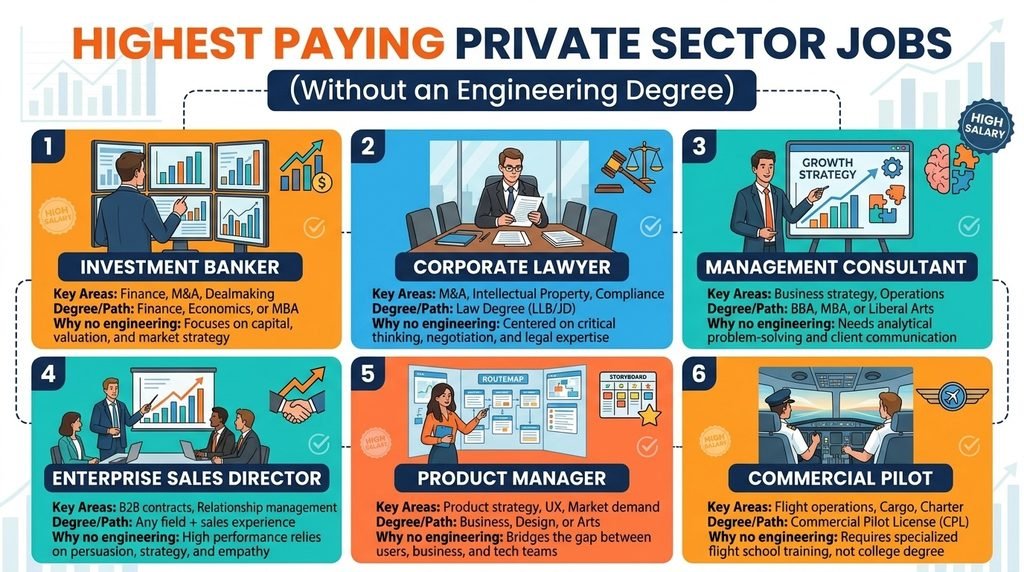
Commerce, economics, and even non-finance graduates who build strong financial modeling and analytical skills — often through certifications like CFA (Chartered Financial Analyst) — can access investment banking, equity research, and corporate finance roles. Entry-level analyst positions at established firms can start anywhere from ₹6–15 LPA depending on the firm and city, with significant growth potential for strong performers, particularly in investment banking, where compensation can scale considerably with experience and performance.
This path demands rigorous preparation and often benefits from a strong academic record and relevant certifications, but it’s genuinely accessible to non-engineering graduates who invest in the specific skill set required.
4. Digital Marketing Leadership (Performance Marketing, Growth Roles)
While entry-level digital marketing salaries are modest, professionals who specialize deeply in performance marketing, growth strategy, and data-driven campaign management can command significantly higher compensation as they build expertise and a track record of measurable results. Senior digital marketing managers and growth leads at well-funded companies can earn ₹15–30+ LPA, particularly in e-commerce, D2C brands, and tech companies where marketing directly drives revenue.
This path rewards demonstrable results (campaigns you’ve managed, measurable growth you’ve driven) more than formal credentials, making it accessible to motivated professionals from any degree background who build genuine expertise over several years.
5. Product Management
Product managers, who bridge business strategy, user experience, and technical execution, come from remarkably diverse educational backgrounds — commerce, humanities, and business graduates work successfully in product roles alongside engineers, provided they develop strong analytical thinking, user empathy, and cross-functional communication skills. Experienced product managers at established tech companies and startups often earn ₹20–40+ LPA, with senior product leadership roles commanding considerably more.
Breaking into product management without a technical background typically requires demonstrating relevant experience (even through side projects, an MBA with a product focus, or transitioning internally from a related role like business analysis) since this remains a competitive field.
6. Human Resources Leadership (Especially Talent Acquisition and HR Business Partnering)
While entry-level HR salaries are moderate, HR professionals who build deep expertise in talent acquisition, compensation and benefits strategy, or HR business partnering for senior leadership can reach strong compensation levels, particularly at large corporations and well-funded startups. Senior HR roles (HR Business Partner, Head of Talent, VP of HR) at established companies can command ₹20–40+ LPA depending on company size and industry.
This path rewards sustained expertise-building and often benefits from specialized certifications (like SHRM or specific talent acquisition credentials) alongside years of hands-on HR experience across increasingly senior responsibilities.
7. Sales Leadership (Particularly Enterprise and B2B Sales)
High-performing sales professionals, particularly in enterprise B2B sales, SaaS sales, and pharmaceutical/medical device sales, can achieve substantial earnings through a combination of base salary and performance-linked incentives. Senior sales roles (Sales Director, VP of Sales) at established companies can command base salaries in the ₹20–35+ LPA range, with total compensation (including commissions) often exceeding this significantly for top performers.
This path is genuinely meritocratic in many organizations — strong sales results often matter more than the specific degree on your resume, making it accessible to motivated professionals from diverse educational backgrounds who develop strong relationship-building and negotiation skills.
8. Data Science and Analytics (Without a Core Engineering Background)
While often associated with computer science and engineering, data science and analytics roles are genuinely accessible to graduates from statistics, mathematics, economics, and even other backgrounds who build strong skills in programming (Python/R), statistical analysis, and machine learning through dedicated courses and projects. Experienced data scientists and analysts at established companies can earn ₹15–30+ LPA, with senior and specialized roles commanding more.
This path requires genuine, demonstrable technical skill-building — typically through structured courses, certifications, and portfolio projects — rather than relying purely on a non-technical degree, but it doesn’t require a formal engineering degree specifically.
9. Legal Practice (Corporate Law, Particularly at Top Firms)
Law graduates who build expertise in corporate law, particularly those who secure positions at top-tier law firms or in-house legal roles at major corporations, can access strong compensation. Fresh graduates from top national law universities joining leading law firms often start at ₹15–20+ LPA, with senior associates and partners earning considerably more over time.
This path requires a specific legal education (LLB, often from a recognized law school) rather than an engineering background, and success is heavily influenced by which law school you attend and the specific practice area you specialize in.
10. Management Consulting
Management consulting firms hire graduates from diverse academic backgrounds — economics, commerce, humanities, and business — particularly from top-tier institutes, into analyst and associate roles that often carry strong starting compensation, frequently in the ₹12–20+ LPA range at leading consulting firms, with significant growth potential for those who progress within the consulting track or transition into senior corporate strategy roles afterward.
Breaking into top consulting firms is genuinely competitive and often favors candidates from specific premier institutes, but strong analytical ability, case interview preparation, and relevant experience can open doors even without an engineering background.
What These Paths Have in Common
Across nearly all these high-earning non-engineering paths, a consistent pattern emerges: they reward specialized, demonstrable expertise built through dedicated effort — professional qualifications, certifications, portfolio projects, or a strong track record of results — rather than simply relying on a general undergraduate degree alone. The earning potential in each of these fields correlates strongly with how deeply and deliberately you invest in building genuine, provable skill within that specific domain.
A Realistic Note on Timelines and Effort
None of these paths offer instant high salaries immediately after graduation — CA and CS require multi-year qualification processes, investment banking and consulting roles are genuinely competitive even for strong candidates, and fields like product management, digital marketing leadership, and sales leadership typically require several years of building demonstrable results before reaching the higher compensation brackets mentioned. Approach these as multi-year career investments, not shortcuts, and choose based on genuine interest and aptitude alignment rather than salary figures alone, since sustained motivation matters considerably for success in competitive, skill-intensive fields.
Frequently Asked Questions
Q1. Which of these paths has the fastest route to a high salary? Investment banking, management consulting, and top-tier law firm roles can offer relatively higher starting salaries immediately after qualification/graduation compared to paths like digital marketing or HR leadership, which typically require several years of experience-building to reach comparable compensation levels.
Q2. Do I need an MBA for any of these paths? Not strictly required for all of them — CA, CS, CMA, and legal practice have their own specific qualification routes, while product management, consulting, and senior marketing/HR/sales roles can benefit from an MBA but don’t universally require one, especially if you build equivalent experience and demonstrable results through other paths.
Q3. Can someone from a humanities background realistically enter data science? Yes, with dedicated effort — many successful data professionals come from non-technical undergraduate backgrounds and built their skills through structured courses, bootcamps, and self-directed projects, though this genuinely requires sustained, deliberate skill-building rather than a passive interest alone.
Q4. Is sales a “lesser” career path compared to these other options? Not in terms of earning potential — strong sales professionals, particularly in enterprise and B2B contexts, can out-earn many other career paths on this list, and it’s a genuinely meritocratic field where results often matter more than pedigree.
Q5. How important is which college or institute I attend for these paths? This varies by path — management consulting, investment banking, and top law firms often show a stronger institute-based hiring bias, particularly at entry level, while fields like digital marketing, data science, product management, and sales tend to weigh demonstrable skill and results more heavily over time, even if institute reputation helps with initial opportunities.
The Bottom Line
A high-earning private sector career doesn’t require an engineering degree — it requires choosing a path aligned with your genuine strengths and interests, then investing deliberately in the specific skills, qualifications, or track record that field rewards. Whether that’s a professional qualification like CA, a technical skill set like data analysis, or a results-driven field like sales or consulting, the earning potential follows genuine expertise-building far more than it follows your original degree stream.
For related reading, check out our guide on Top 15 In-Demand Private Sector Jobs in India for Freshers in 2026, or explore Which Skill Should You Learn in 2026 If You Want a Job in 6 Months?