
Compound interest is one of the most important concepts for anyone learning about saving and investing.
The basic idea is simple: instead of earning returns only on your original money, you can potentially earn returns on your previous returns as well.
Over a long period, this can create a compounding effect that makes time an extremely important part of investing.
For example, imagine you invest money and it earns a return. If you leave the original investment and its earnings invested, future returns can be calculated on a larger amount. Over many years, this process can significantly increase the value of an investment.
Learning what compound interest is can help beginners understand why starting early, investing consistently, and allowing investments to remain invested can be powerful long-term habits.
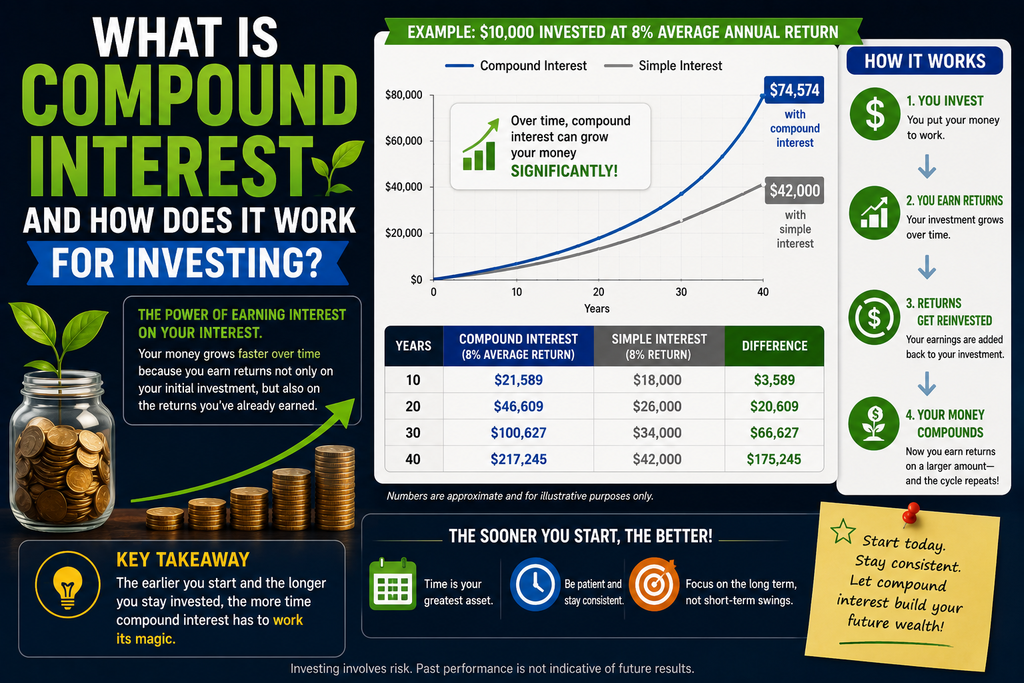
What Is Compound Interest?
Compound interest is interest earned on both your original principal and previously accumulated interest.
The concept can be easier to understand with a simple example.
Suppose you invest $1,000 and earn a hypothetical 10% return during the first year.
After one year:
$1,000 + $100 = $1,100
If the $1,100 remains invested and earns another hypothetical 10% the following year, you would earn:
$1,100 × 10% = $110
Your balance would become:
$1,210
Notice that the second year’s return was $110 rather than $100.
The additional $10 came from earning a return on the previous year’s return.
That is the basic idea of compounding.
How Does Compounding Work in Investing?
In investing, people often use the term compound growth because investments do not normally provide a fixed interest rate.
Stocks, ETFs, mutual funds, and other investments can rise or fall in value.
If an investment generates returns and those returns remain invested, the investment base can grow.
Future returns can then be generated on the larger balance.
Consider this simplified example:
| Year | Starting Balance | 10% Hypothetical Return | Ending Balance |
|---|---|---|---|
| 1 | $1,000 | $100 | $1,100 |
| 2 | $1,100 | $110 | $1,210 |
| 3 | $1,210 | $121 | $1,331 |
| 4 | $1,331 | $133.10 | $1,464.10 |
| 5 | $1,464.10 | $146.41 | $1,610.51 |
The return percentage stays the same in this illustration, but the dollar amount of the return increases because the balance is getting larger.
Real investments do not produce a guaranteed 10% return every year. Actual returns vary, and investments can lose value.
Compound Interest vs. Simple Interest
Understanding the difference between simple and compound interest can make the concept clearer.
Simple Interest
With simple interest, returns are calculated only on the original amount.
Suppose you invest $1,000 at a hypothetical 10% annual rate.
Each year, you earn $100.
After five years, you would have:
$1,000 + ($100 × 5) = $1,500
Compound Interest
With compounding, returns are added to the investment and can generate additional returns.
Using the same hypothetical 10% annual rate, $1,000 would become approximately:
$1,610.51 after five years
The difference becomes much larger over longer periods.
This is why compounding is often described as earning returns on returns.
Why Time Matters So Much
One of the most important parts of compounding is time.
The longer money remains invested, the more opportunities there are for returns to build upon previous returns.
Imagine two investors.
Investor A
Invests $5,000 and leaves it invested for 30 years.
Investor B
Invests the same $5,000 but leaves it invested for only 10 years.
If both investments achieve the same hypothetical annual return, Investor A has significantly more time for compounding to work.
This is one reason starting early can be valuable.
You do not necessarily need a huge amount of money to benefit from long-term compounding.
Time itself can be a powerful factor.
The Compound Interest Formula
The basic compound interest formula is:
A = P(1 + r/n)^(nt)
Where:
- A = final amount
- P = initial principal
- r = annual interest rate
- n = number of compounding periods per year
- t = number of years
For example, suppose:
- Principal = $5,000
- Annual rate = 8%
- Compounding = annually
- Time = 10 years
The hypothetical future value would be approximately:
$5,000 × (1.08)^10 = $10,794.62
This is a mathematical illustration, not a prediction of investment performance.
Actual investment returns are uncertain.
Why Reinvesting Matters
Reinvestment is one of the key elements of compounding.
Suppose an investment generates $500 in dividends.
You have two choices:
- Take the $500 as cash
- Reinvest the $500
If you reinvest it, you increase the amount of money working in the market.
That additional investment can potentially generate future returns.
For example:
Initial investment → returns → reinvest returns → larger investment → potential additional returns
This cycle can continue over many years.
Dividend reinvestment is one common way investors can increase the amount of money remaining invested.
Compounding With Monthly Contributions
Compounding becomes even more interesting when you regularly add money.
Suppose you invest:
$300 per month
You are not relying entirely on your original investment.
Each contribution increases the amount invested.
Over time, those contributions can also potentially generate returns.
For example, an investor who contributes $300 every month for 20 years would contribute:
$300 × 12 × 20 = $72,000
That is the investor’s total contributions before considering investment growth.
If the investment generates positive returns over time, the final account value could be higher than the total amount contributed.
However, actual returns are not guaranteed.
A Hypothetical Long-Term Example
Suppose an investor contributes $300 per month for 30 years.
The total contributions would be:
$300 × 12 × 30 = $108,000
Now imagine, purely for illustration, that the investment produces an average annual return of 8% and returns are compounded monthly.
The hypothetical ending value would be significantly higher than $108,000.
This example demonstrates why regular contributions and time can matter so much.
But an 8% annual return is only an assumption for mathematical illustration. Actual market returns fluctuate from year to year and can be negative.
The Rule of 72
The Rule of 72 is a simple estimation tool for understanding how long it might take an investment to double at a particular annual rate.
The basic formula is:
72 ÷ annual return = approximate doubling time
For example, at a hypothetical 8% annual return:
72 ÷ 8 = 9 years
So $10,000 might approximately double to $20,000 in about nine years under a constant 8% return assumption.
At 6%:
72 ÷ 6 = 12 years
At 10%:
72 ÷ 10 = 7.2 years
The Rule of 72 is only an approximation.
It does not account for taxes, fees, changing returns, contributions, withdrawals, or losses.
Compound Growth in Stocks
Stocks do not pay fixed interest like a traditional savings account.
Instead, investors can potentially benefit from:
- Stock price appreciation
- Dividends
- Dividend reinvestment
- Growth in the underlying business
For example, suppose you own shares of a company.
If the company grows its earnings over many years, its stock price may potentially increase.
If it also pays dividends and you reinvest those dividends, your investment can benefit from multiple sources of potential growth.
But stock prices can also decline.
Compounding does not protect investors from losses.
Compound Interest and ETFs
ETFs can also benefit from long-term compounding.
Suppose an ETF owns hundreds of companies.
If the underlying investments increase in value and dividends are distributed and reinvested, the value of your investment can potentially grow over time.
Broad-market ETFs are often used by long-term investors because they can provide exposure to many companies through a single investment.
However, ETFs are investments and can lose value.
The fact that an ETF is diversified does not guarantee positive returns.
Why Starting Early Can Matter
Consider two investors.
Investor A
Starts investing at age 25.
Investor B
Starts investing at age 35.
Even if Investor B eventually contributes a larger amount each month, Investor A has an additional decade for the investment to potentially compound.
This demonstrates an important investing principle:
Time can be more valuable than trying to find the perfect investment.
Starting early does not guarantee success, but it gives your money more time to experience potential growth and recover from temporary market declines.
What Happens If You Wait to Invest?
Waiting can reduce the amount of time available for compounding.
Suppose you plan to invest for retirement.
If you start at 25, you may have several decades.
If you start at 45, you have a much shorter period.
The later you start, the more you may need to contribute to reach the same financial goal.
This does not mean someone who starts late cannot build wealth.
It simply means they have less time for compounding to contribute to the outcome.
Compounding and Market Volatility
Compounding does not mean your account will increase every year.
Markets can experience:
- Bull markets
- Bear markets
- Recessions
- Crashes
- Periods of high volatility
For example, an investment might gain 15% one year and lose 10% the next.
Returns are not guaranteed to follow a smooth pattern.
Long-term investors therefore need to understand that compounding occurs through a series of uncertain returns rather than a fixed annual interest payment.
The Effect of Investment Fees
Fees can reduce the amount of money available to compound.
Suppose two investments have similar performance before expenses.
If one investment has significantly higher costs, more of its returns are used to pay expenses.
Over a short period, the difference may appear small.
Over decades, however, even relatively small annual costs can have a meaningful effect because the money used for fees is no longer available to compound.
This is why investors should understand:
- Expense ratios
- Brokerage fees
- Advisory fees
- Trading costs
- Account fees
Low cost does not automatically mean better, but costs are an important part of evaluating an investment.
Taxes Can Affect Compounding
Taxes can also affect investment growth.
For U.S. investors, the tax treatment of investment income and gains depends on factors such as the investment, account type, holding period, and individual circumstances.
Tax-advantaged retirement accounts can have different rules from taxable brokerage accounts.
Because tax laws can change, investors should review current IRS guidance or consult a qualified tax professional for personal tax questions.
Compound Interest vs. Inflation
Another important concept is inflation.
Suppose your investment grows by 7% over a year, but inflation is 3%.
Your nominal return is 7%, but your purchasing power has not increased by the full 7%.
This is why investors should consider real returns, which account for the effect of inflation.
Long-term wealth building is not just about making your account balance larger.
It is also about preserving and increasing purchasing power over time.
Common Compounding Mistakes
Mistake 1: Expecting Guaranteed Returns
Investment returns are not guaranteed.
A mathematical compound-interest calculation is an illustration, not a promise.
Mistake 2: Waiting for the Perfect Time
Trying to identify the perfect moment to start investing can cause unnecessary delays.
Mistake 3: Ignoring Fees
Higher costs can reduce the amount available for compounding.
Mistake 4: Frequently Selling Investments
Constantly moving in and out of investments can interrupt a long-term strategy.
Mistake 5: Taking Unnecessary Risk
Compounding works best as part of a sustainable investment plan. Taking excessive risk can produce large losses.
Mistake 6: Forgetting Inflation
A growing account balance does not automatically mean your purchasing power is growing at the same rate.
Mistake 7: Stopping Contributions During Market Declines
Some investors become afraid when markets fall and stop investing.
Depending on their strategy and financial circumstances, continuing regular contributions can allow investors to purchase investments at lower prices during downturns.
How Beginners Can Take Advantage of Compounding
You do not need a complicated strategy.
A simple long-term approach can include:
Start Early
The earlier you begin, the more time your money has to potentially compound.
Invest Consistently
Regular contributions can gradually increase your investment balance.
Reinvest Dividends
Reinvesting dividends can keep more money working in your portfolio.
Keep Costs Reasonable
Lower unnecessary costs can leave more money available for investment growth.
Diversify
Diversification can reduce the impact of a single investment performing poorly.
Stay Invested
Long-term investing generally requires patience through periods of market volatility.
Increase Contributions Over Time
If your income increases, consider whether you can increase the amount you invest.
A Simple Compounding Strategy
A beginner might create a straightforward plan:
1. Build an emergency fund.
2. Pay attention to high-interest debt.
3. Set a long-term investment goal.
4. Open an appropriate investment account.
5. Choose diversified investments that match your risk tolerance.
6. Invest consistently.
7. Reinvest income when appropriate.
8. Keep investment costs under control.
9. Avoid unnecessary trading.
10. Give the strategy enough time to work.
The goal is not to predict exactly how much your portfolio will be worth in 20 or 30 years.
The goal is to create habits that give compounding a reasonable opportunity to work.
Frequently Asked Questions About Compound Interest
What is compound interest in simple words?
Compound interest means earning returns on your original money and on the returns that have already accumulated.
Does compound interest work with stocks?
Stocks do not pay fixed compound interest. However, investments can experience compound growth when returns remain invested and generate future returns.
How often does compound interest compound?
The frequency depends on the financial product. It can be calculated daily, monthly, quarterly, annually, or using another schedule.
For market investments, actual returns fluctuate rather than following a fixed compounding schedule.
Can I lose money despite compounding?
Yes. Compounding does not eliminate investment risk. Stocks and other investments can lose value.
Is compound interest guaranteed?
Not for stock-market investments. A fixed-interest financial product may have stated terms, but investment returns from stocks and funds are uncertain.
Is it better to invest a large amount or invest monthly?
The answer depends on your circumstances and the investment strategy. A lump-sum investment gives money more time in the market, while regular contributions can make investing more systematic.
Does reinvesting dividends create compounding?
Reinvesting dividends can contribute to compound growth because the reinvested money can potentially generate future returns.
Final Thoughts
Understanding what compound interest is can completely change how you think about long-term investing.
The concept is simple: money that remains invested can potentially generate returns, and those returns can become part of the investment base that generates future returns.
The real power comes from combining time, consistent investing, reinvestment, and patience.
However, investors should remember that stock-market returns are not guaranteed. Real investments fluctuate, fees and taxes can reduce returns, and inflation can reduce purchasing power.
You do not need to predict the market perfectly to benefit from long-term compounding.
Instead, focus on building sustainable financial habits: start when you can, invest consistently, diversify appropriately, keep unnecessary costs under control, and give your investments enough time to potentially grow.
The earlier you understand compounding, the easier it becomes to see why long-term investing is often less about finding a quick win and more about giving your money time to work.