
Living paycheck to paycheck can make managing money stressful. Even when you earn a regular income, it can feel like every dollar is already committed before your next paycheck arrives.
An unexpected car repair, higher utility bill, or other expense can quickly create financial pressure.
Breaking this cycle does not happen overnight. It usually requires a combination of controlling spending, building savings, managing debt, and improving the gap between income and expenses.
The good news is that you do not need to completely change your lifestyle in one day.
By taking a few practical steps and repeating them consistently, you can gradually create more financial breathing room.
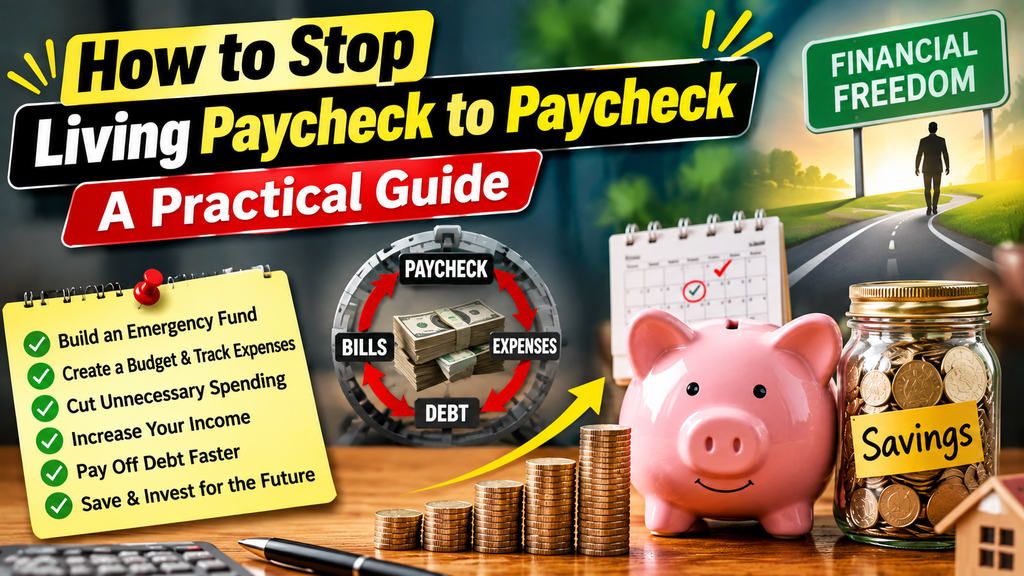
What Does Living Paycheck to Paycheck Mean?
Living paycheck to paycheck generally means relying heavily on your next paycheck to cover regular expenses, with little money left over after bills and everyday spending.
Someone can experience this situation at almost any income level.
A person earning $35,000 may struggle financially, but so can someone earning $100,000 if their expenses and financial commitments consume most of their income.
The key issue is the relationship between income, expenses, debt, and savings.
If there is little or no money available after necessary expenses, even a small unexpected cost can cause problems.
Why Is It So Difficult to Break the Cycle?
Several factors can contribute to paycheck-to-paycheck living.
These may include:
- High housing costs
- Transportation expenses
- Credit card debt
- Student loan payments
- Rising everyday costs
- Lack of emergency savings
- Impulse spending
- Irregular income
- Lifestyle inflation
- Unexpected expenses
Sometimes the problem is not excessive discretionary spending at all.
If essential expenses consume nearly all of your income, cutting small purchases may only have a limited impact.
That is why a successful strategy needs to look at both sides of the equation: expenses and income.
Step 1: Calculate Your Real Monthly Income
Start by determining how much money you actually receive.
Use your take-home income rather than your gross salary.
If you have a regular paycheck, this should be relatively straightforward.
If your income varies, calculate a conservative monthly average based on your recent income history.
Include reliable sources such as:
- Employment income
- Freelance income
- Business income
- Part-time work
Avoid assuming that an unusually high month will continue indefinitely.
Your budget should be built around an income estimate you can reasonably depend on.
Step 2: Track Your Spending for 30 Days
The next step is to understand where your money is going.
For one month, record every expense.
Include both large and small purchases.
Review:
- Rent or mortgage
- Utilities
- Groceries
- Transportation
- Insurance
- Debt payments
- Restaurants
- Entertainment
- Shopping
- Subscriptions
- Other recurring expenses
Do not judge yourself while collecting the information.
The purpose of this exercise is simply to understand your current financial situation.
Once you have accurate information, you can make better decisions.
Step 3: Separate Fixed and Variable Expenses
Divide your expenses into two broad categories.
Fixed Expenses
These generally remain relatively stable.
Examples include:
- Rent
- Mortgage payments
- Car payments
- Insurance
- Minimum debt payments
- Certain subscriptions
Variable Expenses
These can change from month to month.
Examples include:
- Groceries
- Gas
- Dining out
- Entertainment
- Clothing
- Personal purchases
This distinction helps identify which expenses can be changed quickly.
For example, reducing restaurant spending may be easier in the short term than changing your housing arrangement.
Step 4: Find Your Financial Leaks
A financial leak is money that repeatedly leaves your budget without providing much value.
Common examples include:
- Unused subscriptions
- Frequent delivery fees
- Impulse shopping
- Duplicate services
- Convenience purchases
- Excessive entertainment spending
Suppose you discover that several small subscriptions cost you $45 each month.
Canceling them would free up $540 over a year.
Small changes can become meaningful when they are recurring.
Step 5: Create a Bare-Bones Budget
If you are struggling financially, create a temporary bare-bones budget.
This budget focuses on essential expenses.
For example:
- Housing
- Utilities
- Basic food
- Transportation
- Insurance
- Required debt payments
- Essential household costs
The goal is to understand the minimum amount of money you need to maintain your basic lifestyle.
Once you know that number, you can compare it with your income.
If your essential expenses are close to or greater than your income, the solution may require more than simply cutting discretionary spending.
Step 6: Build a Starter Emergency Fund
One unexpected expense can push someone who is already financially stretched deeper into debt.
That is why even a small emergency fund can be useful.
Start with an achievable target.
You might begin with:
- $250
- $500
- $1,000
The exact target depends on your circumstances.
Once you have a starter reserve, continue working toward a larger emergency fund that can cover several months of essential expenses if appropriate for your situation.
Step 7: Stop Using Credit for Everyday Shortfalls
Credit cards can become particularly dangerous when they are used to cover regular expenses that your income cannot currently support.
If you repeatedly charge groceries, utilities, or other essential costs because your paycheck runs out, the resulting balance can become increasingly difficult to repay.
Try to identify the underlying problem.
Is spending too high?
Are fixed expenses too large?
Is income too low?
Is debt consuming too much of your monthly cash flow?
Addressing the underlying issue is more effective than simply moving expenses from one payment method to another.
Step 8: Prioritize High-Interest Debt
High-interest debt can make escaping the paycheck-to-paycheck cycle harder.
Credit card balances are a common example.
Interest charges can consume part of your income without improving your financial position.
List your debts and record:
- Balance
- Interest rate
- Minimum payment
- Due date
Then create a repayment strategy.
The debt avalanche method focuses on the highest interest rate first, while the debt snowball method focuses on the smallest balance first.
Whichever approach you choose, continue making required minimum payments on other debts.
Step 9: Create a Buffer in Your Checking Account
An emergency fund protects against larger unexpected expenses.
A checking-account buffer can help with smaller timing problems.
For example, you may receive your paycheck every two weeks while some bills are automatically withdrawn at different times.
A small cash buffer can reduce the risk of overdrafts or needing to rely on a credit card when the timing of expenses becomes inconvenient.
Start with a small target and gradually increase it.
Step 10: Use a Weekly Spending Limit
Monthly budgets can sometimes feel too broad.
A weekly spending limit can make discretionary spending easier to control.
For example, after accounting for your bills, savings, and debt payments, you might determine that you can spend a certain amount each week on flexible expenses.
This gives you a simple checkpoint.
If you spend less one week, you may have more flexibility later.
If you overspend, you know early enough to make adjustments.
Step 11: Reduce Your Largest Expenses
Do not focus exclusively on small purchases.
Your largest expenses usually have the greatest potential impact.
Look closely at:
Housing
Housing is often one of the largest monthly expenses.
Depending on your circumstances, options might include finding a less expensive home, negotiating where possible, taking on a roommate, or reducing other housing-related costs.
Transportation
Cars can create substantial costs beyond the monthly payment.
Consider fuel, maintenance, insurance, registration, and repairs.
Debt
High-interest debt can consume a large portion of your monthly income.
Reducing expensive debt can eventually create additional financial flexibility.
Step 12: Increase Your Income
Sometimes spending cuts are not enough.
If your essential expenses already consume most of your income, increasing earnings may be necessary.
Potential options depend on your skills and circumstances.
These could include:
- Overtime
- Freelance work
- Part-time work
- Consulting
- Selling unused items
- Developing a valuable skill
- Negotiating compensation where appropriate
The goal is not simply to earn more and spend more.
Try to use additional income to strengthen your financial position.
For example, you could divide extra income between emergency savings, debt repayment, and long-term goals.
Step 13: Avoid Lifestyle Inflation
Lifestyle inflation happens when spending increases as income rises.
Imagine someone receives a $500 monthly raise.
Instead of saving or using some of the extra income to reduce debt, they immediately upgrade their car, subscriptions, restaurants, and entertainment.
Their income increased, but their financial stress remained.
When your income rises, consider keeping your existing lifestyle for a while and directing part of the additional money toward your financial goals.
You can still improve your lifestyle without allowing every income increase to become a new monthly obligation.
Step 14: Automate Your Savings
Saving what remains at the end of the month can be difficult when there is little left.
Instead, consider making savings automatic.
For example, you could schedule a recurring transfer shortly after receiving your paycheck.
Even a small amount can help establish the habit.
As your financial situation improves, gradually increase the amount.
Automation makes saving less dependent on willpower.
Step 15: Give Every Paycheck a Job
Before your next paycheck arrives, know what you want the money to accomplish.
For example:
- Housing
- Utilities
- Food
- Transportation
- Debt
- Savings
- Investing
- Discretionary spending
This approach makes it easier to avoid spending money without a purpose.
It also gives you a clearer picture of how much money is genuinely available.
Step 16: Build a Sinking Fund for Predictable Expenses
Not every unexpected-looking expense is truly unexpected.
Car maintenance, annual insurance payments, holiday spending, and certain household expenses may occur regularly.
Instead of waiting for these bills to arrive, create sinking funds.
For example, if you expect a $600 annual expense, you could set aside approximately $50 per month.
When the bill arrives, you already have money available.
This prevents predictable expenses from turning into financial emergencies.
Step 17: Review Your Budget Every Paycheck
You do not necessarily need to wait until the end of the month.
Review your financial plan whenever you receive income.
Ask:
- What bills are coming?
- How much can I save?
- What debt payment is due?
- How much is available for discretionary spending?
- Are there upcoming irregular expenses?
A short review can help you stay ahead of your finances.
What If Your Income Is Not Enough?
This is an important question.
If your essential expenses are already greater than your income, extreme budgeting may not solve the problem.
You may need to consider larger changes.
Depending on your circumstances, these might include:
- Increasing income
- Reducing housing costs
- Changing transportation expenses
- Refinancing or restructuring eligible debt
- Reducing recurring commitments
- Seeking additional work
- Getting professional financial guidance
The solution will depend on your specific situation.
There is no universal percentage of income that everyone should spend on housing, food, transportation, or other categories.
Common Mistakes to Avoid
Trying to Fix Everything Immediately
Changing too many habits at once can become overwhelming.
Focus on the highest-impact improvements first.
Cutting All Enjoyment
A budget that leaves no room for reasonable discretionary spending can be difficult to maintain.
Ignoring Debt
If high-interest debt continues growing, it can undermine progress elsewhere.
Saving While Constantly Increasing Debt
Look at your overall financial position rather than focusing on one number.
Increasing Spending After a Raise
Use some income increases to strengthen your financial foundation.
Giving Up After an Unexpected Expense
Financial setbacks happen.
If you need to use savings, rebuild them afterward rather than abandoning your plan.
A Simple Plan to Break the Paycheck Cycle
If you are starting from zero, use this basic sequence:
Month 1: Track spending and create a realistic budget.
Month 2: Reduce unnecessary recurring expenses and begin automatic savings.
Month 3: Build a starter emergency fund and create a plan for high-interest debt.
Months 4–6: Increase your emergency savings, reduce debt, and look for ways to improve income.
Long term: Build a larger emergency reserve, contribute toward retirement, and invest according to your financial goals and risk tolerance.
Your timeline may be faster or slower.
The important thing is making steady progress.
Final Thoughts
Learning how to stop living paycheck to paycheck requires more than cutting a few small expenses.
Start by understanding your income and spending, then create a realistic budget that reflects your actual life.
Build a small emergency fund, control high-interest debt, reduce unnecessary recurring expenses, and consider increasing your income when spending cuts are not enough.
As your financial position improves, create a cash buffer and eventually work toward larger savings and long-term investing goals.
You do not need to become financially secure overnight.
The objective is to gradually create a gap between what you earn and what you spend—and then use that gap to build savings, reduce debt, and create long-term financial stability.