
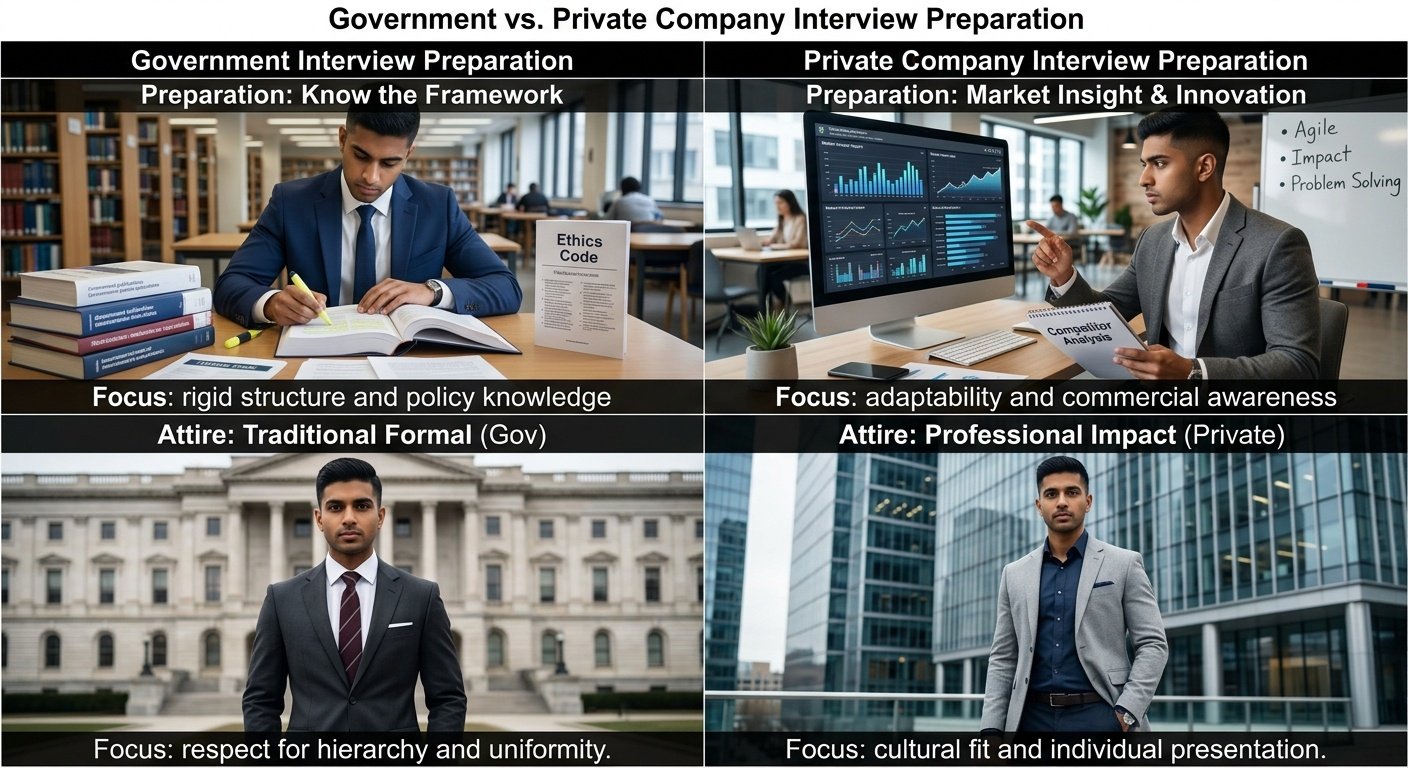
You wouldn’t wear the same outfit to a wedding and a hiking trip, but a surprising number of candidates prepare the exact same way for a bank PO interview and a startup product manager interview. Both are technically “job interviews,” but the panel, the evaluation criteria, and even what counts as a good answer are almost entirely different. Walking into an SSC or UPSC interview board with startup-style casual confidence — or walking into a private tech interview with the formal, rehearsed tone that works for a PSU panel — both come across as slightly off.
Here’s what actually changes between the two, section by section.
Table of Contents
- Who’s on the Panel and What They’re Scoring
- Tone and Body Language Differences
- How to Answer “Tell Me About Yourself” Differently for Each
- Current Affairs vs Technical Depth
- Common Questions Unique to Government Interviews
- Common Questions Unique to Private Interviews
- FAQ
- Final Takeaway
Who’s on the Panel and What They’re Scoring
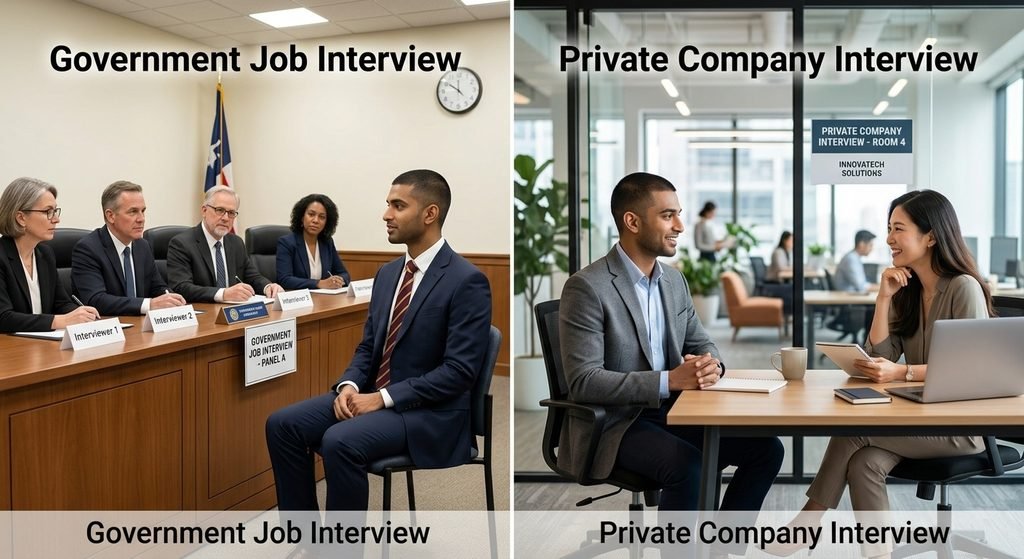
Government interviews (UPSC, state PSC, bank PO, SSC-adjacent posts that include an interview stage) are usually conducted by a panel of 3-5 members, often including a retired senior officer, a subject expert, and a psychologist or HR representative. They’re scoring you against a structured rubric — general awareness, decision-making under pressure, integrity, and communication — often with marks allotted to specific dimensions, not just a gut “did I like this candidate” call.
Private company interviews, especially at startups and mid-size firms, usually involve 1-2 rounds with the hiring manager and sometimes a future teammate. They’re scoring for role-fit, problem-solving approach, and whether they’d want to work with you daily. There’s rarely a formal scoring rubric at the fresher level — it’s a more subjective “can this person do the job and fit the team” read.
This difference changes everything downstream — how formal to be, what to emphasize, and which questions to expect.
Tone and Body Language Differences
| Aspect | Government Interview | Private Company Interview |
|---|---|---|
| Greeting | Formal — “Good morning, sir/madam” to each panel member | Friendly but professional — a simple “Hi, thanks for having me” works |
| Posture | Upright, hands on lap, minimal gestures | Relaxed but attentive; natural hand gestures are fine |
| Language | Formal English/Hindi, avoid slang or casual contractions | Conversational tone, contractions (“I’ve,” “that’s”) are fine and even expected |
| Answering pace | Measured, complete sentences, avoid rushing | Can be more conversational and back-and-forth |
| Disagreeing with the panel | Rare, and if needed, done respectfully with supporting facts | More acceptable to push back with reasoning, especially in technical rounds |
A common mistake: fresher candidates who’ve practiced mock interviews mostly through YouTube videos aimed at private-sector prep end up bringing that same casual tone into a UPSC or bank interview, where it can read as underprepared or overly informal to a panel expecting more structure.
How to Answer “Tell Me About Yourself” Differently for Each
For a government interview, lead with your educational background, then connect it to public service or the specific role’s responsibility — panels are listening for a sense of purpose tied to the post, not just personal ambition.
Example (Bank PO): “I completed my B.Com from Delhi University in 2025, and during my final year, I did a project studying how rural bank branches handle loan disbursement delays. That’s part of what drew me to banking specifically — it’s a sector where a single process improvement can genuinely affect someone’s access to credit.”
For a private company interview, lead with your most relevant skill or project, and connect it directly to the job description — the panel is listening for whether you understand what the role actually needs day-to-day.
Example (Data Analyst role): “I’m a B.Tech grad with a focus on data analysis — I built a demand-forecasting model during my final year that’s still being used by my college’s placement cell, and that hands-on experience with messy, real-world data is what pulled me toward analyst roles specifically.”
Same person, same background — different emphasis based on what each panel is actually scoring.
Current Affairs vs Technical Depth
Government interviews, especially UPSC, state PSC, and even bank PO panels, routinely test current affairs and general awareness — recent government schemes, budget allocations, or policy changes relevant to the post. A candidate for an RBI Grade B interview, for instance, should be ready to discuss recent repo rate changes and their real-world effect, not just define what a repo rate is.
Prep checklist for government interviews:
- Last 3-4 months of major national and state news
- Government schemes relevant to the specific department (e.g., PM-KISAN for agriculture-adjacent posts)
- Basic facts about the recruiting body itself — when it was established, its current head, its core function
- Your state/district’s specific issues if it’s a state-level post
Private company interviews rarely touch current affairs unless it’s directly relevant to the industry (e.g., a fintech asking about recent RBI digital lending guidelines). Instead, expect deeper technical or role-specific questions — walk-throughs of your project code, case-study style problems, or tool-specific questions.
Prep checklist for private interviews:
- Be ready to explain any tool or technology listed on your resume in detail — don’t list something you can’t discuss for 5 minutes
- Practice one full case-study or problem-solving question relevant to the role
- Research the company’s actual product, not just “what industry are they in”
Common Questions Unique to Government Interviews
- “Why do you want to join government service instead of the private sector?”
- “What would you do if you were posted to a remote or rural location?”
- “How would you handle a situation where you’re asked to do something against protocol by a senior?”
- “What recent government scheme do you think has had the most impact, and why?”
- “How do you see this department’s role in [current national issue]?”
These questions are checking for integrity, adaptability, and awareness — not creativity or speed of thought the way private interviews often do.
Common Questions Unique to Private Interviews
- “Walk me through how you’d approach [a specific problem relevant to the role].”
- “What would you do in your first 30 days on this job?”
- “Tell me about a time you had to learn a new tool quickly.”
- “How do you handle ambiguous instructions from a manager?”
- “What’s a product/feature/process you think could be improved, and how?”
These are checking for practical problem-solving and whether you can operate with less structure than a government role typically provides.
FAQ
Q1: Should I dress differently for government vs private interviews? Formal wear (suit or saree/formal kurta) is expected for government interviews without exception. For private companies, especially startups, smart-casual is often fine unless it’s a client-facing or leadership role — check the company’s general dress culture beforehand if unsure.
Q2: Is it okay to ask about salary in a government interview? No — government pay scales are fixed and publicly listed, so asking about salary in the interview itself is unnecessary and can look uninformed.
Q3: Do government interviews test technical skills at all? For technical posts (engineering services, IT cadre roles), yes — but even then, expect it combined with general awareness and situational questions, not a pure technical deep-dive like a private tech interview.
Q4: How much current affairs prep is “enough” for a government interview? At minimum, the last 3 months of major national news, plus anything specific to the recruiting department. UPSC-level interviews often expect broader awareness going back 6-12 months.
Q5: Can I show personality and humor in a government interview? Sparingly, and only if the panel’s tone invites it. Government panels can vary widely by individual members — reading the room matters more here than in most private interviews, where a bit of humor is generally welcomed.
Q6: If I’m interviewing for both types in the same week, how do I switch mindset quickly? Do a 10-minute review right before each interview: for government, skim that day’s newspaper headlines and the department’s core function; for private, re-read the job description and your own resume once, focusing on your strongest project.
Final Takeaway
The core skill — communicating clearly under pressure — is the same in both settings, but what you’re being measured against is not. Government interviews reward structure, awareness, and a sense of public responsibility; private interviews reward specific problem-solving and role-fit. Before your next interview, spend five minutes identifying which of these two categories it falls into, and adjust your tone and prep accordingly — it’s a small shift that changes how prepared you actually sound in the room.