
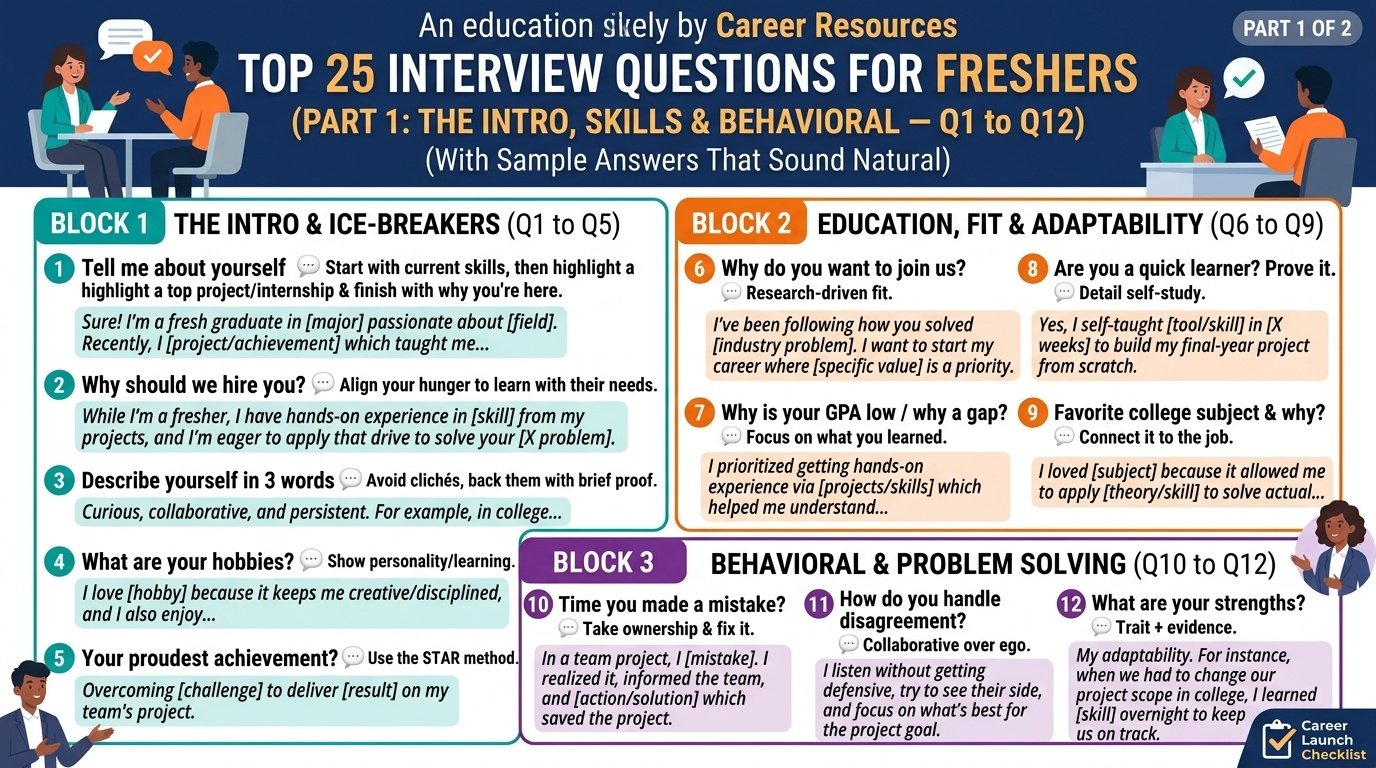
You’ve rehearsed “Tell me about yourself” in front of the mirror twelve times, and it still comes out sounding like you’re reading a résumé aloud. That’s the problem with most interview prep — it teaches you what to say, not how to say it so it doesn’t sound rehearsed. Interviewers, especially at companies that hire in bulk (TCS, Infosys, Wipro, Accenture) or startups doing 3-4 rounds a week, can tell the difference between a memorized answer and an actual thought process in about 15 seconds.
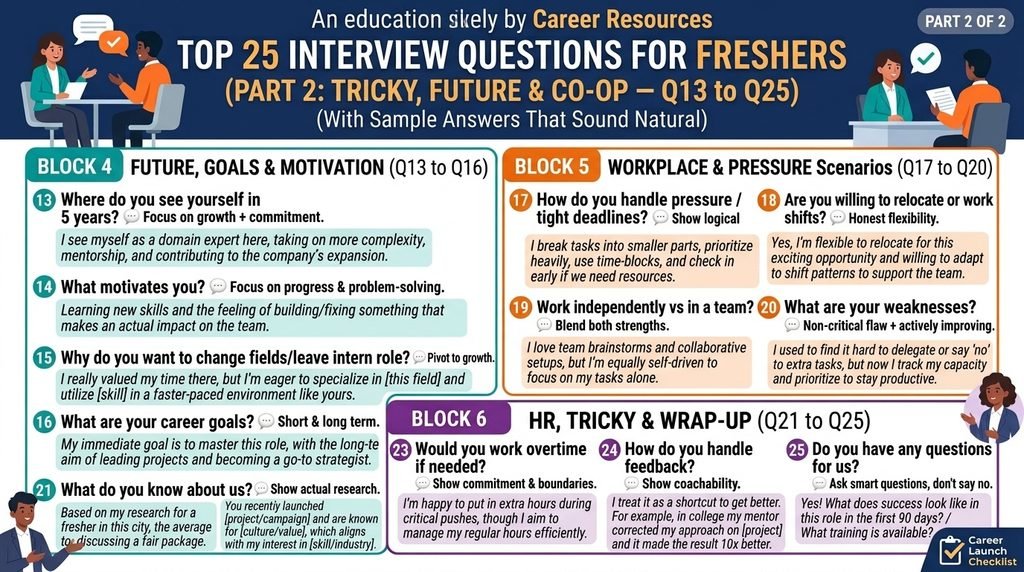
This isn’t a script to memorize word-for-word. It’s 25 real questions freshers get asked, with example answers built to sound like someone thinking out loud, not reciting.
Table of Contents
- About You & Your Background (Q1-5)
- Technical & Role-Specific (Q6-10)
- Behavioral & Situational (Q11-18)
- Company & Role Fit (Q19-22)
- Tricky / Curveball Questions (Q23-25)
- FAQ
- Final Takeaway
About You & Your Background
1. “Tell me about yourself.” Skip the birthplace-to-present timeline. Structure: current status → one relevant achievement → why you’re here. “I just finished my B.Com from Delhi University with a focus on finance. During my final year, I did a two-month internship at a small CA firm where I actually built a basic Excel model to track client GST filings — that’s what pulled me toward wanting to work in finance operations rather than just studying it theoretically.”
2. “Why should we hire you?” Avoid generic “I’m hardworking and a fast learner.” Pick one specific, provable trait. “I don’t have work experience yet, but I’ve shown I can pick up tools fast on my own — I taught myself Power BI over three weekends for a college project because Excel alone wasn’t cutting it, and the dashboard I built is still being used by my department’s admin office.”
3. “What are your strengths?” Back it with a specific instance, not just a label. “I stay calm under deadline pressure — during my final semester, three of us had to redo a 40-page project report two days before submission after our professor rejected our first draft, and I ended up organizing who did what so we finished on time without anyone pulling an all-nighter.”
4. “What is your biggest weakness?” Real weakness + what you’re actively doing about it, not a disguised strength like “I work too hard.” “I tend to over-polish things before sharing them, even drafts that just need quick feedback. I’ve started setting myself a hard time limit — an hour, then I share it as-is — because I noticed I was slowing down group projects waiting to make my part ‘perfect.'”
5. “Where do you see yourself in 5 years?” Show direction without overcommitting to a specific title. “Honestly, I want to get genuinely good at data analysis first — comfortable enough that people come to me with messy datasets. Where that leads in five years, whether that’s a senior analyst role or something more strategic, I’d rather let the first two years of actual work experience shape that.”
Technical & Role-Specific
6. “Walk me through a project you’re proud of.” Use the problem → approach → result structure, with one specific number.
7. “What tools/software are you comfortable with?” Name specific versions or use-cases, not just tool names — “Excel, including pivot tables and VLOOKUP for reconciling sales data” beats “Excel.”
8. “How do you stay updated in your field?” Name actual sources — a specific newsletter, YouTube channel, or course — not “I read articles online.”
9. “Explain a technical concept to a non-technical person.” (common for tech/analyst roles) Pick something simple and use a real analogy — e.g., explaining an API as “a waiter taking your order to the kitchen and bringing food back, without you needing to know how the kitchen works.”
10. “What’s a mistake you made in a project, and what did you learn?” Real mistake, real fix — interviewers are checking whether you can own an error without deflecting blame.
Behavioral & Situational
11. “Describe a time you worked in a team with conflict.” 12. “Tell me about a time you failed.” 13. “How do you handle criticism?” 14. “Describe a time you had to learn something quickly.” 15. “How do you prioritize when you have multiple deadlines?” 16. “Tell me about a time you disagreed with a professor or team member.” 17. “How do you handle repetitive or boring tasks?” 18. “Describe a time you took initiative without being asked.”
For all eight of these, use the Situation → Action → Result structure in under 90 seconds. The most common mistake here is spending too long on the situation and rushing the result — the result is what the interviewer is actually listening for.
Example for Q13 (“How do you handle criticism?”): “During my internship, my supervisor told me my first report had way too much jargon and wasn’t usable for the sales team it was meant for. My first reaction was a bit defensive, honestly, but I rewrote it that evening in plain language, and the next three reports I submitted followed that same simpler format without being asked.”
Company & Role Fit
19. “Why do you want to work here?” Name something specific — a product, a recent announcement, a team’s working style — not “great culture and growth opportunities.”
20. “What do you know about our company?” Research 2-3 real facts before the interview: a recent product launch, funding round, or market position. Generic answers (“you’re a leading company in your industry”) are an instant red flag.
21. “Why did you choose this field/branch of study?” Give a real reason, even if it’s not a dramatic story — “I picked commerce because I found accounting logical, not because of some big realization” is more credible than a manufactured passion story.
22. “What are your salary expectations?” For freshers, it’s fine to say: “I’m early in my career, so I’d like to understand the role better first — but based on my research, I’d expect something in line with the standard range for this role and experience level in [city].” Avoid naming a number too early unless pushed.
Tricky / Curveball Questions
23. “If you don’t get this job, what will you do?” Interviewers ask this to check resilience and whether you’re only applying here. Keep it honest and calm: “I’d look at the feedback if any was given, and keep applying — I’m treating every interview as practice too, at this stage.”
24. “Sell me this pen.” (or similar) This tests thinking on your feet, not sales skill. Focus on identifying a need and matching a feature to it, out loud, rather than a slick pitch: “Before I sell it, can I ask what you’re currently using to take notes?” — showing you’d ask questions before pitching is often more impressive than a smooth monologue.
25. “Do you have any questions for us?” Never say “no.” Ask something that shows you were listening: “You mentioned the team is currently restructuring how reports get reviewed — what does that new process look like day-to-day?”
FAQ
Q1: Should fresher answers be memorized word-for-word? No — memorize the structure and key facts (numbers, project names), not exact sentences. Word-for-word answers sound flat and fall apart if the interviewer asks a follow-up.
Q2: How long should each answer be? 60-90 seconds for most questions. “Tell me about yourself” can run slightly longer, up to 2 minutes.
Q3: What if I genuinely have no work experience to draw examples from? Use college group projects, part-time work, internships, or even personal projects — interviewers evaluating freshers expect this and don’t penalize it.
Q4: Is it okay to say “I don’t know” to a technical question? Yes, if followed by how you’d find out — “I haven’t worked with that specific tool, but I’d start by checking the documentation and testing it on a small sample first” shows problem-solving even without direct knowledge.
Q5: Should answers differ between government job interviews and private company interviews? Yes — government interviews (banking, PSU) tend to reward more formal, structured answers and knowledge of current affairs; private/startup interviews often reward a more conversational tone and specific project stories.
Q6: How do I stop sounding nervous or rehearsed? Practice out loud with a friend asking follow-up questions, not just reciting alone — follow-ups are what expose a memorized answer, so practicing under that pressure helps more than repetition alone.
Final Takeaway
The freshers who get shortlisted aren’t the ones with the most polished scripts — they’re the ones whose answers sound like they’re actually remembering something real, with a number or specific detail attached. Pick five questions from this list, write out your own real answer using the Situation-Action-Result structure, and practice them out loud with a friend who’ll ask you follow-up questions. That’s the difference between sounding rehearsed and sounding ready.