
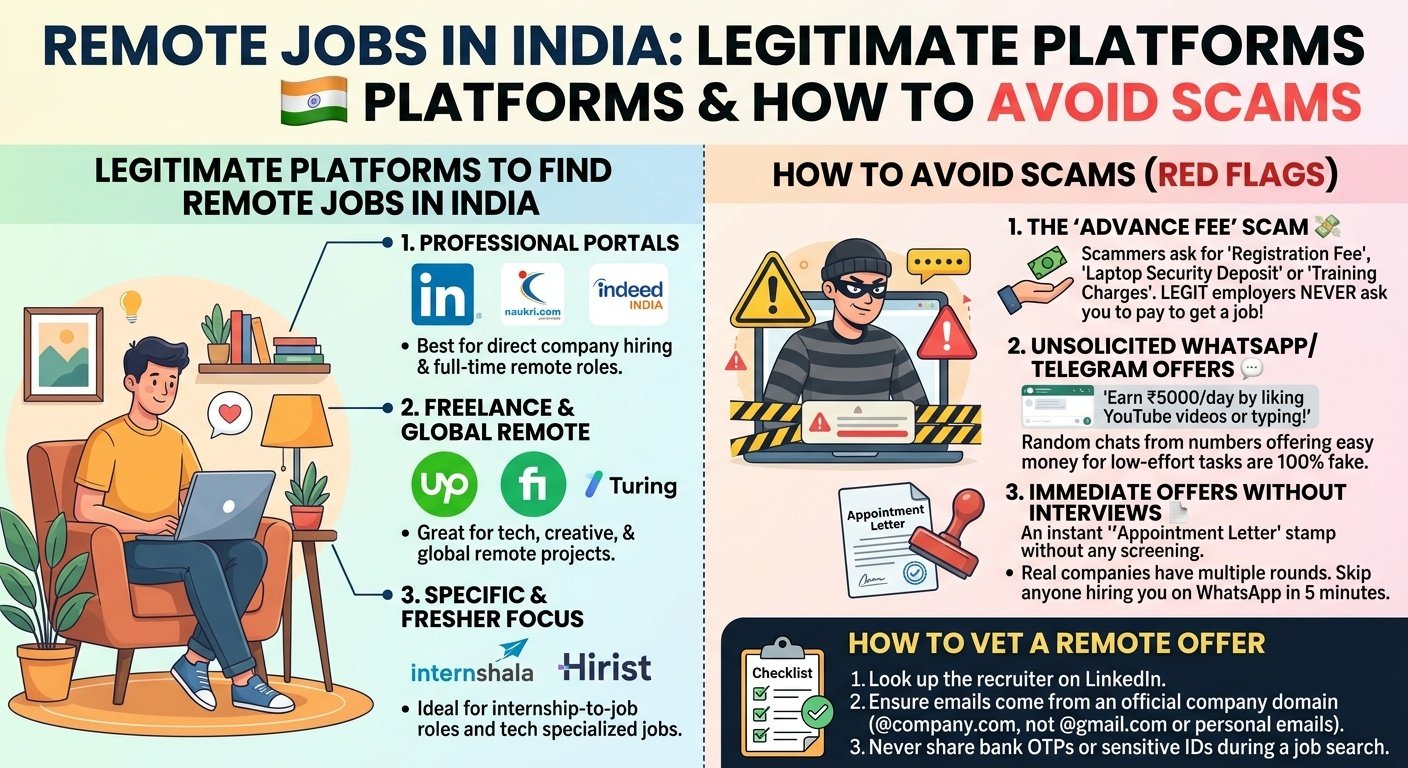
Remote work has genuinely expanded opportunities for job seekers across India, allowing people in smaller cities and towns to access roles that were previously concentrated in metro areas. But this same shift has also created fertile ground for job scams, which have grown considerably more sophisticated in recent years. This guide covers both sides honestly — where to actually find legitimate remote work, and how to protect yourself from the scams that specifically target remote job seekers.
Legitimate Platforms Where Remote Jobs Are Genuinely Posted
General Job Portals With Remote Filters
Major job portals — including Naukri, LinkedIn, Indeed, and Shine — allow filtering specifically for remote roles, and legitimate companies across IT, content, marketing, customer support, and design regularly post genuine remote openings through these platforms. The advantage here is that these postings come from verified company profiles, and you can research the company’s other information (reviews, other job postings, company size) before applying.
Specialized Remote-First Job Boards
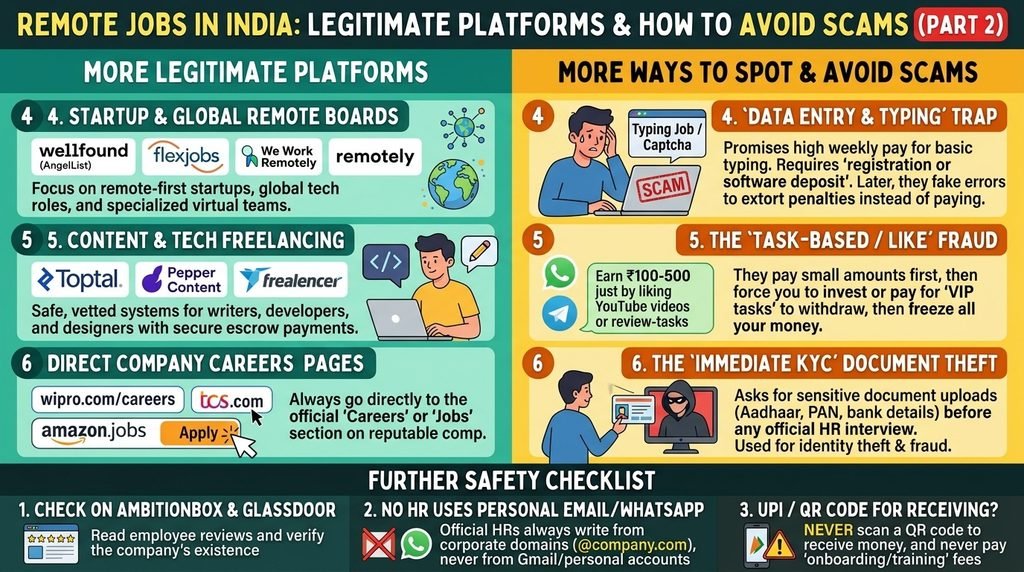
Platforms specifically focused on remote work — such as Remote OK, We Work Remotely, and AngelList (for startup roles) — aggregate remote-specific listings, often including international remote opportunities that Indian candidates can apply for, particularly in tech, design, content, and marketing roles. These platforms tend to have a global candidate pool, so competition can be higher, but the roles listed are generally legitimate, verified postings.
Freelance Platforms for Project-Based Remote Work
Platforms like Upwork, Fiverr, and Freelancer connect freelancers with clients for project-based remote work across writing, design, development, virtual assistance, and various other skills. While not traditional full-time employment, many professionals build substantial, stable income through consistent freelance work on these platforms, and they offer built-in payment protection mechanisms that reduce (though don’t eliminate) the risk of non-payment.
Company Career Pages Directly
For companies you’re specifically interested in, checking their official career page directly is often more reliable than third-party listings, since this eliminates any risk of outdated or fraudulently reposted listings that sometimes appear on aggregator sites. Many companies, particularly tech and SaaS companies with distributed teams, maintain updated remote-specific job listings directly on their own websites.
LinkedIn for Networking-Based Remote Opportunities
Beyond direct job postings, LinkedIn is valuable for building professional connections in your target industry, following companies known for remote hiring, and sometimes learning about openings before they’re widely advertised through networking conversations. Actively engaging with your professional network, rather than only passively browsing job listings, genuinely opens additional legitimate opportunities.
Common Remote Job Scam Patterns to Recognize
The “Pay First” Scam
This is one of the most common patterns — a supposed employer asks you to pay a registration fee, training fee, security deposit, or fee for equipment/materials before starting work, promising reimbursement later. Legitimate employers do not ask candidates to pay money as a condition of employment. Any request for upfront payment, regardless of how it’s framed (registration, training kit, background verification fee), is a significant red flag that should end your engagement with that “employer” immediately.
The Unrealistic Salary-to-Effort Ratio
Scam postings frequently promise unusually high pay for minimal effort or vague task descriptions — “earn ₹50,000 per month working just 2 hours a day, no experience needed.” Legitimate remote roles, like any legitimate job, have salary levels roughly proportional to the skill, experience, and effort required. If a posting’s compensation promise seems disconnected from the actual described responsibilities, treat it with significant skepticism.
Vague Job Descriptions and Company Information
Scam postings often provide vague descriptions of actual work (“data entry,” “online typing job,” “social media task-based work”) without a clear company name, verifiable website, or specific role details. Legitimate companies, even smaller ones, typically provide a real company name, a functioning website with actual content (not just a single landing page), and a specific, clearly described role.
Communication Only Through Unofficial Channels
Be cautious if all communication happens exclusively through WhatsApp, Telegram, or personal email addresses (rather than a company domain email), without any official documentation, offer letter on company letterhead, or verifiable HR contact. Legitimate remote hiring processes, even for smaller companies, typically involve some verifiable documentation and official communication channels, even if initial outreach happens through informal channels like LinkedIn messages.
Requests for Sensitive Personal or Financial Information Too Early
Be wary if you’re asked for banking details, Aadhaar or PAN details, or other sensitive personal information very early in the process, before any formal offer or verified employment relationship has been established. Legitimate employers typically request this information only after a formal offer, as part of standard onboarding documentation, not as a precondition for even being considered.
Task-Based “Work” That’s Actually a Financial Scam
A particularly harmful pattern involves candidates being asked to complete tasks like rating products, following social media accounts, or reviewing content for small initial payments, gradually building trust, before being asked to invest their own money into a “task system” with promises of returns — this is a disguised financial fraud scheme, not a genuine job, regardless of how it’s initially framed.
How to Verify a Remote Job Opportunity Is Legitimate
Search the company name directly, along with terms like “reviews” or “scam,” to check if other job seekers have reported issues — while not foolproof, a pattern of scam reports is a strong warning sign worth taking seriously.
Check whether the company has a genuine, established online presence — a real website with substantive content, verifiable social media presence with genuine engagement history, and ideally, employee profiles on LinkedIn who list that company as their current employer, which is much harder to fabricate convincingly than a standalone job posting.
Look for a formal offer letter or contract before starting any actual work or sharing sensitive information — legitimate remote employers, even for freelance or contract roles, typically provide some form of written agreement outlining terms, responsibilities, and payment structure.
If in doubt, ask directly and observe the response — legitimate recruiters and hiring managers will patiently address questions about company registration, payment terms, and work structure, while scam operations often respond evasively, apply pressure tactics (“this offer expires today”), or become inconsistent when questioned closely.
Building a Sustainable Remote Career
Beyond avoiding scams, building a genuinely sustainable remote career benefits from developing skills that are in consistent demand for remote work — writing, design, software development, digital marketing, virtual assistance, and customer support are among the roles most commonly available remotely across legitimate platforms.
Building a visible professional portfolio or profile — whether through a personal website, a strong LinkedIn presence, or platform-specific portfolios on sites like Upwork — genuinely helps remote job seekers stand out, since remote hiring often relies more heavily on demonstrable work samples than in-person interviews alone can convey.
Starting with smaller, verifiable freelance projects (even at modest initial rates) to build a track record and client reviews often opens doors to larger, more stable remote opportunities over time, rather than expecting to immediately land a high-paying full-time remote role without any established remote work history.
What to Do If You Encounter a Scam
If you identify a job posting or recruiter behavior matching the scam patterns above, avoid sharing further personal information or making any payment, and consider reporting the posting to the platform where you found it (most major job portals have a reporting mechanism for suspicious listings). If you’ve already shared sensitive information or made a payment, consider reporting the incident to India’s Cyber Crime reporting portal and, if financial loss occurred, to your bank to explore any available recourse.
Frequently Asked Questions
Q1. Are all “work from home, no experience needed” job postings scams? Not all — legitimate entry-level remote roles do exist, particularly in customer support, data entry, and content moderation. But this specific phrasing is also heavily used in scam postings, so apply extra scrutiny using the verification steps above before proceeding with any such listing.
Q2. Is it normal for a legitimate remote employer to ask for a laptop or specific equipment? Legitimate employers may specify equipment requirements (a functioning laptop, stable internet) as a condition of the role, but they should not ask you to pay the company itself for equipment as a prerequisite — if equipment is provided by the employer, it should be provided without upfront payment from you.
Q3. How can I verify if a company claiming to hire remotely is actually registered and real? You can check basic company registration details through India’s Ministry of Corporate Affairs portal for registered companies, along with researching their website, LinkedIn presence, and any independent reviews or news coverage.
Q4. Is freelancing on platforms like Upwork a reliable way to build remote income? Yes, for many professionals, though it typically requires sustained effort to build an initial reputation and client base — early income on these platforms is often modest, growing over time as you accumulate reviews and a track record.
Q5. What should I do if a “recruiter” pressures me to decide immediately? Treat high-pressure urgency tactics with significant skepticism — legitimate employers generally allow reasonable time for candidates to consider offers and ask questions, and artificial urgency is a common manipulation tactic used in job scams specifically to prevent candidates from researching or reconsidering.
The Bottom Line
Genuine remote work opportunities in India have grown substantially, and legitimate platforms — from established job portals to specialized remote job boards and freelance marketplaces — offer real, verifiable pathways to remote careers. At the same time, scam patterns specifically targeting remote job seekers have grown more sophisticated, making it essential to verify companies carefully, recognize common red flags, and never pay money as a precondition for employment, regardless of how legitimate the framing initially appears.
For related reading, check out our guide on Freelancing vs Full-Time Job: A Practical Financial Comparison for 2026, or explore Which Skill Should You Learn in 2026 If You Want a Job in 6 Months?