
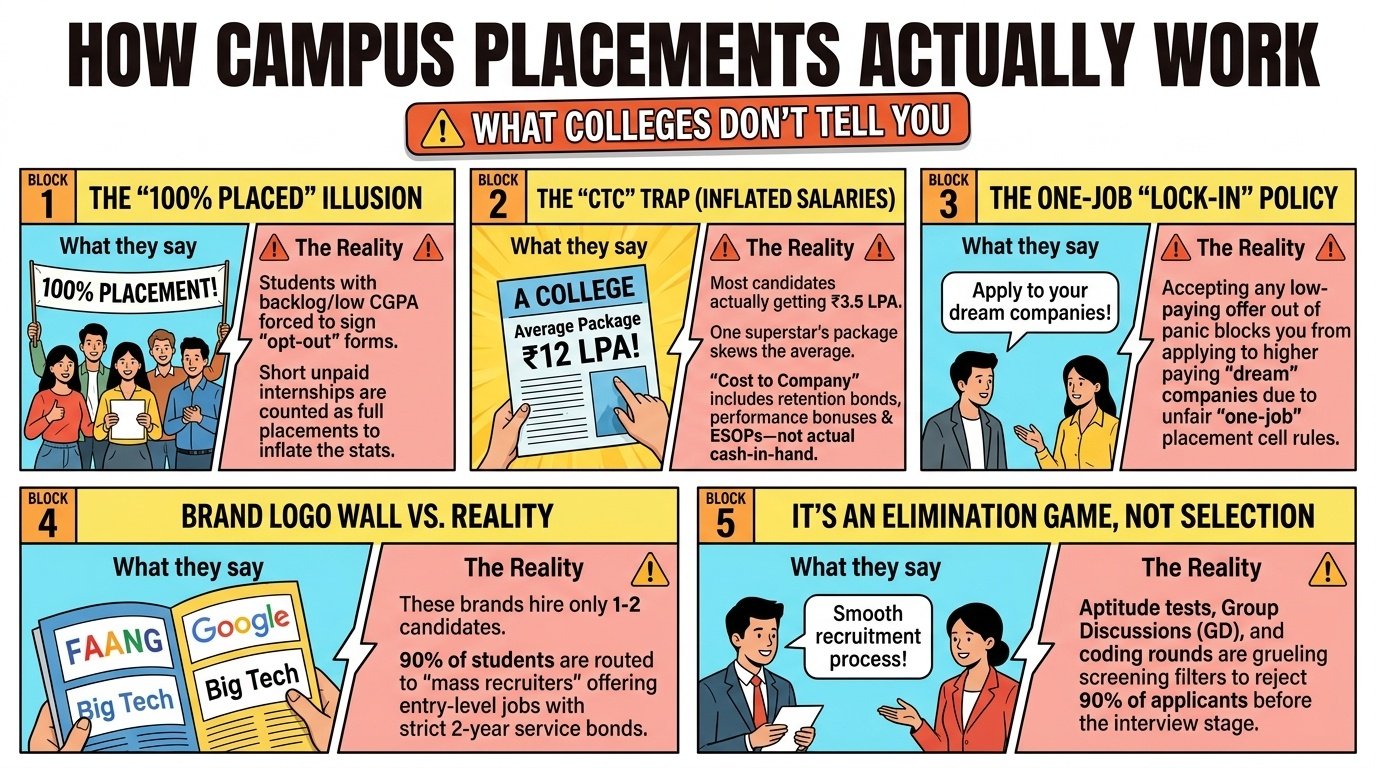
Every placement season, colleges proudly announce their “highest package” figure, and every year, that single number creates unrealistic expectations among students who assume it reflects typical outcomes. The reality of campus placements is considerably more nuanced — and understanding how the process actually works, beyond the marketing figures colleges publish, puts you in a much stronger position to prepare effectively and set realistic expectations.
The “Highest Package” Number Is Almost Always Misleading
Colleges prominently advertise their highest package figure because it’s a strong marketing statistic, but this number typically represents one or two offers, often from a specific company hiring for a niche, highly competitive role, sometimes involving a significant international posting component that inflates the headline figure. It rarely reflects what a typical student in that graduating batch actually receives.
A far more useful figure — one that colleges are less eager to highlight prominently — is the median package or the package range for the middle 50% of placed students. If your college doesn’t publish this transparently, ask current or recent seniors directly, since this gives a much more realistic benchmark for your own expectations than the headline “highest package” figure alone.
How Companies Actually Decide Which Colleges to Visit
Companies don’t randomly select which campuses to recruit from — they typically build a shortlist based on factors including the college’s historical placement track record with that specific company, the relevance of the college’s curriculum to the company’s talent needs, geographic convenience relative to the company’s offices, and sometimes existing relationships through alumni working at that company who advocate internally for campus visits.
This is why some genuinely strong colleges don’t attract certain top recruiters — it’s not necessarily a reflection of student quality, but often a function of these relationship and logistics factors that build up (or don’t) over years. Understanding this helps set realistic expectations about which companies are likely to visit your specific campus, rather than assuming visiting companies should automatically match your aspirations.
The Real Shortlisting Process Before You Even Interview
Pre-Placement Talks and Resume Shortlisting
Most campus recruitment starts with a pre-placement talk (PPT), where the company presents information about roles, compensation, and work culture, followed by resume shortlisting based on criteria the company specifies in advance — often including minimum CGPA cutoffs, specific stream eligibility, and sometimes backlogs or academic gap restrictions.
CGPA cutoffs, while sometimes criticized as an imperfect filter, remain a common first-level screening mechanism simply because companies need an efficient way to filter large applicant pools down to a manageable number for further assessment. If your CGPA is below a typical company’s cutoff for your target industry, focus on companies with more flexible criteria or invest deliberately in demonstrable skills that create alternative pathways, like strong project work or relevant internship experience that can sometimes offset a lower CGPA in company-specific exceptions.
Aptitude Tests and Technical Assessments
After resume shortlisting, most companies conduct an online aptitude test (commonly covering quantitative ability, logical reasoning, and verbal ability) and, for technical roles, a coding or technical assessment. These tests are often standardized across many companies, which is why consistent practice with common aptitude test patterns and coding practice platforms genuinely pays off across multiple company applications, not just one specific company’s process.
Group Discussions (Where Applicable)
Some companies, particularly for roles emphasizing communication and teamwork, include a group discussion round. This round evaluates not just what you say, but how you engage — listening to others, building on points constructively, and demonstrating clear thinking under time pressure, rather than simply speaking the most or dominating the conversation, which is a common misconception that actually hurts candidates in this round.
Technical and HR Interviews
Final interview rounds typically include a technical interview (assessing core subject knowledge and, for technical roles, problem-solving ability) and an HR interview (assessing communication, cultural fit, and career motivation). Companies increasingly conduct these as a blended evaluation rather than strictly separate rounds, so demonstrating genuine, coherent motivation for the specific role — not just the company’s brand name — matters throughout, not only in a dedicated “HR round.”
What Colleges Often Don’t Emphasize Enough
Not Every Student Gets Multiple Offers
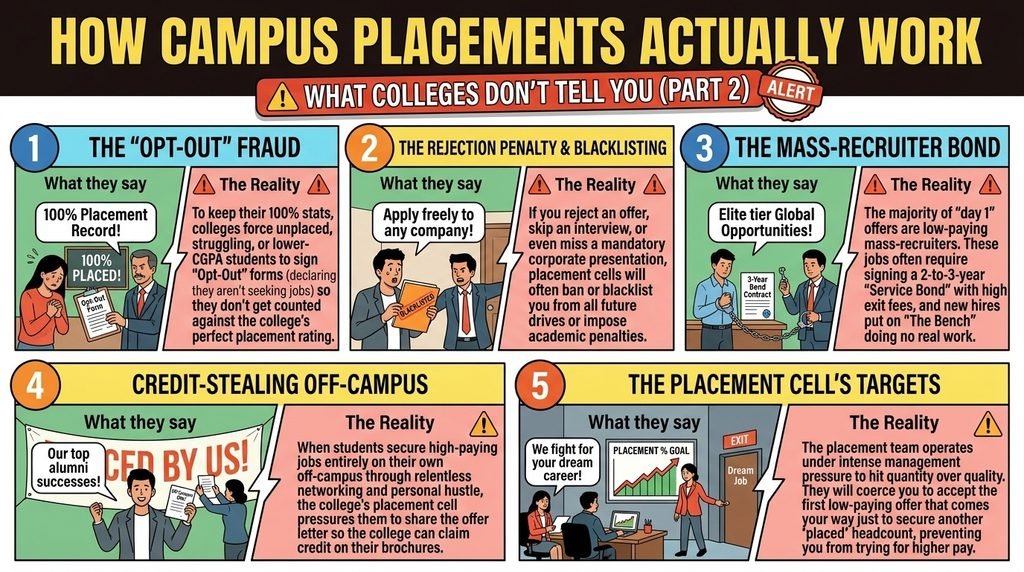
Placement season narratives often focus on students who receive multiple offers or the highest packages, but a significant portion of any graduating batch receives a single offer, or in some cases no offer at all during the primary placement season, requiring off-campus job search afterward. This isn’t a reflection of failure — it’s simply the reality of a competitive process with more candidates than available roles at top-recruiting companies specifically.
If you don’t secure a placement during the main season, off-campus applications, secondary placement drives many colleges run, and building additional skills during the gap remain entirely viable paths — this outcome doesn’t define your career trajectory as strongly as placement season anxiety often makes it feel in the moment.
Company Presentations Don’t Always Reflect Actual Day-to-Day Work
Pre-placement talks are, understandably, a marketing exercise for the company as much as an information session — the roles and work culture described can sometimes differ from the actual day-to-day experience, particularly regarding work hours, specific project allocation (which sometimes differs from what was pitched during recruitment), and career growth pace. Talking to current employees or recent alumni from that company, beyond the official PPT, often provides a more grounded picture before you accept an offer.
The “Dream Company” Framing Can Create Pressure That Hurts Performance
Colleges and peer culture often build significant hype around specific “dream companies” that visit campus, and this pressure can sometimes hurt candidate performance during interviews for that specific company, ironically reducing success rates precisely because of the pressure. Approaching each interview with genuine preparation and reasonable calm, rather than treating one specific company’s outcome as make-or-break for your entire career, generally leads to better interview performance across the board.
How to Actually Prepare for Campus Placements
Start Aptitude and Technical Preparation Early, Not in the Final Semester
Many students begin serious placement preparation only when placement season starts, but consistent practice with aptitude tests, coding platforms (for technical roles), and mock interviews over the preceding 6-12 months builds genuinely stronger performance than last-minute cramming, which is difficult to sustain given the volume of tests and interviews packed into a compressed placement season timeline.
Build a Resume That Reflects Genuine Projects and Experience
Resumes listing only coursework and academic projects without demonstrated application (internships, personal projects, relevant certifications, participation in hackathons or case competitions) tend to blend into a large applicant pool. Investing in at least one or two genuinely substantial projects or internships before placement season meaningfully differentiates your resume during shortlisting.
Research Companies Individually, Not Generically
Generic interview preparation (“tell me about yourself,” standard behavioral questions) matters, but companies increasingly notice candidates who demonstrate specific knowledge about that company’s products, recent developments, and the particular role they’re applying for. Spending time researching each target company individually, rather than treating placement season as one undifferentiated process, improves interview performance measurably.
Practice Mock Interviews and Group Discussions Before the Real Thing
Many colleges offer mock interview and group discussion practice sessions through their placement cell — taking advantage of these, or organizing peer practice sessions independently, builds genuine comfort with the format and reduces nervousness during actual company rounds, where first-time exposure to the format under real pressure often hurts otherwise well-prepared candidates.
Frequently Asked Questions
Q1. Does CGPA really matter that much for placements? It matters primarily as an initial screening filter for many companies, particularly larger ones with high applicant volume — but its importance varies significantly by company and industry, and strong projects, internships, or specific technical skills can sometimes offset a moderate CGPA for companies with more holistic evaluation criteria.
Q2. What happens if I don’t get placed during the main campus placement season? Most colleges run secondary or off-campus placement support, and many companies also hire outside campus placement drives through off-campus applications — not being placed during the primary season is common and doesn’t preclude securing a strong role afterward through continued effort.
Q3. Should I accept the first offer I receive, or wait for potentially better options? This depends on your college’s specific placement policy (some restrict students from sitting for further companies after accepting an offer, often called a “dream offer” or similar policy), your own risk tolerance, and how the offer aligns with your career interests — research your college’s specific rules before assuming you can freely wait for better offers after accepting one.
Q4. How important are extracurricular activities for placement shortlisting? This varies by company and role — for many technical roles, project work and technical skills weigh more heavily, while for roles emphasizing leadership, communication, or general management trainee programs, extracurricular leadership experience can meaningfully strengthen your candidacy.
Q5. Can I improve my chances if my college doesn’t attract many top companies? Yes — building strong technical or professional skills independently, pursuing relevant internships outside your college’s campus recruitment process, and applying directly to companies through off-campus channels are all viable paths that aren’t limited by which companies specifically visit your campus.
The Bottom Line
Campus placements are a genuinely useful process, but they work differently than the simplified “highest package” narrative that dominates college marketing suggests. Understanding the real shortlisting criteria, preparing consistently well before placement season starts, and setting realistic expectations based on median outcomes rather than outlier headline figures will serve you far better than either excessive anxiety or complacency during this process.
For related reading, check out our guide on The Perfect Fresher Resume: A Section-by-Section Template That Actually Gets Shortlisted, or explore Top 25 Interview Questions for Freshers — With Sample Answers That Sound Natural.