
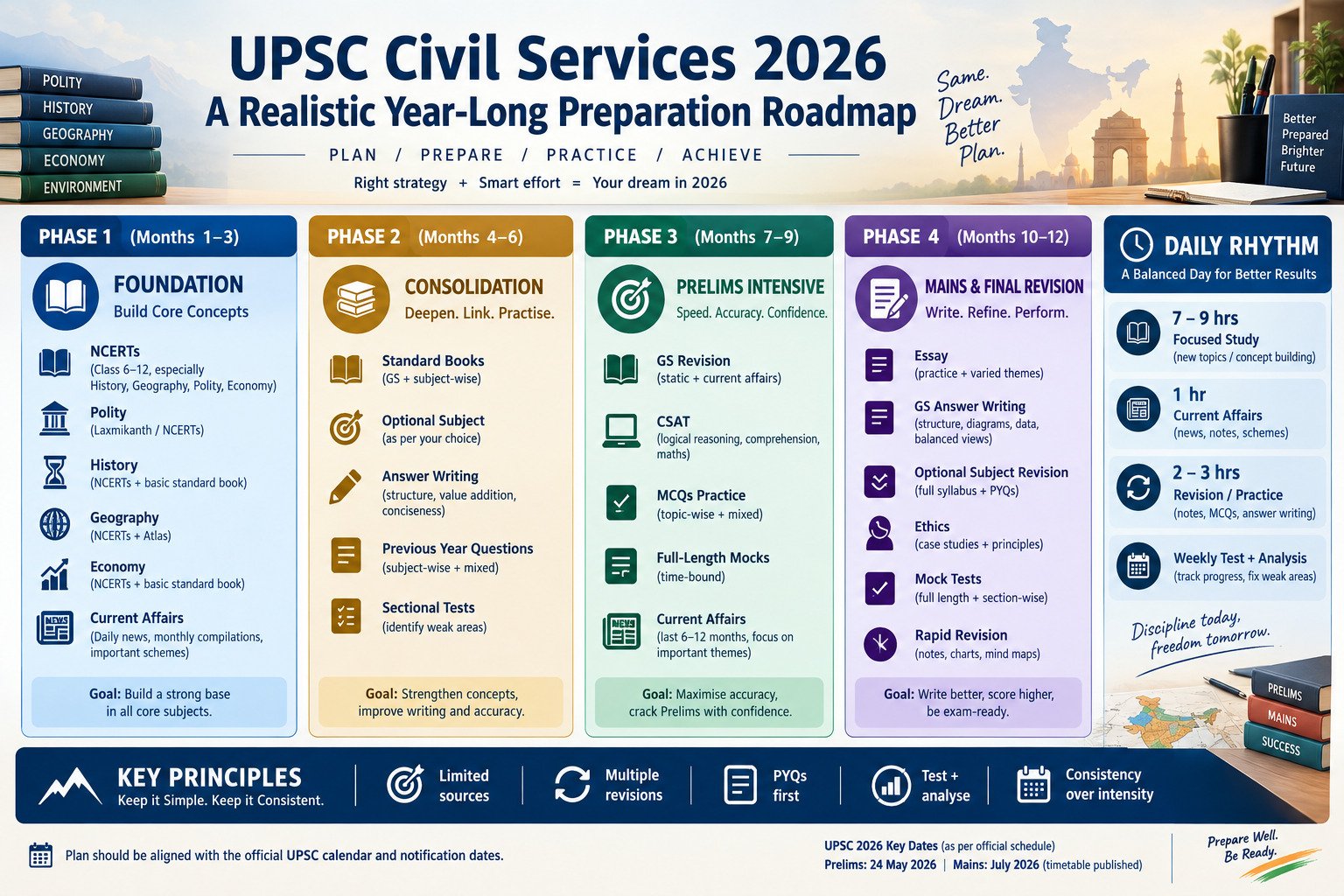
Every year, a large number of UPSC aspirants quietly prepare for their State Public Service Commission exam as a backup — and a growing number are now choosing State PSC as their primary goal, not a fallback option. Yet most preparation content online treats “PSC exams” as one generic category, when in reality, each state’s commission runs its own exam with its own syllabus, pattern, and career outcomes. This guide breaks down what actually differs between state-level and central-level government jobs, so you can make an informed choice about where to focus your preparation.
What Exactly Is a State PSC Exam?
Every Indian state has its own Public Service Commission — such as UPPSC (Uttar Pradesh), BPSC (Bihar), MPPSC (Madhya Pradesh), or MPSC (Maharashtra) — responsible for recruiting officers into state administrative services. These exams typically recruit for posts like Deputy Collector, Deputy Superintendent of Police, District Development Officer, and various other state-level administrative and revenue positions.
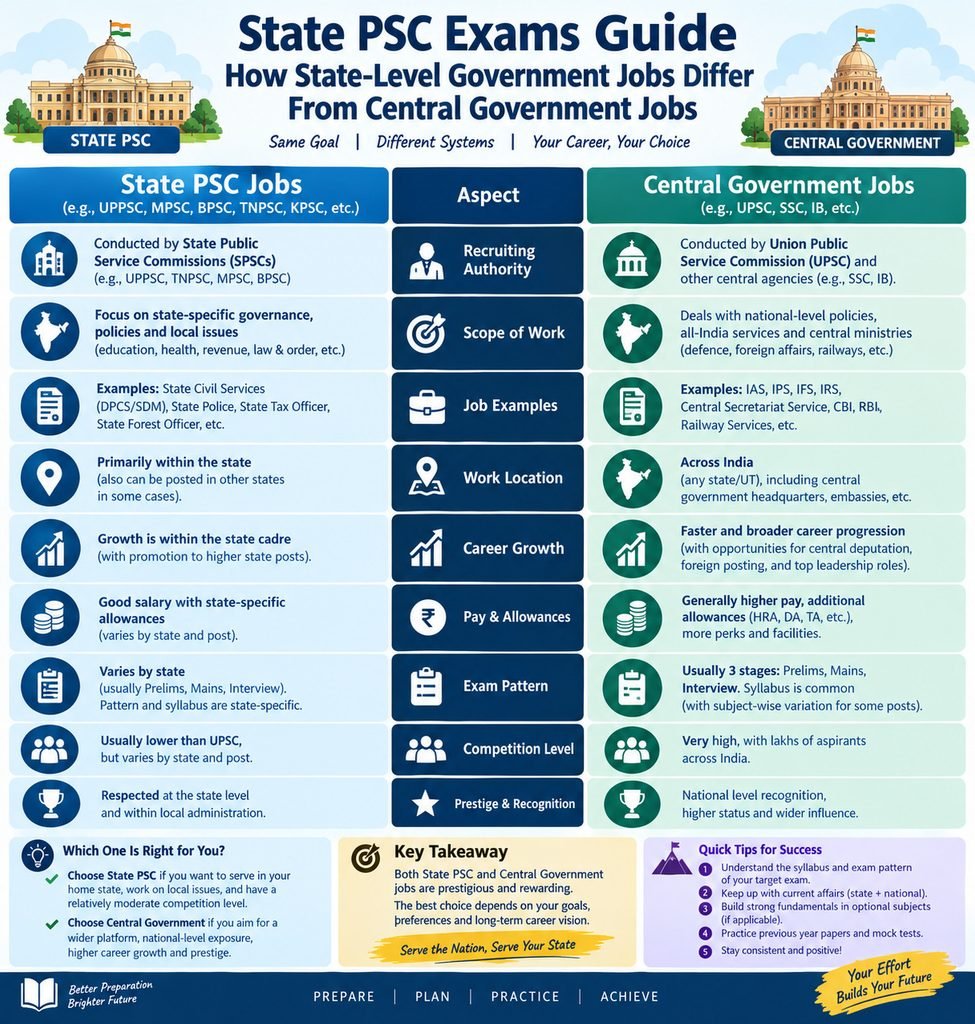
Unlike UPSC, which selects officers for all-India services like IAS, IPS, and IFS (who can be posted anywhere in the country under a common cadre system), State PSC exams recruit specifically for that state’s own administrative machinery. An officer selected through UPPSC generally serves within Uttar Pradesh, working directly within that state’s departments and district administration.
Key Structural Differences From UPSC
Exam Pattern and Syllabus Overlap
Most State PSC exams follow a broadly similar three-stage structure to UPSC — Preliminary exam (objective), Main exam (descriptive), and Interview — which is why many candidates prepare for both simultaneously. The GS syllabus overlaps significantly at the national level (Polity, Economy, History, Geography), but state exams add a substantial state-specific component: state history, state geography, local governance structures, state government schemes, and regional current affairs.
This state-specific layer is often underestimated by candidates who assume their UPSC-level general studies preparation will transfer directly. It won’t fully — you need dedicated study time for state-specific content, ideally using state board textbooks and state government publications rather than relying solely on national-level resources.
Language Requirements
Many State PSC exams either conduct papers in the regional language, offer a regional language option alongside English/Hindi, or include a compulsory regional language paper as part of Mains. This is a significant factor to plan around early — if you’re not fluent in reading and writing the state’s official language, factor in the time needed to build that comfort, since attempting descriptive answers in a language you’re not confident in noticeably affects scoring.
Vacancy Cycles and Frequency
State PSC exam cycles can be considerably less predictable than UPSC’s — some states conduct exams annually with reasonable regularity, while others have faced years-long gaps between notification and result due to administrative delays or litigation. Before committing significant preparation time to a specific state’s exam, research that commission’s recent track record for notification frequency and result timelines, since this directly affects how long you might wait between application and outcome.
Career Outcomes: What the Job Actually Looks Like
Officers selected through State PSC exams — for roles like Deputy Collector or DSP — often get administrative and field responsibilities early in their careers, sometimes even more hands-on than their central service counterparts in comparable early years. District-level postings involve direct interaction with local governance, law and order, revenue administration, and public grievance redressal, giving these roles significant on-ground authority and visibility within the state.
Promotion tracks for state service officers can, in many states, eventually lead to promotion into the IAS or IPS cadre itself, through a defined promotion quota — meaning a State PSC selection isn’t necessarily a permanent ceiling on career growth, though this promotion path varies significantly by state and depends on vacancy availability and seniority.
Salary structures for state services are generally comparable to central government Group A/B scales at entry level, though specific pay bands, allowances, and increment structures vary by state, so it’s worth checking your target state’s current pay commission implementation status rather than assuming uniform figures across states.
Should You Prepare for UPSC, State PSC, or Both?
If you have a strong personal or professional connection to a specific state — you’re fluent in the regional language, understand local governance issues well, and want to serve within that specific region — a State PSC exam might align better with both your strengths and your long-term career interest than an all-India posting through UPSC.
If your GS preparation is already fairly advanced for UPSC, adding a State PSC exam as a parallel target often makes sense, since the overlapping syllabus means the additional preparation burden is primarily the state-specific component and language paper, not an entirely separate preparation track.
If you’re earlier in your preparation journey and unsure which path to commit to, building your GS foundation in a state-neutral way first (national-level NCERTs, standard reference books) keeps both options open — you can layer state-specific preparation on top once you’ve decided which specific commission’s exam to prioritize.
A Practical Approach to State-Specific Preparation
Start by identifying your target state’s exam pattern precisely — download the official syllabus PDF rather than relying on secondhand summaries, since state commissions periodically revise their patterns and older prep content online may not reflect current requirements.
Build a dedicated state-specific notes file alongside your general studies preparation, covering state history, prominent state government schemes, state geography (rivers, districts, economic zones), and recent state-level current affairs — treating this as a distinct subject rather than an afterthought squeezed in during final revision.
Practice previous years’ papers specifically from your target state’s commission — this reveals the actual difficulty level, question framing style, and recurring themes far better than generic preparation content, since each commission has its own distinct pattern that persists across years.
Common Mistakes Candidates Make
Assuming national-level current affairs preparation automatically covers state requirements is one of the most frequent gaps — state government schemes and state-level developments need dedicated tracking, often through state-specific news sources rather than national dailies alone.
Underestimating the language paper is another recurring issue, particularly for candidates who studied in English-medium institutions but need to write Mains answers in the regional language — this needs deliberate practice well before the exam, not last-minute cramming.
Treating every state’s PSC exam as interchangeable in difficulty and preparation approach is a third mistake — some state exams are notably more competitive due to vacancy-to-applicant ratios, and preparation depth needs to match that specific commission’s actual difficulty level, not a generic assumption.
Frequently Asked Questions
Q1. Can I prepare for UPSC and State PSC exams at the same time? Yes, and many successful candidates do exactly this, since the GS syllabus overlaps substantially — the main additional effort for State PSC is the state-specific portion and, in many cases, a regional language paper.
Q2. Is a State PSC job less prestigious or lower-paying than a UPSC-selected job? Not necessarily — pay scales are often comparable at entry level, and state service officers frequently hold significant administrative authority. The primary difference is jurisdiction (state-specific vs all-India) rather than a strict hierarchy of prestige or compensation.
Q3. Do all States PSC exams require fluency in the regional language? It varies by state — some mandate a regional language paper, others offer language choice, and a few conduct the full exam bilingually. Always check your target state’s specific requirement rather than assuming.
Q4. Can State PSC officers get promoted to IAS or IPS? In many states, yes, through a defined promotion quota based on seniority and vacancy availability, though the specifics and pace of this promotion path vary considerably by state.
Q5. How do I find reliable, updated syllabus information for my state’s PSC exam? Always refer to the official State Public Service Commission website for the current notification and syllabus PDF, since patterns are revised periodically and older content circulating online may be outdated.
The Bottom Line
State PSC exams aren’t a lesser version of UPSC — they’re a distinct career path with their own syllabus nuances, language considerations, and administrative career trajectory. Whether you choose to pursue State PSC alongside UPSC or as your primary goal, understanding these structural differences early helps you build a preparation plan that’s actually aligned with the exam you’re targeting, rather than a generic strategy that misses state-specific requirements.
For related reading, check out our guide on UPSC Civil Services 2026: A Realistic Year-Long Preparation Roadmap, or explore Government Job Age Relaxation & Reservation Rules for category-wise eligibility details.