
Building a retirement investment portfolio is one of the most important parts of long-term financial planning. Saving money for retirement is important, but deciding how that money is invested can also have a major impact on your future financial situation.
A retirement portfolio can include investments such as stocks, bonds, mutual funds, exchange-traded funds, and other assets. The right combination depends on factors such as your age, retirement timeline, financial goals, risk tolerance, and other sources of income.
The goal is not to find one perfect investment. Instead, a good retirement portfolio should be diversified, aligned with your goals, and designed for a long investment horizon.
In this guide, you’ll learn how to build a retirement investment portfolio from the ground up, how to think about risk and diversification, and how to manage your investments over time.
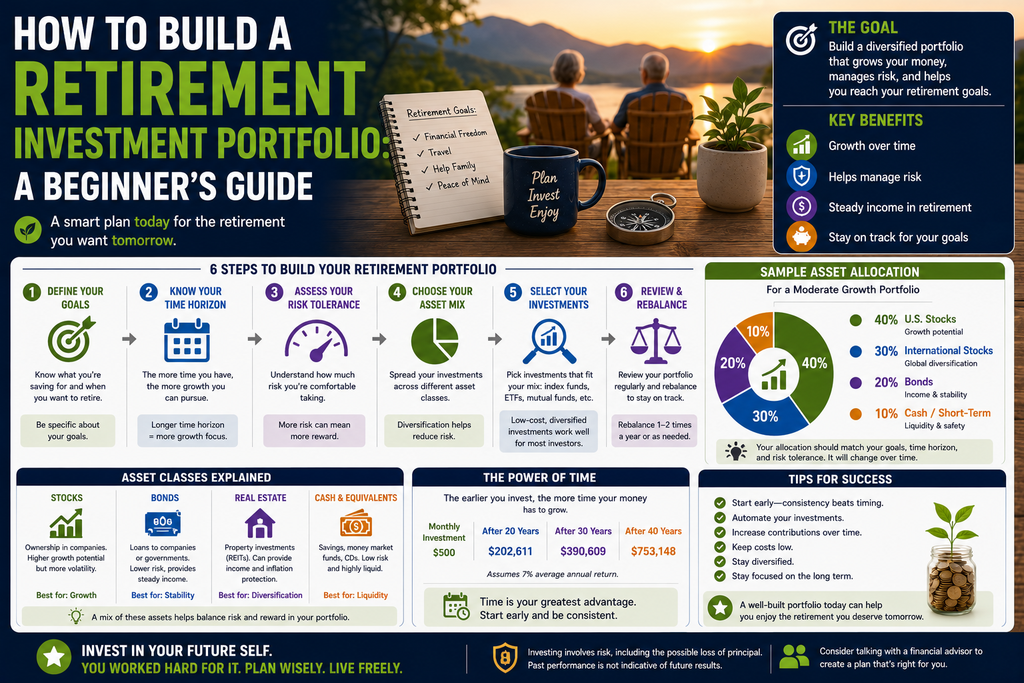
What Is a Retirement Investment Portfolio?
A retirement investment portfolio is the collection of investments you hold specifically to help fund your retirement.
Your portfolio could be held inside accounts such as:
- 401(k)
- Roth 401(k)
- Traditional IRA
- Roth IRA
- SEP IRA
- SIMPLE IRA
- Taxable brokerage account
The account is the container, while the investments inside the account make up your portfolio.
For example, someone might have a 401(k) containing stock funds and bond funds, along with a Roth IRA containing ETFs.
Together, these investments form part of the person’s overall retirement portfolio.
Why Your Retirement Portfolio Matters
Retirement investing is different from investing for a short-term goal.
If retirement is decades away, you may have more time to tolerate market fluctuations. However, as retirement approaches, protecting the money you’ve accumulated can become increasingly important.
Your portfolio needs to balance two competing goals:
Growth: Your investments need the potential to grow enough to support your future retirement needs.
Risk management: You need to avoid taking unnecessary risks that could cause major losses at an inappropriate time.
The balance between these goals can change throughout your life.
Step 1: Determine Your Retirement Goal
Before choosing investments, determine what you’re trying to accomplish.
Consider:
- Your desired retirement age
- Estimated annual retirement expenses
- Expected Social Security income
- Pension income
- Current retirement savings
- Expected future contributions
- Other assets
- Desired retirement lifestyle
For example, suppose you estimate that you’ll need $60,000 per year during retirement.
You may expect $30,000 from Social Security and another $10,000 from a pension.
That leaves approximately $20,000 that may need to come from investments or other sources.
This is only a hypothetical example, but it demonstrates why your investment strategy should be connected to your retirement income needs.
Step 2: Know Your Investment Time Horizon
Your time horizon is the amount of time before you need the money.
Someone who is 30 and expects to retire at 67 may have several decades to invest.
Someone who is 62 and plans to retire next year has a much shorter time horizon.
A longer time horizon can provide more opportunity to recover from market declines, although it does not eliminate investment risk.
Your time horizon should therefore influence how much risk you are willing and able to take.
Step 3: Understand Risk Tolerance
Risk tolerance refers to how comfortable you are with investment losses and market volatility.
Imagine that your retirement portfolio falls 25% during a major market decline.
Would you:
- Stay invested?
- Reduce your stock allocation?
- Sell everything?
- Continue contributing?
- Become worried but remain invested?
Your emotional response matters.
A portfolio that looks reasonable on paper may not be appropriate if its volatility causes you to make emotional decisions.
Step 4: Understand Asset Allocation
Asset allocation means deciding how your portfolio is divided among different types of investments.
Common asset classes include:
- Stocks
- Bonds
- Cash or cash equivalents
- Real estate and other investments
Stocks generally offer greater long-term growth potential but can experience significant price fluctuations.
Bonds can provide income and diversification but also carry risks, including interest-rate and credit risk.
Cash is generally less volatile but has lower long-term growth potential and can lose purchasing power to inflation.
The right mix depends on your circumstances.
Step 5: Consider a Stock Allocation
Stocks can play an important role in many long-term retirement portfolios because they provide the potential for capital appreciation.
However, stocks can also decline significantly.
A portfolio containing only stocks may experience substantial volatility.
For a long-term investor, the key question is not simply whether stocks are “good” or “bad.” The question is how much stock exposure makes sense given your time horizon, goals, and ability to tolerate losses.
Step 6: Consider Bonds
Bonds can provide another source of diversification.
A bond represents a loan from an investor to a borrower, such as a corporation or government entity.
Bond investments can provide interest income, although their prices can change.
Adding bonds to a portfolio can reduce reliance on stocks and may make the overall portfolio less volatile.
However, bonds are not risk-free.
Bond investors can face:
- Interest-rate risk
- Credit risk
- Inflation risk
- Reinvestment risk
- Market risk
Understanding these risks is important before investing.
Step 7: Diversify Your Retirement Portfolio
Diversification means spreading your investments across different securities and asset classes rather than relying heavily on one investment.
For example, owning shares of 20 technology companies is more diversified than owning one technology company, but the portfolio may still be heavily concentrated in one sector.
A broadly diversified portfolio may include exposure to:
- Large companies
- Small companies
- Different industries
- International markets
- Bonds
- Different types of securities
Diversification cannot guarantee that you will avoid losses, but it can reduce the impact of poor performance from a single investment or narrow area of the market.
Step 8: Consider Index Funds and ETFs
Many retirement investors use index funds or ETFs because they can provide exposure to a broad group of investments through a single fund.
For example, an index fund may track a broad stock market index.
Instead of researching and purchasing dozens or hundreds of individual stocks yourself, you can use a fund that holds many securities.
This can simplify diversification.
However, not all funds are equally diversified, and fees, holdings, investment strategy, and tracking performance should be reviewed before investing.
Step 9: Pay Attention to Investment Fees
Investment fees can reduce your long-term returns.
Common costs include:
- Expense ratios
- Account fees
- Trading costs
- Advisory fees
- Fund-related expenses
A seemingly small annual fee can have a larger impact over many years because the money paid in fees is no longer available for investment growth.
When comparing similar investment options, understanding the total cost is important.
Step 10: Choose Investments Based on Your Strategy
Don’t choose investments simply because they performed well recently.
Instead, consider:
- What the investment owns
- Its investment objective
- Its level of diversification
- Its fees
- Its historical volatility
- Its risk
- How it fits into your overall portfolio
Past performance does not guarantee future results.
The purpose of an investment is more important than simply finding the investment with the highest recent return.
Example of a Simple Retirement Portfolio
Consider a hypothetical investor who has several decades before retirement.
They might choose a portfolio such as:
- 70% diversified stock funds
- 25% diversified bond funds
- 5% cash or cash equivalents
Another investor closer to retirement might prefer a different allocation.
There is no universal percentage that is right for everyone.
The example above is only an illustration of how asset allocation works, not a recommendation for every investor.
Should Your Portfolio Change as You Get Older?
Your investment strategy may change as your retirement date approaches.
When you have many years before retirement, you may be able to accept more short-term volatility.
As retirement gets closer, you may want to reduce certain risks because you have less time to recover from a major market decline.
This does not necessarily mean eliminating stocks.
Even retirees may need some exposure to growth-oriented investments because retirement can last for decades.
The appropriate allocation depends on your financial situation and goals.
What Is a Target-Date Fund?
A target-date fund is an investment designed around an approximate retirement year.
For example, a fund might be labeled for investors expecting to retire around 2060.
The fund typically maintains a diversified portfolio and gradually changes its asset allocation over time according to its strategy.
Target-date funds can be convenient because they provide automatic portfolio management.
However, investors should still review:
- Investment strategy
- Fees
- Asset allocation
- Glide path
- Fund holdings
- Risk level
Two target-date funds with the same target year can have different strategies.
Rebalancing Your Retirement Portfolio
Over time, your investments may move away from your original asset allocation.
Suppose your target allocation is:
- 70% stocks
- 30% bonds
If stocks perform significantly better than bonds, your portfolio could eventually become 80% stocks and 20% bonds.
This increases your exposure to stock market risk.
Rebalancing means bringing your portfolio back toward your intended allocation.
You might rebalance periodically or when your allocation moves beyond a predetermined range.
The goal is not to predict market movements. It is to maintain your chosen risk level.
How Often Should You Rebalance?
There is no universal schedule.
Some investors review their portfolio:
- Once a year
- Twice a year
- When allocations move significantly
- When their financial situation changes
The important thing is to have a consistent process.
Constantly changing investments based on short-term market movements can create unnecessary trading and emotional decisions.
Don’t Ignore Your Retirement Accounts
Your investment portfolio should be considered together with your retirement accounts.
For example, you may have:
- A 401(k) at work
- A Roth IRA
- A taxable brokerage account
Instead of analyzing each account separately, consider your total portfolio.
You may hold U.S. stock funds in one account and international stocks or bonds in another.
Looking at everything together can help you understand your actual asset allocation.
Common Retirement Portfolio Mistakes
1. Investing Without a Plan
Buying random investments without understanding your retirement goal can create an inconsistent portfolio.
2. Taking Too Much Risk
A portfolio that is too aggressive may cause unnecessary stress or significant losses.
3. Taking Too Little Risk
Being overly conservative for decades can make it harder for your savings to keep pace with inflation and long-term retirement needs.
4. Owning Too Few Investments
Concentrating your retirement savings in one company, industry, or asset can create unnecessary risk.
5. Chasing Recent Performance
An investment that performed extremely well recently may not continue doing so.
6. Ignoring Fees
High fees can reduce the amount of money available for long-term growth.
7. Constantly Changing Your Portfolio
Frequent changes based on market headlines can lead to emotional investing.
8. Forgetting to Rebalance
Your portfolio’s risk can change as different investments perform differently.
A Simple Retirement Portfolio Checklist
Before investing, ask:
- What is my retirement goal?
- When do I expect to retire?
- How much do I currently have saved?
- How much can I contribute each month?
- What level of investment loss can I tolerate?
- What percentage should be invested in stocks?
- How much should be in bonds or other lower-volatility investments?
- Is my portfolio diversified?
- What are my investment fees?
- Do my investments overlap?
- How often will I review my allocation?
- What will I do during a market downturn?
Having clear answers can make your investment strategy easier to follow.
What Should You Do During a Market Crash?
Market declines are a normal part of investing.
A major decline can be uncomfortable, especially when retirement is approaching.
Instead of making decisions based solely on fear, review your financial plan and determine whether your investment allocation still matches your goals and risk tolerance.
If your portfolio was appropriately designed before the decline, reacting emotionally may cause you to sell investments at unfavorable prices.
However, if your financial circumstances or risk tolerance have genuinely changed, adjusting your strategy may make sense.
When Should You Start Building a Retirement Portfolio?
The earlier you begin, the more time your investments potentially have to grow.
Starting early can also allow you to build the habit of making regular contributions.
You do not need a large amount of money to begin learning about investing.
What matters is developing a sustainable plan that you can maintain over many years.
As your income increases, you can gradually increase your retirement contributions.
Frequently Asked Questions
What is the best retirement investment portfolio?
There is no single portfolio that is best for everyone. Your investment mix should reflect your retirement timeline, financial goals, risk tolerance, and other sources of income.
How many investments should I have in my retirement portfolio?
The number is less important than diversification. A single diversified fund may provide exposure to hundreds or thousands of securities, while owning many individual investments can still leave you concentrated in one area.
Should a retirement portfolio include stocks?
Stocks can provide long-term growth potential, but they also carry market risk. Whether and how much stock exposure is appropriate depends on your individual circumstances.
Should I invest in bonds for retirement?
Bonds can provide diversification and income, but they also carry risks. The appropriate amount depends on your goals, time horizon, and risk tolerance.
Are index funds good for retirement investing?
Broadly diversified index funds can be useful for long-term investors because they may provide exposure to many securities and can have relatively low costs. However, investors should evaluate each fund’s holdings, strategy, fees, and risks.
How often should I check my retirement portfolio?
You can review it periodically rather than reacting to every daily market movement. Many investors review their allocation at least annually and whenever major financial circumstances change.
Should I change my portfolio as I approach retirement?
Your risk tolerance, time horizon, and income needs may change as retirement approaches. Reviewing your asset allocation can help ensure that your portfolio remains aligned with your changing circumstances.
Final Thoughts
Learning how to build a retirement investment portfolio is about creating a long-term strategy rather than finding the perfect investment.
Start by understanding your retirement goals, expenses, timeline, and risk tolerance. Then build an asset allocation that fits those factors and use diversified investments to spread risk.
Keep investment fees in mind, review your portfolio periodically, and rebalance when appropriate.
Most importantly, avoid making major investment decisions based solely on short-term market headlines.
A retirement portfolio should be designed to support your broader financial plan. As your income, retirement date, expenses, and financial goals change, your investment strategy may need to change as well.
The goal is not to predict the market perfectly. The goal is to build a diversified, disciplined investment approach that you can maintain over the long term.