
Exchange-traded funds, commonly known as ETFs, have become a popular way for investors to build diversified portfolios without buying dozens of individual investments. One ETF can hold stocks, bonds, or other assets, allowing investors to gain exposure to an entire market, sector, strategy, or investment theme.
However, choosing an ETF is not as simple as picking the fund with the lowest price or the highest recent return. Thousands of ETFs are available, and many of them can look very similar at first glance.
If you are wondering how to choose an ETF, the most important step is to understand what you are actually buying and whether the fund fits your goals, risk tolerance, time horizon, and overall portfolio.
This guide explains the key factors beginners should consider before investing in an ETF.
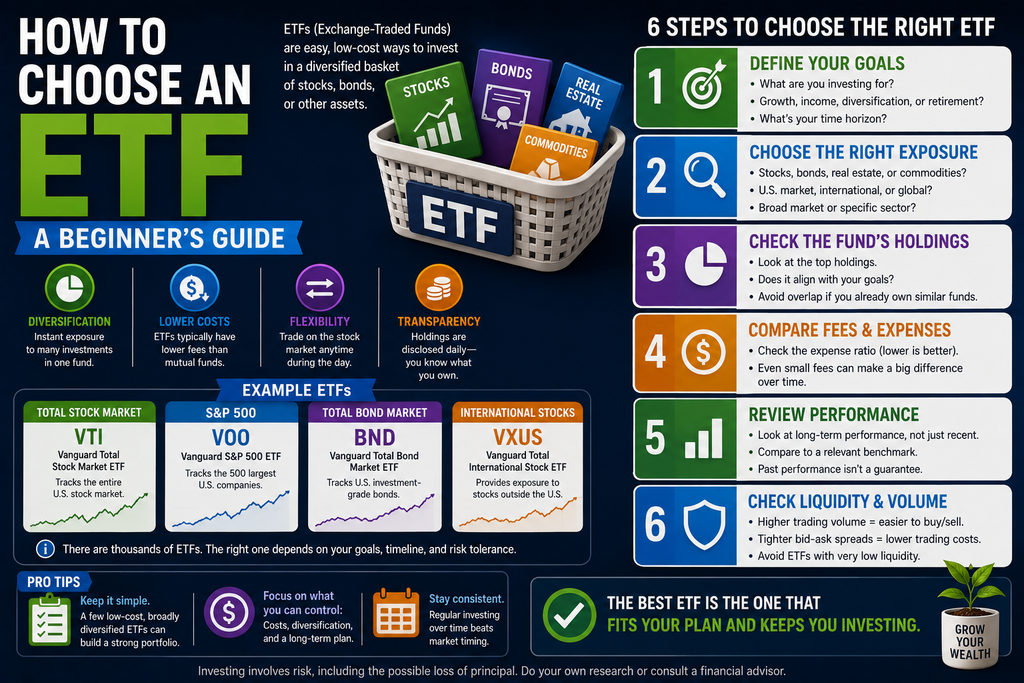
What Is an ETF?
An ETF is an investment fund that trades on a stock exchange during market hours, similar to an individual stock.
An ETF can hold a collection of investments such as:
- U.S. stocks
- International stocks
- Bonds
- Government securities
- Corporate bonds
- Specific industries
- Different market sectors
- Commodities or other assets
For example, instead of purchasing shares of many individual companies, an investor might choose a broad-market ETF that holds hundreds or thousands of companies.
This can make diversification easier, but diversification does not eliminate investment risk.
Step 1: Start With Your Investment Goal
Before comparing ETFs, determine why you are investing.
Your goal can influence the type of ETF that makes sense for you.
For example, your objective might be:
- Long-term wealth building
- Retirement investing
- Generating income
- Diversifying an existing portfolio
- Gaining exposure to international markets
- Investing in bonds
- Getting exposure to a particular sector
A young investor saving for a long-term goal may have a different ETF strategy from someone who expects to need the money within a few years.
The ETF should serve your financial plan—not the other way around.
Step 2: Understand What the ETF Invests In
One of the most important things to check is the ETF’s holdings.
Never choose a fund based only on its name.
Two ETFs might both sound like technology funds but have very different holdings, strategies, and levels of risk.
Look at:
- The companies or assets held by the ETF
- The number of holdings
- The largest positions
- The industries represented
- Geographic exposure
- The percentage invested in major holdings
A broad-market ETF may hold hundreds or thousands of companies, while a narrowly focused ETF might hold only a few dozen.
Understanding the holdings helps you determine what you are actually adding to your portfolio.
Step 3: Check the ETF’s Investment Strategy
Different ETFs use different strategies.
Some ETFs simply attempt to track an index. Others actively select investments according to specific rules or decisions made by an investment manager.
Common ETF strategies include:
Broad-Market ETFs
These ETFs provide exposure to a large portion of a stock market.
They can be useful for investors seeking broad diversification.
Sector ETFs
Sector ETFs focus on a particular part of the economy, such as:
- Technology
- Healthcare
- Financials
- Energy
- Consumer companies
Sector ETFs can provide targeted exposure but may carry more concentration risk than broad-market funds.
Bond ETFs
Bond ETFs invest in fixed-income securities.
They may focus on government bonds, corporate bonds, municipal bonds, or other types of fixed-income investments.
International ETFs
These funds provide exposure to companies outside the investor’s home market.
International investments can increase diversification but introduce additional risks, including currency and geopolitical risks.
Dividend ETFs
Dividend-focused ETFs generally emphasize companies that pay dividends or have other income-related characteristics.
Investors should remember that dividends are not guaranteed, and companies can reduce or eliminate dividend payments.
Step 4: Compare Expense Ratios
An ETF’s expense ratio represents the fund’s annual operating expenses as a percentage of assets.
Fees matter because investment costs reduce the amount of money that remains invested.
For example, imagine two otherwise similar ETFs:
- ETF A charges 0.10% annually
- ETF B charges 0.50% annually
The difference may appear small, but over many years, higher costs can have a meaningful impact on long-term returns.
This does not mean the cheapest ETF is automatically the best ETF. You should consider the fund’s strategy, holdings, tracking quality, liquidity, and other characteristics as well.
Still, when two funds provide very similar exposure, lower ongoing costs can be an important advantage.
Step 5: Look at Performance—but Don’t Chase It
Past performance can provide useful information, but it should not be the only reason you choose an ETF.
A fund that performed extremely well over the last year may not outperform in the future.
Instead of asking only:
“Which ETF made the most money recently?”
ask:
- What does the ETF invest in?
- Why did it perform well?
- What risks does it take?
- Does the strategy fit my goals?
- How has it behaved during difficult market periods?
- Does it fit with my existing investments?
Understanding the reason behind performance is more useful than simply chasing the highest historical return.
Step 6: Check Diversification
Diversification is one of the major benefits of many ETFs.
However, not every ETF is highly diversified.
An ETF might contain hundreds of companies but still have significant exposure to a small number of large holdings.
Check:
- Number of holdings
- Top 10 holdings
- Sector allocation
- Geographic allocation
- Market capitalization
- Asset allocation
Also consider your entire portfolio.
You may own two different ETFs that appear different but hold many of the same companies.
This is called ETF overlap.
Step 7: Check Liquidity and Trading Volume
ETFs trade throughout the day, so liquidity matters.
A highly liquid ETF generally has many buyers and sellers, which can make it easier to trade efficiently.
One useful indicator is trading volume, but beginners should also pay attention to the bid-ask spread.
The bid is the highest price a buyer is currently willing to pay, while the ask is the lowest price a seller is willing to accept.
A narrower spread can generally reduce the trading cost associated with entering or exiting a position.
For long-term investors, liquidity may not be as important as the fund’s overall strategy and costs, but it is still worth checking.
Step 8: Understand Tracking Difference
If an ETF is designed to track an index, investors should consider how closely the fund actually follows that index.
An ETF may not perfectly match its benchmark because of:
- Fund expenses
- Trading costs
- Taxes
- Portfolio adjustments
- Other operational factors
The difference between the ETF’s performance and its benchmark can help investors understand how effectively the fund tracks its target.
A low expense ratio is useful, but it is also worth looking at the fund’s actual historical tracking results.
Step 9: Consider the ETF’s Size and Fund Provider
The size of an ETF can provide additional context.
Larger funds often have substantial assets and established trading activity, but size alone does not make an ETF better.
Also consider who manages the fund.
Research the ETF provider and review the fund’s official documentation.
Look for information about:
- Fund strategy
- Holdings
- Fees
- Risks
- Distributions
- Index methodology
- Portfolio management
- Historical tracking
The ETF’s prospectus and official fund documents can provide important details that may not appear in a short fund description.
Step 10: Consider Taxes
Taxes can affect your actual investment results.
The tax treatment of an ETF depends on factors such as:
- The type of account
- The ETF’s investments
- Dividends or distributions
- Capital gains
- Your individual tax situation
For example, holding an investment in a taxable brokerage account can have different tax consequences from holding it inside a retirement account.
Tax rules can also change, so investors should consider their individual circumstances and seek professional tax advice when necessary.
Step 11: Check Whether the ETF Fits Your Risk Tolerance
Every investment carries some level of risk.
A broad stock-market ETF can decline significantly during a market downturn.
A bond ETF may have different risks, including interest-rate and credit risk.
A narrowly focused sector ETF may experience larger price swings than a diversified market fund.
Before investing, ask yourself:
“Could I continue holding this ETF if its value dropped substantially?”
If the answer is no, the investment may not match your risk tolerance or time horizon.
Step 12: Avoid ETF Overlap
One common beginner mistake is buying several ETFs that contain many of the same investments.
For example, you might own:
- A broad U.S. stock ETF
- A large-company ETF
- A technology ETF
Although these are different funds, they may have significant exposure to some of the same companies.
Adding more ETFs does not automatically mean more diversification.
The goal is to understand how each investment contributes to your overall portfolio.
How to Compare Two ETFs
Suppose you are comparing two ETFs that track similar markets.
You might create a simple checklist:
| Factor | ETF A | ETF B |
|---|---|---|
| Investment strategy | Broad market | Broad market |
| Expense ratio | Lower | Higher |
| Number of holdings | More | Fewer |
| Liquidity | High | Moderate |
| Tracking quality | Strong | Strong |
| Portfolio overlap | Low | Low |
| Risk level | Similar | Similar |
The goal is not to find a fund that wins every category.
Instead, determine which ETF best matches your investment plan.
A Simple Example for Beginners
Imagine Sarah wants to invest for a long-term financial goal.
She finds three ETFs:
ETF A: Broad U.S. stock-market ETF
ETF B: Technology-sector ETF
ETF C: Dividend-focused ETF
Sarah compares their holdings, expenses, diversification, risk, and strategy.
She realizes that ETF B is heavily concentrated in one sector. ETF C emphasizes dividend-paying companies, while ETF A provides much broader exposure.
If Sarah’s main goal is broad long-term diversification, ETF A may fit her strategy better.
This does not mean ETF A is automatically better for every investor. The right choice depends on each investor’s goals and circumstances.
Common Mistakes When Choosing an ETF
Beginners often make ETF decisions based on limited information.
Avoid these mistakes:
Choosing Based Only on Recent Returns
Strong recent performance does not guarantee future results.
Ignoring Fees
Small annual expenses can compound over long periods.
Buying Too Many ETFs
More funds can sometimes create unnecessary complexity and overlap.
Ignoring Holdings
Always understand what the ETF owns.
Focusing Only on the ETF Price
A $20 ETF is not automatically cheaper or better than a $200 ETF.
The share price tells you little about whether the fund is attractively priced relative to its strategy.
Ignoring Risk
A diversified ETF can still lose substantial value during a market decline.
Following Online Hype
Social media trends and online recommendations should not replace your own research.
A Beginner ETF Selection Checklist
Before buying an ETF, consider asking:
- What is my investment goal?
- What does this ETF invest in?
- What index or strategy does it follow?
- How diversified is it?
- What are its largest holdings?
- What is the expense ratio?
- How closely has it tracked its benchmark?
- How liquid is the ETF?
- Does it overlap with investments I already own?
- What risks does the ETF carry?
- Is it appropriate for my time horizon?
- What are the potential tax considerations?
- Have I read the ETF’s official fund documents?
If you cannot explain what an ETF does in simple terms, consider researching it further before investing.
How Many ETFs Should a Beginner Own?
There is no universal number of ETFs that every investor should own.
One diversified ETF may provide substantial exposure to a broad market.
Another investor may use several ETFs to create exposure to different asset classes, markets, or strategies.
The important point is that every ETF should have a purpose.
Instead of asking:
“How many ETFs should I buy?”
ask:
“What role does each ETF play in my portfolio?”
That question can help prevent unnecessary duplication.
ETF Selection and Long-Term Investing
For long-term investors, consistency can be more important than constantly searching for the newest or best-performing ETF.
A well-designed portfolio should generally reflect:
- Your financial goals
- Your time horizon
- Your risk tolerance
- Your desired diversification
- Your investment strategy
- Your ability to stay invested during market volatility
Markets will move up and down. An ETF that fits your plan can make it easier to remain disciplined during periods of uncertainty.
Frequently Asked Questions
What is the most important factor when choosing an ETF?
There is no single factor that matters for every investor. Goals, strategy, diversification, fees, risk, holdings, liquidity, and portfolio fit should all be considered.
Is a lower expense ratio always better?
Not necessarily. Lower costs are generally beneficial when comparing similar funds, but the ETF’s strategy, diversification, tracking quality, and other characteristics also matter.
Should beginners invest in ETFs?
ETFs can be useful for beginners because many provide diversified exposure to multiple investments. However, investors should understand the ETF’s strategy and risks before buying.
How do I know if two ETFs overlap?
Compare their holdings and portfolio allocations. If both funds own many of the same companies or assets, they may provide less additional diversification than you expect.
Should I choose an ETF based on past performance?
Past performance should not be the only consideration. Understand why the fund performed the way it did and whether its strategy fits your long-term objectives.
Can an ETF lose money?
Yes. ETFs can decline in value, and investors can lose some or all of the money they invest depending on the investment and circumstances.
Final Thoughts
Learning how to choose an ETF is an important step for beginner investors.
The best approach is not to search for the ETF with the highest recent return. Instead, focus on understanding what the fund owns, how it works, what it costs, how diversified it is, what risks it carries, and how it fits into your overall investment plan.
A simple process can help:
Define your goal → understand the strategy → review holdings → compare costs → evaluate diversification → check liquidity → consider risk → look for portfolio overlap → review official fund documents.
Once you understand these factors, comparing ETFs becomes much easier.
The goal is not to find the perfect ETF. The goal is to choose investments that you understand and that fit your long-term financial strategy.