
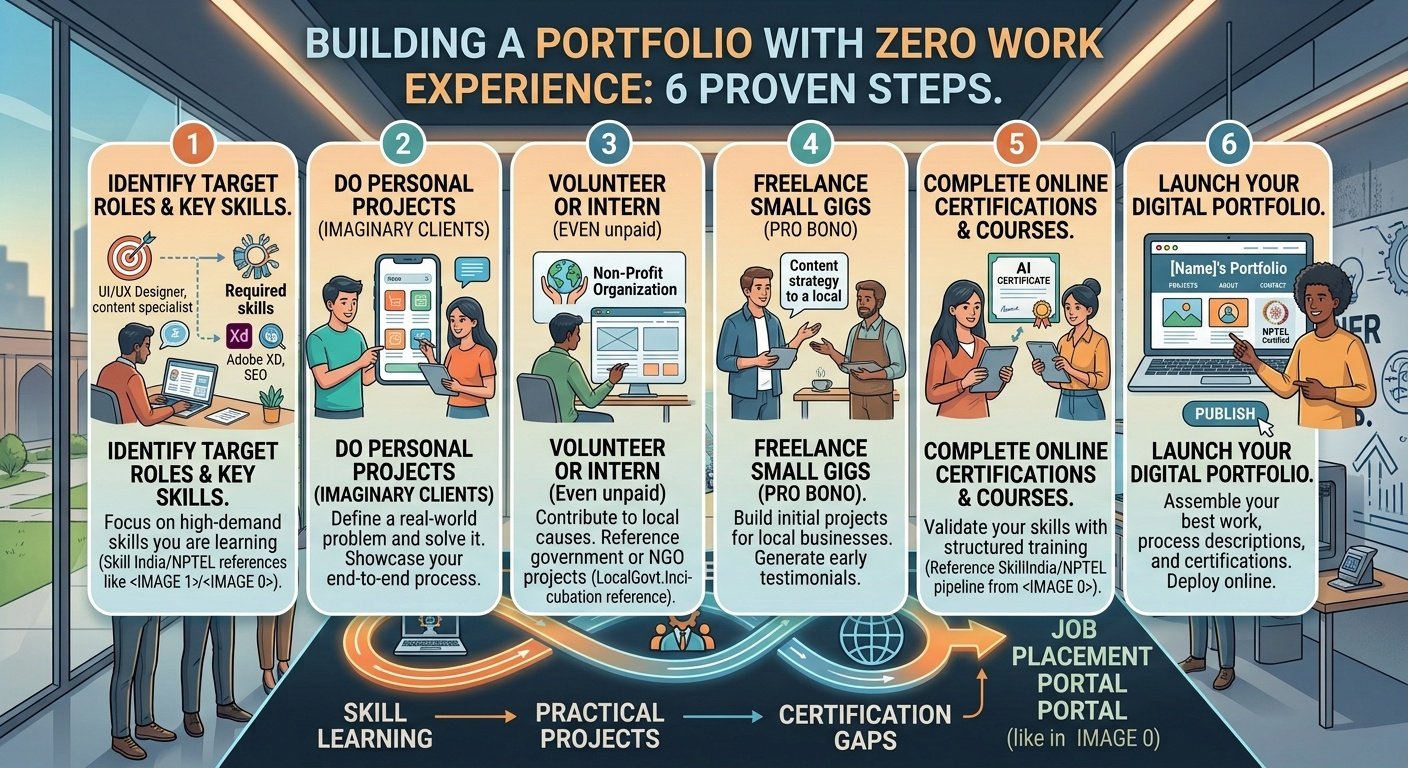
“Show us your portfolio” is a reasonable request when you’ve had two internships. It feels almost unfair when you’re a fresher with nothing but a degree and a resume that’s mostly college coursework. But here’s the part most freshers miss: a portfolio isn’t a record of your employment history — it’s proof of what you can actually do, and that proof can be built entirely on your own, with zero work experience, starting this week.
This article is a practical build plan, not a motivational push to “just start.”
Table of Contents
- What a Portfolio Actually Needs to Prove
- Portfolio Ideas by Field (With Zero Work Experience)
- How Many Projects You Actually Need
- Where to Host Your Portfolio
- How to Write About Each Project (The Part Most People Get Wrong)
- Common Mistakes That Weaken an Otherwise Good Portfolio
- FAQ
- Final Takeaway
What a Portfolio Actually Needs to Prove
A recruiter or hiring manager looking at a fresher’s portfolio isn’t expecting professional-grade, revenue-generating work. They’re checking for three specific things:
- Can you actually do the thing you claim on your resume — not just list “Python” but show a working example of you using it
- Can you make decisions, not just follow tutorials — did you solve an actual problem with judgment calls, or copy a YouTube tutorial exactly
- Can you explain your own work clearly — the interview conversation about your portfolio project often matters more than the project itself
This means a portfolio built from scratch, with no company attached to it, can be just as convincing as an internship project — sometimes more so, because you had full ownership over every decision in it.
Portfolio Ideas by Field (With Zero Work Experience)
Data Analysis:
- Pull a real public dataset (data.gov.in, Kaggle, RBI’s data releases) and build a full analysis — clean the data, find an actual insight, visualize it in Power BI or Tableau
- Example: “Analyzed 3 years of Indian Railways passenger data to identify seasonal booking trends and built a dashboard highlighting the 5 routes with the highest cancellation rates”
Web Development:
- Build a full functioning site solving a real (even small) problem — not a generic tutorial clone
- Example: A simple expense-tracker web app for your own hostel/flat’s shared expenses, or a booking system mockup for a local business you know personally
Digital Marketing:
- Run an actual small campaign — for a family member’s small business, a college event, or even a personal project — with real (if modest) ad spend, and document the results
- Example: “Ran a ₹2,500 Instagram ad campaign for a local bakery’s festive season menu, resulting in a 22% increase in weekend walk-ins over the campaign period” (track this with a simple discount code or “mention this ad” tracking method)
UI/UX Design:
- Pick a real app or website with a genuine usability flaw and redesign it, documenting your reasoning
- Example: “Redesigned the checkout flow of [a specific app] after identifying a 3-step drop-off point through user interviews with 8 people, reducing the flow to 2 steps in the redesign”
Content/Copywriting:
- Build a small blog or write sample pieces for a specific niche you’d actually want to work in — a fintech company’s blog style, a D2C brand’s product copy style
- Example: Ghostwriting-style sample posts for a fictional or real small business’s Instagram, matched to their actual brand voice
Finance/Accounting:
- Build a basic financial model or budgeting tool in Excel for a realistic small-business scenario
- Example: “Built a 12-month cash flow projection model for a hypothetical kirana store expansion, including break-even analysis”
How Many Projects You Actually Need
Quality beats quantity by a wide margin here. 2-3 well-documented, complete projects consistently outperform 6-8 half-finished or shallow ones. Recruiters and interviewers will typically pick one project from your portfolio to discuss in depth — if that project is genuinely thought through, it carries far more weight than a long list of surface-level work.
A good target split:
- 1 “flagship” project — your most complete, most impressive piece, the one you lead with
- 1-2 supporting projects — solid but slightly smaller in scope, showing range (e.g., a different tool or a different type of problem)
Where to Host Your Portfolio
You don’t need an expensive custom website. Pick based on your field:
- Data/tech roles: GitHub (for code) + a simple portfolio page (Notion page, or a free site via GitHub Pages/Carrd) linking everything together
- Design roles: Behance or a free Figma community profile
- Marketing/content roles: A Notion page or simple website with campaign screenshots, results, and write-ups
- General/non-technical roles: Even a well-organized Google Drive folder with a clear index document works, as long as it’s shared as a clean, view-only link
The platform matters far less than making it easy for a recruiter to find and understand your work in under 2 minutes.
How to Write About Each Project (The Part Most People Get Wrong)
Most fresher portfolios describe what was built but skip why decisions were made — which is the part that actually demonstrates judgment. Use this structure for each project:
- The problem (1-2 sentences): What real gap or question were you addressing?
- Your approach (2-3 sentences): What did you do, and — importantly — what alternative did you consider and reject, and why?
- The result (1-2 sentences, with a number if possible): What came out of it, even if it’s a modest, honest result?
Weak version: “Built a dashboard showing sales data using Power BI.”
Strong version: “A local kirana store owner I know mentioned he couldn’t tell which products were slow-moving until it was too late to reorder efficiently. I built a Power BI dashboard from three months of his handwritten sales logs (digitized into Excel first), which required cleaning inconsistent product naming across the manual records. The dashboard flagged 12 slow-moving SKUs he then discontinued, freeing up shelf space for faster-moving items.”
The second version shows a real problem, a real obstacle (messy data), and a real outcome — three things the first version doesn’t communicate at all.
Common Mistakes That Weaken an Otherwise Good Portfolio
- Tutorial clones with no original decisions — building the exact “Netflix clone” or “to-do app” from a popular YouTube tutorial, unchanged, signals following instructions rather than independent problem-solving
- No documentation of process — just dropping a link to code or a dashboard with no explanation forces the recruiter to guess what you actually did versus what a template did
- Too many projects, none finished properly — five unfinished GitHub repos with incomplete READMEs look worse than two fully polished ones
- Choosing projects unrelated to your target role — a portfolio full of personal art projects when applying for a data analyst role dilutes your relevant signal, even if the art is genuinely good
- No link to the portfolio anywhere on the resume — this happens more often than expected; always include the portfolio link directly in your resume header, not just on LinkedIn
FAQ
Q1: Can I use a group college project as a portfolio piece, or does it need to be solo? Group projects are fine, but be specific in your write-up about exactly which parts you personally owned — recruiters will ask, and vague answers about a group project’s overall outcome are a common interview red flag.
Q2: How long should it take to build a solid 2-3 project portfolio from scratch? Realistically 6-10 weeks if you’re doing it alongside other things like coursework or a job search, working a few focused hours per week on it.
Q3: Do I need to spend money on tools or ad campaigns to build a real portfolio? Not necessarily — most tools (Power BI, Figma, GitHub, Canva) have generous free tiers, and even a small ₹1,000-2,000 self-funded ad campaign for digital marketing portfolios is optional, not required; simulated campaigns with mock budgets and projected results are an acceptable substitute if genuinely labeled as such.
Q4: Should I remove a portfolio project if I later realize it wasn’t done well? Yes — an outdated or weak project actively hurts more than having one fewer project. Curate actively rather than just accumulating everything you’ve ever built.
Q5: Is it okay to build a portfolio project around a real local business without their formal permission? For analysis or design concepts, it’s generally fine as a case study exercise as long as you’re not publishing sensitive real financial data; for anything involving actual ad spend or public-facing work under their name, get informal permission first, both ethically and because it may lead to a genuine reference later.
Q6: How do I bring up my portfolio in an interview if they don’t ask about it directly? Reference it naturally when answering behavioral questions — “actually, I ran into a similar challenge in a project I built” is a natural bridge that lets you steer the conversation toward your portfolio work even if it’s not asked about explicitly.
Final Takeaway
A portfolio built with zero work experience isn’t a lesser substitute for an internship — done well, with real problems, real decisions, and honest documentation of your reasoning, it can demonstrate judgment an internship description often can’t. Pick one real problem you can solve this month — even something small and local — and build it end-to-end before starting a second project. One finished, well-documented piece of work beats five half-started ideas every time.