
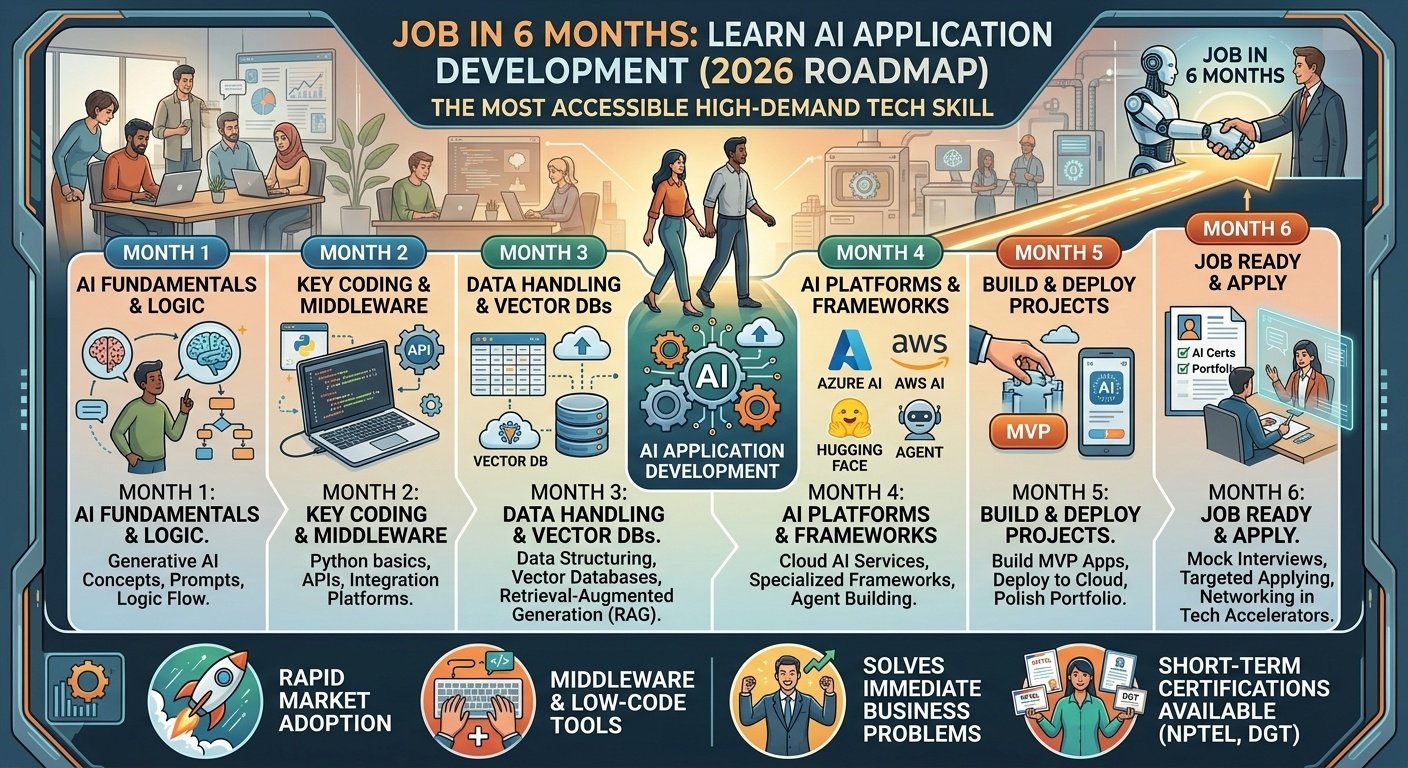
“Learn AI” is the advice everyone’s giving right now, and it’s not wrong — but it’s also not specific enough to act on if you have six months and need an actual job at the end of it, not just a certificate. The gap between “in-demand skill” and “skill you can realistically become hireable in within 6 months, starting from near-zero” is bigger than most advice accounts for. Some skills take 6 months just to reach a beginner-employable level; others can get you to a genuinely hireable spot in 10-12 weeks if you focus.
This is a realistic, timeline-based breakdown — not a hype list.
Table of Contents
- How to Judge “6-Month Hireable” vs “Good to Know Eventually”
- Fastest Path: Skills You Can Get Hireable-Level in 3-4 Months
- Medium Path: Skills That Realistically Need the Full 6 Months
- Skills That Sound Fast But Usually Aren’t
- How to Pick Based on What You Already Know
- A Sample 6-Month Plan (Data Analytics Track)
- FAQ
- Final Takeaway
How to Judge “6-Month Hireable” vs “Good to Know Eventually”
Three factors determine whether a skill is realistically job-ready in 6 months for someone starting from scratch:
- How much of the skill is learnable through structured practice vs. requiring years of accumulated judgment (e.g., Excel and SQL are highly structured; deep system design intuition is not)
- Whether entry-level roles for that skill actually exist in volume right now, not just senior roles
- Whether you can build a visible, checkable portfolio piece in that skill within the timeframe — recruiters for skill-based fresher roles increasingly want to see output, not just a certificate
Skills that score well on all three are realistically 6-month-hireable. Skills that fail even one — usually the second one, entry-level role volume — will leave you skilled but stuck without a foot-in-the-door role to apply the skill against.
Fastest Path: Skills You Can Get Hireable-Level in 3-4 Months
1. Data Analysis (Excel + SQL + Power BI/Tableau basics) This remains one of the most reliable fast paths because entry-level “data analyst,” “MIS executive,” and “reporting analyst” roles exist across nearly every industry — banking, retail, logistics, FMCG — not just tech companies. Excel and SQL are both highly structured, practice-based skills with clear milestones.
Realistic timeline: 6-8 weeks for solid Excel + SQL fundamentals, 4-6 weeks to build 2-3 portfolio dashboards using real public datasets (government open data portals, Kaggle), leaving buffer time for applications and interview prep.
2. Digital Marketing (Performance Marketing / SEO fundamentals) Entry-level digital marketing executive roles are widely available, especially at D2C brands, agencies, and small businesses building their first real marketing function. Google’s own free certifications (Google Digital Garage, Google Ads certifications) are recognized and directly map to job tasks.
Realistic timeline: 4-6 weeks for core concepts and platform certifications, 4-6 weeks running actual small campaigns (even a ₹2,000-3,000 self-funded test campaign for a personal project or local business) to have a real case study to discuss.
3. Basic Web Development (HTML/CSS/JavaScript + one framework like React basics) Junior developer and web development intern/trainee roles at smaller companies and agencies remain accessible for candidates with a solid portfolio, even without a CS degree, though this path is more competitive than it was three years ago due to higher applicant volume.
Realistic timeline: 8-10 weeks for fundamentals, remaining time building 2-3 complete projects (not tutorials followed passively — projects built with some original decisions) for a portfolio.
Medium Path: Skills That Realistically Need the Full 6 Months
4. Python for Data/Automation (beyond basic syntax) Learning Python syntax takes a few weeks, but becoming hireable — meaning you can write functions that solve an actual business problem, work with real messy data, and explain your logic in an interview — genuinely takes most beginners the better part of 4-5 months of consistent practice.
5. UI/UX Design Fundamentals The tools (Figma) are learnable quickly, but building a portfolio strong enough to compete for entry-level design roles — which requires demonstrating design thinking and process, not just visual output — realistically takes the full 6 months for someone starting from zero design background.
6. Cloud Fundamentals (AWS/Azure basics + one certification) Cloud certifications like AWS Cloud Practitioner are achievable in 2-3 months of study, but converting that into an actual entry-level cloud support or junior DevOps role typically needs an additional Linux/networking fundamentals layer most beginners don’t have yet, pushing the realistic timeline to 5-6 months.
Skills That Sound Fast But Usually Aren’t
Generative AI / Prompt Engineering as a standalone skill: Despite the hype, there are very few entry-level roles hiring purely for “prompt engineering” as a job title. It’s far more valuable as an add-on skill layered onto an existing function (a data analyst who’s also fast with AI tools, a marketer who uses AI for content drafts) than as a standalone 6-month career pivot.
Machine Learning / Deep Learning from scratch: The math and conceptual foundation alone (linear algebra, statistics, core ML theory) genuinely takes most beginners 6+ months before they’re competitive for even entry-level ML roles, which are also fewer in number and more competitive than data analyst roles. This is a 12-18 month realistic path, not 6.
Full-Stack Development (broad, multiple frameworks): Trying to learn frontend, backend, databases, and deployment all at “hireable” depth in 6 months usually results in shallow competence across everything rather than genuine hireability in any one part — better to go deep on a narrower web development track first.
How to Pick Based on What You Already Know
| Your Background | Recommended Skill | Why |
|---|---|---|
| Commerce/finance degree | Data Analysis (Excel/SQL) | Directly builds on numerical comfort, high entry-role volume in your existing field |
| Any non-technical degree, comfortable with basic computer use | Digital Marketing | Low technical barrier to entry, fast certification-to-application cycle |
| Engineering/CS background, want faster path than core CS roles | Basic Web Development or Data Analysis | Builds on existing technical comfort, quicker portfolio-building |
| Design-inclined, patient with a longer runway | UI/UX Design | Needs the fuller 6 months but has strong long-term demand |
A Sample 6-Month Plan (Data Analytics Track)
Month 1-2: Excel fundamentals (formulas, pivot tables, VLOOKUP/INDEX-MATCH) + SQL basics (SELECT, JOIN, GROUP BY, subqueries) through free resources or a structured course Month 3: Power BI or Tableau fundamentals; start building your first dashboard using a real public dataset (data.gov.in, Kaggle) Month 4: Complete 2 full portfolio projects with a clear problem statement, not just “here’s a chart” — document your process on a simple portfolio page or LinkedIn post Month 5: Start applying while continuing to refine; take a free NPTEL or Skill India course to add a formal credential alongside your portfolio Month 6: Full application push, interview prep specific to data analyst interview questions, refine resume/LinkedIn based on early application response rates
FAQ
Q1: Is it too late to learn Excel/SQL — hasn’t everyone already learned this? No — while many people list “Excel” on their resume, genuine proficiency (pivot tables, complex formulas, SQL joins) is still uncommon enough among freshers that real competence stands out clearly in interviews and practical tests.
Q2: Should I learn a skill or pursue a certification course — which matters more to recruiters? The skill matters more; the certification is supporting evidence. A portfolio project you can explain in detail beats a certificate you can’t discuss confidently.
Q3: Can I realistically learn a skill and job-search at the same time, or should I focus fully on learning first? Start applying around month 4-5 of any 6-month plan, even before you feel “fully ready” — the application and interview process itself is a skill that takes practice, and early applications often surface useful feedback on what recruiters are actually looking for.
Q4: Do free resources work as well as paid courses for this? For most of these skills, yes — free resources (YouTube, freeCodeCamp, Google’s free certifications, NPTEL) are sufficient if you’re disciplined about actually building projects, not just watching content. Paid courses mainly add structure and accountability, not exclusive knowledge.
Q5: What if I don’t have 6 months — I need a job in 2-3 months? Focus narrowly on Excel + basic SQL, since it has the shortest realistic path to a genuinely applicable, interview-ready skill level, and pair it aggressively with applications rather than continuing to “prepare more.”
Q6: Should I pick a skill based on salary potential or based on realistic timeline? For a first job specifically, timeline and entry-role availability matter more — a strong first role in a slightly lower-paying but accessible field builds the work experience needed to pivot toward higher-paying, more competitive skills later.
Final Takeaway
The fastest path to a job in 6 months isn’t the most talked-about skill — it’s the one where entry-level roles genuinely exist in volume and where you can build a checkable portfolio, not just a certificate, in the time you have. If you’re starting from zero and need results within 6 months, Data Analysis and Digital Marketing remain the most realistic paths for most backgrounds. Pick one this week, not next month — the timeline only works if the 6 months start now.