
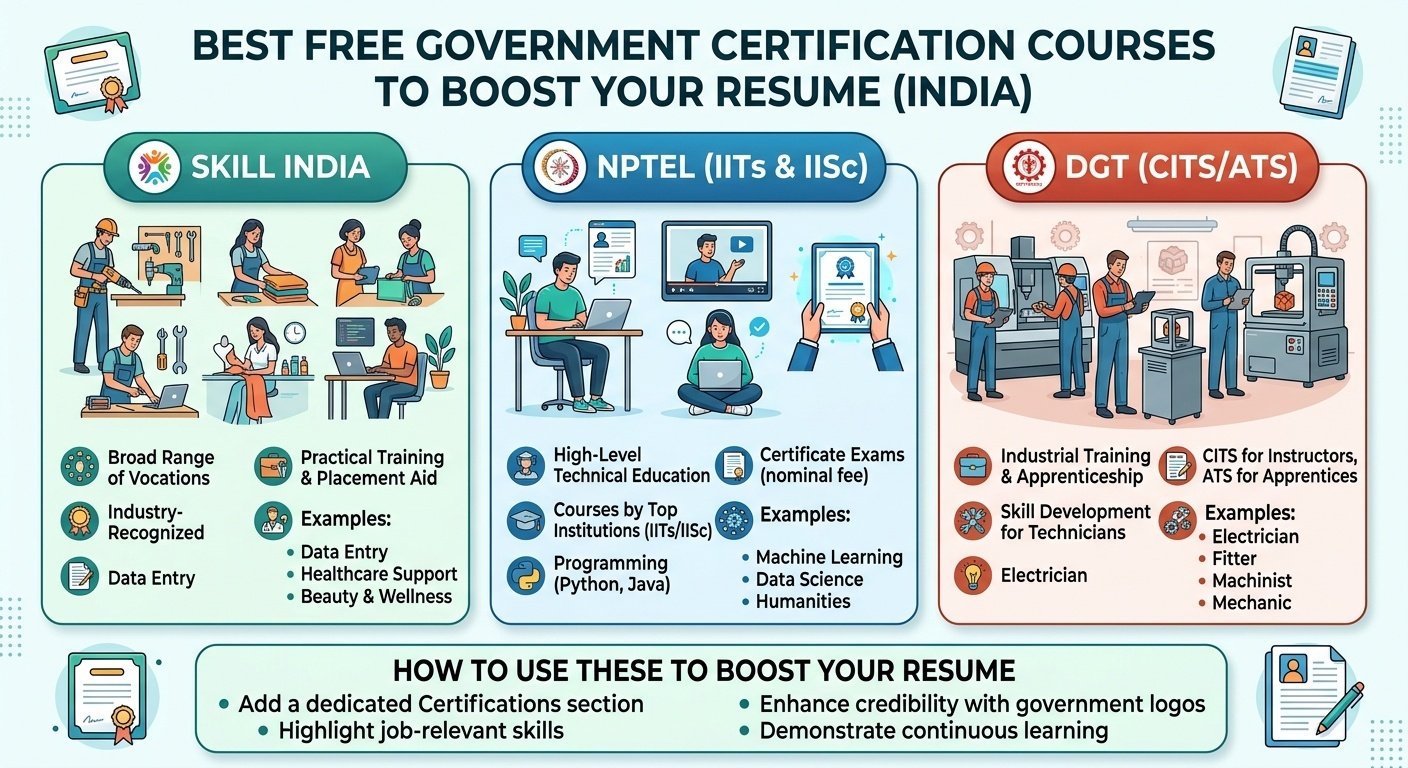
Somewhere between “my resume looks thin” and “I can’t afford a paid course,” there’s a category most freshers overlook entirely: government-run certification programs that are completely free, government-recognized, and in several cases carry more credibility with recruiters than a random paid online course, precisely because they’re backed by an actual ministry rather than a private edtech company’s marketing.
This isn’t a generic “upskill yourself” pep talk — it’s a breakdown of three specific government platforms, what they actually offer, and which one fits which kind of resume gap.
Table of Contents
- NPTEL — For Technical and Engineering-Adjacent Skills
- Skill India Digital (erstwhile NSDC courses) — For Vocational and Industry-Specific Skills
- DGT / NCVT — For Trade and ITI-Aligned Certifications
- How to Pick Based on Your Resume Gap
- How to Actually List These on Your Resume
- FAQ
- Final Takeaway
NPTEL — For Technical and Engineering-Adjacent Skills
NPTEL (National Programme on Technology Enhanced Learning) is run jointly by the IITs and IISc, and it’s one of the most respected free-to-audit certification platforms in India, specifically for technical, engineering, and increasingly management and humanities subjects.
What you get:
- Full semester-length courses (typically 8-12 weeks) taught by IIT/IISc faculty
- Course content and video lectures are entirely free
- A certificate requires clearing a proctored exam at the end, which has a fee (usually ₹1,000-1,500) — but the fee is waived or heavily discounted for students from economically weaker backgrounds
- Certificates carry an “Elite” or “Elite + Gold” grading based on your score, which recruiters in core engineering and IT sectors recognize
Best for: Engineering students or freshers targeting core technical roles — courses in Data Structures, Python, Machine Learning, Digital Electronics, and similar subjects are consistently well-regarded because they’re taught at genuine IIT-level depth, not a simplified bootcamp version.
Example: A B.Tech CSE fresher applying for a data analyst role who completes NPTEL’s “Programming, Data Structures and Algorithms using Python” with an Elite certificate has a specific, verifiable credential to point to in an interview — not just a resume line.
Skill India Digital — For Vocational and Industry-Specific Skills
Skill India Digital (which consolidated several earlier NSDC-run platforms) is the government’s broader vocational training initiative, covering everything from digital marketing and retail to healthcare support and logistics — skills that don’t require an engineering background.
What you get:
- Short courses, typically 20-100 hours, aligned to specific job roles rather than academic subjects
- Many courses map directly to National Occupational Standards (NOS), meaning the certificate is tied to an actual defined job role recognized across the industry
- Free access to course content; some sector-specific certifications (like retail sales associate or beauty and wellness) also connect to apprenticeship or placement assistance programs
- A unified skill profile you can build and share, which some companies partnering with Skill India actively recruit from
Best for: Freshers from a non-engineering background — B.Com, BA, or diploma holders — looking for a specific, job-role-aligned credential rather than a general subject certificate. It’s also strong for freshers targeting sectors like retail, BPO, logistics, or healthcare support where a specific NOS-aligned certificate can be the difference between “no relevant experience” and “certified for this exact role.”
DGT / NCVT — For Trade and ITI-Aligned Certifications
The Directorate General of Training (DGT), under the Ministry of Skill Development, runs the NCVT (National Council for Vocational Training) certification system — this is the formal government body behind ITI (Industrial Training Institute) certifications and Craftsman Training Scheme (CTS) trades.
What you get:
- Recognized trade certifications (Electrician, Fitter, Welder, COPA — Computer Operator and Programming Assistant — among 100+ trades)
- These certifications are specifically weighted in government recruitment — many PSU and railway technical posts require or prefer NCVT/DGT-certified candidates for specific trade roles
- Apprenticeship placement support through the National Apprenticeship Promotion Scheme (NAPS), which pairs certified candidates with paid apprenticeships at partner companies
Best for: Freshers targeting technical/trade-based government roles (railway technician posts, PSU apprenticeships) or private-sector manufacturing and technical support roles where a formal trade certification is a hard eligibility requirement, not just a resume booster.
How to Pick Based on Your Resume Gap
| Your Situation | Best Platform | Why |
|---|---|---|
| Engineering/CS background, want a data or software-adjacent credential | NPTEL | IIT-backed depth, well recognized in tech hiring |
| Non-technical degree, applying to retail, BPO, logistics, healthcare support roles | Skill India Digital | Role-specific certification, apprenticeship pipeline |
| Targeting PSU/railway technical posts or trade-based private roles | DGT/NCVT | Directly required or weighted in specific recruitment |
| Want something to strengthen a government job application (bank, SSC) | NPTEL (management/soft-skill courses) or Skill India (digital literacy) | Adds a demonstrable extra credential beyond the exam itself |
If you’re unsure, the fastest way to decide is to open 3-4 real job postings you’re targeting and check which one’s requirements or preferred skills line up most closely with what each platform actually certifies.
How to Actually List These on Your Resume
Don’t just write “NPTEL Certified” as a vague line — list it the way you’d list a proper credential:
Weak: “NPTEL Certificate — Python”
Strong: “NPTEL Certification — Programming, Data Structures and Algorithms using Python (IIT Madras, Elite grade, 2026)”
Include the certifying institute, the grade/score if it’s strong, and the year. This gives it the same credibility weight as a proper academic credential rather than reading like a generic online-course line.
For Skill India and DGT certifications, include the specific trade or NOS code if applicable, since some recruiters — especially in government-adjacent hiring — specifically screen for these codes.

FAQ
Q1: Are these certifications actually recognized by private companies, or only for government jobs? Both. NPTEL in particular is widely recognized across private tech and core engineering hiring because of its IIT/IISc backing. Skill India and DGT certifications are more strongly weighted in government and PSU hiring but are increasingly recognized by private manufacturing, retail, and logistics employers too.
Q2: Do I need to pay anything at all for these? Course content across all three platforms is free. NPTEL charges a modest exam fee for the final certificate (waived/discounted for eligible categories); Skill India and DGT certifications are generally free end-to-end, sometimes with minor charges for specific advanced trade certifications.
Q3: How long does it take to complete one of these certifications? NPTEL courses run 8-12 weeks alongside the exam. Skill India courses range from a few days to a couple of months depending on the specific course. DGT/ITI trade certifications, if pursued as a full program rather than a short course, can take 6 months to 2 years depending on the trade.
Q4: Can I do these while still in college or after graduating? Yes to both — many students complete NPTEL courses during their degree since it’s designed to run alongside a semester; Skill India and DGT short courses are commonly done by both students and post-graduation job seekers.
Q5: Which one looks best for a UPSC or SSC interview specifically? Any of them can add value by showing initiative, but NPTEL courses in public administration, ethics, or general management topics are sometimes specifically chosen by UPSC aspirants to demonstrate broader awareness beyond just exam preparation.
Q6: Is there a limit to how many of these I can do? No formal limit, but quality matters more than quantity on a resume — 1-2 well-chosen, relevant certifications with strong grades carry more weight than five generic ones that don’t connect to the role you’re applying for.
Final Takeaway
A free government certification isn’t just a resume filler line — when chosen to match an actual gap in your profile and listed properly with the certifying body and grade, it can be a genuine, verifiable credential recruiters trust more than they trust a random paid online course. Pick one platform based on your target role from the table above, and commit to finishing it properly rather than starting three and completing none.