
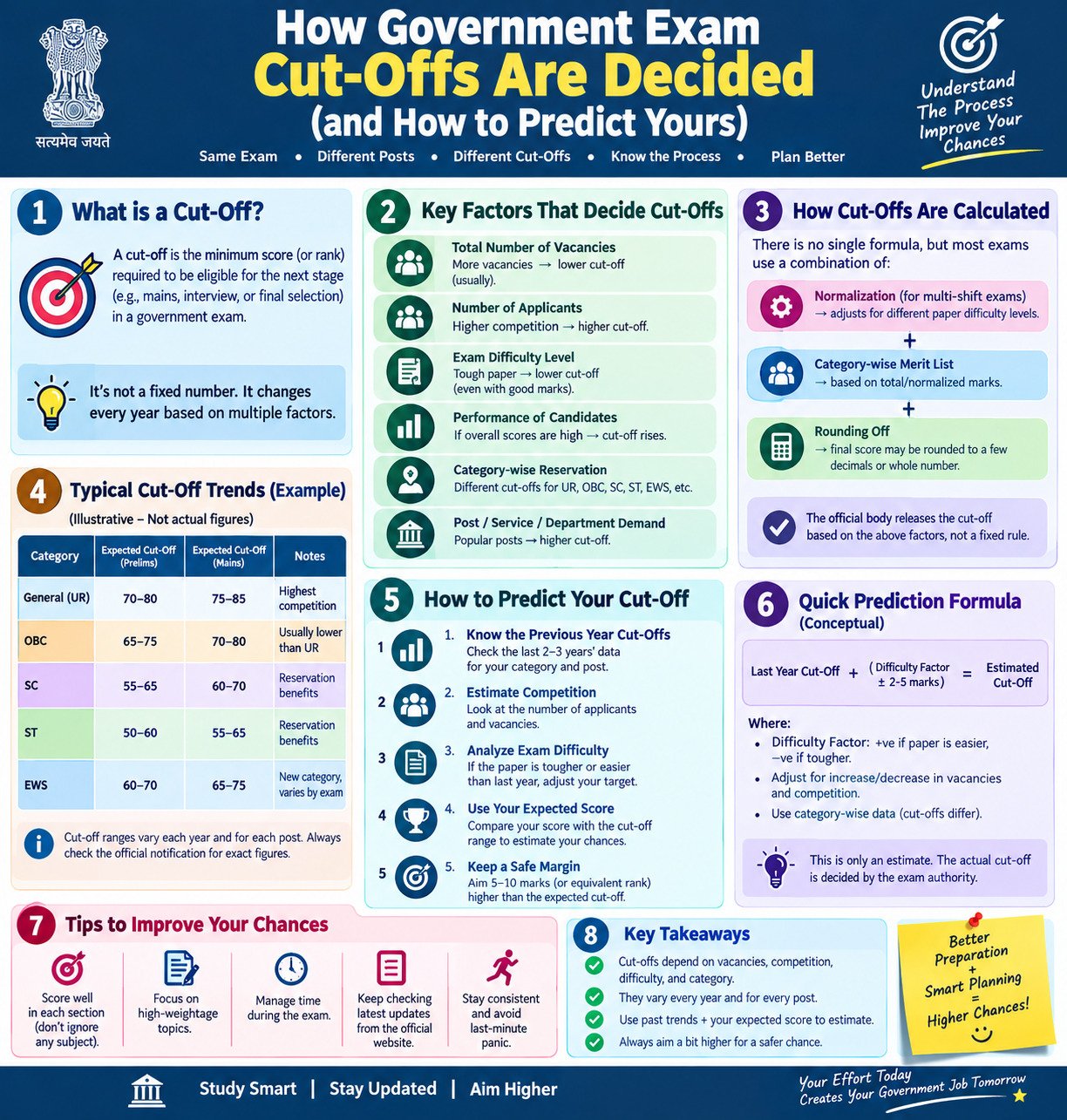
Every result season, the same question floods exam forums and comment sections: “Is 135 marks enough for SSC CGL Tier 1?” The honest answer is almost always “it depends” — and that answer frustrates candidates who want a fixed number to aim for. But cut-offs aren’t arbitrary. They’re calculated based on specific, identifiable factors, and once you understand those factors, you can build a much more realistic sense of where you stand than any single “expected cut-off” prediction floating around online.
What a Cut-Off Actually Represents
A cut-off is the minimum score required to qualify for the next stage of an exam (or for final selection), and it’s determined after the exam is conducted — not decided in advance. This is a critical distinction: recruiting bodies don’t set a fixed score target beforehand; instead, they determine the cut-off based on how candidates actually performed, combined with the number of vacancies available and other administrative factors specific to that recruitment cycle.
This is precisely why cut-offs fluctuate from year to year for the same exam, sometimes significantly, even when the exam pattern remains structurally similar.
The Core Factors That Determine a Cut-Off
Number of Vacancies
This is often the single biggest driver of cut-off fluctuation. If a recruitment cycle has significantly more vacancies than the previous year, the cut-off generally drops, since more candidates need to qualify to fill those additional positions. Conversely, a year with fewer vacancies typically sees a higher cut-off, since fewer candidates can be accommodated at the qualifying stage.
This is why comparing cut-offs across years without checking vacancy numbers for each specific year can be misleading — a lower cut-off one year doesn’t necessarily mean the exam was easier; it might simply reflect higher vacancy availability that year.
Difficulty Level of That Year’s Paper
If a particular year’s exam is unusually difficult, overall candidate performance drops, and the cut-off adjusts downward to reflect that — recruiting bodies generally don’t hold candidates to a fixed absolute score regardless of paper difficulty, since that would be unfair to candidates facing a genuinely harder paper compared to previous years.
Conversely, an easier paper often results in more candidates scoring higher marks, which can push the cut-off upward as competition for the same number of seats intensifies among a stronger-performing candidate pool.
Number of Candidates Who Appeared
A higher number of total candidates appearing for the exam generally increases competition for the same number of vacancies, which can push cut-offs higher, assuming similar difficulty and vacancy levels to previous cycles. This is one reason why exams with rapidly growing popularity sometimes see rising cut-offs over successive years, independent of paper difficulty changes.
Category-Wise Distribution
Cut-offs are calculated separately for each category (General/UR, OBC, SC, ST, EWS, PwD, and sometimes further sub-categories) because reservation policy reserves a specific percentage of vacancies for each category, and the qualifying threshold for each category is determined based on how candidates within that specific category performed relative to the vacancies allocated to them.
This is why you’ll always see a cut-off table with different figures for different categories, rather than one single number — and it’s also why comparing your score only against the “General” cut-off, if you belong to a different category, gives you an inaccurate picture of your actual standing.
Normalization (For Multi-Shift Exams)
Many large-scale exams are conducted across multiple shifts or sessions to accommodate the sheer volume of candidates, and different shifts can have papers of slightly varying difficulty despite efforts to keep them comparable. To account for this, many recruiting bodies apply a normalization formula, which adjusts raw scores to make them comparable across shifts before determining cut-offs.
Normalized scores can differ from your raw score, sometimes causing confusion when candidates check their raw marks against a cut-off without realizing normalization has been applied. Always check whether your specific exam applies normalization, and refer to your normalized score (usually available on your scorecard) rather than just your raw calculated score when assessing your position against the cut-off.
How to Realistically Predict Your Own Chances
Step 1: Compare Against Multiple Previous Years, Not Just One
Looking at a single previous year’s cut-off gives you a very narrow reference point. Instead, compile cut-off data across at least the last 3-4 recruitment cycles for your specific exam and category, and look at the range and trend rather than fixating on one number — this gives you a much more realistic sense of the typical range you’re working within.
Step 2: Factor in Current Year’s Vacancy Numbers
Check the officially announced vacancy count for your current recruitment cycle and compare it against previous years — a notably higher vacancy count this year is a reasonable signal that the cut-off might trend lower than recent years, while a lower vacancy count suggests the opposite, all else being roughly equal.
Step 3: Gauge Difficulty Through Multiple Sources
After appearing for an exam, check candidate feedback and analysis from multiple coaching institutes and online forums rather than relying on a single source, since individual perception of difficulty can vary. Aggregate sentiment (broadly “easier than usual,” “on par,” or “tougher than usual”) gives a more balanced signal than any one person’s opinion.
Step 4: Use Your Category-Specific Reference Point
Always compare your score against previous cut-offs for your specific category, not the general category figure, unless you belong to the general category yourself. This single adjustment prevents a significant and common source of miscalculated expectations among candidates.
Step 5: Build a Realistic Range, Not a Single Number
Rather than fixating on “will I clear the cut-off,” build yourself a realistic range based on the factors above — for example, “based on vacancy increase and moderate difficulty feedback, this year’s cut-off for my category will likely fall between X and Y.” This range-based thinking better reflects the genuine uncertainty involved than chasing a single predicted number, which is often just someone’s guess presented with false confidence.
Why You Shouldn’t Rely Solely on Coaching Institute Predictions
Coaching institutes and online analysis channels often publish “expected cut-off” figures shortly after an exam, based on candidate feedback surveys and historical trend analysis. These predictions can be a useful reference point, but they’re estimates, not official figures, and they can vary noticeably between different sources for the same exam.
Use these predictions as one input among several (alongside vacancy trends and category-specific historical data) rather than treating any single institute’s prediction as a guaranteed outcome — official cut-offs are sometimes higher or lower than even well-reasoned pre-result predictions, since the actual candidate pool’s performance distribution isn’t fully knowable until the recruiting body processes all data.
What to Do While Waiting for Official Results
If your estimated score falls comfortably above the realistic range you’ve built using the factors above, it’s reasonable to start preparing for the next stage of the exam (Mains, Tier 2, or Interview, depending on the exam) rather than waiting idly for the official cut-off announcement — this preparation time is valuable and shouldn’t be wasted on uncertainty alone.
If your score falls within an uncertain middle range, a balanced approach — continuing preparation for the next stage while also staying updated on other relevant recruitment notifications — protects you from losing momentum regardless of the eventual outcome.
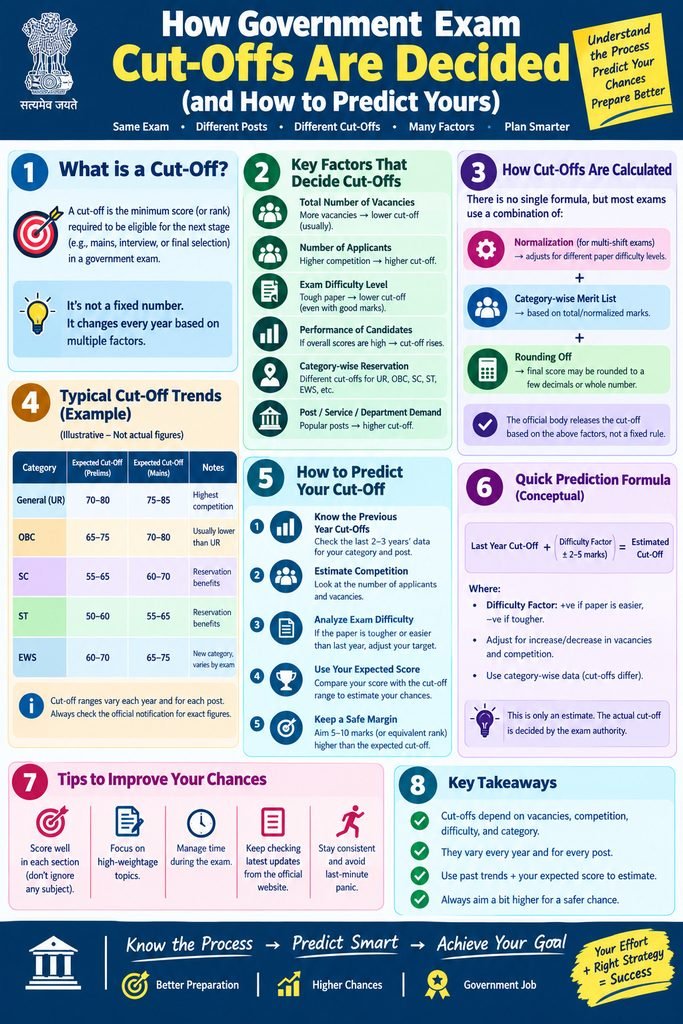
Frequently Asked Questions
Q1. Why do cut-offs differ between General and other categories for the same exam? Because vacancies are reserved separately for each category under reservation policy, and each category’s cut-off reflects how candidates within that specific category performed relative to their allocated vacancy count — not a single unified threshold across all candidates.
Q2. Does a lower cut-off this year always mean the exam was easier? No — a lower cut-off can result from higher vacancy availability, fewer candidates appearing, genuinely higher paper difficulty, or a combination of these factors, not necessarily reduced difficulty alone.
Q3. What is normalization, and does every exam use it? Normalization is a statistical adjustment applied to raw scores in multi-shift exams to account for difficulty variation between shifts, making scores comparable across all candidates regardless of which shift they appeared in. Not every exam uses normalization — check your specific exam’s official methodology.
Q4. Can the cut-off for the same post differ across different states or regions within one exam? Yes, for exams that have region-specific or state-specific vacancy allocation (common in some railway and banking recruitment), cut-offs can vary by region based on that specific area’s vacancy count and candidate pool performance.
Q5. Is it worth attempting a mock cut-off prediction survey after an exam? These surveys, run by coaching institutes and exam portals, can provide a rough crowd-sourced estimate, but treat them as one data point among several rather than a definitive prediction, since self-reported score surveys carry their own sampling biases.
The Bottom Line
Cut-offs aren’t fixed targets — they’re outcomes calculated after each exam, shaped by vacancy numbers, paper difficulty, candidate volume, category-wise reservation, and sometimes normalization. Building a realistic prediction means looking at multiple years of data, current vacancy trends, and category-specific figures together, rather than chasing a single “safe score” number that oversimplifies a genuinely multi-factor calculation.
For related reading, check out our guide on Government Job Age Relaxation & Reservation Rules — A Clear, Category-Wise Explanation, or explore Complete Guide to SSC CGL 2026: Eligibility, Syllabus, and Exam Pattern.