
One of the most common reasons candidates miss out on applying for a government job isn’t lack of preparation — it’s misunderstanding their own eligibility. Age relaxation and reservation rules genuinely confuse people, especially since the rules differ across recruiting bodies, categories can stack in specific ways, and cut-off dates matter more than most candidates realize. This guide breaks down exactly how these rules work, so you can calculate your actual eligibility with confidence instead of guessing.
Why Age Relaxation Exists
Government recruitment in India follows a constitutional and policy framework designed to ensure fair representation across historically disadvantaged communities and specific groups who face structural disadvantages in competitive access to public employment. Age relaxation is one mechanism within this broader framework — it extends the upper age limit for specific categories of candidates, recognizing that a uniform age cutoff can disproportionately disadvantage groups who may have faced delayed access to education or opportunity.
This isn’t unique to India, but the specific category structure and relaxation years here are shaped by India’s constitutional reservation policy and subsequent government orders, which is why understanding the categories matters as much as understanding the numbers.
The Standard Category-Wise Age Relaxation
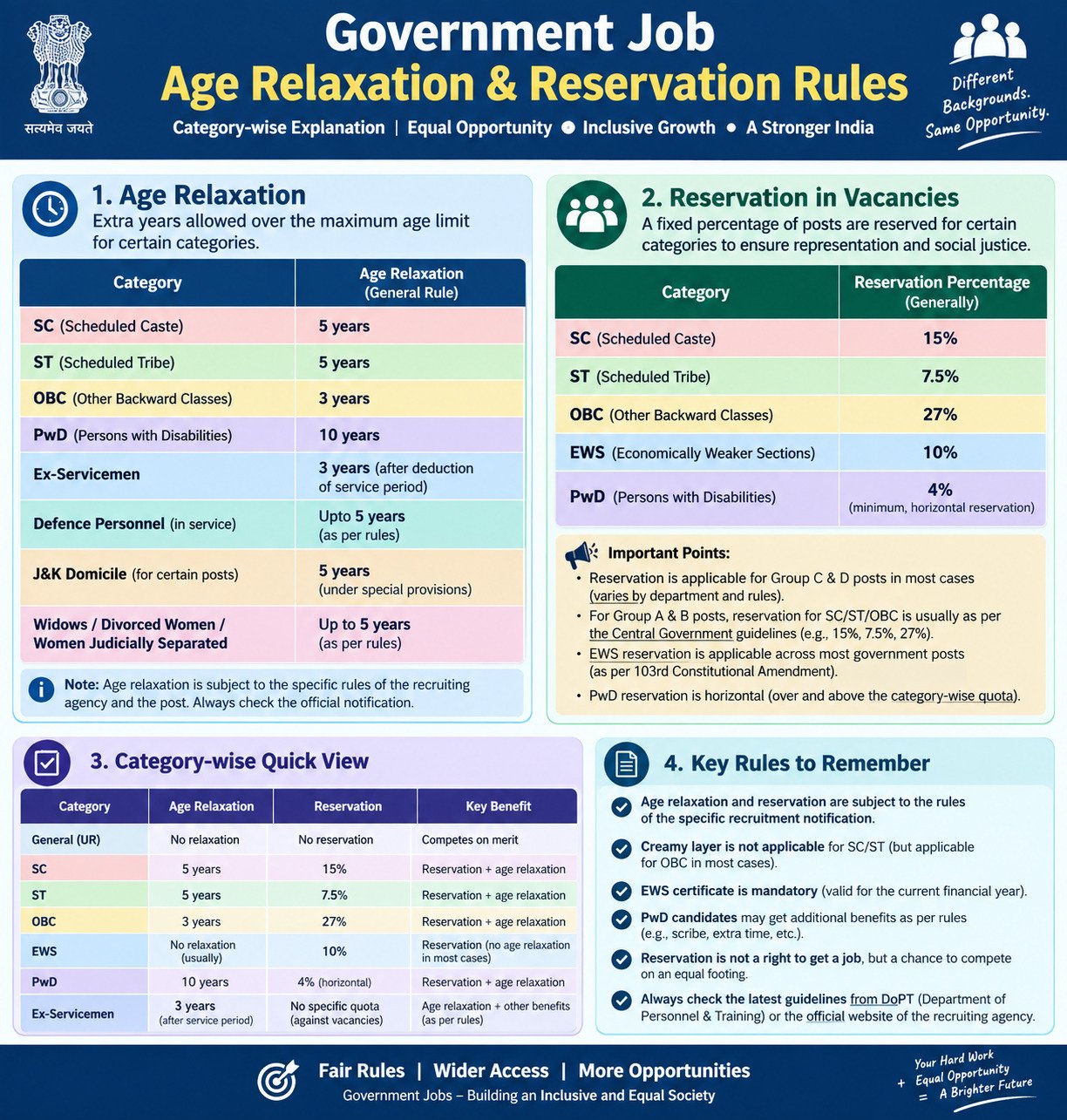
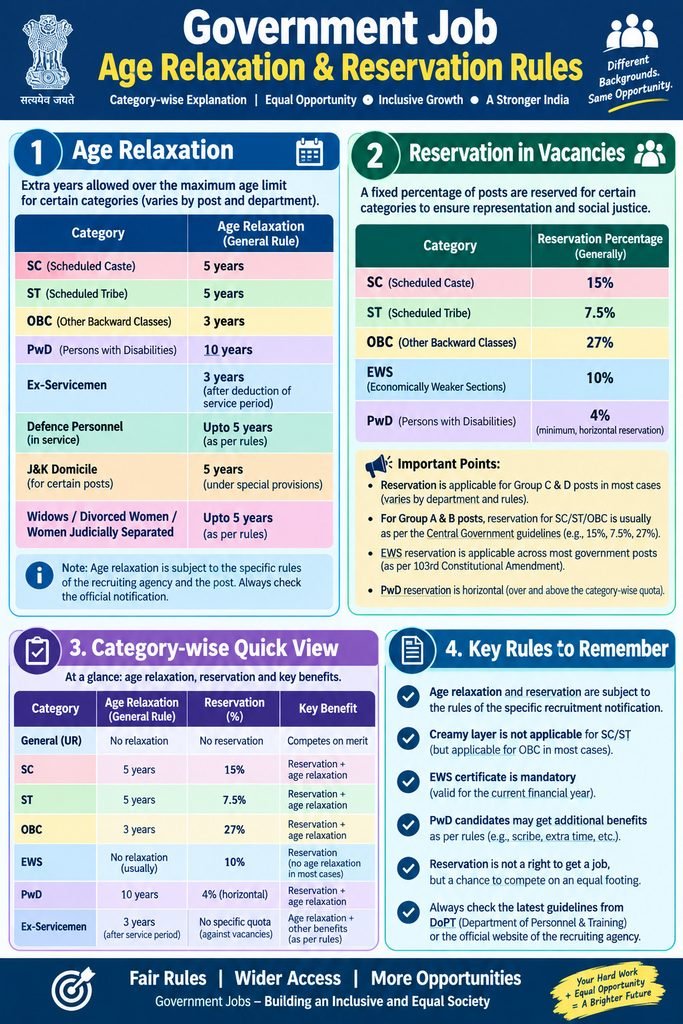
While exact figures can vary slightly by recruiting body and specific notification, the broadly standard relaxation pattern followed across most central government exams is:
| Category | Typical Age Relaxation |
|---|---|
| General/UR (Unreserved) | No relaxation (base age limit applies) |
| OBC (Non-Creamy Layer) | 3 years |
| SC/ST | 5 years |
| PwD (General) | 10 years |
| PwD (OBC) | 13 years |
| PwD (SC/ST) | 15 years |
| Ex-Servicemen | Varies (often up to 3-5 years beyond actual service rendered) |
These figures apply to most central government recruitment (SSC, Railways, Banking exams conducted by IBPS), but it’s essential to verify the exact relaxation specified in your specific exam’s official notification, since some organizations set their own variations, and state-level exams often have their own distinct relaxation structure that may differ from central norms.
How Category Relaxations Actually Stack
A common point of confusion is how relaxation applies when a candidate belongs to more than one relevant category — for example, a PwD candidate who also belongs to the OBC category. Generally, relaxation for PwD candidates is calculated cumulatively with their caste category relaxation, which is why PwD-OBC candidates often see a significantly higher combined relaxation (frequently around 13 years) compared to general category PwD candidates.
However, this cumulative calculation isn’t always straightforward addition, and recruiting bodies sometimes specify the exact combined figure directly in the notification rather than leaving candidates to calculate it themselves. Always check the specific age relaxation table provided in your exam’s official notification rather than assuming a simple addition of individual category relaxations, since some organizations use a capped combined maximum rather than pure addition.
Reservation in Vacancies: How It Works
Separately from age relaxation, government recruitment also reserves a percentage of total vacancies for specific categories. The broadly standard reservation percentages under central government policy are:
- SC (Scheduled Caste): 15%
- ST (Scheduled Tribe): 7.5%
- OBC (Other Backward Classes, Non-Creamy Layer): 27%
- EWS (Economically Weaker Section): 10%
- PwD (Persons with Disabilities): 4% (horizontal reservation, cutting across other categories)
These percentages apply to central government recruitment as a general framework, though specific numbers can be adjusted based on vacancy calculations, roster-based implementation, and any post-specific exemptions defined in individual recruitment notifications. State government recruitment often follows different reservation percentages based on state-specific policy and demographic considerations, so state exam candidates should check their specific state’s reservation framework rather than assuming central government percentages apply uniformly.
What “Non-Creamy Layer” Actually Means for OBC Candidates
OBC reservation benefits apply specifically to candidates in the “non-creamy layer” — meaning their family doesn’t exceed specified income and social status thresholds defined by government policy. This income threshold is revised periodically by the government, so OBC candidates need a current, valid non-creamy layer certificate (typically issued within a specified validity period, often one year, before the application) rather than an older certificate that may have expired based on updated criteria.
This is a frequent source of application rejection — candidates who assume their OBC status is automatically valid without checking their certificate’s current validity and the latest income threshold sometimes find their category claim rejected during document verification, which can affect both their reservation benefit and their age relaxation eligibility.
EWS: A Newer Category to Understand
Economically Weaker Section (EWS) reservation applies to candidates from the general category who meet specific income and asset criteria, introduced through a constitutional amendment. Unlike caste-based reservation categories, EWS eligibility is based purely on economic criteria — annual family income below a specified threshold, along with limits on land holding, house size, and other asset criteria as defined in the applicable government notification.
EWS candidates need a valid EWS certificate issued by a competent authority, and similar to OBC non-creamy layer certificates, this typically has a validity period that candidates need to track and renew appropriately before each application cycle.
Common Calculation Mistakes Candidates Make
Many candidates calculate their age based on the application submission date rather than the specific cut-off date mentioned in the notification (often January 1st of the recruitment year, or a similarly specified date) — this distinction matters because your actual eligible age is locked at that specific cut-off, not at whenever you happen to fill the form.
Some candidates assume their category relaxation applies automatically without submitting the correct, current certificate during application or document verification — reservation and relaxation benefits require valid supporting documentation, and missing or outdated certificates can result in the candidate being treated as general category regardless of their actual community status.
A third common mistake is assuming reservation and age relaxation rules are identical across all recruiting bodies — SSC, UPSC, State PSCs, Railways, and Banking exams each specify their own exact framework in individual notifications, and while the broad structure is often similar, exact figures and specific conditions can differ meaningfully.
How to Calculate Your Own Eligibility Correctly
Start by identifying the exact age limit and cut-off date specified in your target exam’s official notification — don’t rely on secondhand summaries or previous years’ figures, since these can be revised. Next, confirm your exact category status and ensure you hold a current, valid certificate matching the specific format and validity period required by that recruiting body. Then, apply the relevant relaxation figure specified in that same notification (not a generic figure from a different exam) to arrive at your actual effective age limit.
If you fall into multiple relevant categories (such as PwD and OBC, or Ex-Serviceman and SC), check the notification’s specific guidance on combined relaxation calculation, since this isn’t always simple addition and recruiting bodies sometimes specify capped combined figures.
Frequently Asked Questions
Q1. Does age relaxation mean I can apply even if I’m older than the general category limit? Yes, if you belong to a category eligible for relaxation and hold valid supporting documentation — the relaxation effectively extends your upper age limit by the specified number of years for that category.
Q2. How often is the OBC non-creamy layer income threshold revised? It’s revised periodically by government policy, and the exact current threshold should always be verified from official sources rather than assumed based on older figures, since outdated information is a common source of confusion online.
Q3. Is EWS reservation available for state government jobs too? This depends on individual state policy — some states have implemented EWS reservation for state government recruitment, while implementation details vary, so check your specific state’s current reservation framework.
Q4. Can I use my caste certificate from one state for a job application in a different state? Generally, caste certificates are recognized based on domicile and specific inter-state recognition rules, which vary — it’s important to check whether your certificate is valid for the specific recruiting body and state you’re applying to, since this isn’t automatically uniform across India.
Q5. What happens if I claim a reserved category but my certificate is found invalid during verification? This typically results in your candidature being considered under the general category (if you otherwise meet general category eligibility) or rejection of your candidature, depending on the specific recruiting body’s policy — which is exactly why maintaining current, valid certificates before applying is so important.
The Bottom Line
Age relaxation and reservation rules exist within a structured, category-wise framework, but the exact figures and application process depend heavily on the specific recruiting body and current government policy at the time of your application. Always verify these details directly from your target exam’s official notification, keep your category certificates current and valid, and calculate your eligibility based on the specified cut-off date rather than assumptions — this single step of careful verification prevents a significant number of avoidable application rejections every recruitment cycle.
For related reading, check out our guide on How Government Exam Cut-Offs Are Decided (and How to Predict Yours), or explore State PSC Exams Guide: How State-Level Government Jobs Differ From Central Government Jobs.