
Every year, millions of young candidates across India aspire to serve in defence and police forces, but the recruitment landscape here is genuinely confusing — SSC GD, Agniveer, and State Police Constable exams each lead to different organizations, different service conditions, and different long-term career structures. Some candidates prepare for all three without understanding that the physical standards, service tenure, and post-retirement pathways differ substantially. This guide clarifies exactly what each recruitment path involves.
SSC GD Constable: Central Armed Police Forces
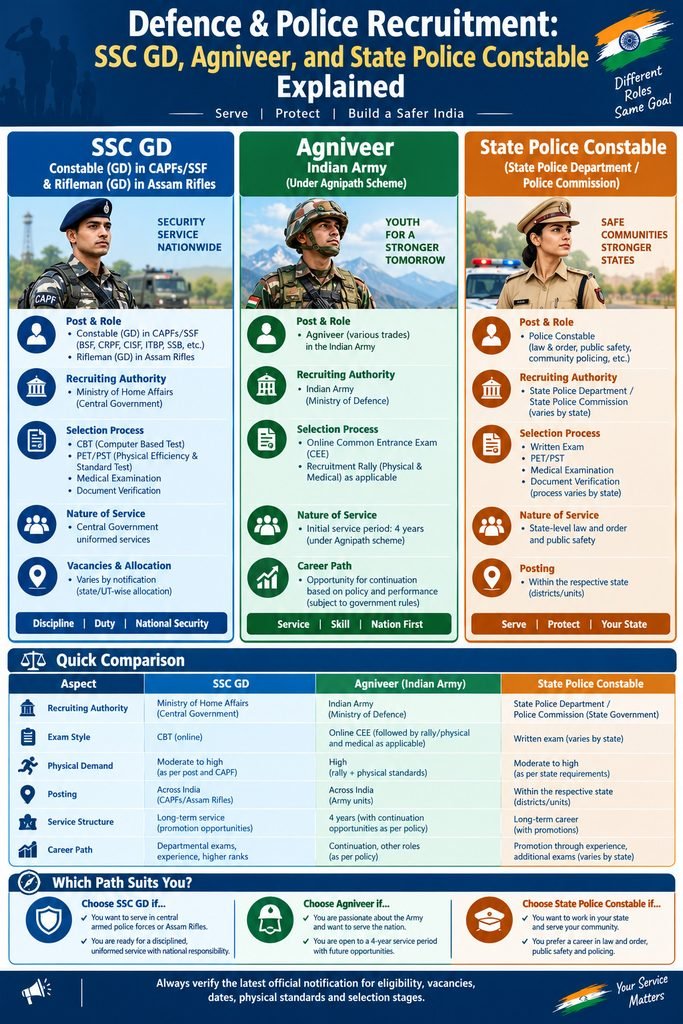
SSC GD (General Duty) Constable recruits for Central Armed Police Forces — including BSF, CRPF, CISF, ITBP, SSB, and Assam Rifles, along with Rifleman posts in some cases. This is a central government recruitment conducted by the Staff Selection Commission, distinct from state police recruitment.
Eligibility: Candidates need a minimum of 10th pass from a recognized board. Age limits are typically 18–23 years, with standard category-wise relaxation for SC/ST, OBC, and other reserved categories.
Exam Pattern: The selection process includes a Computer-Based Test covering General Intelligence & Reasoning, General Knowledge & General Awareness, Elementary Mathematics, and English/Hindi, followed by a Physical Efficiency Test (PET) and Physical Standard Test (PST) — which check running speed, height, chest measurement (for male candidates), and other physical criteria — and finally a Detailed Medical Examination.
Service Nature: SSC GD Constables serve in central paramilitary forces, often deployed for border security, internal security duties, disaster response, and law and order support across the country — meaning postings can be anywhere in India, not restricted to your home state. This is a permanent, pensionable government job with defined promotional avenues over a full career.
Agniveer: The Agnipath Scheme
Agniveer recruitment, under the Agnipath scheme, is a distinctly different model from traditional defence recruitment. It recruits young candidates into the Indian Army, Navy, and Air Force for a fixed four-year tenure, after which a portion of Agniveers (based on performance and organizational requirement, historically around 25%) are offered continued service in the regular cadre, while the remainder exit with a financial package and specified benefits.
Eligibility: Age limits and educational qualifications vary by specific entry (Agniveer General Duty, Technical, Clerk, Tradesman, and others), generally ranging from 17.5–21 years age bracket with 10th or 12th pass depending on the specific entry stream. Always check the current notification, since eligibility windows are periodically revised.
Exam Pattern: Selection typically involves a Computer-Based Test covering General Knowledge, General Science, Mathematics, and Reasoning, along with Physical Fitness Test and Physical Measurement standards, followed by Medical Examination — broadly similar in structure to traditional defence recruitment, but within the Agnipath framework’s specific tenure model.
What Makes This Different: Unlike SSC GD or traditional Army recruitment, Agniveer isn’t a guaranteed full-career pathway from day one — it’s a four-year commitment with a possibility (not certainty) of continued service afterward. Candidates considering this path should understand both the immediate exposure and training benefits it offers, as well as the financial and career planning implications of the fixed initial tenure and the post-exit package structure, which is worth researching carefully through official sources before applying.
State Police Constable Recruitment
Each state conducts its own Police Constable recruitment through its State Police Recruitment Board or equivalent authority — for example, UP Police Constable, Delhi Police Constable, Maharashtra Police Bharti, and similar state-specific drives. These recruit for policing duties within that specific state’s jurisdiction.
Eligibility: Generally 10th or 12th pass depending on the state (some states have moved to 12th pass as the minimum standard), with age limits typically in the 18–25 range, though this varies by state and includes standard reservation-based relaxations.
Exam Pattern: Most state police recruitments include a Written/Computer-Based Test (General Knowledge, Reasoning, Numerical Ability, and sometimes a state-specific General Studies component), Physical Efficiency Test and Physical Standard Test (with state-specific standards for height, chest, and running requirements), and Document Verification, with some states also including a Medical Examination stage.
Service Nature: State Police Constables serve within their state’s police department, typically posted within that state (sometimes with inter-district transfers based on service requirements). This is a permanent, pensionable state government job with promotional pathways through departmental exams and seniority, similar in structure to SSC GD but confined to state jurisdiction rather than central deployment.
Comparing the Three: Key Differences
| Factor | SSC GD | Agniveer | State Police Constable |
|---|---|---|---|
| Recruiting Body | SSC (Central) | Indian Armed Forces | State Police Board |
| Service Tenure | Full career, pensionable | Fixed 4 years, partial extension possible | Full career, pensionable |
| Posting Scope | Anywhere in India | Anywhere, as per force requirement | Within home state (mostly) |
| Minimum Qualification | 10th pass | 10th/12th (entry-dependent) | 10th/12th (state-dependent) |
Physical Standards: What to Actually Prepare For
Physical fitness requirements across all three paths typically include minimum height, chest measurement (for male candidates, with chest expansion criteria), and running tests within a specified time limit — though exact standards vary by organization, category, and sometimes region (hill state and certain category candidates often get relaxed standards).
Given how frequently candidates clear the written test but struggle at the physical stage, dedicated physical training should start well before your written exam date, not after — building running endurance and meeting height/chest standards (where borderline) takes sustained months of preparation, not a quick pre-test sprint.
Which Path Should You Choose?
If you want a stable, full-career central government job with nationwide posting and don’t mind deployment flexibility, SSC GD offers a well-established path into central paramilitary forces with clear long-term career structure.
If you’re specifically drawn to serving in the Indian Army, Navy, or Air Force, and you’re comfortable with the Agnipath model’s four-year initial commitment and the possibility (not guarantee) of continued service afterward, Agniveer offers direct entry into the armed forces with valuable training and experience, regardless of whether you continue beyond the initial tenure.
If you want to serve specifically within your home state, prefer more predictable posting locations closer to family, and want a full pensionable career path, State Police Constable recruitment is generally the better-aligned option — just verify your specific state’s current eligibility and exam pattern, since these details vary meaningfully across states.
Common Mistakes Candidates Make
Neglecting physical preparation until close to the PET/PST date is one of the most common and costly mistakes — physical standards have no partial credit, and candidates who excel in written tests sometimes get eliminated here due to inadequate preparation time.
Not researching the specific service conditions before applying — particularly for Agniveer, where understanding the tenure structure and post-exit implications matters significantly for career planning — leads some candidates to make decisions without full information.
Assuming all state police recruitments have identical standards and exam patterns is another frequent error — always check your specific target state’s current notification rather than relying on another state’s requirements or outdated information from previous recruitment cycles.
Frequently Asked Questions
Q1. Can women apply for SSC GD, Agniveer, and State Police Constable recruitment? Yes, all three have provisions for women candidates, though specific vacancy numbers, physical standards, and some eligibility criteria differ from the male category — check the specific notification for details.
Q2. Is Agniveer a permanent government job? Not automatically — it’s a fixed four-year initial tenure, with a portion of candidates offered continued service afterward based on performance and organizational requirements. It’s not guaranteed to be a lifelong career from the outset.
Q3. Do SSC GD Constables get transferred across different states during their career? Yes, since Central Armed Police Forces operate nationwide, postings and transfers can occur across different states based on organizational deployment needs.
Q4. What happens to Agniveers who aren’t selected for continued service after four years? They exit with a financial package and other specified benefits as outlined under the Agnipath scheme — the exact details are periodically updated, so check current official sources for accurate figures.
Q5. Which of these three has the toughest physical standards? This varies by specific force and state rather than following a strict hierarchy — some Central Armed Police Forces and select state police recruitments have more demanding running time standards, so always check your specific target organization’s current PET/PST criteria.
The Bottom Line
SSC GD, Agniveer, and State Police Constable each serve different purposes and lead to meaningfully different career structures — from full central government careers to state-specific policing to the Agnipath model’s distinct tenure system. Understand these differences clearly, assess your own physical readiness honestly, and choose the path that aligns with both your eligibility and your long-term career expectations.
For related reading, check out our guide on Government Job Age Relaxation & Reservation Rules — A Clear, Category-Wise Explanation, or explore How Government Exam Cut-Offs Are Decided.