
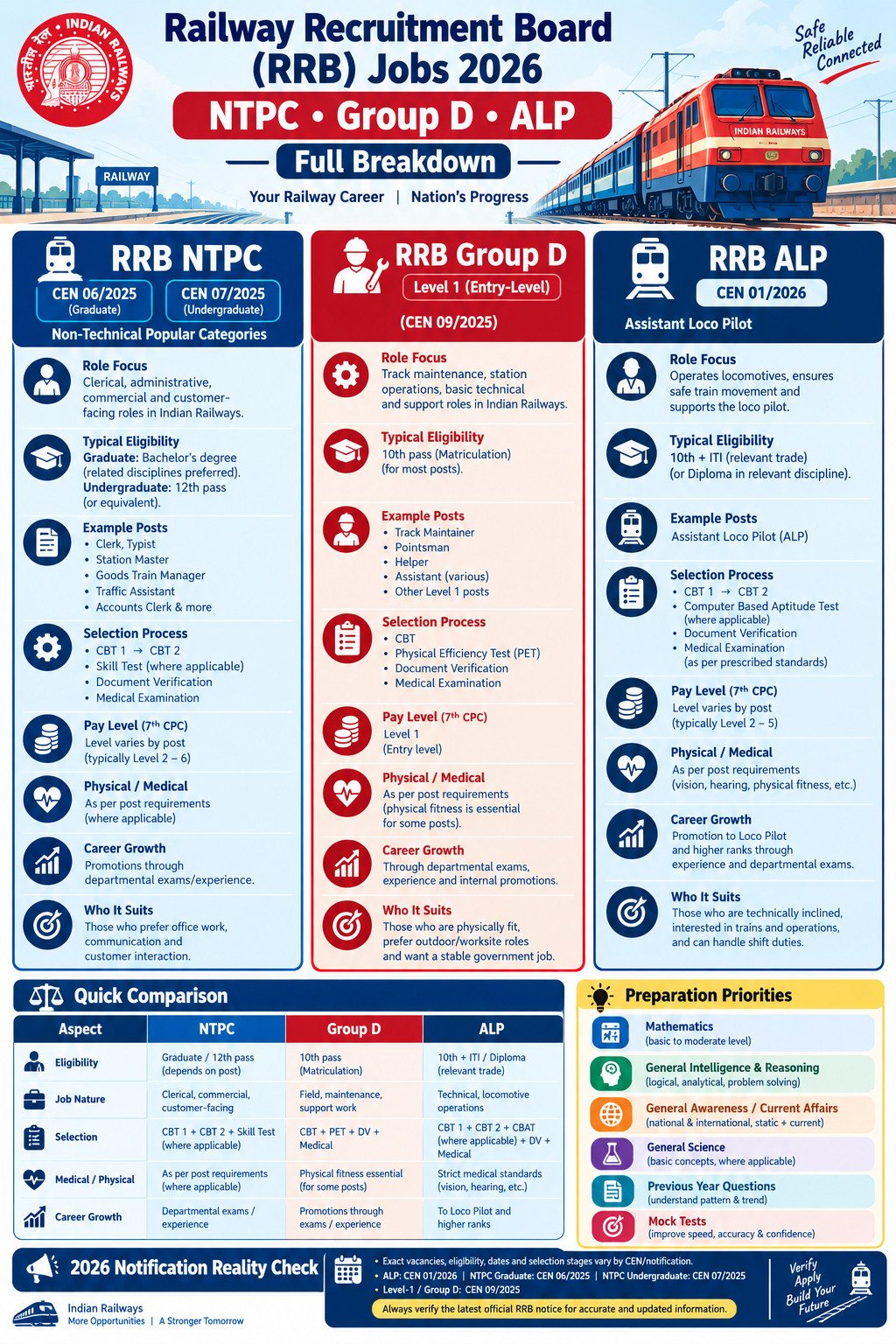
Indian Railways is one of the largest employers in the country, and its recruitment process runs through Railway Recruitment Boards (RRBs) across different exam categories. But “railway exam” isn’t one single thing — NTPC, Group D, and ALP are three separate recruitment drives, with different eligibility criteria, different exam levels, and very different day-to-day jobs at the end of it. Picking the wrong one to prepare for, or spreading your prep too thin across all three without understanding the differences, wastes valuable time. Here’s a clear breakdown of each.
RRB NTPC: Non-Technical Popular Categories
NTPC recruits for a wide range of non-technical, largely office and operations-based roles — including Junior Clerk cum Typist, Accounts Clerk cum Typist, Junior Time Keeper, Trains Clerk, Commercial cum Ticket Clerk, Traffic Assistant, Goods Guard, Senior Clerk cum Typist, Senior Time Keeper, Commercial Apprentice, and Station Master, among others.
Eligibility: NTPC posts are divided into two eligibility tracks based on educational qualification — Undergraduate posts (10+2 or equivalent, for roles like Trains Clerk and Commercial cum Ticket Clerk) and Graduate posts (any bachelor’s degree, for roles like Station Master, Goods Guard, Traffic Assistant, and Senior Clerk). Age limits typically range from 18–33 years depending on the specific post, with standard category-wise relaxations applying.
Exam Pattern: NTPC recruitment involves a Computer-Based Test (CBT) conducted in two stages for most posts. CBT 1 is a screening-level test covering General Awareness, Mathematics, and General Intelligence & Reasoning. CBT 2 is more detailed, covering the same broad sections at a higher difficulty level. Depending on the specific post, this may be followed by a Typing Skill Test, Computer Based Aptitude Test (for posts like Station Master and Traffic Assistant), and Document Verification.
Why candidates choose NTPC: It offers a relatively wide range of posts across both graduate and undergraduate eligibility, making it accessible to candidates at different educational stages. Roles like Station Master, in particular, are popular for their supervisory responsibility and reasonable work-life structure compared to some other railway roles.
RRB Group D: Level 1 Posts
Group D recruits for foundational operational roles across Indian Railways — including Track Maintainer, Helper/Assistant in various technical departments (Electrical, Mechanical, Signal & Telecommunication), Pointsman, and Level 1 posts across various railway zones.
Eligibility: The minimum qualification is 10th pass or ITI from a recognized institution — making Group D one of the more accessible railway recruitment categories in terms of educational requirement. Age limits generally range from 18–33 years, with standard relaxations for reserved categories.
Exam Pattern: Group D selection involves a single-stage Computer-Based Test covering General Science, Mathematics, General Intelligence & Reasoning, and General Awareness on Current Affairs. This is followed by a Physical Efficiency Test (PET), which is a qualifying requirement — candidates must meet specific physical standards (like running a set distance within a time limit, with different standards for male and female candidates) before proceeding to document verification.
Why candidates choose Group D: It’s the most accessible entry point into Indian Railways for candidates with a 10th-pass or ITI qualification, and it doesn’t require the higher educational qualifications that NTPC’s graduate-level posts demand. The trade-off is that the work is more physically demanding and field-based compared to NTPC’s largely office and passenger-facing roles.
RRB ALP: Assistant Loco Pilot
ALP recruits specifically for Assistant Loco Pilot positions — the entry point into a career operating and assisting with train locomotives, eventually progressing toward becoming a full Loco Pilot with experience and internal promotion.
Eligibility: Candidates need a 10th pass with ITI in a relevant trade, or a Diploma/Degree in a relevant engineering discipline. Age limits are typically 18–30 years, with standard category-wise relaxation. This is a technically-oriented recruitment category, so the trade or engineering discipline requirement is stricter than Group D’s general 10th-pass criterion.
Exam Pattern: ALP recruitment involves CBT 1 (screening-level, covering Mathematics, General Intelligence & Reasoning, General Science, and General Awareness on Current Affairs), CBT 2 (more detailed, including a Technical Ability section specific to the candidate’s trade or engineering background, in addition to the general sections), followed by a Computer Based Aptitude Test (CBAT) — a psychometric-style test assessing skills relevant to locomotive operation — and Document Verification along with medical examination.
Why candidates choose ALP: It offers a clear, structured career path toward becoming a Loco Pilot, a role with significant responsibility and a distinct professional identity within Indian Railways. The technical trade requirement means it particularly suits ITI and diploma holders in electrical, mechanical, or related engineering trades looking for a technically-oriented railway career.
Comparing the Three: A Quick Reference
| Factor | NTPC | Group D | ALP |
|---|---|---|---|
| Minimum Qualification | 10+2 or Graduate (post-dependent) | 10th pass or ITI | 10th + ITI or Diploma/Degree |
| Exam Stages | CBT 1, CBT 2, Skill/Aptitude Test | Single CBT + PET | CBT 1, CBT 2, CBAT |
| Nature of Work | Office, clerical, supervisory | Field, technical assistance | Technical, locomotive operation |
| Physical Test Required | No (typing test for some posts) | Yes (PET) | No (CBAT psychometric test instead) |
Salary and Career Growth Across These Roles
Entry-level salary structures across NTPC, Group D, and ALP fall under different pay levels of the 7th Central Pay Commission matrix, with NTPC’s graduate-level posts (like Station Master) generally starting at a higher pay level than Group D’s Level 1 posts, while ALP falls in an intermediate range reflecting its technical nature. Beyond basic pay, all these roles include railway-specific allowances and benefits, including Dearness Allowance, House Rent Allowance, and travel privileges that are particularly valued railway employee benefits.
Career progression varies by role — NTPC posts like Station Master and Traffic Assistant have defined promotional hierarchies within railway operations and traffic departments. Group D employees can appear for internal departmental exams over time to move into higher technical or supervisory grades. ALP holders typically progress to full Loco Pilot status after a specified period of service and internal assessment, which is often seen as a natural and rewarding career trajectory within this specific stream.
Which Railway Exam Should You Prepare For?
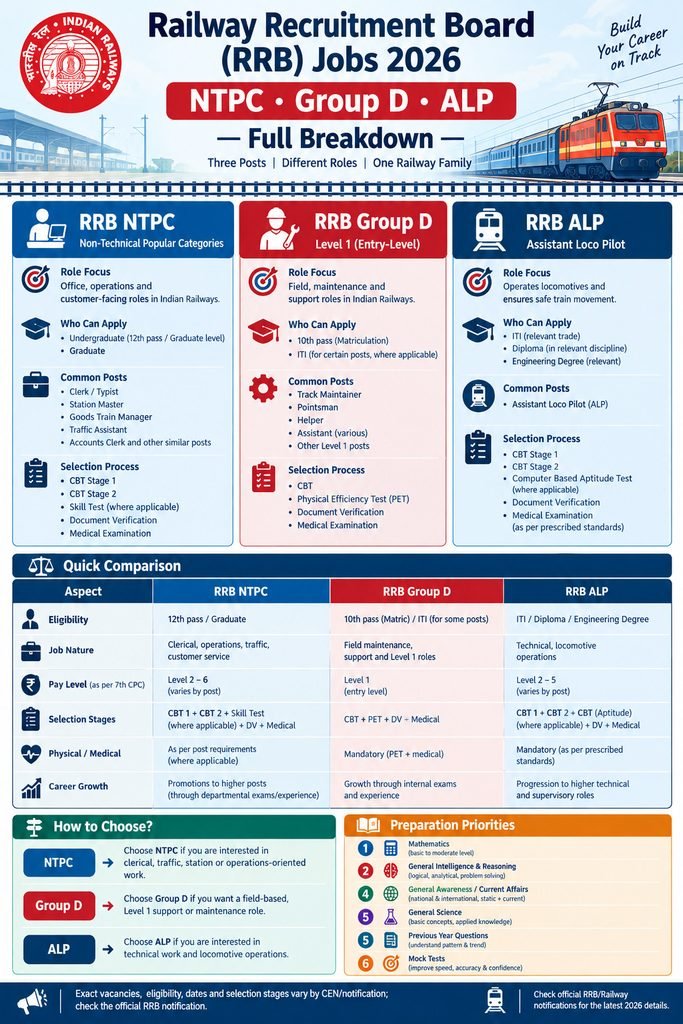
If you’re a graduate looking for office-based or supervisory railway roles and don’t mind a moderately competitive two-stage exam, NTPC’s graduate-level posts are worth targeting — particularly Station Master, which combines decent pay with meaningful responsibility.
If you have a 10th-pass or ITI qualification and are comfortable with physically demanding field work, Group D offers the most accessible entry point into Indian Railways, without requiring higher educational qualifications or specialized technical trade certification.
If you hold an ITI certification or engineering diploma/degree in a relevant trade and are specifically interested in a technical, locomotive-focused career with a clear promotional path, ALP is a strong option — just be prepared for the additional Technical Ability section in CBT 2, which demands trade-specific preparation beyond the general sections.
Common Preparation Mistakes to Avoid
Many candidates prepare exclusively from generic reasoning and math material without practicing railway-specific previous year papers, missing out on understanding the actual difficulty level and question framing style these exams use, which can differ from other government exam patterns.
Underestimating the Physical Efficiency Test for Group D is another frequent issue — candidates who focus purely on written preparation and neglect physical fitness sometimes clear the CBT but struggle at the PET stage, which has a hard qualifying standard with no partial credit.
For ALP aspirants, neglecting the trade-specific Technical Ability section in CBT 2 is a common gap — general reasoning and math preparation alone isn’t sufficient; dedicated revision of your specific trade syllabus is essential for this stage.
Frequently Asked Questions
Q1. Can I apply for NTPC, Group D, and ALP all in the same recruitment cycle? Yes, as long as you meet each exam’s specific eligibility criteria — many candidates do apply for multiple RRB exams when their qualifications and age allow it, though exam dates sometimes overlap, so check the official calendar carefully.
Q2. Is there negative marking in RRB exams? Yes, RRB exams generally carry negative marking for incorrect answers — check the specific notification for the exact marking scheme applicable to your exam category and year.
Q3. Do women candidates have different physical standards for Group D’s PET? Yes, the Physical Efficiency Test has separate standards for male and female candidates, detailed in the official Group D notification.
Q4. How long does it typically take to become a full Loco Pilot after joining as ALP? This varies based on vacancy availability, departmental exams, and seniority, and isn’t governed by a single fixed timeline — check current departmental promotion policies for specifics.
Q5. Which RRB exam has the highest number of vacancies typically? This varies significantly by recruitment cycle based on Indian Railways’ operational requirements — Group D and NTPC have historically had large vacancy counts in various cycles, but always verify current numbers from the official notification rather than relying on previous years’ figures.
The Bottom Line
NTPC, Group D, and ALP each open a genuinely different career path within Indian Railways — office-based and supervisory roles, field-based technical assistance, and specialized locomotive operation, respectively. Choose based on your current educational qualification, physical readiness, and the kind of day-to-day work you actually want, rather than preparing for all three generically without a clear priority.
For related reading, check out our guide on Defence & Police Recruitment: SSC GD, Agniveer, and State Police Constable Explained, or explore Government Job Age Relaxation & Reservation Rules for category-wise eligibility details.